Showing posts with label salvage vessel. Show all posts

Friday, August 12, 2016

8/12/16 Report - South Hutchinson Island Beaches and Salvage Vessel Begins Day. Awl or Fid Artifact. More Storms Predicted.


Written by the TreasureGuide for the exclusive use of treasurebeachesreport.blogspot.com.

Walton Rocks This Morning.
I looked at some beaches along South Hutchinson Island this morning.  Beach conditions remain poor.  There was a lot of mushy sand.  You'll see that in some of the pictures.

I also stopped at Blind Creek, but didn't take pictures.  There were a lot of nudists there already. They used to stay well south of the access, but now are up by the Blind Creek access.  It gives a new meaning to the name Blind Creek.

Beach South of Frederick Douglas Beach.
John Brooks Beach Looking North.
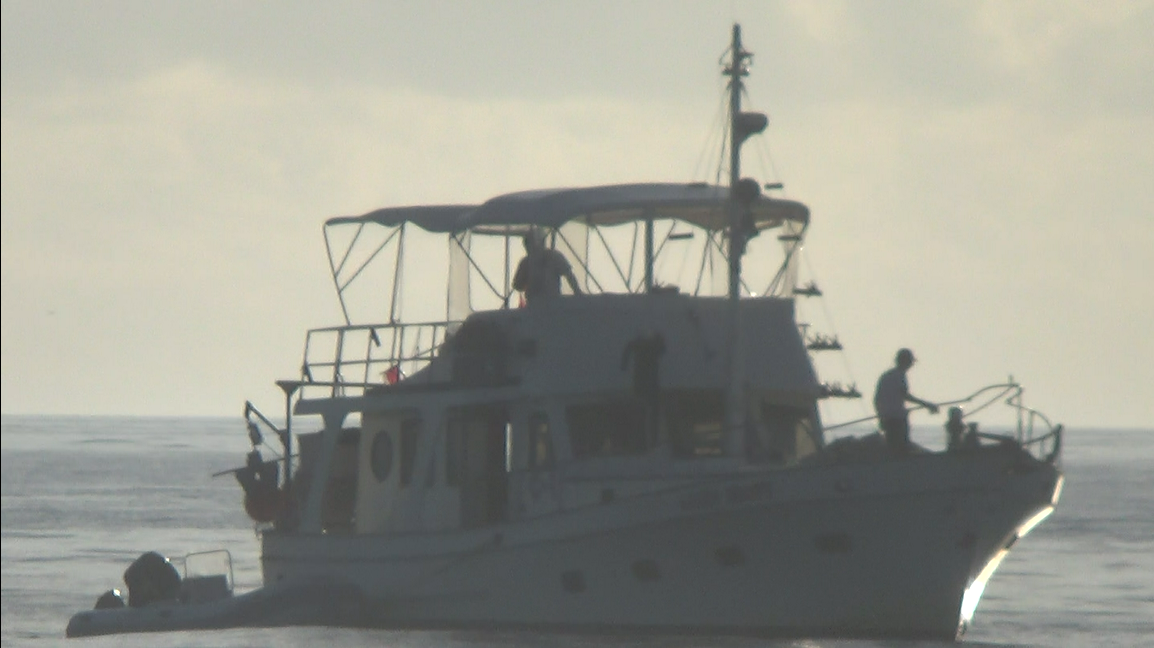
Treasure Slavage Vessel
Arriving At North End of Nieves Site.
Same Boat Getting Ready To Begin Day.
---

Treasure Coast Shipwreck Beach Find.
What do you think this object is?  I wondered about it, but now feel more confident about the answer.  I feel about 80% confident now.

The reason I'm now fairly confident is that I saw a picture of another one having exactly the same shape, and it was described by an archaeologist as an awl.  Unfortunately I can't find that picture again right now.  That one was about an inch and a half longer than the one shown above, but they come in different sizes, and this one probably lost some material to corrosion.

I don't know how they determined that it was an awl, but I assume they had good reason. It looks like it could be a fid.  Maybe it had a dual function.  That could certainly be the case.  Awls and fibs would be used by the same type of person, and you would expect both to be present on a sailing ship.

A fid is conical pin or spike used in splicing rope.  Below are some fids.  They also come if various sizes.


The one awl shown below has a wood handle.  The one shown at the top of the post, if that is what it is, does not, and I do not believe it ever had a handle.  I don't think it would be pointed at the big end if it had a handle.

What I am very confident of now, is that it is either an awl, as the archaeologist said, or perhaps a fid.

---

They revised projections for this hurricane season.  They think there will be more storms than originally predicted.


So far there have been five named storms and two hurricanes. The most active months of the season are just beginning.


Here is a link to that story.


http://www.baltimoresun.com/news/weather/weather-blog/bs-md-weatherpage-0812-20160811-story.html

Happy hunting,
TreasureGuide@comcast.net

Thursday, August 14, 2014

8/14/14 Report - Treasure Coast Gold Artifact Find Identified As Reliquary Pendant. Google Higher Resolution Satellite Imagery Coming Soon. Massive Tomb Found.


Written by the TreasureGuide for the exclusive use of treasurebeachesreport.BlogSpot.com.


2014 Treasure Coast Find (on left) From the Salvage Vessel Booty


New information just in about the Booty's Treasure Coast gold relic find.


I received a photo of this find back a few weeks ago and showed it in my 7/31/14 post.   After doing a little research I said I thought the object might be a pyx.  Yesterday I received an email about the item from author and researcher Laura Strolia.   It seems I was wrong about the identity of the item.  

Here is what our friend Laura Strolia said.


In regards to the recent find ... I believe it is a RELIQUARY PENDANT.  The central oculus would have held an object that belonged to a saint, such as a piece of hair, or a painted image of a holy person.  Crystal would have been added for protection, as well as a chain.


This piece of devotional jewelry exhibits a cross above a sunburst.  The sunburst was intentionally created to take on features of a monstrance, an object used to display the consecrated Eucharistic Host for adoration.  During the Colonial Era, the monstrance design was quite common for displaying relics, with some relicarios being several feet high and others being only a few inches long.  For instance, a beautiful hanging pendant from the late 1600s, belonging to the Hispanic Society of America Collection, shows an intriguing sunburst with a topped cross.  While it does not contain a relic, the subject matter of reverence is an example of its popularity for the time period.


Reliquary pendants suspended on a chain would have been worn with upmost care and love because of their precious contents.  Catholics venerated saints and owned relics to be intimately connected to a favorite saint through prayer.  The remains were a reminder of their existing spiritual relationship.


The size of the pendant recently salvaged seems to be of a quite large dimension compared to the smaller lightweight personal pieces that were worn around the neck or waist.  Wearing a pendant of this size, along with its bulkiness, would put the holy object within at significant risk for physical damage.  Therefore, one would assert it was not designed as a wearable piece of jewelry, but to display elsewhere.  The devout often kept religious items in view, hanging from chains in their private quarters for adoration.  Often these exquisite pendants were given as votive offerings and church treasuries owned many donated ones.  On a holy person’s feast day, it was common for reliquaries to be carried and suspended for public view.  They would then be exhibited in the church during hours of prayer.

It had been mentioned that the found artifact might have been a pyx and would have carried the consecrated Host to the sick or dying.  Catholics believe that the bread and wine truly become the Body and Blood of our Lord, Jesus Christ.  The container used for such an important mission needed to be completely closed on all sides, front, and back. It was crucial no elements came into contact with the consecrated Host through any cracks or opened wire, and that was why small round boxes with secured latches were usually used for the job.  A pyx would have been put in a burse (pouch) that hung around a priest’s neck while traveling.  When looking at the artifact, there seems to be a circle on its top that most pendants have for chains.  This piece of hardware would not be needed on a pyx because it was the burse that included the long fabric or leather pieces for hanging.  When taken out of a church, a pyx would never be hung by itself without being in a burse, and especially with having airy filigree metalwork.  If any Hosts had not been used, the pyx immediately went back to the Church where the Blessed Sacrament was returned to a closed tabernacle.  Now, three hundred years later, the Church still acts with laws regarding the importance of the Sacrament, as I recently attended a meeting by our Bishop in protecting the sanctity and dignity of Holy Communion distribution.  After all, the Blessed Host IS the very life of God, a sacrament which Christ taught is necessary for eternal life. -- Laura Strolia
Thanks much Laura.  

You might have read Laura's book The Marigalera of the 1715 Fleet.  I've read it and mentioned it in this blog.


 Google Maps provides a satellite and street views.  Most of you probably know that.  Maybe you have used google to research remote sites.   Well Google now has a contract with a satellite company to obtain imagery from space that will detect objects as small as ten inches.   That is a good tool for higher definition remote research.

Here is the link.

http://motherboard.vice.com/read/googles-satellites-could-soon-see-your-face-from-space


A massive tomb from the era of Alexander the Great was uncovered in Greece.  Nearly 500 meters in circumference, it is one of the largest ever uncovered in Greece.

http://www.dailymail.co.uk/sciencetech/article-2401057/Have-archaeologists-discovered-grave-Alexander-Great-Experts-enormous-marble-tomb-fit-king-Greece.html

Just goes to show how many things remain undiscovered if this huge tomb could remain hidden for so long.


On the Treasure Coast the tides are still bigger than normal and the surf is predicted to be 1 foot or so for at least several days.

No new tropical activity in the Atlantic either.

Happy hunting,
TreasureGuide@Comcast.net

Thursday, July 31, 2014

7/31/14 Report - Booty Makes Big Discovery On Treasure Coast Wreck Site. Gold Pyx. Low Pressure Area Moves Closer.


Written by the TreasureGuide for the exclusive use of treasurebeachesreport.BlogSpot.com.

Shown below are two parts of the same item found 25 years apart.  The front part (on the right) was found 25 years ago, while the back (left) was recently found by the crew of the Booty.


Treasure Coast Finds.
Photo source: Video from Orlando Sentinel link below.

A truly great discovery was made this summer by a Treasure Coast salvage crew.  In fact a lot of discoveries were made, but the one I want to focus on today isn't a gold coin or even a bunch of gold coins, but something more important.

25 years ago a very intricate gold hinged frame was found, or at least that is what they thought it was.  This year, last month in fact, another very intricate piece of gold was found by the Schmitt family who operates the salvage vessel Booty.  It appears that the new find is the back of the item that was found 25 years ago.

The item appeared to be a frame before, exciting enough by itself, but having the additional part, they now believe the item is not just a frame, but it could be a pyx.  A pyx is a small, flat, clamshell type of container made of brass or other metals but lined with gold used in Catholic services. 

In the Catholic church a pyx would be used to hold the Eucharistic Host.  It would sometimes by carried in a fabric or leather pouch with cords and worn by a priest, deacon or minister of Holy Communion along with a monstrance.  When not carried, it would be kept in the church tabernacle.

This pyx would have definitely been owned by someone important.  It reminds me of the Pelican of Piety, which was also found on the Treasure Coast, and which I believe could be associated with the pyx.  Certainly both are very impressive gold religious artifacts.

I've posted about the Pelican of Piety in this blog back in 2012, and Laura Strolia, researcher and author, sent me a couple of excellent articles on the Pelican which I posted. 

You might want to go back and look at my 11/4/12 post, for example.

You can always use the search box on the main page of this blog to look for particular items or topics.  Enter either "Laura Strolia" or "Pelican of Piety" as search terms.  That should get you there. 

Here are two links about the recent find of the back of the pyx.   Cool video showing the discovery.

http://www.orlandosentinel.com/news/local/breakingnews/os-sanford-family-finds-sunken-treasure-20140729,0,1244901.story

http://www.wptv.com/news/region-st-lucie-county/fort-pierce/fort-pierce-booty-salvage-discovers-centuries-old-spanish-treasure-off-coast


Congratulations Booty!!

The low pressure area that I've been following for a few days is moving closer to the Lesser Antilles and now has a 60% chance of becoming a cyclone according to NOAA.

Source: www.nhc.noaa.gov
 
On the Treasure Coast we still have a one-foot surf, which by this weekend will get just a little bigger.


The most read post of this blog for June 2014 is the 6/29/14 Report -  National Archives For Research, Detecting Military Shells With a 2-Box Detector,  Getting To More Remote Beaches, & US Religious Shrine

I'm going to highlight the most read post of the month at the end of the following month.  If I did the current month it would usually be one of the early posts of the month since readers continue to read the older posts for a while after they are posted.  This way there is enough time for even the most recent posts of the month to be read.  At the end of August I'll see what the most read post of July was.

As I pointed out, you can always go back and read old posts.  Using the search box is a convenient way to find particular topics.


Happy hunting,
TreasureGuide@Comcast.net

Wednesday, June 18, 2014

6/18/14 Report - Salvage Vessel at Cocoa, Mucking, Class Ring Found On Old Shipwreck Returned and Stamp Worth Nearly 10 Million


Written by the TreasureGuide for the exclusive use of treasurebeachesreport.blogspot.com.


Salvage Vessel  Working Up At Cocoa
Photo by John Morgan

John Morgan sent me this picture and email message.

Hi Treasure Guide,
At 8:25 AM  6/18/2014 I spotted a treasure salvage boat with blowers down outside on my balcony at 16th south Cocoa Beach.
They are 1/3 mile offshore...


John heard Josh Fisher talking on a podcast about a wreck of the 1715 Fleet that they thought was around Cape Canaveral.


Thanks for the information and report John!  Nice photo too!


Do you know the difference between this blog and some of the others?  This one is all about you.  I'd rather post your finds, reports and information than mine.

I'm not trying to get attention or sell you anything.  Not even trying to make money off of clicks by advertising.  No ads here.  I just pass along information.

The thing that makes me happiest is when the information that I post helps other people and I hear about that.  One person recently sent me an email and said his finds have about doubled since he began reading this blog.  That is the kind of thing I like to hear.

Another reader recently said that as a direct result of one of my tips, he looked where he never would have looked and found two high quality rings.

I do enjoy researching and analyzing and passing along what I learn.  I was a researcher in academia for a lot of years, and I enjoyed it.  I also enjoy analyzing things and learning, as well as sharing what I learn.  That is why I do this blog.

Typical Sandy Treasure Coast Beach This Morning Near Low Tide 

Here is one typical Treasure Coast beach as I found it this morning.

I have pictures of other beaches from this morning, but they all look pretty much the same.  

In the picture above. towards the right you can see slight remains of an old cut (right of the ATV tracks), and all of that sand in front has washed up since.  You can see the last high tide line.

If you are detecting on the Treasure Coast now, during these sandy conditions, your best bet is recent drops. There is a lot of sand.  Even recent drops are sinking or being covered quickly, both in the water and in the wet sand area.

The renourishment projects added a lot of sand to our beaches too.  Much of the renourishment project sand has been dragged into the shallow water, where it extends out quite a few yards.

I did a little detecting in front of a small hotel this morning where the renourishment was.   I ran loose scan pattern to find any concentrations, then I focused on one small area but only came up with coins.  I don't remember getting anything but coins there - no trash at all.

I then moved on and did some mucking at another beach that had been replenished recently and has been eroding. The sand that was brought in has a lot of torn aluminum in it.  I detected in front of a cut there even though I knew I would find tons of aluminum trash.  

By "mucking" I mean detecting a very trashy where I figured there would be a few good targets. 

The area where I was mucking had about ten aluminum targets to every non aluminum targets, at least that is how it seemed, although I did not keep track exactly, yet it took less than a half hour to find a ring.  Come to think of it, there was only one coin found in that mess, and about a half dozen other non-aluminum targets, plus the ring.  

There is a trick to mucking.  Read the pattern of trash to find the areas where other kinds of targets are most likely to be found.    I should have taken some pictures of that area so I could explain the technique better.  Basically, you analyze the pattern of junk, both laterally and depth, and it will point you to where you might find better things.  There is no escaping digging the trash though.  The trash is what will tell you how things are distributed, and therefore, where to go.

Mucking takes patience.   But it will often pay off.

 ---------------------------------------

I show them all the time - rings that are found and returned to the owner.   A 1972 class ring was found by a treasure salvage crew off of Vero and returned to the owner who last saw the ring when it was stolen form his apartment in Miami some 40 years ago.

Here is the link to that story.

http://www.wptv.com/news/region-indian-river-county/vero-beach/tcoast-treasure-hunters-find-class-ring-missing-for-40-years


---------------------------------------

One cent stamp sold for $9.5 million.  Here is the link for that story.

http://xfinity.comcast.net/video/Rare-Postage-Stamp-Sells-for-Millions/283452995508/Comcast/Today_in_Video/?cid=hero_sf_TIV


-------------------------

On the Treasure Coast we'll have about a one-foot surf for several days.  That won't change the sandy conditions we have.

Happy hunting,
TreasureGuide@comcast.net