Showing posts with label scotland. Show all posts

Saturday, December 21, 2019

12/21/19 Report - Cortes Anchor Found. Old Railway Track Explored. A Couple Recent Finds From Treasure Coast.


Written by the TreasureGuide for the exclusive use of treasurebeachesreport.blogspot.com.

It is not exactly one of those days when a whisper of wind turns into a hollow scream and normal men scurry to their hidey-hole, but at least there is some stirring in the air and surf.  It is better than the slow and steady accumulation of dead sand over the summer.  It wouldn't take much for things to turn good, but it might not do that.

Below are photos of a find made by John B in the Vero area along with a nickel for comparison.   John says the object is slightly larger in diameter than the nickel but thinner.   I assume he hasn't tested the metal yet.  If he did, he didn't mention it.

Find (left) by John B.
Photos by John B.
John was asking for ideas on the object.

---

I was talking about small objects that I dug in the past couple days.  Below is another one.

Dug Find on Dime.


Here is a closer look at the other side of the object.


Other Side of Same Object
It is very thin.  When I picked it out of the sand I didn't think it looked metallic to me, in part because it is so thin.  The signal made me expect something bigger.

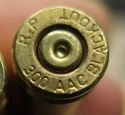
I think could be the end of a bullet.  Maybe something like the one shown below.


What do you think?

I also found something a little bigger.  It is a heart very much like one found in Kathleen Deagan's book on Spanish Colonial Artifacts.  In fact I found one exactly like it before, and also one of silver.  I thought I had photos of it on my thumb drive, but they weren't there when I got ready to post them.  Maybe I can get that done some other time.

--


MEXICO CITY: Archaeologists have discovered two iron ship anchors off Mexico’s Gulf Coast that they say date back 500 years and could have belonged to Spaniard Hernan Cortes’ fleet, which landed in 1519 before overthrowing the Aztec empire...

Cortes famously burnt the first ships he and his crew used to sail to Mexico, forcing his small army of treasure-hunters to march inland...

Two new television series are also stirring new interest in the history, one released last month by TV Azteca called “Hernan,” and another planned to be developed by famed Hollywood director Steven Spielberg entitled “Cortes” that stars Oscar-winner Javier Bardem...


Here is the link for more about that.
https://arynews.tv/en/anchors-mexico-spanish-conquest/

---
An extensive archaeological excavation of Scotland's first railway track is planned for next year.
Wooden rails from the 297-year-old Tranent-Cockenzie Waggonway were uncovered in a dig in June this year.
Part of a cobbled horse track for the ponies which pulled the wagons up to coal pits at Tranent in East Lothian was also discovered.
A community project hopes next year excavation might unearth some of the timbers used to lay the railway...

Here is that link.

https://www.bbc.com/news/uk-scotland-50728225


---

We still have some good wind and a five to seven foot surf.  The wind, though, is from the east.


Source: MagicSeaWeed.com.

Only a few more detecting days before Christmas.

Happy hunting,
TreasureGuide@comcast.net

Thursday, August 30, 2018

8/30/18 Report - Pillars and Waves Example. Native American Fort. 400-Year-Old Clan Artifact. System Coming Off Africa.


Written by the TreasureGuide for the exclusive use of treasurebeachesreport.blogspot.com.


Reproduction Eight Reale After Cleaning.


Other Side of the Same Coin.


Not long ago I posted what appears to be a reproduction escudo with the plating corroded off.  I thought I might have one just like it, so went looking for that one.  I didn't find it, but located the one shown above, which I dug up some years ago.  If I correctly recall, it was found near Jensen Beach.

Anyhow, I cleaned off much of the encrustation.  It was heavily encrusted when found.  It is fairly heavy - 22.2 grams.  Not too far off the real thing.

As you can see the Pillars and Waves side still has some plating on it, but some has come off, revealing the copper underneath.

The other side is still encrusted, and the cross can barely be seen.

This one is particularly chunky and although it gave some excitement as it came out of the sand, it really isn't very realistic when you see it cleaned.

Even where the plating is still intact, it looks strange.  When new, it would still have been an obvious fake.

The Pillars and Waves side doesn't look like a genuine silver cob at all.  A genuine old silver coin that has spent time in salt water will be grey to black.

---

... Not only did experts recently find the remains of the 17th century fort, they discovered some artifacts including arrow and spear tips that date back an estimated 3,000 years, indicating Native Americans were active at the site for generations. No evidence of human remains has been found...

He said it appears the Norwalk Indians, a tribe that historians know little about, had a fort at the site from about 1615 to 1640 and used it to trade goods with early Dutch settlers. The site is on a small sliver of land next to railroad tracks that carry Amtrak and Metro-North commuter trains. A 19th century history of Norwalk mentions an old Native American fort, and a road near the site is still named Fort Point Street.

The site was found during preliminary archaeological surveys ordered as part of the state's upcoming replacement of the 122-year-old Walk Bridge, which spans the Norwalk River and swings open to allow boats to pass. The bridge has gotten stuck in the open position several times and caused massive rail service delays. Construction is set to begin next year...


Here is the link for more about that.

https://www.newsday.com/news/nation/native-american-fort-connecticut-1.20709914

---

A 400-year-old clan artifact was uncovered near ruins in Scotland.

Artifact Discovered Near Ancient Ruins.
Source: HeraldScotland.com link below.

Site Where Artifact Discvoered.
Source: HeraldScotland.com link below.
Here is the link if you want to read about that.

http://www.heraldscotland.com/news/16601818.ancient-clan-artefact-uncovered-after-being-hidden-for-400-years/

----

It has been a very quiet summer.  There have been no storms of any effect.

There is now one developing, but it is just coming off of Africa, and it will be a while before we know what it is going to do.  If it does eventually come our way it will take several days.

Source: nhc.noaa.gov
In the mean time...

Happy hunting,
TreasureGuide@comcast.net


Tuesday, June 12, 2018

6/12/18 Report - How to Get More Fun and Money Out of Your Coin Finds. 1719 Battlefield Surveyed.

Written by the TreasureGuide for the exclusive use of treasurebeachesreport.blogspot.com.


A find is the beginning for another hunt.  After the find comes research, which adds additional  meaning, interest and value to the find.  That is true for coins as well as artifacts - even what are apparently common coins.

There are coins in circulation today that are worth hundreds or even thousands of dollars.  As you would suspect, such coins are rare, but you still might be lucky enough to find a good one if you carefully check the coins you have.

If you've been detecting very long, you've probably found a lot of coins.  Even pennies can be valuable if they have a mint error.

Most of us spend our common coins without paying too much attention to them, but you might enjoy and even profit from going through them very carefully.

First though, familiarize your self with the types of coins you have and what to look for.

There are many web sites such as this one entitled Lincoln Penny Key Dates, Rarities and Varieties (  https://www.thesprucecrafts.com/lincoln-wheat-penny-768219 ).

That one is not necessarily the best.  It is just one of many that provides useful information.

I've been spending some time searching for errors lately and learned a few things that might make it easier for you.

I'd recommend categorizing your coins before you begin.  It is much easier to search one type of coin and date at a time.  You can research that type of coin at a site like the one I just mentioned and then go through those coins.  There  is just too much to remember to go through a bunch of random coins and dates.  It is much easier if you know what you are looking for and look at one type and date at a time while the known errors that you found through your research are still fresh in your mind.

Another advantage of doing one type and date at a time is that you can compare coins.  After you've seen several of a particular type and date you'll quickly notice any that appear different.  Maybe it is one digit in the date that is smaller, larger or in some other way different.

Unfortunately many of the coins found by detectorists have been buried, banged up or corroded.  That makes many coins, even with errors, less valuable.  It also makes it difficult to identify any errors.

Some mint errors are common or inconsequential, while others are valuable.  If coins are damaged, it is hard to tell if something suspicious is an error or something that happened to the coin after it went into circulation.  That can require some real detective work.

In the coins that I've been searching lately I've found a variety of surprising things.  One coin was made to look like what is called a "greaser," which is a coin that was struck through grease, resulting in an unclear image on part of the coin.  It has been determined though, that that coin, a wheat penny, actually had acid applied to it in such a way that the image was blurred.  The coin weighed two grams less than a normal wheatie, which would not have been the case if the coin was actually struck through grease.

Even something as seemingly simple as a double die error can be difficult to see and identify.  Some are small, and double die errors can easily be confused with die bounce, which is not the same thing.

As with everything, knowledge helps.  If you just want to go through a stack of coins and hope to find something odd, you'll probably miss important things.

There are some types of damage that are difficult to distinguish from true mint errors.  The easiest thing is to scan coins that are in pretty good shape to begin with and know what kinds of errors are known to exist for that type of coin.

Many valuable errors are not easy to see.  I would consider some type of magnification to be absolutely necessary.

I have a little lighted system that I use to make some of my coin photos.  It blows the coin image up several times and makes it much easier to scan for errors.

In summary, you can add to your enjoyment of common coin finds and possibly find something interesting, but you need to do a little research first.

Again, I highly recommend, starting with one small class of coins, depending upon what you have.  If you have enough coins, maybe start with steel pennies, war nickels, or certain dates of wheat pennies.  The more coins you scan, the better chance you have of finding a coin worth something, and the more you'll learn in the process.

The most valuable coins are rare, so it might take some work, but if you search enough coins, you probably will find at least some of the more common error coins and you'll learn enough to be on the alert for the more valuable coins.

---

Here is an excerpt of a nice article from Scotsman.com.

...The catalyst for the 1719 Rising was the outbreak of war between Spain and Britain the year before.

The Spanish saw the benefit of resurrecting a Jacobite uprising for increasing pressure on the British government and offered the Jacobites an alliance and assistance in war, according to the inventory of Scotland’s battlefield.

Around 5,000 Spanish soldiers set off to invade Britain but the fleet was wrecked by a storm off the south coast of England and the manoeuvre abandoned.However, a smaller contingent led by Jacobite George Keith, 10th Earl Marischal Keith, of Dunnottar Castle, was on its way from the Basque country and set up camp at Eilean Donan Castle.

In May, the castle - traditional seat of Clan Mackenzie - was attacked by the Royal Navy with 39 Spanish marines taken prisoner....

Here is the link for the rest of the article.

https://www.scotsman.com/lifestyle/study-at-battlefield-glen-where-spanish-joined-the-jacobites-1-4753199

---

We should soon start to hear from the local salvage crews about the new finds made this year.

Happy hunting,
TreasureGuide@comcast.net

Sunday, May 20, 2018

5/20/18 Report - New Technology to Detect Paper Money. Diamond Ring Find. Engagement Ring Found and Returned. Royal Scotland Dock Yards.


Written by the TreasureGuide for the exclusive use of treasurebeachesreport.blogspot.com.

New Diamond Ring Find.
That ring is heavier than it looks. 

---

I'm always interested in new ideas and different ways of solving problems.  Here is an article about a different approach to finding large amounts of cash.  

Sniffing Out Billions in US Currency Smuggled Across the Border to Mexico
Criminals are smuggling an estimated $30 billion in U.S. currency into Mexico each year from the United States, but help could be on the way for border guards, researchers reported recently. The answer to the problem: a portable device that identifies specific vapors given off by U.S. paper money...
Here is the link for the rest of the article.

http://www.labmanager.com/news/2014/08/sniffing-out-billions-in-us-currency-smuggled-across-the-border-to-mexico#.WwDGmUxFzTg

I guess you could call it a cash sniffing machine.

$30 billion dollars could be used a lot of ways in the federal budget.

It reminds me of the time many years ago when I arrived at a Treasure Coast beach and found huge wrapped bails.  The bails must have been four or five foot cubes.  It was very early in the morning and no one was around.  One bail was down by the water, and one was up behind the dunes.  I wondered if it was cash and took a look.  It was pot, heavily wrapped so it wouldn't be damaged by water.

That is back in the day before cell phones.  I wondered if anyone would be returning for it.

---

Here is a great story about an engagement ring that was found and returned by a metal detecting police officer.

May 16 (UPI) -- A Texas woman is praising a police officer who spent hours on a beach to find and return her lost engagement ring...


Jaradi used a metal detector and the pair searched together for hours before giving up for the night.
Haelen said she received a message from Jaradi about 4:30 a.m. saying he had found the ring...
And here is that link.

https://www.upi.com/Odd_News/2018/05/16/Officer-searches-beach-for-hours-to-find-lost-engagement-ring/9661526490844/

I like to post found and returned stories.  If you have any new ones let me know.

---


---

After a good soaking is always a good time to check out old hunted inland sites again.

Happy huntng,
TreasureGuide@comcast.net


Wednesday, January 22, 2014

1/22/14 Report - Harness Pendant, Mystery Object, Diamond Ring Donation, Treasure Trove Laws in Scotland


Written by the TreasureGuide for the exclusive use of treasurebeachesreport.blogspot.com.


Diamond Ring Dropped in Salvation Army Kettle This Year.
Photo: See link.
Every year unusual donations are placed in the Salvation Army kettles that you see at Christmas time.  Gold coins and jewelry are some of the items that are donated.  For several years an expensive piece of jewelry has been dropped in a kettle in Florida with a note from the same woman.

Here is the diamond ring that was dropped in a kettle this year.

Here is the link to that story.

http://www.upi.com/blog/2013/12/18/Salvation-Army-red-kettle-receives-diamond-ring-donation/4161387427495/


Here is a web site that explains the treasure trove laws in Scotland.  It is nice that they clearly post guidelines and procedures that the public can actually understand and support.

Notice that they are not interested in coins later than 1707.  They also have a brief gallery on the web site.

I was in the process of looking for the most detectorist-friendly countries, and those that make the best use of volunteers and detectorists in order to better preserve the countries historic heritage.  Detectorists and others interested in history could provide a very valuable resource to governments that do not persist in portraying the public as the enemy, which is where we seem to be headed in the U. S.

Here is the link to the Scotland treasure trove web site.

http://www.treasuretrovescotland.co.uk/index.html


Below is a small lead or pewter beach find.  It isn't a new find but I got a close-up photo and now it appears that there might actually be writing around the inner circle rather than just radiating lines, but I can't make out what, if anything, it says.  See what you think.

Lead or Pewter Object
Is there writing around the inner circle?

I thought it might be part of a lead seal or button, although I'm leaning toward seal, but after looking at the gallery in the web site above, I see another possibility.  Notice the harness pendant.  That appears to be another possibility.  Here is that pendant.

Harness Pendant
Source: Scotland web site linked here.


Here is the harness pendant that I found in the gallery on the Scotland treasure trove web site.


Joan T. sent me a good St. Lucie County document for research purposes.  It discusses the coastal areas.

There is a table that lists the various public access areas for water access.  There are more than I thought.

And the appendix at the end of the document lists a page and a half of historic sites.  That is one of the most interesting parts of this document.  It is one of the better lists for St. Lucie County that I think you will find.

Here is the link to that document.

http://www.stlucieco.gov/pdfs/5_coastal.pdf

Thanks Joan!  Very interesting.

Same old beach conditions on the Treasure Coast.  Nothing changing much.

Happy hunting,
TreasureGuide@comcast.net