Showing posts with label diamond ring. Show all posts

Wednesday, August 7, 2019

8/7/18 Report - Diamond Ring Find. Important Bottle Dates. Good Links for Good Info.


Written by the TreasureGuide for the exclusive use of treasurebeachesreport.blogspot.com.

Beach Find.
There are always good things to be found on the beach.  I've said this before, but there is always some place to hunt and something to find.  

I've been talking a lot about Spanish shipwreck treasure and other old finds lately, but the beaches are always being replenished with new items.  Here is one nice 14K gold and diamond ring find.  While I know very little about diamonds, this one seems to be cut very nicely.  There are a lot of facets and they seem to work very well together.

Not only is the central diamond nice, but the surrounding diamonds aren't bad either.

---

I have three different threads going lately.  For a while I'll be on one, and then I'll jump to another.  I might be on one topic for a day or two or three and then change.  One of my recent topics has been how to determine the age of items.  My list of factors is general and can be applied to almost any type of find.  That, of course, includes bottles.

One type of mark you'll find on many bottles is “FEDERAL LAW FORBIDS SALE OR REUSE OF THIS BOTTLE.” This law went into effect in 1935 and was repealed on December 1, 1964.  So that gives you a fairly specific date range, although the mark can be found on bottles that were distributed later than that date.

Here are some other important dates that can help you determine the date of a metal detecting site.
  • 1934: Colored labeling makes its soft-drink-bottle debut. In the original process, the coloring was baked on the bottle.
  • 1952: The first diet soft drink—a ginger ale called "No-Cal Beverage" produced by Kirsch—was sold.
  • 1957: Aluminum cans for soft drinks were introduced.
  • 1959: The first diet cola was sold.
  • 1962: The pull-ring tab was invented by Alcoa. It was first marketed by the Pittsburgh Brewing Company of Pittsburgh, Pennsylvania.
  • 1963: In March, the "Pop Top" beer can, invented by Ermal Fraze of Kettering, Ohio, was introduced by the Schlitz Brewing Company.
  • 1965: The resealable top was invented.
  • 1970: Plastic bottles for soft drinks were introduced.
  • 1974: The stay-on tab was introduced by the Falls City Brewing Company of Louisville, Kentucky.
  • 1979: Mello Yello soft drink was introduced by The Coca-Cola Company as competition against Mountain Dew.
  • Those and other dates can be found by using the following link, which will take you to a site about soda pop and other carbonated beverages.

  • https://www.thoughtco.com/introduction-to-soda-pop-1992433

Here is a link to a great web site for information about beer and soda bottles.  It will ask you a bunch of questions about your bottle to come up with a date range. It does requires some previous knowledge of bottle terminology.

http://www.sodasandbeers.com/SABDateGlassBottles.aspx

---

Here is a nice little web site about the basics of archaeology.  It talks about a lot of the same type of stuff that I've been discussing lately such as the difficulty of evaluating artifacts.

Here is a brief excerpt.

After establishing all of the scientific data about an item, the archaeologist must begin to direct higher level questions at the object such as: who made it? Why? How was it used? Who used it?


Deductive reasoning rather than laboratory analysis better answers these questions. Once the archaeological eye leaves the university microscope, it quickly refocuses on scanning an overview of all of the hard, physical evidence in order to deduce answers to the philosophical questions. Here is where interpretation begins to become mistily subjective...

Here is the link if you want to read more.

---

Time Travel.
There are no weather systems of special interest right now.

Happy hunting,
TreasureGuide@comcast.net

Sunday, July 14, 2019

7/14/.19 Report - 17th Century Shipwreck With Gold Coins, Diamond Ring and CHEESE. Old Plated and Gilt Buttons. Barry.


Written by the TreasureGuide for the exclusive use of treasurebeachesreport.blogspot.com.

Source: See TheLocal.se link below.


Of the gold coins, diamond ring and cheese salvaged from a 17th century shipwreck, it seems the cheese received the most attention, perhaps because it was somewhat unusual or said more about daily life on board the ship.


Divers excavating the royal ship Kronan in the waters off the Baltic Sea island of Ă–land came upon the smelly material inside a black tin jar found on the seabed this month.


"It's a pretty good guess that it's some kind of dairy product, and we think it is cheese," researcher Lars Einarsson at the Kalmar County Museum told The Local on Wednesday.


"It looks a bit like some kind of granular Roquefort cheese. It's been in the mud, so it's reasonably well preserved, but at the same time it has been at the bottom of the sea for 340 years – we're not talking Tutankhamun's burial chamber," he said.


Einarsson said the thick, gooey find smells strongly of cheese and yeast.


"I think it smells quite nice, because I like exotic food. But I would not want to taste it."

He and his team presented the suspected cheese on Tuesday along with some of the other items salvaged during the two-week diving project in July – including 14 gold coins and a diamond ring...

Here is the link.


---

Yesterday I posted the following button for ID.


Mitch King identified it as a modern blazer button.  That is what I get for dumping a bunch of buttons together and not doing the research or labeling them.  Actually I couldn't have planned it better, because it goes along perfectly with what I wanted to discuss today.

Yesterday I talked about putting the puzzle together.  I was talking about the evidence that remains on a site that when put together gives a nice picture of what happened at a ;particular time and place in history.  My example was a land site where there were was still a lot of evidence of that time in history.

The beach is different.  Instead of finding many pieces of the puzzle in context, on a beach it is more like you took puzzle random pieces from a lot of different puzzles, threw them altogether, and churned them continually for years.  You might occasionally get a few things that go together, but things from different times, and even different places, can be mixed in.  In the dunes, things are as randomly mixed, and in the deeper water things aren't as completely mixed.  And if you get down to deeper layers of sand, things haven't been disturbed as much, but if you are talking about that area near the water line where there is almost continual movement, old things can show up once in a while, but things from more recent times can show up as well.  You can't tell much about the age of the item from its context, because the context has not been preserved in that great mixing bowl.  You can find things that differ in age from millions old to things that were lost just yesterday in the same place.  Furthermore, the items can move north or south on the beach, not just up and down or in and out.  They can also come from farther out in the water or down from the dunes.

When you are getting multiple items, sometimes you can actually trace them to try to determine where they are coming from.  I've found, for example, lead shot on the beach and also on slabs falling down the dune face.  That convinced me that at least some of them were coming from the dunes.  Other times you might be able to trace them down into the water, but it is often not easy to figure out where they came from, especially when they come from that very dynamic zone where sand and other things move almost continually.

---

Here are some old dug buttons without much identifying information other than the back marks, yet there are some clues.


Near 3/4 Inch Domed Button That Reads PLATED.

Below is a flat button that reads STANDARD COLOUR RICH.  I can't make out the other marks.


Reads: STANDARD COLOUR RICH

I assume that one is British because of the spelling of color.


And below is a coat button.  I assume that because of the large, over one inch, size.


Flat Coat Button.

I was going to post the front and backs of each of these and some other buttons, but when I started to do it I realized I had some of the photos labeled wrong.  Maybe I'll straighten out that some other time.

---

Source: nhc.noaa.gov

As you can see, Barry has move north.  The other system that was in the Atlantic has disappeared.

Watch for more of those though.  Once it starts there are usually several systems coming off of Africa.

Happy hunting,
TreasureGuide@comcast.net

Wednesday, January 2, 2019

1/2/2019 - New Year - New Finds. Catapult Stone. Inscribed Stone. Gold Ring with Gem Stones. Flat Surf.


Written by the TreasureGuide for the exclusive use of treasurebeachesreport.blogspot.com.


Finds by Tony Smith with Quarter for Comparison.
The top left item appears to be a drill bit.  Two iron flakes on the right, and a shark tooth on the left.

Tony found these on a 1715 wreck beach and was asking about the item that appears to be a drill bit and the age of it.  I have no idea of the age.

Here is a closer look at the drill bit and shark tooth.

Finds by Tony S.
---

I watched a new Curse TV show.  This one was Curse of Civil War Gold.  I hadn't seen it before, but don't know how long it has been out there or if it is new.

Anyhow, it is on the History channel and apparently done by the same producers.  Too bad.  It is done the same way as the other curse program -  same worn out war room discussions with lots of hyperbolic "Could it be..."  narrative.  It even sounds like the same narrator.

---

Experts believe they have found a carved stone which would have been fired from a giant catapult during the pivotal siege in 1296. It led to Edward I seizing control of the medieval fortress, plundering its treasures and shipping them to London, and the castle being held under English rule for 18 years. 

Archaeologists made the discovery at the site of the proposed new Virgin Hotel, which is earmarked for a large swathe of Edinburgh’s Old Town...

Here is that link.


---

An ancient stone tablet bearing a historic inscription of the Resolution of Nikouria, dating back to the 3rd century BC, has resurfaced on the island of Amorgos after it had gone missing for roughly a century, Greece’s Ministry of Culture announced on Friday.

According to the ministry, the inscription was a key document about the history of the Aegean and was first discovered in 1893 in the Panagia Church on the islet of Nikouria, opposite Aigiali on Amorgos.

The priceless artifact had been temporarily transferred to a nearby stable where it remained until 1908, but then disappeared from view and its fate was entirely unknown...
https://greece.greekreporter.com/2018/12/30/missing-ancient-artifact-stone-of-nikouria-rediscovered-on-amorgos/

---


New Year Ring Find.

New year, new finds.  This is a nice one.  14K gold, diamonds and probably garnet.

Same Ring.
---

The tides are moderate and the surf will be only about a foot for a few days.

Happy hunting,
TreasureGuide@comcast.net


Thursday, November 8, 2018

11/8/18 Report - Mint-State Silver Coin Beach Find. Lost and Found Diamond Ring. Garden Treasures.

Written by The TreasureGuide for the exclusive use of treasurebeachesreport.blogspot.com

One Ounce Silver Coin in Plastic Container.

A day or two ago I mentioned how you can on rare occasion find a near mint state coin on the beach.  It doesn't happen often, but it does happen.  Here is one I found in it's plastic container at the water's edge one day.

I was awed by the fine condition of the coin, especially compared to most of the coins that I find.  Most are in poor condition.  In comparison, this one has a strikingly fine appearance.  I think it is just beautiful.  I didn't take it out of its container, so you will see some dust, scratches and reflections from the plastic, but the coin is beautiful.  Here is a closer look.

Closer View of the Same Coin as Seen Through Plastic Container.

Another View Showing the Mirrored Surface of the Background.
I was just struck by the beauty of the coin and thought I'd show it.  It is so rare to get something in that good of condition on a beach.

---

Story of One Lost and Found Diamond Ring.

Sometimes the most amazingly unbelievable things happen.  One incident that happened to me about fifty years ago just came to my mind this morning and it seems just as unbelievable to me today as it did then - in fact, more so.

Anyhow, I was dating my wife, and I was wearing a diamond ring.  I never, never, never wear any jewelry, and haven't for many many years.  I'm a very active physical person, even though I've slowed down some lately.  I'd rather cut a tree with an axe than try to get a chain saw started, and am as likely to dig in the earth with my hands as use a shovel, so I don't like anything hanging on my fingers, hands or arms.

Anyhow, about fifty years ago when I was dating, I had a diamond ring, which my father gave to me as a present when I graduated from graduate school and got my first good job.  It never really occurred to me before, but this morning I had to wonder how he bought a diamond ring at that time. I sent money home from school every month when I got my assistant ship money.  I lived VERY frugally - ate rice three times a day every day one year.  He must have saved some of the money I sent home every month to buy something for me.  Me having and wearing a diamond ring back then is hard enough for me to grasp, but there is more to it.

I had taken my wife-to-be out on a date, and I took her home.  It was a little old house down a long gravel country lane in hilly rural West Virginia.  It was maybe about eleven o'clock at night and pitch black.

After I took her  home and left, a few miles down the road I noticed that my diamond ring was not on my finger.  Panic hit me.  I turned around and drove back to her home.  The house lights were off and there were no lights other than my headlights and the stars.   As I pulled down the lane, in front of her house, I saw one glint of light in the headlights in the gravel.  I got out and there was the diamond ring.  Boy was I relieved.  How unlikely was that - to see that one small flash of light in the gravel in the black of night.  Hard to believe, but true.

---

If you've ever noticed, a lot of very good accidental finds are made by gardeners.

While digging in the backyard of his Wiltshire farmhouse in England in February 2015, Irwin hit a cold, flat surface, he explains on his company's website. He was trying to install electricity cables so his children could play ping pong in their old barn, but instead he unearthed an untouched 1,500-year-old Roman mosaic...

Here is the link for the rest of that story.

https://www.countryliving.com/gardening/news/a38257/roman-villa-digging-garden/

It helps when you live on top of an ancient Roman residence.

---

No real change in beach conditions.

Happy hunting,
TreasureGuide@comcast.net

Thursday, August 16, 2018

8/16/18 Report - Another Favorite Find. Gold and Silver Prices. Tropical Storm Ernesto.

Written by the TreasureGuide for the exclusive use of treasurebeachesreport.blogspot.com.


A few days ago I talked about my favorite sea glass find.   That one piece of red uranium sea glass really sticks out as a clear favorite.  It is the most valuable and most unique.

My second favorite piece of sea glass is a distant second.  It is a piece of blue sea glass that is ideally shaped for jewelry making.

There are a lot of different kinds of thing you can find on the Treasure Coast beaches.  There are coins, shells, fossils, jewelry, artifacts, etc.  For most of those categories I have a favorite.  For some categories, there is a clear favorite.  For other categories, it is hard to pick a favorite.

It is difficult for me to pick a favorite jewelry find.  Jewelry finds can be divided into sub-categories.  There are Spanish colonial shipwreck jewelry finds and then there are vintage and modern jewelry finds.  It is hard for me to compare those.

There are also rings, watches and other things.  It is hard to compare many of those, especially the very good ones.

Some jewelry favorites stick out because of value.  Others stick out because of age or history.   And some are distinguished by the circumstances surrounding the find.

The ring shown above is one of my favorite jewelry finds.  It is not THE favorite jewelry find. There are so many good ones.

This one has seven quality diamonds, each of which is well over one carat.  It is a large man's ring.   But what makes it really stick out for me is the story of the hunt.  I told that story before, so I won't go into it in detail again.

To boil it down, I had a little time after work before I had to do something else.  I had my detector and gear in the car, and wanted to do a little detecting, but didn't have much time. I felt I didn't have enough time, but something kept telling me to go.  The traffic was heavy and by the time I got there, I only had about fifteen minutes to detect.  I got in the water,and right away hit this ring.  I then quickly packed up and left.

It was one of those times when I felt pulled to a find.  That is part of what made it so memorable to me.  It was one of those experiences that I remember well many years later.

I also find it difficult to difficult to pick a favorite artifact find.  Many of those favorites are firsts, such as my first 18th century military button.  Others are unique in some way.

Some favorites consist of multiple finds.   That would include two coin rings found on one of my birthday weekend.  Each one was a favorite, but the pairing of a ring containing a 20th century gold coin with a ring containing an 18th century gold coin on the same birthday weekend, helped to make them extra special.

---

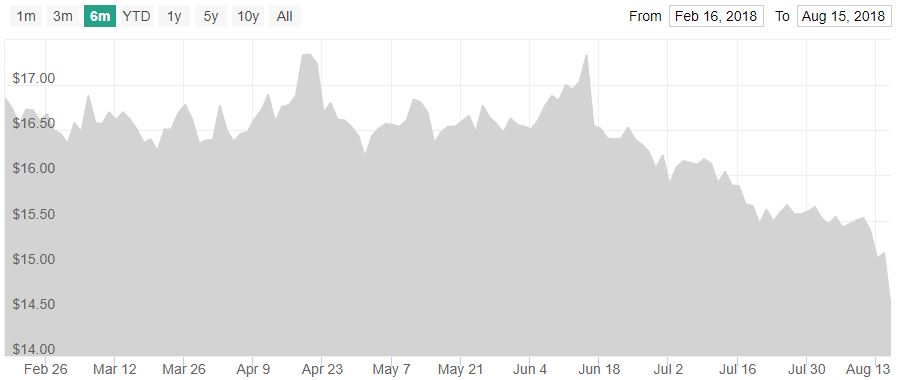
Silver Prices Six Months.


Gold Prices Six Months.

As you can see both silver and gold has been falling the last six months.

---

Tropical Storm Ernesto is heading northeast and away from us.

The surf is around one or two feet today.  The low tide will not be quite as big today.

Happy hunting,
TreasureGuide@comcast.net

Sunday, May 20, 2018

5/20/18 Report - New Technology to Detect Paper Money. Diamond Ring Find. Engagement Ring Found and Returned. Royal Scotland Dock Yards.


Written by the TreasureGuide for the exclusive use of treasurebeachesreport.blogspot.com.

New Diamond Ring Find.
That ring is heavier than it looks. 

---

I'm always interested in new ideas and different ways of solving problems.  Here is an article about a different approach to finding large amounts of cash.  

Sniffing Out Billions in US Currency Smuggled Across the Border to Mexico
Criminals are smuggling an estimated $30 billion in U.S. currency into Mexico each year from the United States, but help could be on the way for border guards, researchers reported recently. The answer to the problem: a portable device that identifies specific vapors given off by U.S. paper money...
Here is the link for the rest of the article.

http://www.labmanager.com/news/2014/08/sniffing-out-billions-in-us-currency-smuggled-across-the-border-to-mexico#.WwDGmUxFzTg

I guess you could call it a cash sniffing machine.

$30 billion dollars could be used a lot of ways in the federal budget.

It reminds me of the time many years ago when I arrived at a Treasure Coast beach and found huge wrapped bails.  The bails must have been four or five foot cubes.  It was very early in the morning and no one was around.  One bail was down by the water, and one was up behind the dunes.  I wondered if it was cash and took a look.  It was pot, heavily wrapped so it wouldn't be damaged by water.

That is back in the day before cell phones.  I wondered if anyone would be returning for it.

---

Here is a great story about an engagement ring that was found and returned by a metal detecting police officer.

May 16 (UPI) -- A Texas woman is praising a police officer who spent hours on a beach to find and return her lost engagement ring...


Jaradi used a metal detector and the pair searched together for hours before giving up for the night.
Haelen said she received a message from Jaradi about 4:30 a.m. saying he had found the ring...
And here is that link.

https://www.upi.com/Odd_News/2018/05/16/Officer-searches-beach-for-hours-to-find-lost-engagement-ring/9661526490844/

I like to post found and returned stories.  If you have any new ones let me know.

---


---

After a good soaking is always a good time to check out old hunted inland sites again.

Happy huntng,
TreasureGuide@comcast.net


Tuesday, June 20, 2017

6/20/17 Report - How To Determine How Old A Ring Might Be. Tropical Storm Near and Heading for the U. S.


Written by the TreasureGuide for the exclusive use of treasurebeachesreport.blogspot.com.

Old Photo of Me Using an Aquasound Metal Detector.
The Aquasound was a good metal detector.  The photo must be from twenty some years ago.  I just ran across it.

---

After Warren's amazing ring find that I showed a few days ago, I thought it would be a good time to look at some of the things that will help you get a good idea of a ring's age.  If you don't know what to look for you can easily mistake a ring that is centuries old for a new ring or vice versa.  In the past I mistook some very old finds for modern finds.  It can be tricky.  I remember one enameled ring found on a 1715 Fleet beach that I immediately concluded was modern because I thought enameling was a more modern technique.  I was wrong about that.  That is just one example.

Below is an old Roman ring.  Would you know right that it was old when if you dug it up.  And what would you look fo?.


There are some features on this ring that would make you think it might be real old as soon as you saw it.  First, the setting.  The setting is covers everything but the top of the stone.  The setting would be one of the first things that would suggest to me that it is probably an old ring.  Secondly, the stone is polished instead of cut like most of today's gem stones.

Rings looked fairy similar up through the middle ages.  As I explained the other day, gems were not faceted until later.

Here is a web site on antique rings.

http://www.langantiques.com/university/Rings:_Ancient_to_Neoclassical

Below is an example of an 18th century ring that is faceted.


You can see that the the diamonds are clearly faceted.  Now look at the settings.  The stones are surrounded by the setting.  They are not set with prongs like most of the diamond rings of today.

18th century rings will often be "foiled."  The gem will be surrounded on the sides and bottom with foil - sometimes gold.  Modern diamond rings are faceted and the setting is very open to permit the light to flow through the gemstone.

I"m not a jewelry expert, but those are a few things that might help you determine if a ring might be old or not.  There are other things to look for, but I'll have to get into some of those another time.

Some old things can be in very good shape (especially if they are gold) and look almost new.  And modern items can be in terrible condition, but that does not necessarily mean they are old.  It can be very difficult to tell the difference between old and new items.

Plain bands can be difficult since you do not have all the clues you would have with a gemstone ring. Crucifixes can also be tricky.

---

We now have the two named tropical storms - the first of the hurricane season.  We had a named storm earlier in the year, but that was before hurricane season began.

Bret is heading west/northwest along the north coast of South America.

Cindy looks to be headed towards Louisiana.

Tropical Storm Cindy
Source: nhc.noaa.gov

On the Treasure Coast we'll have a 2 - 3 foot surf Tuesday and Wednesday.  Then it will decrease a bit for the rest of the week.

The tides are a little bigger and we'll have a nice negative tide Tuesday.

Happy hunting,
TreasureGuide@comcast.net

Thursday, May 25, 2017

5/25/17 Report - Various Types of Finds and Objects. A Quick Video Tip For Target Recovery.


Written by the TreasureGuide for the exclusive use of treasurebeachesreport.blogspot.com.

Great Diamond Ring Metal Detector Find.
Find and photo by SuperRick.
Great find Rick!  Thanks for sharing.

---

50,000 frozen Alaskan artifacts were saved.   Some were very unusual exceptionally nice.  Here is a brief excerpt from a BBC News article.

He [ Frank Knecht ] said: "The unique conditions in this arctic region mean artefacts have retained an unbelievable level of detail.

"We have uncovered grass baskets and mats made when Shakespeare walked the earth but when we take them out of the ground the grass weaving still retains a trace of its green colour and we have been amazed by the variety and intricacy of the woven patterns."


One Beautifully Preserved Wood and Ivory Artifact.
Source: See BBC link below.
Here is the link.

http://www.bbc.com/news/uk-scotland-north-east-orkney-shetland-39973667


---

These very old fossil finds were made earlier this week.

Fossil Finds From This Week.
The above fossil finds were discovered in shell piles this week.  They aren't the biggest or best Treasure Coast fossils, but they certainly are old.

Included are three turtle skutes and one pad.

As you can see, they are all fairly small.

---

Now for something really ugly that sold for over  $110 million.

http://www.939thebeat.com/2017/05/22/basquiat-painting-sold-at-110-5-million-sets-new-auction-record/

One Very Ugly But Very Valuable Painting.
Source: See The Beat link above.
Certainly ugly, but very valuable.  There is no accounting for the tastes of some people.   It can be difficult to estimate the value of some collectibles.

---

In a recent post I mentioned how I watched YouTube videos and counted the seconds it took to recover targets.  Here is a tip that might help you recover targets more quickly.  I use it, but it will only be helpful if you detect and pick up any small iron targets.  If you discriminate iron or don't detect in junky places, it won't help you much.

I sometimes use a magnet with a long handle, mostly when detecting old house sites or something like that.  When you have an small iron target, like maybe a nail or some other piece of rusted iron, just use the magnet to pick it up.  Don't spend time pinpointing or trying to dig it up until you've used the magnet.  Chances are that in a high percentage of the situation, especially if the soil is mostly sand, the magnet will pick up the nail or whatever in no time at all.  A lot of iron junk will be near the surface, but you can even work the magnet down into the sand a little ways, and you will hear the target click onto the magnet.  The video shows one example of when the target was very near the surface and another time when the target was down an inch or so.

Here is the link to the short little video illustration.

https://www.youtube.com/watch?v=eZ2XQiljBF4

This is just one more tool that you might find handy at times.  I think I got the one shown at Tractor Supply for just a few dollars.  You can also purchase magnet rakes like those used by roofers to clean up after a job.  They can be used before detecting just to get some of the junk out of the way.  I call it "site preparation."

Of course you can discriminate out iron, but it is often better to remove it for a variety of reasons.  For one thing, it can mask good targets.  And there might be iron targets that actually help you understand a site and other iron targets that might be desirable relics.


I once posted a description of a multiple stage detecting strategy for old sites.

---

Yesterday was windy.  Even the wind of an isolated thunder storms can cut a beach a little if it hits at the right time and way.  It won't be huge though, but it can make a difference.

Don't expect any big changes to the beach for at least a few days though.  The surf will be small. There will be some decent tides though.

Happy hunting,

  • TreasureGuide@comcast.net