Showing posts with label Seminole War. Show all posts

Saturday, November 17, 2018

11/17/18 Report - Remnants of Old Dock Near Fort Anne. Indian River Lagoon History. Trash and Treasure. Lucky Penny.


Written by the TreasureGuide for the exclusive use of treasurebeachesreport.blogspot.com.

Source: See KayakingKSC.com link below.

You've heard it said that one man's trash is another man's treasure.  That is especially true if you hunt old bottles or are an archaeologist, but it is true for many others too.

I was reading a post on an archaeology web site and the author mentioned that it was odd that at one archaeological site the owner of the homestead stored his trash on his land instead of having it hauled away.  I can only assume that that was written by a millennial or younger person who never lived in the country.  Where I grew up we always buried our garbage on our property.  Everybody had a trash pile.  Most dug a hole so that what remained after the trash was burned was buried.  Rural areas didn't have garbage pickup and neither did the Treasure Coast at one time.

I didn't find out when trash pickup began on the Treasure Coast, but from what I've seen along the Indian River lagoon, it wasn't until maybe the fifties or sixties along there.  Maybe someone can tell me when it was.

If you walk along the banks of the Indian River today, you'll find a lot of old bottles (many more than would have simply been thrown away by boaters or travelers).  You will also find the remains of old trash or burn piles.  Some are still very evident and continue to get washed out whenever there is erosion.

I've talked before about the signs of treasure.  Some of the first signs that you'll often see are pot shards, which tend to remain visible on top of the ground for decades or centuries.

Trash can be one very promising sign of the possible presence of treasure.  The treasure we dig today is what was left behind by the peoples of the past.  Discarded or lost bits can tell you a lot.

When people talk about the history of Florida, they usually only go back a few centuries, but Florida has a very ancient and important past.  I found one very good post about the history of the Indian River Lagoon, including the photo above, on the Kayaking the Kennedy Space Center web site.  Here is the link.

https://www.kayakingksc.com/History-of-the-Indian-River-Lagoon.html

Not only does that post show the remnants of a dock near the Seminar War Fort Anne and the old blockhouse, but it also provides information about the even older history of the lagoon.  Here are a few facts from the KayakingKSC post that demonstrate why the ancient history of the lagoon area is so important.


Jaw dropping facts:

**168 individuals recovered from the mortuary pond. Latest dating is between 7,210 years and 7,320 years “before present”

**Woven fabrics- the oldest-known in the world.

**Brain matter in skulls- DNA was extracted

**DNA results: Rare Haplogroup X –

X is one of the five haplogroups found in the indigenous peoples of the Americas.

Now that is some pretty impressive history.


Here are a few interesting facts on the history of trash from garbagemanday.org (full link below).

3000 B.C. – The first landfill is developed when Knossos, Crete digs large holes for refuse. Garbage is dumped and filled with dirt at various levels.

1388 – The English Parliament bans dumping of waste in ditches and public waterways.

1551 – The first recorded use of packaging: German papermaker Andreas Bernhart begins placing his paper in wrappers labeled with his name and address.

Around 1757 Ben Franklin started the first street cleaning service and encouraged the public to dig pits to dispose of their waste. We were even smart enough to melt down a statue of King George III and use it as ammunition against his armies.

In 1885 America built its first incinerator on Governors Island, New York. The Big Apple also developed the nations first comprehensive system for garbage management. We even tried Austria’s waste reduction plants which compress organic grease, oils and by-products from waste. Although, they were quickly vetoed due to nasty odors.

For more about garbage: http://www.garbagemanday.org/history-of-the-garbage-man/

---
Mounted 1958 Wheat Penny Find.

This is not exactly a holed coin, but close to it.  The mounting is minimal, and I couldn't find anything special about the coin.  I looked closely at both sides to find anything special and it just looks like a regular wheat penny.  It is in very nice condition except for the discolouring, but I had to wonder why someone would mount it.  It is nicely, although inexpensively, mounted.  Perhaps the date was significant, or it was a lucky penny, or a gift.

---

On the Treasure Coast the tides are flat.  From the look of the wind this morning, I would suspect that there are some scallops and perhaps some very small cuts on some of the beaches.

Here are the surf predictions for the next few days.


Happy hunting,
TreasureGuide@comcast.net

Tuesday, June 13, 2017

6/13/17 Report - Disappearing Shipwreck Site. More Seminole Reading. Gorget. Smooth Surf.


Written by the TreasureGuide for the exclusive use of treasurebeachesreport.blogspot.com.

A maritime survey in 1987 reported that the remains of the ship were still visible in shallow water beside the reef wall, but the latest expedition, in January of this year, found that the sea has now claimed the last traces of the Jenny Lind...

Here is the link for the rest of that article.

https://www.livescience.com/59422-19th-century-shipwreck-vanished-from-south-pacific.html

In thirty years, evidence of the shipwreck disappeared.  That illustrates the foolishness of the belief held by many archaeologists that it is better to let shipwrecks remain untouched even for decades or centuries rather than salvage them in anything less than the most thorough and strict way.  The fact is things deteriorate - sometimes more rapidly than might be expected.

---

As I was saying yesterday, I want to become more familiar with Seminole silver.  As I looked for more information, I ran across a number of posts in this blog that provided information and references that I forgot about.  That happens every once in a while.  When searching the internet, I frequently end up getting pointed back to my own blog.

While looking for more information on Seminole silver, In one of my old posts I found a link to the NativeTech web.  Below is an example of the type of thing you will find at that web site.

---


---
I found some items like these at an old 1700s site in the Carribbean.  I posted a picture of one of those. Some people thought it might be a gorget.  I don't know, but at this point it is still my best guess. I don't know what else it could be.

Here is the link to the NativeTech web site.

http://www.nativetech.org/seminole/silverwork/index.php

The web site says that ornamental Seminole metalwork was made of German silver or by hammering silver coins.

Here are a couple additional references listed on that web site.


  • "Silver Work of the Florida Seminole.", John Goggin, El Palacio, Vol. 40, No. 2, 1940.


  • "Florida Seminole Silverwork.", Byron Johnson, Florida Anthropologist, Vol. 29, No. 3, 1976.


  • ---

    I also found a link that I once posted that will take you to a great free ebook.  It is A Voyage to the Spanish Main in the Ship "Two Friends."  It was written by John Miller and published in 1819.

    That ebook provides some very interesting reading, including a section on the Seminole War.

    Here is that link if you want to read that book online.

    http://babel.hathitrust.org/cgi/pt?id=wu.89096224696;view=1up;seq=316;size=75


    Here is another digital book, entitled The Seminoles of Florida (1910 edition).

    Click here to go to that one.

    And here is an 1836 book, The War in Florida, which you can also read online.

    Click here to read The War in Florida.


    One thing leads to another.  I'm going to wrap up this topic for now.

    ---

    I heard some thunder early this morning.  Didn't seem to get to the coast though.

    We're supposed to have a one foot surf for a few days.

    Happy hunting,
    TreasureGuide@comcast.net

    Wednesday, June 10, 2015

    6/10/15 Report - More Than An Object. Seminole War and Voyage To The Spanish Main. Geoducks.


    Written by the TreasureGuide for the exclusive use of treasurebeachesreport.blogspot.com.


    National Geographic Photo.
    More on that below.

    I've been showing a lot of older found objects lately.  Those are things that just recently saw the light of day for the first time in centuries.  There have been cannon balls, musket balls and even a rare 1800s Indian Head penny.

    An object is more than an object though if you've done your research to learn more about it.  It becomes a part of living history.  It can tell a story of a time and place.

    The object was made for a purpose.  It started with a desire or motive.  Someone needed or wanted it enough to create it.  Someone owned it and used it.  And eventually someone discarded, lost or left it behind.

    Everything connects.  Every little object was made with a purpose that was a part of a specific time, place and circumstances.  It had its place.

    Peoples connect - and sometimes clash.  It is true today and was always true.

    It is amazing to me how found objects from the past can lead you on a journey into the past - a journey of adventure and an adventure of endless learning.

    I just received an email from James F., who along with his wife, found the musket ball and trigger guard that I showed back a week or so ago.  Here is what James said.

    As a result of my wife and I locating some Second Seminole War artifacts, I did notice and completely read a free Google Play e-book entitled "The War In Florida" with some rather extensive narratives of the U.S. Army and Seminole Indian exploits during the Second Seminole War. I was amazed to read of several Archaeological digs and studies done in 2006 by a university, who decided to keep locations of their study a "secret" because of "looters," whose questions on troop actions, supplies and movements via artifact data, and burned wooden posts are all pretty much answered in this book's narratives published in 1836. This is the second time in the last few years I have found published historical data, written by the folks who were actually there, that archaeologists were completely unaware of! Do they not do document searches any more?? At any rate, if you can deal with the early 19th Century way of spelling and somewhat involved descriptions, it makes very interesting reading. It also can be emotionally trying to read first hand the double-standard and pleading of the Seminoles for the whites to just leave them alone in the land of their fathers and they would fight no more. Sometimes it makes you wonder how Americans could treat their native brothers in such a way...it can make you question our shining words of freedom, then compare it with our past actions. Not a good thing sometimes.

    Thanks much for the note James.

    First of all, James gives one more good example of the great resources we have today on the internet.  When you can find something like that it makes your found objects really come alive.

    This is the Google Play book that James is talking about.

    The War in Florida: Being an Exposition of Its Causes, and an Accurate History of the Campaigns of Generals Clinch, Gaines, and Scott ... By a Late Staff Officer
    Woodburne PotterLewis and Coleman 

    And here is the link to that book.

    https://play.google.com/books/reader?id=C8d1AAAAMAAJ&printsec=frontcover&output=reader&hl=en&pg=GBS.PA109

    One of the things I notice while browsing that book is that the Negroes  (as they were called in the book) that joined the Seminoles were referred to as being the property of the Indians.  I had always read that the escaped slaves from the north just joined the Indians.  I never saw anything before suggesting that the Seminoles treated the escaped slaves as slaves or held them as property.  Perhaps it was a misperception or intentional misconstrual.  I don't know.

    Anyhow, there is a lot of good information out there on the internet that will help you make finds.  The same resources will help you make more sense out of your finds, which makes them both more interesting and valuable - in more ways than one.

    When I was reading other historical documents, I was surprised to learn how prevalent scalping and other forms of violence were back in the colonial days.  Our history books and teachers don't present that like the books and documents written back a century or so.

    ----

    Here is another online book you might enjoy.  This one was written in 1819.


    And here is the link for that one.

    http://babel.hathitrust.org/cgi/pt?id=wu.89096224696;view=1up;seq=316;size=75

    This one also talks about Black Beard and privateers.

    Take a look at the table of contents and chapter headings and jump to the sections you want to read.


    ----

    Geoduck For Dinner.
    Isn't that an amazing picture at the top of the page.  I've had some awe inspiring experiences with manatees, porpoise, and other creatures in the sea, but none of that size.  Could you imagine!  If you could put yourself in that diver's place, it would be a truly awesome, and probably frightening experience.

    Mark B., is an experienced diver who harvested geoducks for ten years off of Vancouver.  He is interested in doing our type of treasure diving.

    Don't know what a geoduck is?   It is a large salt-water clam delicacy.

    Thanks for the great photo Mark.

    ----

    Nothing much new about Treasure Coast beach conditions.  The surf is small and we had a good low tide this morning.  Also a few rain showers.

    Happy hunting,
    TreasureGuide@comcast.net


    Wednesday, June 3, 2015

    6/3/15 Report - Join The Enironmental Metal Detecting Movement. Various Finds By Readers Of This Blog.


    Written by the TreasureGuide for the exclusive use of treasurebeachesreport.blogspot.com.


    Great Military Button Find.
    Find and photo by William M.

    I'm going to start it right here right now - I was going to call it the Green Metal Detecting Movement, but that might be taken as a broader political statement, so for now I'll use the term Environmental Metal Detecting Movement instead.

    Detectorists remove metallic items that otherwise might be in or on the ground for centuries.  If you think about it, who else will remove all of the lead sinkers and fish hooks from the beach?  Who else is going to pick up the pull tabs in the parks?   Nobody!  And those beer cans are not biodegradable.  The same old cans and pull tabs will be littering the ground for thousands of years if they are not removed by somebody, and that somebody is us.

    I like to leave a location in some way better than I found it.  That might mean removing iron, aluminum, lead, glass or whatever.  You don't have to do it all at once.  You can do it gradually..

    I don't pick up every piece of junk on any one visit.  That would be impossible.  But I do remove some junk on every visit.  You'd be surprised how that helps.  If nobody ever picks it up, in time the entire area will be covered with a solid blanket of junk.

    Some Treasure Coast beaches that were once heavily littered with beer bottle caps, pull tabs and what have you, are now much much cleaner.  I know that for certain.  You can now detect some beaches with absolutely no discrimination and find almost no junk.  That is a big change and a real accomplishment.  It was accomplished little by little over time.  I'd like to think that I had some small amount of influence in getting that done.

    Who wants our fields and beaches to be covered with junk?  If you see junk, how hard is it to pick it up and stick it in a bag?  Some of it can be recycled for cash.  Recycling junk is another benefit o the movement.

    If you see trash and don't remove it, how are you whole lot different from the person that littered in the first place?

    I like the beach.  I like nature.  I like the woods.  I like that old path I showed the other day.  And I hate to see it junked up with all kinds of trash - buried or not.  Some of it might be buried now, but that doesn't mean it always will be.

    If you remove the trash, not only are you preparing the site for better detecting, but you are also cleaning up the natural environment.  I think that is a good thing.

    We don't do a good job of letting people know how everybody benefits from the detecting hobby.  I think this is something we should promote, do and publicize.  In time people might come to appreciate it.

    If we all become a part of the movement, it will make a difference.

    ---
    Same Button
    Find and photo by William M.

    The picture at the top of this page shows a military button found by William M.  I previously said that it was from the Seminole War period.  That was wrong.  My mistake.  This button actually would date something like 1875 to 1902.

    Very nice condition with a lot of gold still on the front.

    The back mark is Horstmann Philadelphia 


    Below is a picture of some miscellaneous finds by William, including the button and a ring along with a close-up of the ring.

    Congratulations William!  Thanks for sharing.


    Miscellaneous Finds by William M.
    Photo by William M.

    Closer View Of Ring.
    Find and photo by William M.


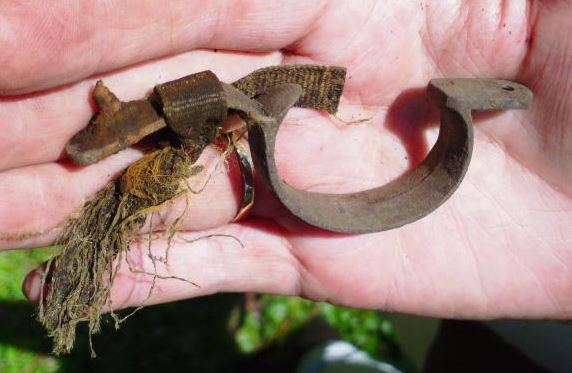
    James F., his wife and several friends have been hunting an old Seminole era fort site in Central Florida on private land where they received permission to hunt. 

    Musket Ball From Central Florida
    Photo by James F.
    Trigger Guard with Material Attached.
    Found by Mrs. James F.


    James said they were using a good bit of discrimination because of the foil, aluminum, pull tabs, and crushed beer cans.

    As you know, I showed a lead shot from West Virginia a couple of days ago.  James said he was surprised to read that I was talking about lead shot when that is the kind of thing they were finding.

     Congratulations to Mr. and Mrs. James F.!

    Very nice finds.  Thanks for sharing.

    And from the Treasure Coast, Dan B. submitted this picture of some partially cleaned old props.

    Find photos submitted by Dan B.


    Those old boat props could bring in a pretty penny.


    And here is a toe ring find by Dan B.

    Looks like silver.

    Thanks for sharing and congratulations Dan!


    People are finding things.  Not too much from the Treasure Coast beaches though.  You know how that goes.  Conditions just haven't been very good for beach hunting.  A lot of people are more interesting in the older item.  There are different types of hunting, and as I advised the other day, it is good to switch it up once in a while.

    It is sometimes surprising what is most valuable.  It pays to be aware of the prices of different types of items even if you don't plan to sell things.

    ---

    On the Treasure Coast it looks like we'll have a one to two foot surf for a few days.  At least we have a decent negative tide.

    Sometime we'll get an actual change in beach detecting conditions.  Hopefully sooner rather than later.


    Happy hunting,
    TreasureGuide@comcast.net

    Friday, January 9, 2015

    1/9/15 Report - Another Important Shipwreck Anniversary This Year. Great Treasure Coast Button Finds. Beach Conditions Failed To Improve Today


    Written by the TreasureGuide for the exclusive use of treasurebeachesreport.BlogSpot.com.

    Treasure Coast Beach This Morning Around High Tide
    Here is my main message or today.  Instead of continuing to improve over the night and into this morning, beach detecting conditions deteriorated.  This particular beach, which I showed yesterday too, shows a lot of deterioration.  The front beach is filling and the cuts aren't as high today.

    I'll stick with my "2"  Treasure Coast beach detecting conditions rating for now but expect a decrease soon.  The waves were really pounding the front of the beach and washing sand and shells up.  You can see the sea weed and shells in the above picture. 

    Yesterday I forgot to mention that there were a lot of little Portuguese Man-O-War on the beach.  They were small.

    -------------

    I've mentioned the 300th Anniversary of the 1715 Fleet disaster this year.  There is another big shipwreck related anniversary this year.   Do you know what it is?   It also is an anniversary that begins with a 3 and ends with a 0.

    2015 is the 30th Anniversary of the discovery of the Atocha mother lode.  Yep, it was found in 1985.

    Speaking of the Mel Fisher organization, the Dare and Magruder will both be working on the site of the Margarita for a while this winter.  The site of the Margarita is more protected and in more shallow water than the Atocha.


    According to the research of Eugene Lyons, there is still missing from the Santa Margarita 80,000 silver coins, 27 silver bars, 4 bronze guns and 22 copper ingots, totaling around $166 million in value.

    ---------------

    A very interesting old piece of pottery was found on a Treasure Coast beach last night.  I'll have more on that in the future.

    ---------------
    
    Button Finds and photos by William M.
    And here are a couple very nice Seminole War era buttons found by William M., who was expecting an unexciting hunt in a backyard but found these great buttons.

    That was his first time on the property and of course he is planning on going back

    Nice Finds William!

    Thanks for sharing.


    .


    I have other finds of various types to show, but that will be all for today.


    Happy hunting,
    TreasureGuide@Comcast.net


    Tuesday, July 8, 2014

    7/8/14 Report - Fort Harrel Found (?), Horse Shaped Cob & Biting Great Whites and Noseeums


    Written by the TreasureGuide for the exclusive use of treasurebeachesreport.blogspot.com.

    
    Cob Shaped Like Horse
    Source photo: Sewall Menzel's book
    Cobs, Pieces of Eight, and Treasure Coins.
    Cobs were formed in a variety of fanciful shapes.  Hearts are most common.  A Sedwick auction had an entire group of those. 

    Besides hearts, or pomegranites, other cobs were shaped like horses, birds or arrows. 

    The precise reason for these oddly shaped cobs is not known.   Some think they were special favors used as jewelry and some believe they were used for religious puposes.

    Many had holes so they could be worn.

    Sewall Menzel believes that they were not "made at the mint."   That doesn't seem right to me, but he knows a heck of a lot more about it than me.

    He wonders if one example was made as a joke or at the whim of a public official.  This is one of those things that you can wonder about but will probably never know.


    Section of Gold Chain Found

    It is possible! If you do your research you can go out there and find a historic site that has been lost for a century or more.  That is what recently happened.

    A high school chemistry teacher, a computer engineer and a U. S. National Park Service Employee recently found what could be the site of Fort Harrel in the Everglades.

    http://articles.sun-sentinel.com/2014-07-02/news/fl-historic-fort-found-20140702_1_everglades-fort-site-seminole-war

    Reading can help.  You never know where you'll find that important clue.  Then they did some more reading and put in some hard time looking.

    I don't think most detectorists do much research at all.  Many just go out to the beach to get some exercise.  Nothing wrong with that, but if you want to make new discoveries research will definitely help.

    Here is an extensive list of Seminole War forts.

    http://fortwiki.com/Seminole_War_Forts_List


    You might take some insect repellant the next time you go to the beach.  The noseeums haven't been as bad as I've seen them, but they have been out there.   One got inside my ear phone cup the other day and chewed my ear up.   That was a first for me.   They've eaten me before, but not from the inside of my ear phone. 

    They seem to be bad when the sand gets wet from rain.  And as you know that has been happening.

    Watch out for lightening too.  We had a lot of lightening yesterday.


    Here is an article about a fellow that got bit by a Great White.  Creatures can decide to take a bite out of you.  Beware.

    http://nypost.com/2014/07/06/shark-attack-victim-it-lunged-and-locked-into-my-chest/


    And here is an article about the NSA accumulating and saving messages by regular people who were not targeted.

    http://www.washingtonpost.com/world/national-security/in-nsa-intercepted-data-those-not-targeted-far-outnumber-the-foreigners-who-are/2014/07/05/8139adf8-045a-11e4-8572-4b1b969b6322_story.html


    The surf on the Treasure Coast is running around two feet.  The tidal change is modest.

    Happy hunting,
    TreasureGuide@comcast.net


    Thursday, April 17, 2014

    4/17/14 Report - Another Bunch of Finds, Buttons and Coins, Cannon Ball, Semiole War Items, Surf & Erosion

    Written by the TreasureGuide for the exclusive use of treasurebeachesreport.blogspot.com.

    As you've been seeing from some of my recent posts this month, some guys have really been cleaning up with the artifacts and silver coins.

    Great US Coat Button Find
    Find and photo by SW.
    SW has been detecting a Seminole War era site where he found all the following listed items.  And he says there is still more left to be found.

    Here is a listing of his finds.

    Period finds; 1 Dragoon button, 1 Artillery button, 1 Great Coat button, 1 unmarked flat button, 1 4 hole button, 1 brass clip, 1 Jeweled screw, 3 copper nails / tacks, 2 round balls, 2 other bullets, 1 2 1/2 inch Iron ring, 1 8 inch iron ring (both badly deteriorated) and other unidentified items.


    Modern items; 1 silver Quarter 1948,
    2 silver dimes 1952-54,
    3 wheat pennies 38, 42, 57,
    1 George Junior Republic token 1946.

    Clad; 7 Quarters, 11 dimes, 4 nickels oldest 1947, 48 pennies.

    
    18 Pound Cannon Ball
    Photo by SW
    He said, A ton of trash was removed,   I only hunted a small portion of the lot. I know better items are there.  Good luck to the next guy.   

    Thanks for sharing SW.  Great finds!

    And some people think there is nothing left to be found. 

    SW also said,
    I acquired this cannon ball on the 7th.  The story I got, it was collected by a dock contractor from the Dry Tortugas. The book, out of the blue, I ordered on the 4th!! I think my next book will be on Gold Cobs!!! The guy with the cannons should contact me maybe we can identify the age and country of origin. The Ball is an 18 pounder unknown age. ...  I am researching a pirate site for my next project.


    As I've been showing there are still good sites out there if you do your research and get permission.


    I went out to take a look at the beach this morning.  Most of the cuts that I showed yesterday had already disappeared.  The sea was rough.  The water was coming up onto the flat beach at high tide.

    We had the expected higher high tide.  The trouble is that the wind also changed direction and the water was now hitting the beach pretty much from the East.  

    Wind and water direction, which are correlated, are among the most important factors for predicting erosion.   Surf height and tides are also included, but in my opinion the angle that the water hits the beach is most important.

    Just the other day when we got the cuts that I showed, there was very little surf.  Now the surf is bigger and the erosion mostly all but disappeared.


    This is what the water looked like at one 1715 Fleet beach this morning.  Pretty rough.

    Later today the surf is supposed to be bigger and then decreasing tomorrow.  It looks like the wind will be coming more from the South, which won't be any help.

    Based upon what I saw today, I'm not expecting a beach conditions upgrade now.

    Happy hunting,
    TreasureGuide@comcast.net


    Tuesday, April 1, 2014

    4/1/14 Report. How a Nor'easter Works, What Happened at Riverbend Park & Seminole War Battle Site


    Written by the TreasureGuide for the exclusive use of treasurebeachesreport.blogspot.com.

    Why do people always talk about Nor'easters?  How are they different?  And why are they associated with treasure finds?  Those are a couple of questions I'll begin to answer today.


    Here is a picture of a Treasure Coast beach that has a cut running for a hundred yards or more.  It is not a picture of the beach today but was taken some time ago.

    First notice the two straight black lines.  The straight black lines show the line of wave fronts as they come up onto the beach.  They are hitting at about a 45 degree angle in this case.

    I always talk about the angle that the wind and waves hit the beach.  That is very important and has a lot to do with what will happen to the sand on the beach front.

    The picture was taken near low tide when the water was not hitting the cuts.  The cuts were made earlier during the previous high tide.

    The small arc (C) in the picture shows how the water of one wave would come up onto the beach and go back down again.  It comes up onto the beach at about a 45 degree angle, moves south and then back into the ocean.

    The larger arc (B) would be when the tide was higher or the waves were higher.  The water would come up, cut along the face of the cut and remove sand and possibly other objects back down the slope and into the water.

    Typically, one wave will hit the face of the cut, and if it hits with force on the face of the cut, it will knock a slab of sand lose, which will get undercut and/or washed away by the next waves.

    One very important thing about a northeaster is that the waves maintain much of their speed as they go up onto the beach at an angle and then back down the slope and into the water.

    If you stand and watch when the water is hitting the face of the cut, you will see the water taking sand from the face of the cut and washing it down the slope and back towards the water.

    Also if there is a lot of water coming up the slope, if you are digging a target and don't get it safely in your scoop, it will be moved with the water.  So if you know the path of the water you'll usually be able to find the lost target again, usually to the south and down the slope a yard of so, depending upon the density and shape of the target.  A piece of foil will wash away quickly and perhaps not be found again.

    When the tide is up and the waves are up and hitting the beach at an angle like this, there is a continual flow of waves from North to South along the beach front in front of the cut.  This North to South almost river-like movement of fast water along the beach front is what makes a Nor'easter different.

    Some time soon I'll show how things work very differently when the waves are not hitting at much of an angle.

    Remember, it takes more than big waves and high tides to create erosion on a natural beach.

    ---------------------------------

    It seems that history is never as simple as its made out.  There is always a perspective or bias of some sort.  I don't think that can be entirely avoided.

    I once picked up a history book in a thrift store that had been used in a school in the West Indies.  The title is West Indian History.  It starts with Columbus and goes through the early days of colonialization, slavery, the Sea Dogs, buccaneers, etc. etc.  Pretty good reading, but it treats the British kindly, which is not really surprising considering the author and publisher.

    One student had written 1955 in the book, which was first printed in 1936, so I guess it was still in use in the fifties.  

    Anyhow, yesterday I mentioned that there was slavery and brutality in the New World long before the white men arrived.  As this school book points out, there was also slavery in Africa before Europeans got involved.  And the Spanish colonizers had large numbers of slave imported to the New World before other European groups got involved, other than the Portuguese who often purchased slaves from African tribes who enslaved members of other African tribes, and then exported them to the New World.

    It would be easy to get the idea from what you hear today that white plantation owners in the South were responsible for slavery in the New World, but slavery was in both the New World and Africa before the white man became involved, and the Spanish colonial system in the New World made use of both native and imported slaves long before the British had significant settlements in the New World and long before the US was born.

    You'll find a good description of some of that in the articles linked to the bibliography that I gave you a few days ago.


    ----------------

    Do you know what happened at the site of Riverbend Park just south of Indiantown Road?

    On January 24th 1838 Major General Thomas S. Jesup, accompanied by fifteen hundred troops, met three hundred Seminoles on the banks of the Loxahatchee River in the last standing battle of the Second Seminole War. During the battle General Jesup lead a charge to the river and was wounded. The Tennessee Volunteers, lead by Major William Lauderdale, took most of the casualties. The Battle ended when Col. William Harney and his Dragoons crossed the river and outflanked the Seminoles. Outnumbered, the Seminoles fled into the swamps. Seven soldiers were killed and thirty one wounded, including the General.

    After the Battle of the Loxahatchee, General Jesup petitioned Washington to allow the Seminoles to remain in the Everglades and end the war. Washington denied Jesup’s request, whereby six hundred Seminoles were captured under a white flag of truce at Fort Jupiter.

    Here is the Parks and Recreation web site link telling about that.

    http://www.pbcgov.com/parks/loxahatcheeriverbattlefield/jesupsbattle.htm

    That was the site of one very historic battle during the Seminole war.  And despite the pictures we often see, the Seminole forces were not all Native Americans.  A good number were black.


    On the Treasure Coast today the high tide will be unusally high and the low tide very low.  The surf will be about two feet.   That means it will be easy to hunt down the slope near the water line at low tide.

    Happy hunting,
    TreasureGuide@comcast.net

    Tuesday, February 4, 2014

    2/5/14 Report - S & M Farms Token, Seminole War Artifacts & Embossed Silver Nip Bottle

    Written by the TreasureGuide for the exclusive use of treasurebeachesreport.blogspot.com.
    Token Found by William M.
    Yesterday I showed some jewelry finds from the Treasure Coast, today I'm showing a variety of items. 

    This token was found by William M.  I saw a similar one online being offered for sale for $30.   

    William says this one is the same on both sides.

    Do you know what the letters stand for?  Let us know if you can identify this token.


    The Mel Fisher organization will be covered on CNBC at 9:30 PM on Feb. 5.

    An ancient Tequesta village has been discovered in Miami.

    Here is that link.
    Seminole War Buttons and Other Associated Relics
    Found by SW.

    I previously reported on the Seminole War button found by SW.

    Here is a picture of that button along with one more button and a couple of other artifacts.

    Congratulations SW and thanks for the photos.

    The first button has been positively identified.


    As the entrance to Charleston Harbor is dredged, France is watching for signs of Lafayettes ship to emerge.  


    Joan T. picked up this Silver Nip bottle.  You can see the embossed lettering.  

    It is 6.5 inches tall.

    Here is what she learned from her research.
    The words "Silver Nip" were first used in 1928. The word mark was register by the Florida Fruit Canner Corp. of Frostproff, Florida and the product was grapefruit for making beverages. the brand was registered by new owners several times over the years and is still active. Your bottle sounds like an old one. I'd guess in the $3-5 range. Digger


    On the Treasure Coast the wind will be from the South.  The tides are more back to normal and not as big as they have been. 

    The surf will decrease daily until being very small Sunday.


    Happy hunting,
    TreasureGuide@comcast.net