Showing posts with label trigger point. Show all posts

Sunday, March 26, 2017

3/26/17 Report - An Important Experiment That Helps Explain When Beaches Will Erode. A Little More Erosion On One Beach.


Written by the TreasureGuide for the exclusive use of treasurebeachesreport.blogspot.com.
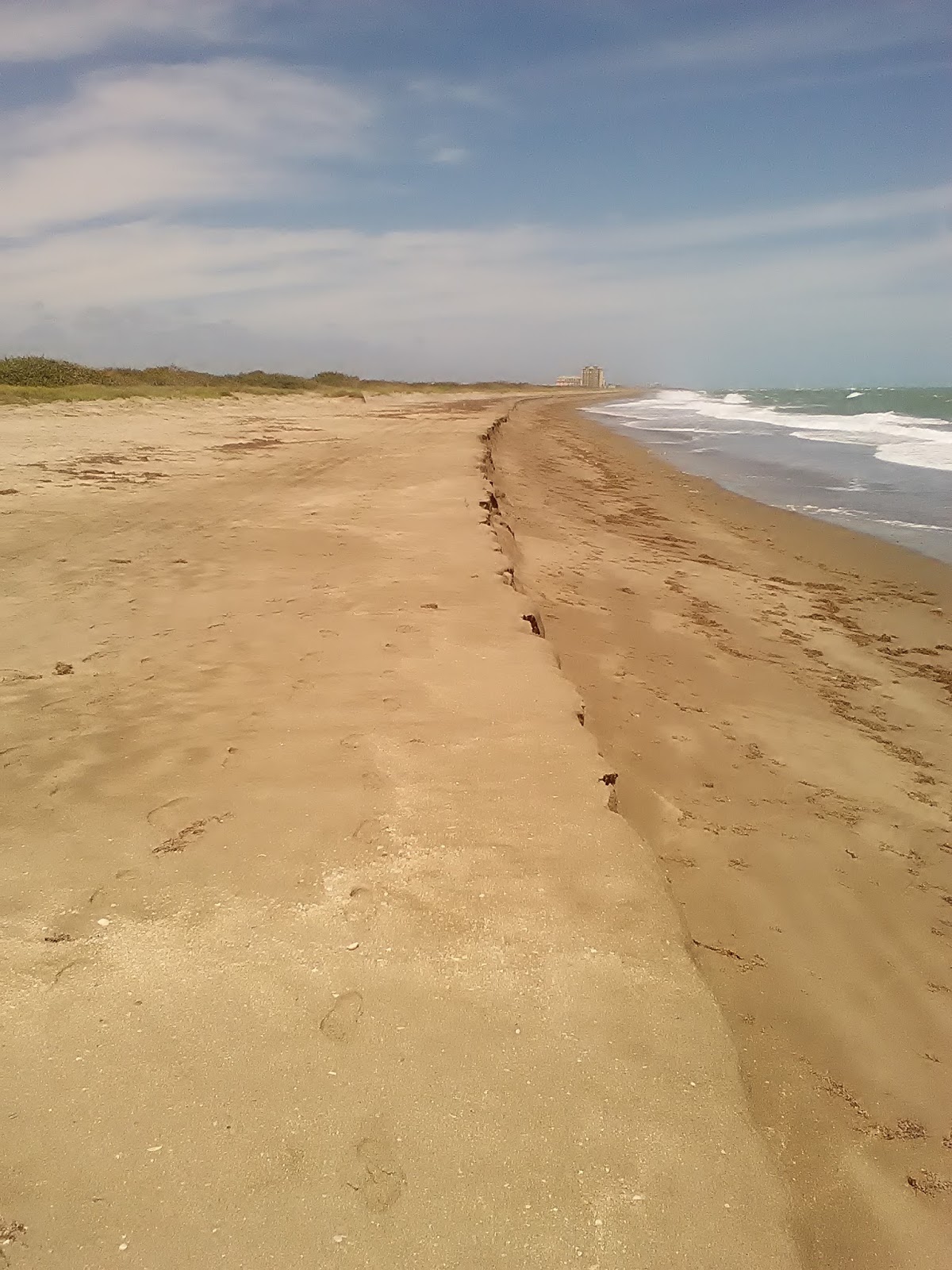
John Brooks Saturday Afternoon.

This is one place along the Treasure Coast that shows a cut.  Friday I showed the same beach, but nearer to high tide.


John Brooks Beach Friday Near Low Tide.

Between Saturday morning and the Friday low tide, another half foot had been added to the cut at John Brooks.  The slope was not as mushy either.

Another beach I looked at was not cut at all, but was showing an area that would have probably produced at least some modern coins if I had made the walk.  It was a good ways off.

---

From time to time I talk about how beach sand moves.  I've referred to how crashing waves push water into the sand and put pressure between particles of sand.  I found a good YouTube experiment that hows how water with some velocity saturates and and how the process can actually lift sand particles.  You might remember the photo that I posted in which in looked like sand was actually being sucked up into a wave.  This experiment might help you better visualize how that happens.

The experiment shows how sand will be moved.  If you remember my post on sand liquefaction, this is something like that.  The result is "sand shearing."  Sand shearing, I recently discovered, is the technical term for one way that sand moves.

Water Poured Into  Sand Contained in a Transparent Container \
Source: YouTube video link below.
The above illustration clearly shows what I imagined must happen and what I tried to describe before.  In the middle where the most water is hitting, you see two things.  One is that the water is penetrating the sand.  That is hardly surprising.  Notice also that the sand is pushed out from the area of greatest force on the surface of the sand.  Sand is also lifted there.

So what does that have to do with metal detecting?  Imagine a coin sitting on the surface of the sand when a wave hits the same spot.  The coin, unless the force is so great that the coin is lifted too, would slip down into the depression and eventually be covered.

There is another thing to consider as well.  When the sand is lifted, it will be easily swept away by water moving over the surface.

On a day when the surf is not so rough, the waves are breaking out in front of the beach.  When the waves are bigger and the tide is up, the waves will crash farther up on the beach.  When that happens, the sand will wash away quickly.

When the water is hitting with force any type of cliff from any erosion that has already occurred, the erosion will occur quickly due to the water bouncing back off the cliff and washing disturbed sand down the slope at a relatively rapid rate.

On calmer days when the water is washing up the slope, sand and other materials that are easily lifted and moved will wash up onto the slope.  The water force will slow as the water goes up the slope and the sand will be deposited.  The water washing down the slope will be even less forceful, due to water sinking into the sand.

Here is the link to the video.  There is more to it.

https://www.youtube.com/watch?v=nCJLuB0NgcI

If you remember my discussions of trigger points, the water must be moving with enough force to move both sand and coins for coins to wash in.  (I'm not talking about coins being uncovered or washing out now.) While the force diminishes, the coins will settle or drop out of the flow while the sand is being moved.  The sand will settle out at some other location where the force diminishes even more.

I hope these experiments help you to visualize what I've been talking about.  The technical terms make it much easier for me to talk about my observations.

Sand shear or soil shear are two good terms that I'll be using more in the future.

---

It looks like we'll have a three to five foot surf for a few days.  The wind will be from the east.  That isn't promising, but we'll have bigger tides later in the week.

Happy hunting,
TreasureGuide@comcast.net


Thursday, November 17, 2016

11/17/16 Report - On The Beach Or In The Hills Some Things Remain The Same. Sanitation Workers Find Wedding Ring.


Written by the TreasureGuide for the exclusive use of treasurebeachesreport.blogspot.com.

Showing Recovered Wedding Ring.
Source: See link below.

Sanitation workers dug through tons of trash to find this lady's lost ring.

Here is the link for that story.

http://abcnews.go.com/Lifestyle/ny-sanitation-crew-finds-womans-lost-wedding-rings/story?id=43574824

---

Not long ago I was hunting in the hills of West Virginia.  While I was doing that I noticed several similarities to beach hunting.

It was very hilly.  You can see that in the photo I showed in my 11/14 post.

There was a flat spot about a quarter of the size of a football field.  It was down the hill from an old settlement, and I know that it was heavily used.  There were certainly many thing lost there, yet I found almost nothing there but aluminum.  Why?  Because tons of leaves piled up and rotted there year after year for hundreds of years.  The leaves were piled about a half a foot deep, then under that was partly rotted leaves, and under that very loose new soil.  Anything of any age was deep, except for the stuff like aluminum foil, which remained on top of it all.

That flat area was very much like an area on a beach where the sand is very loose.  The loose sand moves in and covers any stationary objects, just like the leaves covered more stationary objects on the flat spot.

That wasn't the only area that was similar to a beach area.  They had heavy rain there last summer. The rain ran down some of the steeper areas and washed leaves and loose soil off the slope.  The result is that some surface objects were removed with the top lighter soil.  Some things were left behind though.  That area was also very much like a beach in some ways.

You'll might remember my lengthy discussions on "trigger points" and "drop points."   When the force of water is great enough some objects will be moved and others not moved.  The same thing applies to hilly land.  (For more on trigger and drop points, see my 8/30/15 post.)

The top soil and some objects got washed down over the slopes where the slope was great enough and the water flow forceful enough.  It as on such a slope that I found the oldest coin (about 100 years old).

The same slope  was very hard packed.  That was because the looser soil was washed off with some objects.  Whatever washed off the slope ended up at the bottom of the slope, whether that was a flat area or a gully.

I'm sure that if I could move a foot or more of soil, the flat area would produce a lot of older coins and things.  As it was, the older materials were found on the slopes.

One way that that land was different from a beach is that there were roots and a lot of rocks.  The roots and rocks held some of the items that would have been moved by the water.

Old bottles also washed out of the hillside along the gullies.

No matter whether you are on a beach or in the hills, I'm always happy to see erosion.  Erosion can always uncover some older items.  It also moves sand or soil that can cover up items.

---

A six-thousand-year-old underwater site was mapped and artifacts recovered.

Here is the link to that interesting article.

http://www.ibtimes.co.uk/underwater-stone-age-settlement-haven-fishing-yields-mysterious-elk-antler-pick-axe-1591682

---

We're going to have a small surf for a few days, but big tides, at least tomorrow.

Happy hunting,
TreasureGuide@comcast.net

Wednesday, January 27, 2016

1/27/16 Report - Most Recent Observations On How Water Moves Objects On A Beach.

Written by the TreasureGuide for the exclusive use of treasurebeachesreport.blogspot.com.


Yesterday was an excellent day for observing how objects move on a beach.  The surf was about three to five feet.  That was rough enough that there were significant waves and enough force, while not too rough to be able to get close to the crashing waves.  There were also lots of shells and small rocks.  That made it possible to observe how things move.

At low tide I stood near the low point of the beach where the waves were crashing at the time.  There were a lot of shells and things periodically exposed as the waves crashed and the water and sand came and went.  Shells and things would be exposed, moved up and back down the beach, and then sometimes covered by sand again, and then exposed and moved again and again.  Occasionally some were moved higher on the slope where they remained for a while.

I focused on one small roughly coin-shaped shell and watched the water rush back down the slope over that shell.  At first it didn't move as the water rushed over it.  No movement.  No movement.  Then all of a sudden it popped up off the sand, into the current and quickly retreated down the slope and disappeared into the swash.

The thing that struck me most about that observation is how quickly it popped up off of the sand and how quickly it moved after a period of hugging the sand and not moving as the water rushed over it.

Here is a quiz to see if you read my blog in the past.  What have I called the point when the water force becomes sufficient to move a specific object?

It is the trigger point.  And what I have just described is an excellent illustration.  Again, what struck me was how sudden it was.

I think it is tempting to think that it is a more gradual process and that if the water is moving, objects are being moved in a similar way at and at similar rate.  But water moves more gradually while objects being moved by the water can be moved not at all and then very suddenly. The trigger point is all or nothing.  Eight it has been reached or it has not.  Once the trigger point is reached and the object becomes suspended it moves very quickly until the what I have called the "settle point" is reached, and the object settles down on the bottom again.

Objects such as coins, which are relatively flat and settle against flat the surface, sometimes even settling slightly into the surface, move differently from round objects, which roll around - first up the beach and then back down.  Rounder objects do not hug the surface and provide more surface area for the water to push against.

Flat coin-shaped objects quickly settle into the surface and do not provide much surface area for the water to push against, until they are lifted off the surface, and then they are moved quickly, sometimes flipping.

You can not observe how this works when the water is very rough.  You can't stand in the crash zone when the surf is strong, and if you could you would still not be able to see small objects because the water is so rough and turbulent.

If you look at the illustration  at the top of the post, the red area is where the waves were hitting with force and masses of shells were exposed.  Occasionally they would get covered with sand and disappear, but often the sand was removed to expose the shells and rocks.

When a wave crashed, the water would dislodge settled objects and some of them would get washed up the slope.  Many would get washed back down the slope with the returning water, but those that settled near the top (blue area on the illustration) formed a shell pile.  Occasionally the water would hit the shell pile and wash some objects back down the slope.

This was all happening at low tide.  As the tide gets higher, the crash zone moves up, as would other the surge and objects. At other times the shell pile might be pulled down into the water and disappear again.

All of this is very well explained by trigger points, and the increasing and decreasing water flow interacting with various characteristics of the objects, including density, size, shape and surface characteristics.

I was observing shells and rocks today, but coins are moved in a very similar way.  Coin lines are formed in the same way as shell piles.  You can't often observe the same process with coins though. There are much fewer coins, and they are more difficult to see.  Shells will be moved slightly differently than coins, because of differences in density, size and shape, but the same basic principles apply.

I had plenty of other things to post today but thought I should post this while I was thinking about it.

Even when you are not finding what you want, take advantage of your time on the beach to observe how it all works.  You might find something else in the process.

Remains of An Old Cut As Seen Yesterday Afternoon.

One Formless Beach As Seen Yesterday Afternoon Near Low Tide.
I'll try to get some good close video of the things I described above.  I guess I was so intent on watching that I forgot to take a video.

Every time I do try to catch a video of something in the crash zone, it seems things don't happen when I want.

It rained last night and much of today.  The surf is down today and will be nearly flat for a few days.

I'll get back to recent finds in my future posts.

Happy hunting,
TreasureGuide@comcast.net

Tuesday, September 22, 2015

9/22/15 Report - How Coin Lines Are Formed: The Basic Beach Dynamics. CSS Georgia Salvage.


Written by the TreasureGuide for the exclusive use of treasurebeachesreport.blogspot.com.

Yesterday I talked about finding coin lines.  Today I will attempt to illustrate the basics of how coin lines are formed.

The above illustration shows how the amount of water and force decreases as it goes up the slope of a beach.

The key concepts are those I've mentioned many times before.  First is the trigger point, which is the amount of force needed to pick up and move specific objects - in this case coins.

The force is greatest near the bottom of the slope and decreases as the water goes up the slope, sometimes eventually ceasing altogether.

At some point the water slows enough that it can no longer carry the objects and they settle out.  In my simple diagram that would be about at the number two.

That is the most simple scenario capable of creating a coin line.

However, not only does the water rush up the slope, very often there is a backwash.


In this illustration the red line shows the backwash.  If the water retreating back down the beach is strong enough to carry coins, it can carry coins back down the slope.

Remember, when the water slows to the critical "drop off" points, objects will be dropped.

But different objects have different "trigger points" as well as different "drop off" points.  Both the surge and the backwash can move coins and sand, or if not strong enough to move coins, it will just move the sand, leaving coins behind.

If the backwash has enough force it will carry coins back down the hill and also sand.  Sometimes it will have enough force to carry sand but not coins.  That applies to both the surge and backwash.

To additionally complicate matters, the coins can start out either in the water or in the sand.  They can be washed up or down.  They can be carried up the beach and dropped off at some point, or if they start out in the sand, they can be uncovered as the sand is washed away and washed down the slope.

A coin line can be very narrow when the surge is consistent or wide when you have a waves and a surge that varies more.

Once a coin gets covered by sand, it can be protected from the flow of water, which will flow over it without moving it until the sand is moved and it is uncovered.  If the water is moving enough to move the coin, of course it will also move the sand.

The backwash can be very strong in some cases, and in others virtually non-existent.  The balance between the two is important.  You'll often see the surge colliding with the backwash,

This is overly simplified, but I think it is still a decent illustration of the key concepts.

I'll possibly add to this in the future, considering things such angles, different sources and abrupt changes in beach profiles.

---

Terry T. recently found these coins in a coin line.  You might remember that I mentioned that discolored coins are good signs or markers.  They have been out there long enough to have been sifted and sorted and dropped in a line.

Coins Recently Found In A Coin Line On The Treasure Coast.
Photo submitted by Terry T.
Here is what Terry said in response to yesterday's post about a coin line.

...All in the picture were found to the south of a public beach about 300 yards a few days ago. I had about an hour to detect. A cut approximately 3 ft ran for about 60 yards. 26 years ago people were able to park off of A1A on top the dune very close to the beach ( an old party spot). I have got stuck there many times in the sand. Only to come to the conclusion that a couple of 8 inch wide pieces of wood cut 3-4 feet in length stored inside my vehicle, and a little patience along with a small shovel (and a lot of sweat back in the day) would get me out of the situation. Now AAA will be called -lol. All are modern U.S. coins, but have been there for sometime ( I excluded the pop tabs - both modern and old school types from the picture). Not one fishing sinker was found - nor any gold, but this area has produced gold in the past along with other items. I went back 2 days later after digging the coins in the picture, and the cut was filled in. She hides it well.....

Thanks Terry.

The primary purpose of hunting a coin line is not to find modern coins, but they can also be made of old coins and sometimes even better things as well.  The thing about the coins is that they reveal a pattern that can then be exploited.

Any old green coin like those shown above can be a sign of a coin line or coin hole.

---

Many artifacts and a 9,000 pound Dahlgren cannon has been recovered from the wreck site of the CSS Gerogia.

Here is that link.

https://www.dvidshub.net/news/176414/second-dahlgren-rifled-cannon-surprises-css-georgia-archaeologists#.VgBQ1t9Vikq

---

It looks like Ida will fizzle out in the Atlantic.  There is a disturbance to the north of Florida that can be helping some of the states to the north of us.

The Treasure Coast is supposed to have a slowly increasing surf for the next week.  I'm not real hopeful.  We are getting into the Fall when typically we get some kind of storm.

Happy hunting,
TreasureGuide@comcast.net

Saturday, August 29, 2015

8/30/15 Report. Erika Gone. Supermoon Last Night. More on Trigger and Drop Points. Flying Aircraft Carrier Sunk.


Written by the TreasureGuide for the exclusive use of treasurebeachesreport.blogspot.com.


Two Disturbances
Erika has disappeared.  However, the remnants are just off of Cuba formed from the remnants of Erika.  At the time of the 8 PM update, this disturbance only had a ten percent chance of becoming a cyclone in the next 48 hours.  We will get a lot of rain from it.

There is another disturbance coming off Africa.  It has already turned into a tropical depression.

Erika fizzled out like Danny did.  The surfing web site are predicting something like a three to four foot surf on the Treasure Coast tomorrow.  Then it is supposed to decrease again on Monday.

---

Last night was a supermoon, the first of three supermoons to occur this Fall
...In fact, the term ‘supermoon’ is not astronomical. Scientists call this event a ‘perigee moon’: it takes place when the full Moon reaches the closest point to Earth on its oval orbit. This point is called perigee and it is about 50,000 km closer to our planet than the opposite side of the Moon’s elliptical path – apogee...

Here is a link for more about that.

https://www.rt.com/news/313812-supermoon-rising-saturday-august/
You might recall that it was worried that Erika would arrive during a supermoon.

---

I received the following email from Brian H.

I have been reading your blog and thought what if we had T-Shirts with Environmental Clean up Crew printed on them. Would make a great conversation point.

I have been studying your blog mainly on how objects move in the sand, fresh water lakes act different than the ocean but the fluid dynamics are the same. I do have the Great Lake Michigan in my back yard and it acts like an ocean.

I will hit a hot spot of 60's era flip tops and think no one has been here before? Then I will get into bottle cap heaven and dig like a hundred of them. One day I saw one in the water scooting across the surface of the sand and I started thinking differently.

It is when I get into the coins and nickels that I normally find the gold rings. Birds of a feather?

The weather on the lake for tomorrow will change to a Northeast and a Super Moon.

I will take a couple of machines and watch the sand movement.

Brian is right.  The water dynamics are the same.  Anywhere there is running water, even rain runoff, watch for the same basic principles at work.  Thanks Brian.  

Watching junk can tell you a lot.  Junk can help tell you how things are being distributed and therefor also where the good and bad areas are.

---

I really learned a lot about escudos lately.  It happened primarily as a result of looking at the recent Treasure Coast finds.

In the past couple of years I have also learned a lot more about how sand and objects move on beaches.  That is something I've studied for a long time, but I just made some new breakthroughs that help explain a lot. The more you learn, the more knowledge you have to build on, and that leads to learning new things.

A diver told me he was pretty sure that at least some of the escudos that were found this year down in the pot holes and cracks were up on the slabs before the blowers removed the sand.  A lot of the escudos were found on top of the slabs even after the blowers removed the sand.  That information was important to me for several reasons.  Basically it confirmed some things I suspected but was not absolutely sure about.

One of the books I mentioned the other day said that Frogfoot Weller wanted his blowers to run no faster than 600 rpm.  That was so the coins would settle down in the hole instead of being blowing around.

That provides an excellent example of how what I have named "trigger points" are important.  In case you haven't read what I've said about trigger points, a trigger point is the amount of water movement or force needed to get different objects to start moving.

Little force is needed to move silt or fine sand and more force is needed to move small pebbles and even more force is needed to move things like gold coins.  Every object has its trigger point.  If you know where each object lies on the scale, you know in what order things will be moved as the amount of force increases.  If you think about that continuum and how the various trigger points are  met as the amount of force increases, you'll understand how some objects are moved and others left behind as different amounts of force are produced.

The other important thing is the "drop point," which refers to the point at which different items drop out of moving water and settle.  As water movement decreases, different objects settle out at different times.

An important thing to watch is when and where the amount of force changes.  For example, there will be a lot of force directly in front of a breaking wave and less as the water goes up the slope on the front of the beach.  If the trigger point for an object, such as a coin was exceeded at the base of the slope, the "drop point" might be reached at some point as the water slows as it goes up the slope. Objects that are less easily moved will generally settle out first, but it is not a straight line function.

It gets more complicated since you also have to take into account such as back flow, which may have enough force to move sand or other objects back down the slope again.

Up to 600 rpm the force produced by Frogfoot's blowers moved the sand, but above 600 rpm the coins were also being blown around.  What they wanted was to blow the sand but not the coins, which would then tend to settle down into the hole.

---

Flying Aircraft Carrier
Source: see link below.
As early as 1916 the Navy had begun designing lighter-than-air (LTA) rigid airships, and by 1926 the focus had shifted to airships that could support aerial scouting missions. The first flying aircraft carrier, USS Akron (ZRS-4), was commissioned in 1931 – and after several incidents in two years, the airship crashed and sank off the coast of New Jersey in 1933...

I thought that was pretty interesting -  a flying aircraft carrier.  Note the size of the planes below the airship.  In the article there was is a picture of how the old planes were attached.  Really interesting idea that evidently didn't work out.

Here is the link.
http://news.usni.org/2015/08/19/exploring-the-wreck-of-uss-macon-the-navys-last-flying-aircraft-carrier

---

Happy hunting,
TreasureGuide@comcast.net

Wednesday, August 13, 2014

8/13/14 Report - How Objects Sink During Summer Beach Conditions. Valuable Antique Jewelry. H. L. Hunley Submarine. Titanium On Beach


Written by the TreasureGuide for the exclusive use of treasurebeachesreport.BlogSpot.com.

Antique Diamond and Ruby Ring.
Source: See aol.com link below.
I'm often asked about those light pieces of melted metal that people find along the coast.   They look a lot like aluminum.  I believe that many of those are titanium.   I've posted about that in the past.  Since I still get questions about those finds, here is a little repeat of what I said.

If you've ever dug up a piece of metal that looks something like melted aluminum on a Treasure Coast beach, it could be titanium from a rocket or maybe the space shuttle Challenger disaster.

Here is a link to a web site that tells how to identify titanium.

http://mrtitanium.info/2008/03/17/how-to-tell-if-a-piece-of-metal-is-really-titanium/

As you might know, titanium is also used to make inexpensive jewelry these days and is much less expensive than platinum, gold or silver.


Below is a beach photo that I showed a few days ago.  I'm showing it again as an illustration.

Recent Treasure Coast Beach Picture.

A few days ago a lifeguard told me about a diamond engagement ring that was lost a few days earlier.  He said the lady was in knee deep water at the time.  He also said that even though the ring was lost a few days before, the water had been calm.  He was thinking it would still be about where it was lost since the water had been so calm.
 
What the lifeguard did not understand is the poor sandy beach conditions in that area.  Despite the generally very calm surf, things were not staying near the surface, but rather were quickly sinking our of detector range.
 
The wave in the above photo is not as big as it looks.  It wasn't much more than about a foot.  It is breaking nicely and from its form you couldn't tell it from a ten foot wave. 
 
What I want to point out is that where the red line is, the crashing water will churn the sand even though the surf is small.  Furthermore, the line of impact will move as the tide goes in and out so that the red line will move ten or twenty yards or more in and out twice a day.  Not only that but the area in front of the crashing wave, between the red and yellow line has surging water which will move the sand and keep it from settling.  That means sand will be accumulating from the red line to the yellow line and a little beyond.   That is what happens during a summer beach.
 
So even though the water looks very calm, it won't take long for an object like a ring to be buried.  It is partly a matter of the ring sinking and partly a matter of  it being covered.  The sand in this area is loose and the apparent sinking happens at a fairly rapid rate.
 
As I have pointed out in the past.   It takes more water force to move some objects than others.  I'm talking about horizontal movement now, not vertical.
 
It takes very little water movement to move sand, especially when it has been suspended, as it would be by the crashing wave.
 
The fact that it takes little force to move sand but considerably more to move something like a ring, which is more dense,but which also is shaped in a way that does not provide good surface area to the water to push against, what happens is that the sand moves faster around the curved object, letting the object sink through the loose sand while at the same time moving more sand in to cover it up.
 
There is what I call a trigger point for different objects.   The trigger point (amount of water force need to move an object) for sand is much lower than the trigger point for an object like a ring.   That is much of what accounts for objects like rings sinking quickly in sand when the force of water is slight.  That is what basically what happens during poor beach conditions.
 
The trigger point is determined not only by an objects weight or density, but also by its shape.  I've demonstrated that by experiments in the past.
 
Here is one link to reference.  You can search for others.


Above is a picture of an antique diamond and ruby ring worth $80,000.  Use this link to learn more about the ring and a matching $160,000 bracelet

http://www.aol.com/article/2014/08/12/antiques-roadshow-diamond-and-ruby-jewelry-worth-a-fortune/20945611/


The H. L. Hunley being conserved.

http://www.postandcourier.com/article/20140812/PC16/140819871/1177/scientists-to-begin-exposing-the-real-hunley

Nice picture and article.


There is no tropical weather to watch in the Atlantic.

On the Treasure Coast the tides are still fairly big, but the surf is still around one foot and will remain that small for several days.

Happy hunting,
TreasureGuide@Comcast.net