Sunday, March 20, 2011

3/20/11 Report - Selecting a Beach & Nugget Find


Huge Nugget Sold for $460,000.


This nugget was found by a man in his own back yard. Wouldn't that be fun? He also found two other smaller nuggets. One of the smaller ones sold for $7000, and the other for $17000 if I remember correctly.

Now that would be some fun homework. Imagine being able to find nuggets like that in your back yard. I'd probably be out there digging all the time. There would be a hole half way to China.

I think I'd finding natural untouched undisturbed gold nuggets would be more fun than anything - maybe because that is one thing I've never really done yet.

Here is the link to the entire story.

http://www.sfgate.com/cgi-bin/article.cgi?f=/c/a/2011/03/16/BARD1ID82A.DTL


It is interesting how one thing leads to another when you are researching history. Every clue leads to something else. Then you have more leads and find more clues. Even factual errors can lead to additional information and step-by-step you end up getting more and more information.

I like doing those posts where I open up a topic and continue to get more information and keep adding to the story a little day after day. I hope you like them as much as I do.


If you are interested in South Florida history and especially the Indian mounds of Florida you might want to check out this thread which I found in a forum about hiking in Florida. It talks about some Indian mounds that are more or less accessible for visitors. This isn't some gone-wild treasure hunter thing. In fact the Palm Beach County Historic Preservation Officer/Archaeologist is a contributor and leads some of the hikes.

Here is the link to that forum.

http://www.myfloridahikes.com/forum/topics/indian-mounds-in-sofla?commentId=2257444%3AComment%3A39439&xg_source=activity


You might occasionally find old license plates, especially if you hunt along some of the local waterways. Did you know that there are people who collect old license plates, and some sell for good amounts. The license plate reading OUTOFTIME that was on the car used in the movie Back to the Future sold for over $10,000.

Kovels Komments says, Pennsylvania began issuing license plates in 1906. Early plates were enamel and were issued to the driver, not the vehicle. The first plates issued for a specific vehicle were made in 1910. A metal tag in the shape of a keystone was attached to each plate. The first plates for dealers were also made in 1910, but without the keystone... Collectors search for plates with low numbers or special number combinations, plates made of unusual materials, those that are smaller than usual or commemorate special events, plates that have unusual pictures or slogans, interesting vanity plates, and special plates that belonged to a famous person or were used in a movie or TV show... There is a club for collectors of license plates, Automobile License Plate Collectors Association, Inc., 118 Quaker Rd., Hampton, VA 23669-2024, website www.alpca.org.


Now I'll give some very basic tips that will help you find more gold if you want to hunt some of the tourist beaches during Spring Break. One of the first and most important things is beach selection.

Here are some factors that you should consider.

Fact 1. Some cultures and groups wear more gold than others. That is obvious, but take advantage of that knowledge and hunt beaches where the people who wear more gold gather.

Fact 2. Wealthier and flashier people tend to wear better jewelry than poorer and less ostentatious people. That is not always true because some wealthy people do not wear much good gold while there are some poorer groups that do wear good gold. If you watch a TV show about India for example, you will see some very poor people wearing a lot of high-karat gold.

Given the choice between hunting a beach with a lot of low-quality jewelry versus one with higher quality jewelry, I would often take the beach with the higher quality stuff even if the finds are less frequent. Some beaches have a lot of gold but some of those beaches will have predominantly lower-quality 10K or plated gold or silver rather than 14K or 18k gold, for example. And some cultures still use 20K gold.

Fact 3. Tourists tend to lose more gold than locals. First, tourists often do not want to leave their valuables in the car or hotel and so unlike locals are more likely to wear their good stuff to the beach. Second, tourists often are not aware of how easily gold can be lost in the sand or water.

Fact 4. Young active people usually lose more jewelry than more mature people. It is often the diving, hand-stands, cart-wheels and other youthful carelessness that leads to many of the loses.

Summary Conclusion. Not taking beach or water conditions or other factors into account, you will find more gold where young active wealthy careless people, tourists and people from gold wearing cultures gather, style and frolic. South Florida has beaches where all of those factors come together to create some great hunting.

I have created and use my own checklist of over twenty factors that can be used to select the most productive jewelry beaches. The above are only four of the main factors taken from the socio-economic factors section of my checklist.


Conditions and Forecast.

On the Treasure Coast the wind is now from the northeast and the seas are running only about two feet. WE had a big low tide yesterday afternoon and will have one this afternoon after a nice high tide. That should move some material around.

Six foot seas are predicted for tomorrow. That is a pleasant surprise. Between the Super Moon, the northeast winds and the increased swells, it might get a little more interesting.


Happy hunting,
TreasureGuide@comcast.net

Friday, March 18, 2011

3/18 Report - Pirates and Treasure Lore of Florida & Super Moon


Wood Carving Found on Treasure Coast Beach This Morning.

It's funny what you can find on a beach. Almost everything and anything. I found this wood carving this morning. Just a funny curiosity. It reminds me a bit of the voodoo and Santeria stuff that I used to find on the beaches of South Florida sometimes.


Some people were surprised when I mentioned cobs being found in the Miami area. I guess most people think of the Treasure Coast when it comes to shipwreck treasure, but don't forget that other areas of our state have a lot of treasure too.

I think most detectorists in the Miami area focus on the beaches where they can find a lot of gold. There are several good reasons for that, but there is a lot of history to the area and a lot of old treasure that has been found around there too.

If you ever visited Key Biscayne and the old lighthouse, just about a hundred yards away from the lighthouse you can still see signs of an old spring that was used as a supply of fresh water by some of the first explorers. I've heard it said that three barrels of treasure were once buried near that spring. And a chest was found not far away from there. Fresh water was also obtained from around the mouth of the river near downtown Miami.

Anyone who is familiar with pirate lore of that area knows about Black Caesar and Ceasar's Creek and some of the prominent treasure discoveries in that area.

There are many historic areas in South Florida and around the state where treasure has been found and can still be found. I think one of the problems with hunting old treasure down south is that much of the area is now either private property or protected by parks. But I think another reason that few people hunt old treasure down that way is that people think that all of the old stuff has been discovered. I also think that they follow everybody else, most of whom seem to be detecting the glitzy beaches. Again, nothing wrong with that, but don't forget about the shipwreck and buried treasure in an area with so much history.

The last few days I got so engrossed in some of the research resources that I've been browsing that this blog took a bit of a turn, but that is temporary. I just can't help but share some of this interesting material. I really enjoy reading the history and think that you will find it both interesting and helpful.

I ran across this article that was printed in 1946 in The Tequesta,the journal of the Historical Association of South Florida. It discusses a lot of different pirates and treasures and is not confined to South Florida but talks about many different parts of the state and includes the 1715 Fleet treasure and the ventures of Henry Jennings.

You might be surprised that in 1946 mention is made of one man using his prop wash to blow sand off a wreck, and the article also talks about one of the early radio frequency detectors brought into the state.

There is too much good stuff to tell you about, so I'll just give you the link.

Here it is.

http://digitalcollections.fiu.edu/tequesta/files/1946/46_1_01.pdf

That isn't what I was going to talk about today, but this article is so good that I just had to share it.

On that topic, I think I mentioned the other day a detectorists that I knew that found a chest full of coins in the Keys in the 1990s.

I hope you enjoy research material like the article today and the research resources like the links to maps that I posted yesterday. I generally post the things I like and I'm never quite sure if anybody else will like them.


Kovel's Komments says, Spider-Man's first appearance in Amazing Fantasy comic book No. 15 in 1962 led to the private sale of a near-mint copy of the comic book for a record $1.1 million. It was sold this month by a private seller to a private buyer.

It is sometimes funny what things bring in big bucks.


Forecast and Conditions.

Some people are talking about what they call the Super Moon that will be tomorrow. The moon will be closer tomorrow than it has been for eighteen years. That means Super Tides. The high tides will be higher than normal and the low tides will be lower than normal. Some beach and water hunters go a lot by the amount of discrepancy between the high and low tides, preferring to hunt when the difference is greatest. I take that into account, but don't put as much emphasis on it as some others.

This morning on the Treasure Coast you could see the higher water line form the last high tide. Some beaches were scalloped and I even saw some small cuts near the high tide mark at one location.

Tomorrow might be a good day to get out at low tide to search that area.

I also heard that a lot of sharks are headed north from Palm Beach County.

It seems to me that sharks are bothered by the electrical pulses emitted by detectors. I'm going by my personal observations and wonder if anybody else thinks there might be something to that. I know it didn't bother a barracuda that always followed me around at one location. After a while he would start to get on my nerves.

I didn't see Seagrape Trial today, but from what I saw there in the recent past, this new high tide might make it one of the better beaches to try.

The wind is now from the east, and on the Treasure Coast seas are running around two feet. It still looks like Monday might have increasing waves.


Happy Hunting,
TreasureGuide@comcast.net

Thursday, March 17, 2011

3/17/11 Report - 1855 Map of St. Lucia & Various Other Topics


Part of Historic Map of St. Lucia Showing Fort Capron and Fort Pierce.

I've been looking for an older topographic map of South Hutchinson Island in the hope of answering a question sent in by one of this blog's readers and found this interesting map from 1855 showing Fort Capron, which I've been talking about lately. That is an interesting story that provides a lot of hints.

If you want to see the entire map, here is the link.

http://fcit.usf.edu/florida/maps/galleries/county/stlucia/index.php


I also discovered this utility that allows you to look at the entire coast, and more, taking an aerial view. It is quite amazing what all you can see - even features underwater near shore. You might find it as useful as I did.

http://www.terrafly.fiu.edu/

It seems the internet really has a lot of resource tools these days. The problem now isn't so much finding out if something is on the internet, the problem is sifting through everything to find exactly what you want. There is just a lot of stuff out there.

Kenneth B. from Kentucky, and one of the Garrett users counted in my last survey, sent in the following links, which you might also find useful.

http://www.lib.utexas.edu/maps/topo/florida/
http://alabamamaps.ua.edu/historicalmaps/us_states/florida/topos/armymap.html
http://alabamamaps.ua.edu/historicalmaps/us_states/florida/topos/index.html
http://www.historicmapsrestored.com/USGS/Florida.html
http://scholar.library.miami.edu/floridamaps/about.html

Those are some good research tools.

Sometimes I have too much to write about and can only post a fraction of what I have. That is the case today. I'll get to some of the other topics over the next few days.


Some people have been asking me about where certain things were found. That's natural. But remember, your not looking for what has already been found, you're looking for what has not yet been found.


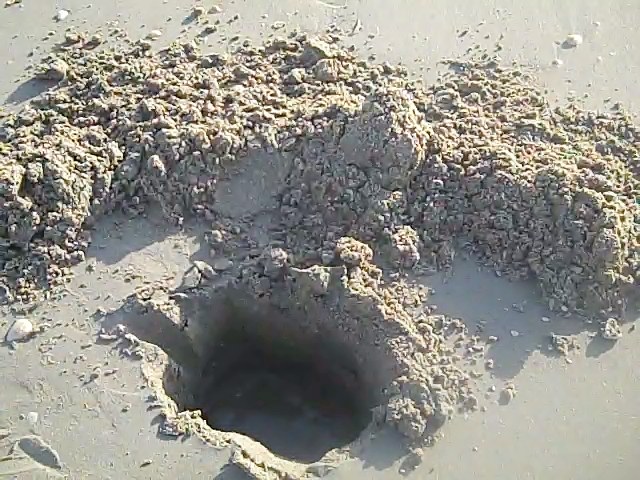
I recently mentioned how there are some deep and hard to dig artifacts out on some of the front beaches now. Sometimes the hole keeps getting filled in by the waves. one thing you can do in a situation like that is what is shown in the photo below.


Use the sand from the hole to create a dam on the lower side to help keep the waves from getting into the hole. This particular hole is about a 1.5 feet deep and the same wide. The artifact was laying near the top of a layer of rock, which was under a little more than a foot of sand.


Empty Hole.

Did I mention Arkansas Bill yesterday? I don't remember. Anyhow he used to travel through Florida in the spring when Fort Lauderdale was the place to be, hitting all of the top Spring Break beaches. He lived out of his van during those trips and did quite well using an Aquanaut 1280 picking up a lot of modern gold. Anyhow on one of his trips down to the Keys he managed to find some nice Tumbaga bars. Although he didn't show them off much, is someone saw one of the bars, he would tell them that they were lead. People who didn't know any better believed him.

When working the Spring Break beaches, he mostly worked the dips right in front of the beach. I'll get into some of those techniques more some other day.

There wasn't room to walk between the beach blankets sometimes in those days.


It seems that most people aren't buying the 'cleaning the grates' story anymore. In fact some people are telling me that they know it isn't true. I won't say one way or the other. First, it doesn't really matter much to me what they are doing since it is in a leased area, and, second, everybody knows about the wrecks around there anyhow.

A Very Common Type of Ring Design That Has Been Used Through the Ages.

Snake designs have been used in jewelry almost as long as time. Some designs, like this one have been use for centuries. You can most easily identify the era of some of these age-old designs from the type of manufacture and any markings that might be found. If you hunt very long you might find several of these snake rings.

This particular one is fairly large and heavy. The eyes are diamonds.

I haven't even started some of the topics I had in mind for today, but I'm running out of time. I got into too many miscellaneous items today and didn't think that I would even get a post done.


Conditions and Forecast.

The wind is now from the east and the seas are running two to three feet on the Treasure Coast. That isn't enough to change beach conditions significantly.

The seas are expected to remain at current levels for a few days. It looks like maybe Monday they'll pick up some.


Have fun,

TreasureGuide@comcast.net

Wednesday, March 16, 2011

3/16/11 Report - Underwater Gold & Be Grateful


Galley Brick From El Rubi Wreck.

I like to post photos of things you might find on a beach but which you might easily overlook as being either junk or just plain insignificant. This galley brick is for sale on eBay and listed with a starting bid price of $500.

I've found old bricks on the Treasure Coast beaches that could be from wrecks. This particular galley brick is broad and not very thick. It is only about an inch thick.

Here is a link to more information on the El Rubi.

http://www.flheritage.com/archaeology/underwater/galleontrail/shipwreckpages/10_Capitana.cfm

I believe that a detectorist should learn to identify different types of artifacts. Even if not valuable in an economic sense, they can indicate the possible presence of a nearby wreck. One item like this should also remind you to keep your eyes open for other non-metallic items.

I've been receiving a lot of interesting email lately thanks to the readers of this blog.

Does anyone know where I can find an older topographical map of the Treasure Coast area online? I'm thinking 1950s or earlier might do the job. It could help one blog reader solve a local history problem. Thanks.

I've heard from some readers, including one who collects colonial American artifacts, and the consensus seem to be that the lead item that I recently showed is indeed a lead stylus. When I picked it up that possibility didn't occur to me. I didn't think of that possibility until later when I vaguely remembered that I might have seen pictures of something like that before. That is why I post things like bricks for you to look at. I've thrown away things before I knew what they were and then regretted it later - sometimes years later. Several come to mind right now.

Don't be too quick to throw away unidentified items.


Starting off on my general beach and shallow water hunting topic, the first and most general thing to know is that if you want to find a lot of modern era gold, a lot more is found in the water than on land. I once had the ratio calculated from the detailed records that I kept. Although I don't remember what the exact numbers were now, off hand I would say that you will find something like about seven times the amount of gold in the water than on land. Of course that depends upon a lot of variables, but on the average, if my memory serves me, that is about the ratio that I discovered. Even if the number is wrong, I do know that the number of gold items found per time period in the water is several times higher than found on land.

You might ask why then would you spend any time detecting on land. The obvious answer is that sometimes it is very difficult or impossible to detect in the water, and the second reason is that sometimes there are nice productive holes found on the beach. Conditions change in the water as well as on the beach. For best success, adapt to the prevailing conditions.

You will find rings, chains and things in the dry sand and the wet sand, but you will find much more gold per hour of hunting in the water. That of course means that you will need a good submersible detector. Don't bother with target ID or discrimination. That is even less important in the water than on land. Just get a detector that will detect small pieces of gold at good depth.

I won't recommend a detector here because the very best are custom made and cost a lot, and it is not that easy to find a dealer of custom made machines that is good to deal with. Some will hold you for an arm and a leg if you need repairs. You won't really need a custom detector anyway and I won't recommend one, so don't ask.


Effort, knowledge and skill will pay off in the long run, but sometimes luck does come into play, especially when it comes to those exceptional once-in-a-lifetime finds.

I remember once when I had a few minutes to detect and couldn't decide if I should even bother to try. After I drove to a spot that I felt compelled to go to, I really didn't have more than a few minutes left to detect. I got on my wet suit, jumped in the water and bang. There it was. A real eye-popping find. I got out and drove home happy and glad that I went with my feelings even though it seemed like I didn't have enough time to really do anything.

I call that luck. There was some small amount of specialized knowledge involved, but it seemed as if there was something more than that.

I don't know if you believe in intuition, or whatever you might to call it, (I want to talk about that more some other time.)but it could be just plain stupid dumb luck.

Balancing out those kinds of special times, there are those other times when you hunt and hunt and don't find a single thing when it really seems like you should. So where is the intuition then?

People want to take credit for their successes. When things go well, they claim that it was their special knowledge or skill that earned their success. Failure, on the other hand, is usually blamed on bad luck.

People who feel cheated in life are quick to give blame, while those who think they did well, are quick to take credit. That is the way it is.

I believe there is a mixture of luck and skill involved a lot of the time, but sometimes there is a lot of luck involved, especially when you make one of those once-in-a-lifetime finds. Yes, some people will try to promote themselves and use such finds as compelling evidence of their superior skill, but truth be known, the most exceptional finds are often largely accidental.

Sometime I'll have to tell you about a chest of old silver coins that was discovered, and how one guy found some nice old Spanish tumbaga bars. Now those are some real treasure finds. But I'll tell you more about that some other time.

I know of one lady that found a gold escudo the first time she ever went detecting. She could have written a book and spent the rest of her life promoting herself as the greatest natural treasure hunter on earth, but the way I see it, that was luck.

And even though there might be a lot more behind the story than you usually hear, those good ole boys that were supposedly out lobster hunting when they found the Fort Capron payroll treasure, if the story is as it is often told, that was luck.

And how about the life guard that was out for his morning swim who looked down and saw the freshly uncovered site of the Jupiter wreck? Luck! He wasn't even looking for the wreck site, but there it was.

Those are a few examples, but I think you see what I am saying. Sometimes there is a large element of luck involved in those types of finds. Sometimes there is good luck, but also sometimes bad.

You'll never know what you missed when you turned left rather than right on a big empty beach. Maybe it is good that you don't know what all you missed. It could be disheartening.

No matter what your past luck has been, over time if you are persistent, do your research and spend a lot of time on task, you will eventually have good finds. But don't brag too much when it finally happens. Remember, you never know what all you missed. And you have to count yourself fortunate just to be able to get out in the air and sunshine to pursue your hobby. Be glad that God will never embarrass you by saying, "That is a nice find there, but you don't know how hard it was for Me to get you to finally stumble onto it, and just look at what all you missed in the process.

Treasure hunting is very much like life in general. You never know how much you missed.

When things are going well, be grateful, not proud, arrogant or boastful.


Forecast and Conditions.

A mild cool front will be coming through. The wind has shifted and is now coming out of the southwest. That, of course, means relatively calm seas. On the Treasure Coast we'll be getting two and three foot seas for a few days. Although conditions for hunting cobs remains poor, as I recently showed, there are still a few artifacts to be found on the front beaches. Targets are often fairly deep and the digging not so easy to layers of shell under the sand. You might need a heavy duty scoop or shovel.

West winds generally mean calm seas for water hunting. As I've been mentioning the Spring Break season has started and there are a lot of tourist and beach-goers out in the beautiful weather.

I have a lot more to write about but that's it for now.

Don't forget to do the survey on the main page of this blog.


Happy hunting,
TreasureGuide@comcast.net

Tuesday, March 15, 2011

3/15/11 Report - Blog Changes Coming & More on the Stylus and Capron Treasure


Photos of Other Found Lead Syli.

Yesterday I posted a photo of a recent find that came from a Treasure Coast treasure beach. I thought it might be a lead stylus and asked for help in identifying the item. One reader (mzbarrerras - Thanks!) wrote and provided links to two web sites that showed lead syli. The first web site, and the one that the above pictures came from, is a UK Finds Database. It is a very nice web site for browsing detector finds.

Here is the link to the finds database.

www.ukdfd.co.uk

After reading about lead styli, I could see in my mind's eye a hihg-ranking survivor of the wreck standing on the beach trying to keep count of salvaged treasures or supplies. That was only my imagination, but it makes sense to me that it certainly would have happened.

I also read somewhere that lead styli were used from very early on and up to the 20th Century, and in addition to be used to write on wax tablets as I mentioned the other day, I read that they were also used for writing on slate.


I've been talking about the Fort Capron payroll treasure. Tom Guidus of Wreckovery Salvage (see the link to his web site listed in my treasure site link list) wrote in to say that there were more coins that were found as a part of that treasure than those listed in the tables that I recently showed. I won't get into that whole story now, but there were 2600 other coins that were initially found and were not included in those tables.

Sometimes what you learn as you follow a story is the treasure. I always like learning new things, whether it is about a part of history or an object like a lead stylus.


Still Out There.

These guys must be making a permanent full-time job out of cleaning the grates(?).

This morning the smaller boat brought some crates that were moved to the platform boat.


You may have noticed the new addition to this blog's title and description. I've been thinking for a while that I needed to make some changes to this blog, but didn't know exactly what. Now I know.

It has been such a slow year for hunting shipwreck treasure coins that I decided to add more how-to information on beach and shallow water hunting techniques that should help almost anyone find more gold.

The material in this blog has always been applicable to hunting more than treasure coins on the Treasure Coast, but that was and will continue to be one of my main areas of focus. I'm not going to quit doing what I have been doing, I'm just going to add more material on beach and water hunting techniques.

As I've often mentioned, it is good to expand your hunting experiences. You can learn things from any type of treasure hunting that will apply and help you with other types of hunting.

When I first started detecting, I began on the tourist beaches of South Florida where I lived. I often hunted the beaches in Broward as well as those in Dade County and the Keys and other places. I always enjoyed traveling and hunting new places. It's always interesting to try new and different types of beaches.

No matter where you hunt, many of the same principles apply. It doesn't matter if you are detecting along the Gulf of Mexico, in the ocean, or in a lake or stream, or hunting foreign soil.

I have a lot of new topics in mind. They aren't really new topics to me, but with the new breadth of this blog, I'll include them whenever they seem to fit.

When one type of hunting is slow or you are ready for a little change, you'll be able to use this new beach and water hunting information almost anywhere.

If you hunt long enough your preferred targets will probably change. But no matter what you want to hunt, the more diverse your knowledge and experience, the more likely you will be to maintain a good level of success over time. As things change, you will need to change and adapt too.

But like I said, I won't be doing away with my Treasure Coast treasure beach reports. That will continue to be my central focus. I'll just be adding a little more material on beach and shallow water hunting techniques.

This blog had evolved from the time I started it and it will continue to evolve. I never imagined that the blog would be getting over 300 hits a day when I started it.

Although the Treasure Coast has some very good treasure beaches, you should also know that you can also find old shipwreck coins down through Palm Beach, Broward, Dade County and the Keys. In fact my first treasure coins were found down in Dade County. And in this blog I've shown shipwreck coins and artifacts that came from down south.

Anyhow, I hope you like the new topics that I add to future posts of my Treasure Coast Treasure Beach Report.


Don't forget to take the survey on the main page of this blog.


Forecast and Conditions.

The weather is beautiful. The wind is out of the southeast and the seas remain relatively calm. As you probably know by now, that means continuing poor conditions for finding shipwreck coins on the Treasure Coast beaches.

It is almost like we are already into summer conditions this year. In fact, we hardly had anything else. It just was a sandy year.

Anyhow, calm seas mean easy water detecting. That makes my new direction even more fitting.

There are a lot of tourists on the beaches for Spring Break already. I was even finding new coins dropped on some of the treasure beaches.

Makes me think back to the time when Fort Lauderdale was the place to be for Spring Break. That beach was packed beyond belief.

A lot of class rings came from that place.

If you want to take advantage of the busy beaches, this is a good time to get started. There is plenty out there to be found.

One of the topics that I will cover through a series of posts is how to evaluate a tourist beach.

That's about all for today.

Happy Hunting,
TreasureGuide@com

Sunday, March 13, 2011

3/14/11 Report - Detecting Tourist Areas and Lead Object


South Florida Weekend Finds.

If you are tired of banging your head against the tons of sand we have here on the Treasure Coast looking for 18th Century shipwreck treasures, you might take a Spring Break and hunt some of the big tourist and Spring Break beaches for a while. With the beautiful weather and all the beach goers it is not unusual to come up with some nice gold, and you know the price of gold these days.


As you know, I put a survey on this blog that asked about your favorite brand of detector. The survey results initially showed what I was expecting. Minelab took an early and big lead. That matched my personal observations on the Treasure Coast. But then all of a sudden, Garrett users started voting and quickly caught up with Minelab. It seemed like some kind of write-in campaign.

Anyhow Minelab and Garrett ended up tied for the top with each having 30% of the votes, followed by Whites with 19%.

Of course this survey wasn't scientific, but I found it interesting.

I put a new survey on the blog this morning. It asks about your oldest coin find.


Have you been watching the coverage of the earthquake and tsunami in Japan? The power of nature is amazing. When I watch the results of a natural disaster on TV, I can't help but notice how many things are lost and how many old things are uncovered and the good detecting spots that are created when the earth is moved by an earthquake, flood, tornado or hurricane. Yet I won't allow myself to focus on that. That, in my opinion, would be a pitiful response to human tragedy.

As humans, we are by nature self-centered, but also as humans, we can grow and develop. We can become less self-centered. We can put aside petty self-interests and consider the needs of others. We can pitch in and help those in need.

I recently mentioned how people often get their first cobs by being among the first to get out on the barrier islands immediately after a hurricane. That is how a lot of first finds are made. But I don't think that reflects well on the detecting hobby, or the human race for that matter.

I know that some people dream of the opportunity to hunt in the wake of a hurricane. I know that people can come up with all sorts of justifications and rationalizations for that, but when it comes down to it, what it represents is the ability of some people to ignore the needs and losses of others to pursue their quest for a little silver or gold. To me, that speaks of a poverty of spirit.

I understand that some people won't see it that way, but maybe someday when they are in need, they might wonder why people who could easily be helping them are too busy pursuing a trivial pursuit in the midst of a disaster.

Think about it.


Three Inch Long Lead Object Found

This was found this morning on a beach front. After a while, I thought I remembered seeing a picture of an object very much like this described as a lead stylus that was used to write on wax tablets.

If anyone knows where I can find a picture or description of an artifact like that I'd like to hear from you. Or if you think I am way off track and it is something else, please let me know.

It has no holes or anything other than one end being more pointed than the other. It fits the hand like a pencil very well.


Forecast and Conditions.

The wind is out of the southeast this morning and there are some shell piles and some scalloped beaches. The seas are running about three feet.

I'd call conditions for finding cobs on the Treasure Coast poor. There are however some areas where there are some deep hard-to-dig artifacts on the beach fronts.

I found the lead item above in an area like that this morning, and in the same area I found a shipwreck spike. I had to leave some items for another time.

As I mentioned above, there are also a lot of busy tourist beaches in Florida right now and some good water hunting if you want to do a little day trip.


Happy hunting,
TreasureGuide@comcast.net

Friday, March 11, 2011

3/13/11 Report - More on the Fort Capron Treasure & Jeremiah Dashiell


Fort Capron Payroll Gold Coins Found.

If you've been reading this blog, you know that I've been talking about the coins that were lost in 1857 when a boat sank and lost the payroll for Fort Capron near the old Fort Pierce inlet.

Coming from a academic research background, I'm very particular about how things are recorded and reported, knowing that even under the most rigorous scientific conditions mistakes are made and observations are reported in such a way that you have to know a lot before you can precisely figure out the real situation. There are just so many variables. And language is not really very precise unless you take great pains to avoid the possibility of misinterpretation. I don't make a huge effort to be as precise as possible in this blog because first, I don't have the time, and secondly, I assume that people who are interested in treasure hunting know the nature of the literature and that you always have to check and double check to fill in the blanks. I write this blog much differently than I would write a scientific article.

Fort Capron Payroll Silver Coins Found.

Anyhow, Tom Guidus had the article from the Historical Quarterly and sent me these tables listing the gold and silver coins found. As you can see there were more gold coins than silver, and a lot of both.

I have a hard time believing that there aren't at least a few that haven't been found yet.

Whenever I get into a topic like this, one thing leads to another. I usually don't remember all the details and then go and look some things up and discover some other things of interest.

One thing about the Fort Capron payroll treasure is that it points to a geographical area where a treasure was found but which doesn't receive very much attention from treasure hunters. Maybe they believe that all of it was found and there is no reason to hunt there anymore. Even if all of that treasure was found, when there is treasure in an area, it means that there was activity in that area and there is the distinct possibility of more treasure or other treasures in the area. Indeed, books like Frank Hudson's, though not the most trustworthy in every detail, do indicate that there are other treasures in the same area.

I also discovered another related article. It is about the life of Jeremaih Dashiell, the man that was in charge of the lost Fort Capron payroll. Guess what! That is not the only payroll he lost. He lost another up by Jacksonville. Very interesting!

Here is the link if you want to read more.

http://georgiaheritagecouncil.org/site2/commentary/brooke-jeremiah-dashiell.phtml


Here we go again. I love archaeology, but some of the archaeologists absolutely drive me crazy.

Now they are criticizing the Smithsonian because the Smithsonian plans to exhibit artifacts recovered from a 9th century wreck by a "commercial" company. Heaven knows that archaeology is for archaeologists and nobody else. Tax payers should fund any and all archaeology projects but any findings should be published only in expensive professional journals and any finds should be kept in museum basements where only the special few will ever see them. That makes sense, doesn't it?

Forgive me for the rant, but this type of thing does it to me.

At least the public will be able to see the artifacts - unless the archaeologists have their way.

Here is one paragraph from the article that I'll quote directly. Underwater archaeologists have been fighting for decades to protect shipwreck sites from treasure-hunting operations that mine sunken ships for artifacts to sell. In 2009, the archaeological community scored a major victory when the UNESCO Convention on the Protection of the Underwater Cultural Heritage came into effect. It stated that "underwater cultural heritage shall not be traded, sold, bought or bartered as commercial goods."

I might be wrong, but it sounds to me as if the authors might not approve of the way that the State of Florida handles shipwreck salvage.

And what is this "fighting for decades" business. It was not many decades ago (you can certainy count them on one hand) that underwater archaeology became a recognized academic discipline. And that came about because of the work of treasure hunters such as those we know so well here in Florida.

I won't rant much more about this, but isn't it ironic that those archaeologists who complain about commerciaization of salvage operations make a business and living out of archaeology. If they don't want archaeology to be commercialized they should donate all of their time and work.

I could rant on about this all day, but I'll leave it at that.

Here is the link if you want to read more.

http://news.sciencemag.org/scienceinsider/2011/03/smithsonian-shipwreck-exhibit.html?ref=hp


Forecast and Conditions.

The wind is from the East/Southeast and the seas are running about 3.5 feet and will remain at about the level for at least a few days. That means no significant changes on the beach for then.

You might explore some new areas.


Happy hunting,
TreasureGuide@comcast.net