Thursday, December 7, 2017

12/7/17 Report - Sebastian Fisher Treasure Museum Admission Free Sunday. Analyzing Cut Marks. Coastline Angles.


Written by the TreasureGuide for the exclusive use of treasurebeachesreport.blogspot.com


I just received an email announcing the open house yesterday.  Admission free Sunday.

---

John C. sent his thanks for helping to identify his USMC ring and wanted to especially thank Sherry, who came up with the answer.

He sent the following picture and said, Here is What happens with discarded fishing line ,This turtle washed up at wabasso beach in 2010 ,It looks like heavy test 80 or a 100 pound ,I think it's from long liners, But I'm not sure .

Turtle On Wabasso Beach Back A Few Years Ago
Photo by John C.
I just happened to see a TED talk where they showed small pieces of plastic in a fishes gut.

---

You probably know about Vero Man and what that is all about.  It all started when a local collector noticed carvings on an old fossilized bone.  I've found what appears to be shark bite marks on Dugong and other bones, but just the other day I picked up a vert and later noticed what appears to be bite marks on it (See below.).  Of course that is nothing scientifically significant.  It was just interesting to me, and goes right along with an article I was going to post today anyhow.

Large Vert With Cut Marks.
By the way, if you can identify what this vert is from, let me know.

The International Business Times reports that scientists have developed a method to analyze the marks on animal bones recovered from archaeological sites. The shallow marks left by stone tools are often “V” shaped, while those made by trampling animal hooves are usually “U” shaped. The new technique, which employs 3-D imaging, shape analysis, and Bayesian statistics, was shown to identify butchery marks made by volunteers with stone tools 88 percent of the time.

Here is the link.


http://www.ibtimes.com/how-smart-were-prehistoric-humans-their-knives-tell-scientists-lot-2624672

---

Source: Google Maps

I was talking to somebody about beach and wave angles.  I often talk about the beach like it runs north/south, which is seldom the case.  As you can see from the map above, the Treasure Coast runs more to the northwest, while south of Palm Beach it is more north/south.

On the Treasure Coast it takes more of a northerly direction to get that slicing action that causes erosion.  If it is just a little to the north, it will actually be hitting most of the beaches pretty straight on.

Of course the coastline is not straight and there are many curves or bends.  That means that the waves will be hitting at a different angle as you go around a bend.  Before you get to the bend you might see accretion, but when you get around the bend you might see erosion.  The angles change.

Beautiful day.

I'm planning some experiments that will demonstrate some important things, but I don't know if I'll get it done by tomorrow.

Happy hunting,
TreasureGuide@comcast.net


Wednesday, December 6, 2017

12/6/17 Report - Ring of Well Known Person Found After Being Lost On A Florida Beach For Decades. Another Reale Find On The Treasure Coast.


Written by the TreasureGuide for the exclusive use of treasurebeachesreport.blogspot.com.

Some Nice Coins and a Ring Found Sept. 25.
Finds and photo by Chris N.


Below is a message I received from Chris N. who found the items shown above.

I found this ring belonging to Fairleigh S Dickinson Jr of New Jersey. He was an avid fisherman, adventurer, businessmen, New Jersey Senator, and instrumental in laying out the plans for the Meadowland Complex along the Hackensack River in East Rutherford New Jersey. Also note His father was Farleigh Dickinson Sr. who help start Becton Dickinson Medical formally in that area as well as the University in Rutherford, NJ.  He attended the New York Military Academy in Cornwall,New York, and the Ring was dated 1937. .And was in the United State Coast Guard in the 1940's.

With help of the Police departments in New Jersey and a little research,we were able to get the ring back to the family, who were astonished that we went through all this trouble to get it back to them. They were surprised and happy that Metal Detector Enthusiast do their best to try and return items. "Thats what we do"

He passed away in 1996, and I was informed that they had no idea the ring would ever be found. We can assume that "Hurricane Irma and the Nor'Easter shortly between each other exposed the original hard pack in which we were able to pick it up on the Metal Detectors September 25, 2017. {Using a Garrett AT Pro, and Mine Lab Sovereigns  GT}

Extensive erosion inadated the Northern Florida coast where ring was found. 
Amongst other items found were old coins dated 1895 and later to Modern Clad, other Jewelry Items, Copper Sheeting, Ballast Rocks, but no Spanish Coins!!! Yet?


Found Ring With Name Clearly Inscribed Inside
Find and photo by Chris N.

Thanks Chris for all of the good work involved in getting it back to the family and providing some more good PR for the metal detecting hobby.

Congratulations of the great finds as well!

Florida beaches have long attracted people from around the country and around the world.  That is one thing that makes detecting here so interesting.


---

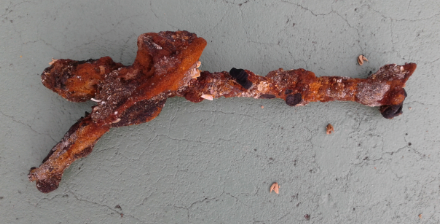
Below are some items found by Darrel S. not long ago. 

Fused Bolts.
Photo by Darrel S.
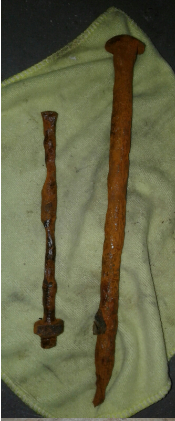
Darrel S. sent me the above photo of the two dug fused bolts or spikes and then the picture below of the same items after they were cleaned.

Bollts After Cleaning.
Photo by Darrel S.

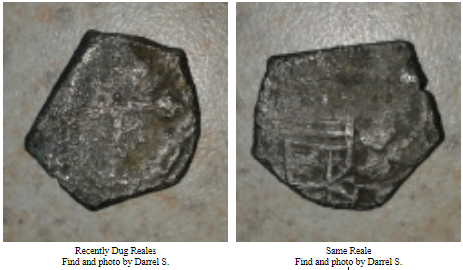
Here is something else he found with the bolts.


Thanks Darrel.

---

We''re still having some big tides on the Treasure Coast, including a nice negative tide in the early AM hours.  The surf is going to be only around two or three feet.

Happy hunting,
Treasureguide@comcast.net


Tuesday, December 5, 2017

12/5/17 Report - Wabasso Beach Report. Best Resource I Know Of For Overview of History of 1715 Fleet Salvage.


Written by the TreaureGuide for the exclusive use of treasurebeachesreport.blogspot.com.

Wabasso Sunday
Photo by Eric H.

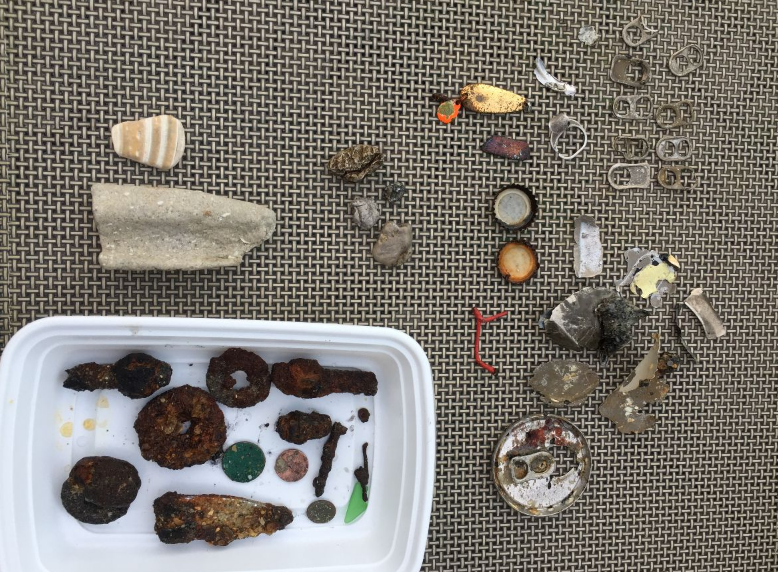
Eric H sent in these photos and a report on his Sunday Wabasso hunt.  Here is what he said.

Just wanted to let you know I went out to do a little hunting today ( Sunday ) at Wabasso beach and had plenty of targets, but nothing exciting...

What was interesting is that I was getting deep targets.  I found an 18 inch long piece of rebar that was buried 20 inches deep and my Sea Hunter screamed out the signal. I was really excited there for a while until I saw that it was rebar. 

I got one iron target that was about 22 inches deep (lucky for me it was high enough on the beach that I could retrieve it, if it had been in the wet sand I would have had one heck of a time getting it out.  As it was I had to dig a huge hole.  One thing that surprised me was that I found all the heavy items higher up on the beach, and the trash aluminum was at the low tide line in heavy shells (where I thought the better targets were going to be). There were virtually no items in the small holes and pockets in the low tide line/shallow water.


Miscellaneous Targets Frm Wabasso Sunday
Photo by Eric H.

Depth Eric Was Digging.
Photo by Eric H.
\
Thanks for the photos and report Eric.  Your report should help anyone interested in evaluating beach conditions.

---

Detectorists remove a lot of junk from the beaches.  That is a benefit that the public doesn't realize.

It doesn't hurt to pick up some of those ropes, flip flops and plastic bags while you are out there.

Here is an article about how such things endanger the sea turtles.

http://www.spacedaily.com/reports/Sea_turtles_sad_fate_from_restaurant_menus_to_plastic_soup_999.html

---

The best book on 1715 Fleet salvage history that I've seen is the 241 page large format The Rainbow Chaser's Tricentennial Yearbook by T. L. Armstrong and Tommy Gore, published by Signum OPS, 2015.  I was sent a copy of that book some time ago by Jon Morgan, who does the Lets Talk Metal Detecting podcasts after he interviewed the primary author, and I found it to be the best and most comprehensive summary that I have seen.  There are sections on the wrecks, the finds, stories, techniques, dig boats, and the finders.  

The first sentence of the foreword refers to the Donald Rumsfield comment,"We don't know what we don't know."  That is something I said in this blog before I knew anyone famous said it, and it is something good to remember, especially as it relates to treasure hunting.  Sometimes things become commonly accepted as fact and, but when new information turns up, we sometimes have to change our minds.

There is new information concerning the location of at least part of one 1715 Fleet wreck that will be coming out before long, but I can't say more about that now.  I'm sure it will be published.

If you have access to the Rainbow Chaser's book, you might want to check out page 152, which is part of a section entitled Anchoring.  You'll see a photo taken by the author entitled A Mangled Anchor, Destroyed by the Reef  that looks very much like the one Darrel S. found and which I recently posted, though Darrel's was not mangled.  

Anyhow, good book.  Thanks Jon.

---

In the past I wrote a lot about beach dynamics.  I learned a lot of that when I was hunting modern gold on the beaches of South Florida before I moved to the Treasure Coast.   In retrospect, I can see that it was a good place to start detecting.  The crowds left a lot of coins on the beach, which made it easier to identify patterns.  As I said yesterday, beside goals, you need a way to quantitative measure to evaluate what you are doing.  Careful monitoring will teach you a lot by itself.  Learning is easier when you have a lot of data points.  Careful observation and constant monitoring helps the learning process no matter what you are trying to do.

---

I have a good post started for tomorrow.  It is about a ring lost by a famous person eighty years ago that was recently found on a Florida beach and returned to the family.

---

Don't wait until later to do the things that you want to do.  You might think you'll have all the time in the world to do those things when you are retired, but things can happen and it might not turn out like you expected.

The moon is beautiful and the tides are big.  The surf will be increasing a little in the next couple of days.

Happy hunting,
TreasureGuide@comcast.net

Monday, December 4, 2017

12/4/17 Report - Focus, Goals, Feedback Loops and Analysis For Improving Metal Detecting Success. Perspective.


Written by the TreasureGuide for the exclusive use of treasurebeachesreport.blogspot.com.

Focus, Objectives and Strategies.

I don't think there is anything that improves the chance of success in anything more than a good clear specific statement of the objective.  I used to teach that a lot when I did consulting for fortune 100 companies and government agencies.   It is very obvious that you need to know exactly what you want to accomplish, yet most people don't see the need to develop a good clear specific statement of the objective.  I'm not just talking about having a a general idea of what you would like to happen or what you would like to accomplish.  There is a great benefit in thinking it out completely and being able to specify the goal in very specific terms along with some kind of quantitative measure of success.

It is perfectly OK to just go out and bop around and see what pops up, if that is what you want to do, but if there is something you really want to accomplish then you need to be clear about exactly what that is.  If, for example, you really want to find a Spanish shipwreck coin, then set that as a goal, and make decisions based upon that goal.  If you want to find a big glitzy diamond ring or a lot of glitzy rings, that is an entirely a different matter, and you might want to choose a different type of detector and visit a different set of sites.

If you watch what people do over any length of time, you can often tell that they don't have a very well defined goal.  They don't have focus.  They jump around from one thing to another and seldom make any real progress.  That is what I see on the Oak Island TV show.

One of the things that drives me crazy when I watch that show in particular is the apparent lack of focus, goals and strategy.  They only go far enough in any one direction to come up with new questions.  That might be OK for keeping a TV show going, if that is their primary goal, but it is not the most efficient way to accomplish a serious goal of any type.  At different times they express different goals, and that is one reason the search appears to be such an unfocused hodge podge of unanswered questions and dead ends.  I'm sure the goals of the TV production company adds to the apparent disorganization.  They want to keep the excitement level up. and to do that they encourage wild unwarranted assertions that do little but keep the viewer watching.  It doesn't bother them when someone picks up a find and excitedly exclaims that it is a gold coin even when it is a plated button.

Whatever happened to the shipwreck spike and plank found in the swamp?  Not important?

Exploring the TV side of things for a minute, they have to keep it interesting while the big longer term projects plod along.. They have to find something to get excited about every once in a while.  An endless series of frustrated attempts and questions without answers would be too much for most TV viewers, so the production company has found a savior in metal detecting, which, while not recovering anything near the magnitude of the Holy Grail or treasure chests overflowing with gold, at least it provides something to entertain the viewers, even if it is nothing more than broken toy guns, chunks of iron, spikes without ships, with some old coins and buttons thrown in, all of which is standard detecting fare for any location with history that has not been cleaned out by detector wielding hoards. 

What does all the metal detected surface trash and treasure have to do with the money pit or answering the big questions?  Very little.  Maybe there might be some clue discovered that actually answers an important question, but most of the metal detected finds are little more than momentary diversion to keep viewers entertained while the big finds remain elusive.  It has little to do with what I would suspect is the major objective.

How does that relate to you?  First, if you want to accomplish something, it helps to be very clear about exactly what that you want to accomplish.  Secondly, it helps to have a quantitative measurable way to evaluate your progress.

When I started metal detecting, I wanted to find a lot of coins.  I kept records of each hunt.  I could tell how I was doing and if I was improving.  Then I started keeping track of the value of the coins I found.  That is slightly different than finding a lot of coins.  Later my goal was to find a lot of gold items.  Then high value gold items.  As I improved, I changed my goals.  But it was important to have a way to measure progress.

In these days when AI and robotics are talked about so much, you probably know that the feedback loop is an important element.  You can't make the best adjustments unless you have some way of measuring analyzing performance.  You need to keep on track.  That is the function of the feedback loop.  If you have a very clear objective (or objectives) and some way of measuring progress, you can keep track of how you are doing and continually make improvements.

For example, I look at the number of hits and page views on my blog daily.  That helps me get an idea of what people are interested in and what they like.  The total number of page views is near two million now, and the daily hits are usually somewhere between 500 and 1000.  Of course, I also use other things, such as emails.

It isn't always simple to analyze the data.  Some people love certain posts, but the posts that some people really like are not always the ones that get the most views.  They touch certain individuals powerfully but don't particularly appeal to the mass audience.  There are various reasons for that and I won't get into all of that now.

In summary, I'd encourage you to be real clear about what you want to accomplish, and come up with some measurable way to keep track of your progress.  I know I won't get a lot of people to do that, but if you do, I think you'll be happy with the results.

I don't really think this will be one of my most popular posts, but to me it is probably one of the most important and can help you a lot if you take it to heart.

---

I thought I might need to add some perspective.  If my Ole Timer Talk post about Clint's finds back in 1984 and 1991, you might be tempted to conclude that those were the good old days, and now it is all gone.  If that is what you think, what you are missing is the rarity of those times.  Thanksgiving 1984 is known as an exceptional time for treasure hunting on the Treasure Coast.  It doesn't happen all the time.  And did you notice that Clint went from 1984 to 1991.  That is a period of seven years.  When it is hot it is hot, and when it is not it is not.  There are times when the beaches are exceptionally good, and when they are not.  You can't take blowers and remove all of the sand from the beach.  You have to wait, and hopefully you'll be at the right place at the right time.  That is why I put so much attention on the wind, waves and surf.  If you keep up on that, you'll have a better chance of being there at the better times.  You can spend everyday on the beach for a year and not get as much as you would in a week when the conditions turn good.  We've had some better beach conditions a few times this year and finds were made, but it wasn't anything like Thanksgiving of 1984.  2004 was good after Francis and Jeanne.  Some of the other hurricanes since then didn't do nearly as much for metal detecting.

----


They've been running the Shooter movie a lot lately.  It is an interesting movie, but I found it more interesting and less far-fetched than when I saw it about a year ago because of the current political environment and what we've learned about the intelligence agencies the past year.

---

We're having some nice big tides but the surf is only running around two or three feet.  The winds aren't particularly favorable.

Happy hunting,
TreasureGuide@comcast.net

Sunday, December 3, 2017

12/3/17 Report - Sphinx Found in California. Get Your Ark Ready. Anchoring Information. Mystery Find and Museum Engraving Tool.


Written by the TreasureGuide for the exclusive use of treasurebeachesreport.blogspot.com.

An Egyptian sphinx was uncovered in the Guadalupe-Nipomo Dunes in California.
"The Ten Commandments" film was a masterpiece in its day. Hollywood director Cecil B. DeMille had Paul Iribe, a French artist known as "the father of art deco," create 21 sphinxes for the movie. DeMille placed the sphinxes in the movie's biblical Exodus set, where he filmed scenes of the Jews toiling under the Egyptians and later escaping through a parted Red Sea. DeMille filmed the Exodus portion of the movie in the Guadalupe-Nipomo Dunes, because it looked like sandy Egypt, Jenzen noted.
The Exodus set was enormous. It had pharaohs, sphinxes and colossal temple gates that, in all, reached 12 stories high and spanned 800 feet (240 meters) in width, Jenzen said. But legend has it that DeMille realized two things when he was done filming: The set was too expensive to move and too valuable to leave behind for rival filmmakers to steal, Jenzen said.
DeMille solved his dilemma by having the Exodus set buried in the sand...

Here is the link to that LiveScience article if you want to read more.

https://www.livescience.com/61045-hollywood-sphinx-found-in-dunes.html

Like I was saying the other day, it can be difficult to identify an item.  There are different ways that items can end up somewhere, and sometimes those ways are unexpected and surprising.  And t
here is also the problem of copies or reproductions.  I've posted some of those in the past.  I've found reproduction coins that were actually made of silver and gold.   They should be marked as such, but aren't always.  

---

Get your ark ready.


Sea-level rise in this century may threaten Jamestown in Virginia, the first permanent English settlement in the Americas; the Kennedy Space Center in Florida, which launches all of NASA's human spaceflight missions; and the Cape Hatteras Lighthouse in North Carolina, the tallest brick lighthouse in the United States, a new study finds.

These iconic locales are some of the more than 13,000 archaeological and historical sites on the Atlantic and Gulf coasts of the southeastern United States that rising sea levels will endanger this century, researchers in the new study said.

Global warming may lead sea levels to rise by about 3.3 feet (1 meter) in the next century and by 16.4 feet (5 m) or more in the centuries afterward, according to research from the Intergovernmental Panel on Climate Change and others. These rising sea levels could have severe effects, as more than 40 percent of all people worldwide currently live within a 60-mile (100 kilometers) distance from a coastline, many in low-lying areas vulnerable to sea-level rise, according to reports from the United Nations and others...


That comes from another LiveScience article.  Here is the link for the rest of the article.

https://www.livescience.com/61063-rising-seas-may-destroy-archeological-sites.html

---

Concerning the found anchor that I posted yesterday, Captain Jonah said, The anchor is most likely not Hartmans. They didn't use stern anchors. Instead use to use rims with tires attached to crown lines. And would have the guys dig deep holes burying them up to the crownline. They are still there every once and awhile we come across one. Just to clear up.

---

Concerning the mystery find that I posted on 12/1, Galen went back to McLarty Museum and found a good comparison piece.

Tools On Display At McLarty Museum.
Photo by Gaylen C.
Below is a photo of the engraving tool shown in the middle of the above photo (left) beside the point of the item Gaylen found (right).

Engraving Tool Point Beside Point of Mystery Find.
Photo by Gaylen C.

Here is what Gaylen said about that.

Went back to McLarty yesterday with grandson. Saw something I missed on the first trip in the display donated by Douglas Armstrong regarding the very early french explorers in FL.  This is an extremely similar piece. As displayed it could perhaps explain what I thought looked like wood remains. In an article I was reading it was reported to Menendez that some of the French escaped the slaughter and had traveled at least 75 miles to the south. We need some historians to address that. But the imagination can use that as the reason I found this in Ft Pierce. If it indeed is an engraving tool it fits into the activities in this area in these times. It could very well be Spanish as well as it could be French. I am curious as to who identified the piece on display. Is Douglas Armstrong still in the area? If so perhaps he could offer some insight. As I said, unless this is determined to be a positive ID, it kind of expands the realm of possibilities:

1. It is an early French tool, and even older than thought.
2. Frenchmen carried it south?
3 Spaniards acquired it by raiding the French.
4 It's really Spanish.
5 It is something totally different.

Last photo shows the two items in comparison. What think ye mateys?

For me - they sure do look alike.

Gaylen is cleaning the item and thinks he might see remnants of a wood handle.

Thanks Gaylen.

---

On the Treasure Coast we have beautiful weather - if you like beautiful weather.  I prefer windy and rainy.

The moon is beautiful too.   Good high tides but small surf.

Happy hunting,
TreasureGuide@comcast.net

Saturday, December 2, 2017

12/2/17 Report - Art Hartman's Anchor? Tools From the Age of Sail. Fid or Marlinspike. Difficulty of Identifying Some Finds. Big tides.


Written by the TreaureGuide for the exclusive use of treasurebeachesreport.blogspot.com.

Recovered Rusted Remains of Anchor
Find and photo by Darrel S.
Darrel S. dug this anchor years ago.  One of the all-time top treasure salvage guys of the Treasure Coast got excited when he saw this anchor because he remembered the time when Art Hartman lost an anchor in the same area.

If you know much about Treasure Coast treasure salvage, you probably know something about Art Hartman (deceased Dec. 24, 2015, sorry to say).

---

The dating game can be very difficult. I'm not talking about trying to meet a member of the opposite sex.  I don't know how you know what is the opposite sex any more.  According to what I've been hearing, there are a dozen or more other sexes.  You've probably heard about the LGBTXYZ... whatever.   Anyhow.  In the past things weren't thrown away like the are today.  Broken objects were repaired or the parts or materials were reused.  A tea kettle, or example, would be repaired time and time again, and then when it was beyond repair the copper would be used to make other things.  I saw pictures of finds from one old fort site that yielded at least twenty different types of items made from the copper from old kettles.  Items were repaired so many times and were used for such a long time that it could be especially difficult to put a date or age on the item.

I often remind people that old items are being lost everyday.  That is another thing that can be confounding.  I've found coins just after they were lost that were hundreds of years old.  People still wear or carry old stuff at times.

Deciding what a thing is can be difficult too.  Some things could be used for a variety of different purposes.  Just think about a rock.  It could be a building material, a weapon, a weight, a hammer.  How it was actually used, can be a difficult thing to determine.  And some items were used in more ways than one.

How about the item found on the Treasure Coast by Gayle C that I showed yesterday?  John L. thought it might be a fid.  That was one of my first thoughts.  It could certainly be a fid or something very similar.

Brian M. sent this photo of a similar item he once found at a land site.  His is a bit longer and thinner.  Note the eye at the one end of Brian's item.

Find by Brian M.

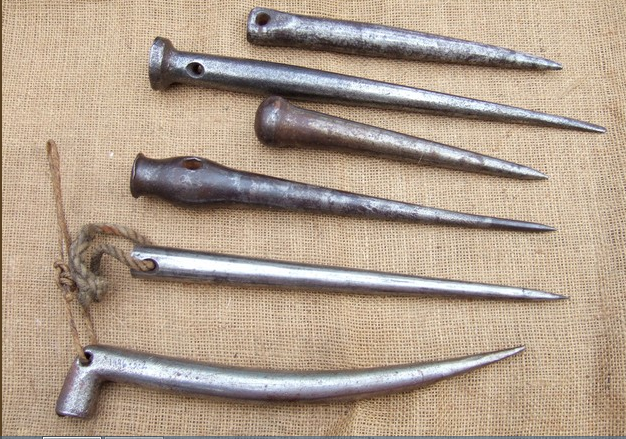
The fid was the traditional tool of the sailor from the dawn of sailing all the way into the beginning of the last century.  It was used to loosen and tighten knots.  It was used to separate the strands of rope for splicing.  The fid was used as a club and a temporary pull handle.  It was used to shape hand sewn grommets in sails and clothing.  After the knife, it was the sailors most important tool.  The fid was often a handmade affair and was sized according to the size rope that was being worked.  Wood, bone and antler being the predominant choices.  Its an easy tool to make for yourself and can be made from just about anything you have available.   This simple tool had a good long run and is still of use to those who work with traditional ropes and cordage.  As ships began to transition to mechanical power and rigging was replaced with wire cables, the fid fell out of favor.

That text is from the pirateking web site.  Here is the link.

http://www.thepirateking.com/historical/marlin_spikes.htm

It seems that some people use the terms "fid" and "marlinespike" interchangeably, but I think "fid" more often refers to an object made of wood and used to work with ropes, while "marlinespike" more often refers to a metal object which is used to work with wire cables.

Here is a description of a Marlinspike.


Below is a picture of a variety of pointed sail-making tools.

Variety of Sail Making Tools.

I lost the sources for the last two pictures.  If you know where they came from, let me know.  I'll post the sources as soon as I find them.

I once posted a similar find that I made (See following link.).  I thought it could be a fid or an awl.  Hard to tell.  There were a lot of good uses for pointed objects on sailing ships.

http://treasurebeachesreport.blogspot.com/2016/08/81216-report-south-hutchinson-island.html

And here is the link to a very good web site that shows a wide variety of old sailing ship tools.

http://www.ageofsail.net/aosbt.asp

I think we have yesterday's mystery find narrowed down as well as we can.  Gaylen now has the job of cleaning and preserving his find.

---

I can tolerate cold weather and snow when putting up Christmas decorations, but I find mosquitoes and fire ant bites especially annoying and something one shouldn't have to put up with at this time of year, but that is what I got.


We're getting close to a full moon and the tides are now big.  The surf will only be 2 - 3 feet though.

Happy hunting,
TreasureGuide@comcast.net

Friday, December 1, 2017

12/1/17 Report - Devil Dogs: Mystery Solved. New Mystery Find. Skeletons on Ghost Ships.


Written by the TreasureGuide for the exclusive use of treasurebeachesreport.blogspot.com.

Recent Find.
Find and photo by Gaylen C.

Other End of Same Item.
Find and photo by Gaylen C.
Point of Same Object
Find and photo by Gaylen C.


I received the following message from Gaylen C. who found the above object.

Found this item at the foot of eroded dunes on Sunday....  Have had no luck identifying it. Certainly looks to be very old. Sent photos off to U of F for help. Thought perhaps you might have come across something similar. Of course with sand being artificially moved around so much there's no telling where else it could have been. I found it buried in 6-8 inches of sand that looks like it had fallen from a vertical dune 6 or 7 feet above the beach. My guess, as well as some others, is that it is a needle or punch of some kind. It appears to be hand hammered, with a long taper. No idea if the curve in the opposite end is intentional or accidental. Could be an eye under the accumulation. Since this is only my 3rd beach detecting experience I don't know the advisability of chipping away at an artifact. . Probably would not be if I had found real valuable treasure first. 


Any help you may render in the identity and preservation of this thing would be greatly appreciated.

Gaylen told me the item is 13.5 inches long and no wider than .25 inches.   I sent Gaylen information concerning perservation.  

 What do you think it is?  Notice particularly the curved top, and what appears to be the bulbous shape on that end.

I want to comment on one of Gaylen's sentences.  Nor do I have knowledge about how to best conserve it. Didn't think finding little "treasures" would be so involved and such fun.

I often talk about how the find is often just the beginning.  Then comes the questioning, cleaning, and researching.  That is when you learn a lot.  You get into the history of the item, and it changes you to some extent.

That is not always so true of items that are obviously valuable, like a gold coin that a person might not think much more than its value.  They'd read the marks, and then look it up and find that it is worth X amount, and that is about it, other than the bragging.  

Those who do not detect for old items don't understand what it is all about.  They always ask, "What is the most valuable thing you found."  They often don't realize that a rusty artifact has any value at all.  That is the big difference between someone who hunts and cherishes rusty things and those who don't.

---

Going from a mystery to an answer, I recently posted a USMC ring found by John C.  We couldn't tell what the image on the face of the ring was.  Thanks to Sherry Y., we now know.

The image is known as the Devil Dog.  Wikipedia says, According to United States Marine Corps legend, the moniker was used by German soldiers to describe U.S. Marines who fought in the Battle of Belleau Wood in 1918. The Marines fought with such ferocity that they were likened to "Dogs from Hell." The "Devil Dogs" nickname for Marines first appeared in newspapers in the United States in April 1918...

Super job Sherry!  Thanks much.

That also helps with dating the ring.  The image means the date of the ring is later than 1918.

---

Ghost ships washed up on the shores of Japan with skeletons aboard.

Here is the link.

http://www.cnn.com/2017/11/28/asia/north-korea-japan-ship/index.html

---

This might be the last of Darrel's beach photos for a while.  I'll miss that.  It was a big help to me.  I don't get around to all the beaches that much and like to keep you up to date on beach conditions.  He says he is off to other adventures for a while.  Thanks and good luck Darrel.

Turtle Trail Looking North Yesterday.
Photo by Darrel S.

Darrel said, Beaches are really leveling, but are dips near low tide. Low 10:40am.  

The photo was taken yesterday.

---


The Treasure Coast surf is down to around two or three feet today, but the tides are increasing.

I have a lot more to talk about, but that is all for today.

Happy hunting,
TreasureGuide@comcast.net