Friday, February 16, 2018

2/16/18 Report - Holed Treasure Coast Half Reale. Washington Commemorative Plaque Dug Up. Armstrong Site Report.


Written by the TreasureGuide for the exclusive use of treasurebeachesreport.blogspot.com.


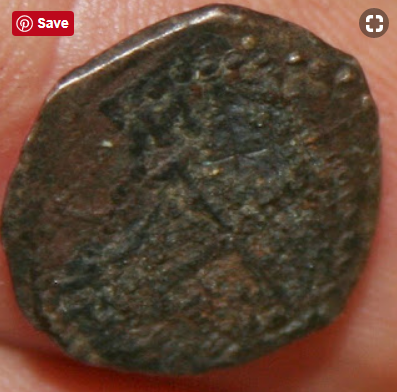
Holed Phillip IV Half Reale
Sorry the picture isn't better.  The camera I use for close-ups isn't working.

I was talking about holed coins a few days ago, so decided to show this one.  It is a Mexico minted Phillip IV half reale.

The numismatic archaeology book that I used as a reference a few posts ago mentioned that holes are usually made at the top of the side of the coin that is meant to show.  In this case that would be the cross side.

Below is the other side.

Same Holed Half Reale.
In this case the monogram side is upside down and at an angle when the hole is at the top.

---

Maintenance workers in Beckley W. V. dug up a sidewalk and found a rectangular 12 by 8 by 8 inch stone marker with a metal shield commemorating the bicentennial of George Washington's birth.  The shield read, Memorial Tree; George Washington Bicentennial; 1732 - 1932; Capt. James Allen Chapter; N S. D A. R.; REGISTERED; American Tree Association.  The original American elm was no longer there, but the monument was restored and remounted.

Source: Winter 2018 The SAR Magazine

----

Here is a good summary on the Armstrong site located in the Canaveral National Seashore where the remains of a 16th century French camp was found.  I think you'll find this well worth reading.

Here is the link.

http://oceanexplorer.noaa.gov/explorations/14lostfleet/background/survivor/survivor.html


---

Here are some interesting statistics.

Nearly 1.3 million people die in road crashes each year, on average 3,287 deaths a day. An additional 20-50 million are injured or disabled. More than half of all road traffic deaths occur among young adults ages 15-44.

More than 64,000 Americans died from drug overdoses in 2016, including illicit drugs and prescription opioids--nearly double in a decade.

----

Looks like more of the same for the Treasure Coast beaches - just a touch smaller surf.  Expect a 2 - 3 foot surf for a week or two.

Not much else to report about that.

Happy hunting,
TreasureGuide@comcast.net


Thursday, February 15, 2018

2/15/18 Report - Are You Searching As Thoroughly As You Think? Sweep Patterns: Problems and One Tip. SAR Museum Artifacts Deaccessed.


Written by the TreasureGuide for the exclusive use of treasurebeachesreport.blogspot.com.


You might think that you move your coil in nice straight slightly overlapping parallel lines something like the way you mow the lawn if you have a rectangular lot without trees or obstacles.  If you are in a hurry or just not being careful to cover every inch, your coil might move more like the pattern shown immediately below.

Common Sweep Pattern
This pattern is so nice and neat as the ideal one you might imagine.  As you continually move forward so does your coil.  And the sweeps do not typically move in a straight line across your body.

How you move your coil makes a difference.  It is easy to move too quickly.  When you look out over a beach you can see hundreds of yards of sand to cover.  There is more ground than you can possibly cover.  The tendency is to get in a hurry and move too quickly.

If you think about all the beach you can see, your target might be in one square inch.  The trick is to put your coil over that very small area that contains the target.  Hitting that one square inch isn't all that easy.  If there is a concentration of targets, your chances of hitting something is much better.

I remember way back shortly after I began detecting, a fellow hid his watch under the sand and asked if I could find it.  A watch should be easier to find than a coin, but I made a pass and was surprised that I missed the buried target.  That showed me that I wasn't covering very well.

When you move quickly, whether it is too quickly or not, you can get false signals at the end of each sweep where the change of direction is abrupt.  That is especially true when there are variations in ground mineralization.   It is also common to slightly, though perhaps imperceptibly, raise the coil at the end of a sweep too, which can also add to false signals unless your sensitivity is low.

One little trip that I've found helpful is to think about moving your coil in a small loop at the end of each sweep.  You do not need to actually move the coil in a perceptible loop to get the effect.  Just the slightest amount will make the change in direction smoother.

Imagined Loops at End of Sweeps.
If you are getting false signals at the end of some sweeps, instead of lowering the sensitivity, you might try this. Again, the loop doesn't have to be big.  This techniques might also help you slow down your sweep speed.

Pay attention to your coil movement.  Try this technique and see if it does anything for you.  I always recommend testing things.  I personally do a lot of testing and experimenting with my detector and even if I read something in a manual, I test it out for myself.  I recommend that you do the same thing.

I've had coils that were supposed to be the same that showed significant differences.  I found that out through testing.

-----

The Sons of the American Revolution Museum is deaccessing artifacts.  Some will be claimed, but unclaimed artifacts will be auctioned off.

Here is a web site where you can check out the artifacts to be deaccessed.

https://sar.org/deaccession-artifacts

I've heard from people in the past who have donated items to museums and then were disappointed by how those items were used or not used.  Some were never on display and some were lost.  I don't want to discourage you from lending or donating artifacts, but you might want to make sure how they will be handled before doing that.

---

Of course the big news yesterday was about the shooting in Broward County.  As you'd expect the shooter had problems and there were warning signs.

Here is a link about that.

http://blog.spiritdaily.com/news/shooter-had-troubled-past

There are a lot of hurting broken people out there and they tend to spread the hurt.

What beautiful weather for enjoying nature.

On the Treasure Coast we've had something like a two to four foot surf for a while, and that will continue.

Not much to talk about there.

Happy hunting,
TreasureGuide@comcast.net

Tuesday, February 13, 2018

2/13/18 Report - Future of Metal Detecting. How To Become Successful.


Written by the TreasureGuide for the exclusive use of treasurebeachesreport.blogspot.com.


 St. Valentine's Skull in St. May's Basilica
Source: https://www.atlasobscura.com/places/st-valentines-skull


Watching the Olympics I was noticing how young the athletes are.  They're kids.  It seems like most people are kids these days.  What happened?  It made me wonder what metal detecting will be like in the future.

I feel confident that metal detectors will continue to improve, although I'm surprised how slowly they have improved over the past few decades.  I know some of you disagree with me about that, but I remember many years ago reading about metal detectors that will show you what is in the ground before you dig it  That hasn't happened - at least not the way I expected  to see it.  Maybe I was expecting too much.

Will there even be metal detecting.  Maybe it will be made illegal.  Maybe there will be a better means of detection.

Will there be anything worth detecting that you will be allowed to detect?  Money seems to be on its way out.  

There are a lot of questions you could come up with.

I once conducted a poll to determine the age of detectorists.  Here are some of the results as reported in a 2014 post.


Only 3, or 1% of those responding, are fifteen or under.

In this poll, only 1 person, (less than 1%) was 16 to 25.

Even more surprising to me is the fact that only 7 (2%) of those that responded to the poll are 35 or under.

Here is the biggest finding for me. 93% of those that responded to the poll are 36 or older. That is pretty astounding even taking into account any margin of error or any possible interpretation of the results.


That seems unfortunate considering how educational metal detecting can be.


Speaking of age - there are a lot of studies of when people are most productive in different endeavors.  Most peak accomplishments come around middle age, but that is a gross generalization.

Here is an interesting article on how to become expert at anything.

http://www.businessinsider.com/anders-ericsson-how-to-become-an-expert-at-anything-2016-6 

If you read the article, two things are emphasized that I preach for metal detecting.  The author uses the term deliberate practice, which is not just hours of practice.  Here is an excerpt.

...To become an expert, you may need to be willing to sacrifice short-term pleasure for potential satisfaction of success down the road. A key tenet of deliberate practice is that it's generally not enjoyable.


Instead, it's about doing things that don't come naturally or easily, which can be tough. "Practice really involves failing a lot until you eventually reach your goal," Ericsson told me.
He cited research on figure skaters (which appeared in this book) that found elite skaters spent more time than average ones practicing jumps and spins in routines they hadn't yet mastered. By contrast, average skaters spent more time going over routines they were already good at.
Most people like to work those things they do well instead of their weaknesses.  Arnold Swartzeneggar always said,  "Work your weak areas."
But this isn't something that most of us take that seriously.  We're in it for the fun.  
---

Ink From a Twenty Dollar Bill Inside a Card.

My wife received this greeting card with a twenty dollar bill enclosed.  She noticed the ink imprint of the bill on the card and thought that might mean it was counterfeit, so she checked it out.  

Click here to view a video that will show you how to check a twenty.

There are a lot of security features on a genuine twenty.  I once saw a very poor counterfeit twenty.   It was really bad.

I was thinking about copies and reproductions.  I don't know how many you've found, but I'd guess that I've found probably six or seven fake cobs - only a small fraction of the number of genuine cobs.

I've talked about that before and showed some examples.  Some cobs are pretty convincing to look at, but none of those that I've found were solid silver or gold.

I'd recommend getting an acid test kit, but there are times when you don't want to do a rubbing of a coin.  There are less destructive test pens etc., but what I recommend these days unless you really do a lot of testing is take your item to a pawn shop or jewelry store that will test it for you.  Some will not only test for precious metals but also other significant metals.


Copies or reproductions are based upon the real thing.  Toys or fantasy pieces are not.  At least that is a distinction that I would make.  

---

Have other things to do,
Happy hunting,
TreasureGuide@comcast.net

Monday, February 12, 2018

2/12/18 Report - Two Types of Metal Detecting Mistakes and Which Is Worse. Marx FIT Lecture. 54th Foot Button.


Written by the TreasureGuide for the exclusive use of treasurebeachesreport.blogspot.con.

Pewter British 54th Regiment of Foot Button
The above button years ago in the West Indies.  It was found near a battle site where the French and British fought in December of 1788.  I'll talk about that more below.

The 54th Regiment of Foot was an infantry regiment of the British Army. Originally formed in 1755 as the 56th Regiment of Foot, it was renumbered as the 54th when the 50th Regiment and 51st Regiment were disbanded. It was renamed as 54th (the West Norfolk) Regiment of Foot on 31 August 1782.


I've made a lot of mistakes and expect to keep making mistakes as long as I walk this earth.  I expect to make mistakes but I try to avoid repeating the same mistakes.

There are two types of mistake that I want to talk about today.  They are opposites.  One is thinking a find is not a good when it actually is, and the other is thinking an item is good when it is actually not.

The first example of the first type of error that comes to my mind is a musket flint that I found.  I detected a very twisted rusted piece of metal that I uncovered, but paid no attention to.  I then saw the flint.  This was my first time that I detected a site like that.  I was accustomed to digging gold rings in those days and didn't know much about hunting artifacts.  I can remember that experience precisely today: where I was, uncovering the rusty metal item, etc.  And I regret to this day that I didn't recognize the twisted piece of rusty metal and flint.  I'd appreciate them much more today than I did then.

Not only do I wish I had kept what I later realized was a musket hammer and the flint, but the failure to appreciate the find in the field resulted in not hunting the immediate area more effectively. Who knows what else might have been found where those items were.  I did find several other nice finds during that hunt including grape shot, soldier art and military buttons ( including the one at the top of this post ) but I still wish I had picked up the flint and hammer.

That is an error caused by not recognizing the possible significance of a find when it was found.  If I had taken the item home but still didn't realize its significance, I could have still lost it or damaged it through improper cleaning.  If you do not treat an item as potentially significant until you prove otherwise, a good find can easily be lost again or damaged beyond repair.

The area had already been studied by archaeologists but the park ranger was interested to see what I could find near the ocean where the archaeologists couldn't excavate.  They had a small museum there, and they kept a grapeshot that I found.

Another example would be a medallion from a  1715 Fleet beach that I did not recognize because when I dug it up it was encrusted and didn't look like anything other than a common coin.  I kept it for quite a while without really studying it and eventually put it in a tumbler with a bunch of modern coins.  When I took it out of the tumbler, it was clean enough that I could recognize it as a religious medallion and it still had some silver gilt on it.  After that it was studied, but the damage was already done.

I could give you more examples of times when I made the same type of mistake, some of them involving even nicer items, but the point is that treating a find as being nothing significant before you know for sure can have disastrous results.

If, on the other hand, you make the other kind of mistake - that of treating an item as valuable or significant when it is nothing - the results aren't nearly as bad.  The biggest thing with that type of error is that you end up getting disappointed when you learn that the item is not as good as you hoped it would be.  That is why I recommend trying to avoid the first type of error even if it means making the second kind of error.

Here are two recommendations that I often repeat.  First, never throw away an item until you KNOW that it is nothing good.  Don't be hasty.  And second, if an item has any chance of being good, treat it as if it is.  As I've shown in the past, it can take a long time to be absolutely sure.  You might never solve the puzzle.  It is better to think a find might be good even if it is not, than to make the mistake of concluding that it is no good and then finding out too late that it is better than you thought. I learned the hard way.  Some of my biggest regrets are the result of not appreciating an item enough to care for it properly.   My advice is that when there is any doubt, keep it and study it until you are absolutely sure.

To give just one example of when I thought a find was good when it wasn't, I once found what appeared to be a gold escudo.  That was back in my early days of detecting.  It would have been my first gold escudo, and it came from a treasure wreck beach, so it seemed possible.  It was encrusted and so I tried to clean it.  I took great pains to carefully clean it.  I got it fairly well cleaned and was confused by the fact that I couldn't identify it.  This was before I was experienced with testing metals, and I didn't have the reference books that I have today.  Eventually I figured out that it was a fake.  Yes I was disappointed, and I wasted time in trying to carefully clean it, but I learned a lot.

---

There will be a free Robert Marx lecture at FIT on February 20.

---

Civilized people should be able to disagree without being disagreeable.

Happy hunting,
TreasureGuide@comcast.net

Sunday, February 11, 2018

2/11/18 Report - Everglades Treasures and Treasure Coast Burial Site: Ole Timer Talk.


Written by the TreasureGuide for the exclusive use of treasurebeachesreport.blogspot.com.

John Brooks Beach Saturday Afternoon.
It is a beautiful weekend. I don't think I ever saw more people on the beaches around Fort Pierce.  The Fort Pierce beach parking lots were jammed.  There should be some new modern items out there after all of the beach traffic.

What a beautiful joyful Sunday morning!

---

Yesterday I posted some of Southern Digger's email to me.  Today I'll post more of the same email.  It tells about a large collection of silver coins obtained from Florida Everglades sites.  Here is what he said.

: ... That collection filled about fifty 8 X 12 inch Riker cases. The viewing was so private that I was not allowed to note the address or location and I was never given the names of the collection owner. That did not bother me. Just to view and study it was a vast education which helped me in later years on seeking sites in the deep woods of the everglades--that is, on privately owned land. 

I know the collection I saw came from lands now under state and Federal laws and are off-limits. Moreso, I have heard that people who ignored these boundaries were arrested; severely fined; and, sometimes imprisoned for trespassing and digging these sites. I won't go into detail how the collection was obtained, but it involved the Caloosa Indians, Mendenez's Gold, and later European contact which evidence showed was on wild and hidden places of tribal ceremony -- I might add, on land which had not enforced government restrictions at the time it was discovered. 

In fact, when young and hunting in the glades it was not uncommon to enter a hammock from five to twenty miles from the nearest dirt access road and find a cabin and a few occupants living free off the land. Maintaining food from gardens and hunting; and, water from makeshift cisterns. The Federalization of the Big Cypress and other parts of the everglades ended this by the late-1960's.

The collection included finds that dated from early European contact--including rare glass beads which were identified to date back to Portugal from the fourteenth century; it contained gold beads up to 3/4" long and 1/4" or thereabouts diameter. Some silver coinage was hammered into breastplates with stick-figure artwork of deer being chased by stick figure Florida Indians pursuing the game. On some of these, you can still make out the stretched/hammered outline of the original coin enought that you could determine what type of coin was used to make it. I recall being bold enough to ask if I could photograph at least part of the collection, but of course, was refused. 

This treasure was not obtained from one site--but rather from several sites and much hard work and much time camping in the glades away from the comforts of society. Referring back to the coins--I saw they were of Spanish. English and American origin--the latest dating to the 1830's indicating Seminole and Spanish Indian influence and use of sites which date back to pre-Mendez era and of course, prehistoric. Most likely, some of these items were obtained from beached shipwrecks and shipwreck survivors. Many of the coins were in part defaced. Scratch marks in the head of Liberty or the King, which indicate hatchet marks; and scratches on the throat indicating the obvious.

Southern Digger also emphasized that there is a lot that was not reported and much of what is published is often twisted.

On the question of 1715 Fleet burials, which I've mentioned a few times recently, Southern Digger said,  At the Disney site on the Treasure Coast--before the structures were built--was a raised dune near and just north of the old beach access. When that was scraped back by construction, an archaeologist representing Disney stated to me that they found a grave which was believed to be a shipwreck victim as they recovered a ring with it. Also, they found an anchor in the dunes. Of course, I did not know the source and just regarded it as here-say. Perhaps research of published State records can prove such finds were actually recovered.

Southern Digger has long been involved in South Florida archaeology.  Thanks for sharing S. D.

---

The wind picked up Sunday morning, but was coming from a southerly direction.  Everything else is pretty much unchanged.  The tides will increase a little again in a few days, while the surf continues to run around two to four feet.

May you find peace within,
TreasureGuide@comcast.net

Saturday, February 10, 2018

2/10/18 Report - More on Holed Coins and One Ole Timer's Finds. Espada Ancha. The Antiquary.


Written by the TreasureGuide for the exclusive use of treasurebeachesreport.blogspot.com.

Source: Smithsonian Bulletin (See link below)

I got a long email from Southern Digger in response to my post on holed coins.  The note is too long to post as written.  I'll give you part of it today.

I have found some, but less than a half dozen, holed coins in South Florida. The most interesting, a 1792 half reale, had one crude hole and hatchet marks in the King's Head. This was found in an 1837-38 camp of the Philadelphia and Louisiana Volunteers in SW Florida. Although Seminoles had previously camped in the area, no signs of Indian habitation--historic or prehistoric was noted in the camp area. 

While researching and reading an early journal during my research in Washington DC and in Florida, a reliable source who moved south with the army ... opened an above-ground, bark-covered Seminole grave. He and a few others studied and recorded the procedure of the burial and the objects left. Afterward, they returned the items and re-covered it. However, he noted that many of these same volunteers who came south with the regular army were opening the graves and removing the trinkets and leaving them in disarray... 


Because of their superstition and hatred to the whites, the coins usually are defaced. If anyone finds a holed coin which was defaced, you can bet it had come through the hands of the true discovers of our continent.

Regarding my half-real, it is probable that it was removed from a Seminole Grave in the area of Fort McNeil--an area SE of Orlando where Osceola was born and spent part of his life.

I made a point during one vacation to visit the supposed grave of Osceola--minus the head--at Ft. Moultrie, S.C...

I'll have more of Southern Digger's email concerning a vast collection some other time.  Thanks for the email S. D.

You might want to read The Seminole Indians of Florida - Fifth Annual Report of the Bureau of Ethnology to the Secretary of the Smithsonian Institution, 1883-84, Government Printing Office, Washington, 1887, pages 469-532.  Below is the link.

https://www.gutenberg.org/files/19155/19155-h/19155-h.htm

Here is one paragraph from that report pertaining to object made of silver coins being worn.

The ornaments worn by the men which are most worthy of attention are crescents, varying in size and value. These are generally about five inches long, an inch in width at the widest part, and of the thickness of ordinary tin. These articles are also made from silver coins and are of home manufacture. They are worn suspended from the neck by cords, in the cusps of the crescents, one below another, at distances apart of perhaps two and a half inches. Silver wristlets are used by the men for their adornment. They are fastened about the wrists by cords or thongs passing through holes in the ends of the metal. Belts, and turbans too, are often ornamented with fanciful devices wrought out of silver. It is not customary for the Indian men to wear these ornaments in everyday camp life. They appear with them on a festival occasion or when they visit some trading post.

---

Here is a nice web site on Spanish Colonial swords from Mexico. The title of the page is Espada Ancha: Swords of Mexico and Spanish Colonial America.


Here is one of the illustrations from the site, and below is a link if you want to see more.

http://www.vikingsword.com/ethsword/espadaan/

---

And here is a digitized magazine that you might enjoy browsing.

The Antiquary: A Magazine Devoted to the Study of the Past.  Click here to view.

---

If you want to be happier, give the other fellow the benefit of the doubt.

Happy hunting,
TreasureGuide@comcast.net

Friday, February 9, 2018

2/9/18 Report- Excitement and Challenge of Identifying Isolated Beach Finds.


Written by the TreasureGuide for the exclusive use of treasurebeachesreport.blogspot.com.


Mystery Object No More (?)

I've done this blog for a long time now - about ten years daily.  That is a lot of posts.  I know there were metal detecting forums and things before I started my blog, but I don't know of any that involved a single person doing a post on a daily basis for such a long period of time. 

I get emails from a lot of people.  I get questions, information, pictures and comments.  Some are posted and some are not.  All are read.  And I try to respond to most.  

One thing I know is how difficult it can be to identify items dug up on a beach.  That is a real challenge.  Items found on a beach are isolated finds.  By that I mean they are not found in a meaningful context.  That is why archaeologists have no use for them.

Beaches are tumbled.  They are tumbled like coins in a rock tumbler.  The front of the beach is always getting jostled around.  The waves hit and the tides come and go, moving sand and anything else in the area.  The back of the beach only gets jostled once in a while - when the waves and tides are higher than normal.

On submerged shipwreck sites you have some context, although things can get scattered far and wide.  You might have a hull and a ballast pile, and when you find items you might be able to make sense of the relationship between some of those items.  That makes it easier to say that an item probably came from this or that wreck, but there are exceptions.  Things from different wrecks and even different time periods can get mixed togethers.  Still you have a better chance of identifying the source of an item than you do when an item is found by itself on a beach.

Items on a beach can be thousands of years old, centuries old, decades old or dropped just minutes ago, and they get mixed together in the same sandy soup. They get buried, and then the time is right they pop up to play a game of catch-me-if you-can with any sharp eyed beach comber or detectorist.

My point is that any unmarked piece of this or that could have come from nearly anywhere or anytime, which makes it quite difficult to identify.  Archaeologists have made big mistakes.  Even under the best of circumstances and with the best training and tons of experience, it is still difficult.  The best trained and most experienced are at times taken too seriously, even by themselves, and fall into the trap of over confidence.  Being wrong is one thing.  It is natural.  But being totally confident while being wrong is not so easy to overcome.

Having done this blog for around ten years now, I recognize the familiar pattern of excitement and hope that a detectorist has for a new mysterious find.  Sometimes it ends in disappointment.  But through the process, there is likely to be a range of emotions.  There is the fun of the hunt and the excitement of a discovery.  There is research and learning.  And there is the sharing of the experience with other like-minded individuals.

When I started this blog I didn't know I would receive so much email.  I intended to provide what information I could by sharing my own thoughts experiences.  I didn't know that I would receive so much in return.

But what I started to talk about today is how difficult it can be to identify more or less amorphous beach items.  I wanted to remind you that it can take decades to correctly identify an item, and it might never be identified, but keep at it.

I found the 10 gram silver ingot or whatever it is, shown at the top of the post, probably thirty or more years ago. It is marked with a "1" over a faint wreathe.  I first figured it was a silver ingot.  Some people thought it was a button, but there is no evidence that there was ever any type of connector.  I was never able to identify the meaning of the 1 or the wreathe.  After a number of years, I thought, like some others, that it might be a scale weight.  But not too long ago, I read more about the assay process and decided it must be a post-assay sample.  I think that is what it is now.  It took many years to come to that conclusion, and it is possible that I will change my mind again, even though I think I know what it is now.  I still have no idea of why a post assay ingot would be on the beach, but you can find almost anything on a beach.  The point being that it isn't always easy and it can take a long time, which can be frustrating, enlightening and enjoyable.

The lack of context is not the only challenge presented by beach finds.  They are often heavily worn or corroded.  My experience shows that small beach cobs often ave lost a third or more of the original material.  That can erase important marks and make items indistinguishable.

It is also difficult to tell age from the amount of wear.  Here are two half reales.  Which is the oldest?


If you go by the amount of wear, you might say that the top one is the oldest.  Fact is, its the same coin.  One side is dull and worn while the other is crisp and clear.

I found this cob at Jupiter beach a number of years ago.  I'm pretty sure it came from the dunes instead of the ocean.

Here is why one side is so crisp.  The monogram side was covered by a hard crust that actually protected the surface (below).

Monogram Side Before Cleaning.
The monogram side was protected by the crust while the other side got worn down.

I've seen too many exceptions and peculiarities to be highly confident about much of anything.  I don't expect you to accept what I say just because I say it. I hope you will test out for yourself any tips that I present.  I try to explain my reasoning, examples, illustrations and sources as much as I can. I always appreciate alternative explanations and corrections and will gladly change my mind when I think it is warranted by the evidence.  When it comes to the ideas and opinions of others, I present what I have, to the best of my ability, and let you be the judge.  I try to lay it out there as fairly as I can.

---

Google Stats tells me that yesterday there were just over 1100 page views. 

I received some good new information for future posts.  I heard of one beach burial that was uncovered, and also about a big collection of holed coins.

The tides are pretty flat now, as are the beach surf predictions for the next week or two.

Happy hunting,
TreasureGuide@comcast.net