Friday, May 24, 2019

5/24/19 Report - Beach Conditions and Observations. Wreck of the Clotilda Found. Another Bottle Find.


Written by the TreasureGuide for the exclusive use of treasurebeachesreport.blogspot.com.

John Brooks Beach Early Friday Morning.

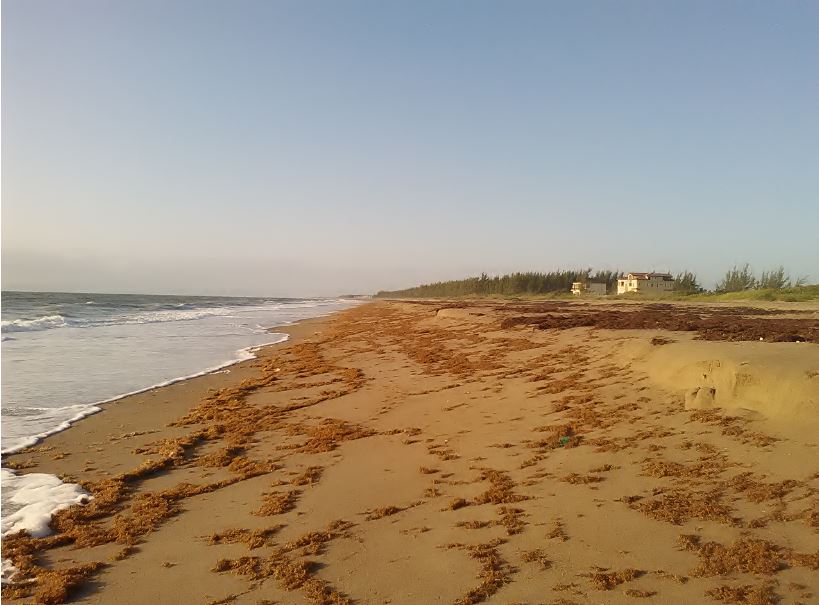
I checked out a few beaches this morning.  As you can see, John Brooks had a little recent erosion, but had filled in a little again since the erosion.


John Brooks Beach This Morning.
I did a quick check, maybe about thirty minutes and found a few crusty modern coins.  Nothing interesting.


Frederick Douglass Beach Friday Morning.
Frederick Douglass beach also had some small cuts, but less than John Brooks.


Blind Creek Friday Morning.
Blind Creek had no cuts.  The only detectorist I saw this morning was the nude detectorist of Blind Creek, if you didn't know better you might think that has something to do with the name of the beach.


Blind Creek Friday Morning.
I really didn't really look, but I know that was  no goody bag.  I don't know what he does with finds.


Fort Pierce South Jetty Friday Morning.
South Jetty Park had a little erosion but was pretty much covered with seaweed.

As you can see, seaweed was seen on every beach this morning.

There had been a little recent erosion on most of the beaches, but still they didn't look very good to me.  My quick check only turned up a few crusty clad coins.

The tides are flattening out now and the surf will be slowly decreasing for a few days.

My favorite find this morning was a plastic milk bottle carrier.  The last time I was at a store I thought about buying one, but I didn't like the price.  The plastic crates are good for storing bottles.

---


The remains of the last known ship to bring enslaved people to the United States have been found nearly 160 years after its illegal voyage from Africa to Alabama, state officials say...

In 1860, the Clotilda transported more than 100 people from Benin, Africa, to Mobile, Alabama, a voyage that took place 52 years after the United States banned importing new enslaved people...

The leaders of the Clotilda voyage, Timothy Meaher and Capt. William Foster, evaded authorities and destroyed the ship by burning it after their illegal trip, the state's historical commissions says...

Here is the link for more about that.


---

Here is another of my ink bottle finds.

Cone Carter's Ink Bottle. 

The bottom reads:  CARTER - MADE IN USA - NO 5.

The William Carter Company was founded in 1858 as an ink manufacturer, and became the world leaders in this field at the end of 1800. In the mid of 20s they entered the fountain pen market, that at the time was in its full development. But after the great depression of 1929, which caused a sharp reduction in the fountain pen market, the company decided to stop producing pens and mechanical pencils in the early 30's.

The pens produced by Carter were excellent quality, and they made in unusual colors much different than those of its competitors of that time. Because the short period of activity of the company, its pens are quite rare and quite sought by the collectors.

Carter cone bottles come in different colors. I have a brown one and have sold both brown and green.

I remember finding my first cone ink bottle - a brown CARTER'S cone that I sold.

The bottom of the brown one I still have is similar and reads:  CARTER'S - 1897 - MADE IN USA.

That one can be seen in my bottle barn web site.


---

Happy hunting,
TreasureGuide@comcast.net


Thursday, May 23, 2019

5/23/19 Report - Less Known Treasure Coast Wrecks. More Sand Coming. Bottle Finds.


Written by the TreasureGuide for the exclusive use of treasurebeachesreport.blogspot.com.

Three Frank Hudson Books.
After looking for one book in particular, I found a few that I hadn't seen in quite a while.  Among those that I found are the three Frank Hudson books.  It was one of those I was originally looking for.  I thought I better do this while I have them out.

At one time I compiled my own list of Florida sunken and buried treasures from all the sources I could find at the time.  That was before the internet became the place to look.  I also found my computer printout that lists the treasure sites.  The printout is about twelve feet long.

Maybe you can remember the days when computer printouts came on long rolls of paper with holes along both sides that were used by the printer to move the paper along.  Now you usually get the regular 8.5 by 11 sheets. 

Anyhow, if you look at books like the ones shown above, you might find some surprising omissions, but you'll most likely find some you never heard of before and maybe some you forgot about.

If you hunt the Treasure Coast, you probably know about the 1715 Fleet sites, but there might be other wrecks that you don't know so much about.

Here are a few examples from Hudson's Florida Shipwreck Treasures book.  

The Bark Nantwich (1696) off of Fort Pierce with $10,000 in gold.  Almost nothing compared to the treasure galleons, yet would make a nice find.

Maybe you know about the three 1565 galleons.  Hudson lists those.

The San Pedro and Pedro Menendez (both 16th century) off Cape Canaveral.

And there are the British ships Barkentine and Burrough listed as being around Jupiter Inlet.

Those are just a few examples of the many wrecks that are out there.  Of course Hudson's books do not give precise coordinates, so there is a lot left to do, however it never hurts to be familiar with what might be out there.  The point is that if you do your research you might find some new sites that you'll enjoy.  I did.

---

I received an email from DJ about the recent plans for more sand for the Vero Beaches.  He provided a link to an article from VeroNews that begins as follows:  The City of Vero Beach's eroded shoreline will be getting a major infusion og sand this fall - from the Tracking Station Park all the way to Castaway Cove - partially paid for by funds included in the $91.1 billion budget approved last week by the Florida Legislature.


DJ offered his opinions, which you migth well agree with. Here is what he said.


I have never been more aware of beach sand than the last two years while treasure hunting and studying the beaches as they erode then sand in.

I cannot remember a beach where I thought there was a lack of sand that negatively impacted the tourists and locals. Certainly not now.

I think this sand ‘crisis’ has been fabricated. Also interesting is the last several attempts were squashed by the feds and the Vero charter prohibits ‘using it’s own money for sand unless for emergency work’.

Just because an elected official says it is imperative and makes the beach better for tourism, business and world peace does not make it so. (The Emperor's new clothes) 

And the timing to miss sea turtle nesting (Which I support) will be just in time for the winter nor’easters to remove it all.

Maybe the feds will cut it out once again, or the Guv will veto it.

Anyway my unsolicited 2 cents. 

I'm sure you a lot of people will agree with you DJ.  Thanks!

---

I decided to store away some of my bottle finds and started with some of the more common ink bottles.

A Variety of Ink Bottle Finds.

All but three in this group are screw-top bottles.

Besides the Waterman's bottles that I've already shown, this group includes Parkers and Sanford ink bottles.  Several do not have a mark indicating the manufacturer.

Sanford Ink Bottle


Parkers Ink Bottle.

I have some ink bottles that are older and more interesting, including some cone bottles.  I've sold some of those in the past.  They sell easily.  I'll show some cone bottles in the future.

---

The surf will start increasing on the Treasure Coast today, reaching three to four feet by tomorrow, however the wind will still be from the south.

Happy hunting,
TreasureGuide@comcast.net


Wednesday, May 22, 2019

5/22/19 Report - Pirates and Buried Treasure by Jack Beater. Metal Detecting A Frank Hudson Site. Mining Your Time.


Written by the TreasureGuide for the exclusive use of treasurebeachesreport.blogspot.com.


Buried Treasure Books.

When I was looking for one of the Frank Hudson books for some reason the other day, I found some other "treasure" books that I had forgotten about.  One is by Jack Beater, who lived in the Fort Myers area, and wrote a book entitled Pirates and Buried Treasure, which was published in 1959.

Jack was a veteran of WW I and moved to Florida in 1920.  Stories of pirates and treasure fascinated him, so he started talking to every old timer or anyone who could tell him more about that.  I was given a copy of his book many years ago by someone who knew him.

Pirates and Buried Treasure is an entertaining easy read that also provides good information.  It focuses primarily on the West Coast of Florida and the Keys.  It talks about Gasparilla, Juan Gomez, Captiva, Charles Gibbs, Anne Bonny, Captain Rackam, Henri Caesar, Key Largo, Tarpon Springs, Useppa, Charlotte Harbor, Carla Pelau, and Estero Bay, Fort Myers Beach and others.   Of course, some of those places you can no longer metal detect.

Concerning Hudson's books, Bill P. detected one of the sites mentioned, and found the book to be accurate.

Here is what Bill said.

An old detecting friend and I hunted a location that Hudson mentioned in that book (I believe) on the gulf coast many years ago. He gave many details about this area that were actually fairly accurate. We hunted the area several times over a couple years and turned up some pretty cool items. The area had been hunted by Hudson and there were uncovered holes everywhere. There were a lot of indian artifacts too. Among the items we found were a broken, rusty end of bar shot that was fired from a cannon with the hopes of taking out the rigging of another ship. I found a Spanish, milled half reale that was holed, and dated 1784. That was cool. We also found what we believed to be a human bone...creepy to say the least. The most interesting thing that happened was, in between trips there someone else was apparently hunting there too. We found a freshly dug hole approximately 2 feet deep and in the bottom of the you could see where roots had grown around something square shaped around 2 feet square!. Disappointing for us but still exciting that someone actual found a box of......who knows. The worst part was the little black salt-marsh mosquitoes. Who knows what is still there? Bill 

Thanks Bill.  Fun times.

That reminds me of one time in the eighties, I think it was, I was in Tampa on a business trip and remember a construction project on the beach that unearthed a bunch of gold coins.  I remember taking my Aquanaut in its grey hard case with me on the plane.

If you go through Hudson's books, one thing you'll notice is several buried treasures around every inlet.  There might be an exception, but I don't think so.  It is important to remember that some of the inlets have moved.

If you combine the treasures in the Hudson and Beater books with those reported in various other sources, you'll notice that there are few coastal areas without sunken or buried treasure somewhere nearby.  Just those that I'm familiar with are numerous, extending from Key West all the way up the coast.  

This is the first I really looked at those books for many years.  When I first read them, I saw them very differently.  Each X marked a dream that could happen - if I hit it.

I look at things very differently now.   Now it seems to me more like, treasure is all around, so I don't wonder so much where the treasure is - instead I wonder what treasure is in the area where I stand.

Think of it.  You can start out in a place like Frederick Douglas, walk north to John Brooks, and a little more to the old picked over wreck near the Fort Pierce Jetty, then north to Pepper Park, and then past the Fort Capron payroll area, continue on to the Sandy Point Wreck and Rio Mar, and Turtle Trail, and Seagrape Trail, and Wabasso, Golden Sands and Treasure Shores and Ambersands, etc. etc.  And I am sure there are treasures in between of one kind or another.   There are wrecks along our coast that are less known and less hunted, yet very interesting.  And there are artifacts of various ages on the beach, and fossils and sea glass, not to mention the native American artifacts and the shiny things that are being lost daily.

I can look out my front window and see the spot where I picked up an inscribed Native American pot shard laying on the surface after a storm, and where I go walking to pick up old bottles and other things.   And not far from my back door is an area where workers in the early 20th century drank after work and discarded their bottles.  There is treasure all over the place.  That is how it seems to me now.

My goals changed over the years and decades too.   I've told before about how when I started metal detecting I tried to find as many coins as I could.  After I progressed some, I targeted gold and quit counting the coins.  That wasn't the end of the changes, but I'll skip over the rest.

Not too long ago I used the term alchemy in one of my post titles.  Poorly defined, alchemy attempts to turn base metals in to gold.  For me today it is more about mining or transforming the moment.

Through aging and a variety of other circumstances, I now see time and life as the most precious commodity.  Digging up gold is really nice, but the important thing is extracting the treasure from the moment in which I stand.  That can be done by digging up something good, but it can also be done without digging up anything.  The treasure is not so much in the gold, but what you bring to it.

For example, treasure hunting with the wrong attitude can leave you worse off, whether you find anything or not.  There was a time when I'd go out hunting with a very specific goal, and if I didn't find anything good I'd come back in a very bad mood.  I let it ruin the moment.  Likewise, making a good find can be poorly handled in a variety of ways.  You've probably heard of lotto winners who destroyed themselves and their families.

Life is precious.  Every moment is precious.  You can make of it what you will.

The moment, like gold, is there to be mined.  Mine it.

---

Some of the salvage boats have been taking advantage of the small surf, but later today the surf will increase and we will have a couple days of bigger surf.


Source: MagicSeaWeed.com


Make your moments count,

TreasureGuide@comcast.net

Tuesday, May 21, 2019

5/21/19 Report - Buried Treasure, Pirate and Otherwise. Bernard Romans and Bleach Yard. Lost Payroll.


Written by the TreasureGuide for the exclusive use of treasurebeachesreport.blogspot.com.

Source: Trial of the Twelve Spanish Pirates of the Schooner Panda, a Guinea Slaver (link below).
Yes Virginia, pirates did bury coins on the beach - at least that is what the book shows.  The book I'm talking about is Trial of the Twelve Spanish Pirates of the Schooner Panda, published by Lemuel Gulliver in Boston in 1834. You can read a free preview online by using the following link.

https://books.google.com/books?id=IQQWAAAAYAAJ&printsec=frontcover&source=gbs_ge_summary_r&cad=0#v=onepage&q&f=false

In case you didn't recognize the "Yes Virginia" part, in 1897 a young girl wrote a letter to a newspaper asking if there is a Santa Clause, and that led to a very famous editorial response that included the much repeated, "Yes Virginia, there is a Santa Claus."

You will find the testimony describing the burying of treasure as illustrated above on page 16 of the ebook.  Testimony concerning distribution of the treasure along with other interesting events is also included. It is not easy to follow the testimony, but if you manage, I think you'll find it entertaining.

Here is a link if you want to read a very brief summary of the criminal acts leading to the trial of Don Pedro Gilbert and the other pirates of the Panda. The robbery and destruction of the Brig Mexican occurred off Stuart, Florida.  The web site presents a variety of additional information on pirates.

http://self.gutenberg.org/articles/eng/Pedro_Gilbert?View=embedded's,%20newfoundland%20and%20labrador

If Lemuel Gulliver rings a bell, it is also the name of the fictional character and narrator in Gulliver's Travels, which was written about a century earlier.  For a minute it made me wonder if the author's name on the pirate's trial book might be a pseudonym, but the same Lemuel also published a book on another trial that took place in Boston in 1834 as well as a number of other non-fiction titles, some being almanacs.

---

Yesterday I referred to a Frank Hudson book entitled Lost Treasure's of Florida's East Coast and mentioned Hudson's poor reputation for accuracy.  I happened to find that book  (which turned out to be surprisingly easy) and inside found the following map of what is labeled as the St. Lucie Inlet area.  After opening the book and briefly scanning it, I was less than impressed by the contents.  Nonetheless, here is the map of what is presented as the St. Lucie Inlet, the same general area that I discussed yesterday.


Illustration Found in Frank Hudson's book,
Lost Treasures of Florida's East Coast.

I'm really not confident of much of anything shown on the map, but would not find it surprising if treasures were buried around the St. Lucie Inlet (which was located at a different locations at different times) or any other Florida East Coast inlet, for that matter.

Treasures 1 through 5 are described as (1) gold bars, (2) iron bound chest, (3) buried cannons, (4) iron bound chest, and (5) iron bound chest.

Number 6 is the most interesting as a possible lead.  Hudson says, in 1834 an army paymaster was moving $8000 in a dugout canoe up the river when it was lost in the river.  Hudson additionally wrote that if you send him a stamped envelope seeking additional details, his source, who did not want to named in the book, would provide additional details.

While I doubt the accuracy of much in that book, it could nevertheless lead to some real facts if anyone is moved to do some research.  I often start looking into one thing and find something else that was totally unexpected.

The Hudson book on buried treasures of the Florida East Coast was published in 1983.  

---

Yesterday I also mentioned the "Bleach Yards" down by Gilbert's Bar and couldn't remember the map where I originally saw it.  Ron J. came to the rescue and pointed to my 9/6/15 report that discusses  Bernard Romans and provides a link to the Romans book, which contains the map.  Below is the link to that post.

https://treasurebeachesreport.blogspot.com/2015/09/9615-report-bernard-romans-and-1715.html

You might enjoy looking at both the post and book.

Thanks Ron!

---


I have a lot more to talk about, but that is about it for today.

The surf is still one to two feet but Thursday will start increasing, reaching three to four feet on Friday.

We are still getting some nice low tides.

Happy hunting,
TreasureGuide@comcast.net


Monday, May 20, 2019

5/20/19 Report - Treasure Lore of the Jensen and Sewall's Point Areas. Pirate Don Pedro Gilbert. Bottle Finds.


Written by the TreasureGuide for the exclusive use of treasurebeachesreport.blogspot.com.


Source: Trial of the Twelve Spanish Pirates of the Schooner Panda, a Guinea Slaver


The Jensen and Sewall's Point area has been very much neglected in treasure lore.  There are many scattered rumors as well as finds and documented history, but the area hasn't received near the attention that has been focused on some other areas.  I'm amazed that one of Frank Hudson's books that lists 133 Florida treasure shipwrecks completely skips the area between Jupiter and Fort Pierce, for example.   It definitely deserves more attention than it receives.

A couple days ago I posted a photo of a cannon ball that was found in the Jensen area.  SW sent me the following email in response.


I am not surprised at the cannonball. I know of a small hand cannon found in a yard on Sailfish Point. There was mention by a mid 19 Century survey team of ruins in the Jenson area. I know the location but have never been granted permission to hunt. I believe it was a pirate hideout. It is also known ships used the river to bleach their sails. I have not been out for over a year due to a job change, less free time. I read the blog daily. Like you say there are many forms of treasure hunting. I still treasure hunt, just a different kind. I also have enough items to research probably the rest of my life. I have several fantastic sites I know of, some with maps. Just can't get permission to hunt. Maybe someday I will do a book, I tried a blog just do not have the dedication it takes. Best hunting to all. SW.

In this blog I've posted about Pirate Don Pedro Gilbert, who gave his name to Gilbert's Bar. If you want to research it, you should know that his name is sometimes spelled differently. In my 1/13/13 post, I gave a link to a free ebook about his trial (See photo above.)

I also remember once posting about a kid in a canoe finding a musket barrel at Indian Riverside Park, but I can't seem to find that post now.  If you can find it, please let me know.

On an old map there is an area on the river near Gilbert's Bar that is marked something like Bleech Yarde.  That is probably the same one that SW referred to.  I can't find the map right now either.

There is a TV show that I've seen a few times that shows Brent and Jonah and another fellow or two magging for a wreck off Jensen Beach.  At the end there was a find.  If I remember that one correctly, it was a sword hilt.

I'm having brain overload, I guess.

Then there are the middens at Mount Elizabeth and Mount Pisgah, and the remnants of a coquina building thought to be a pirate hangout.

But there is much more than that.  There was a novel written by a local author who conducted a lot of research and had maps and documentation of tunnels and gold at Sewall's Point.

There is also the story about a motel worker and maintenance man at an old motel that no longer exists that was located just north of the current Jensen Beach park who found a box or barrel of gold after a storm.

All that said, it is a very historic area with a lot of treasure lore.

Here is a little of the history of Sewall's Point.

http://sewallspoint.org/community/history/

 I just recalled another book by Frank Hudson that does place several found and buried treasures around that area the St. Lucie Inlet area.  The title is something like Buried Treasures of Florida's East Coast.

You can't put much faith in Frank Hudson, even though I mentioned him a couple times today.  His reputation for accuracy is not great.   I first mentioned him to illustrate how that area of the Treasure Coast hadn't received a lot of attention.

That isn't everything, of course.   I just listed the first things that I thought of.

Long ago I put together my own list derived from numerous sources.  

I  just found the printouts, but am not going to go through all of that now.

---

Yesterday I posted some pictures of three Waterman's ink bottles that I found.  Here is another older one.  It is a two oz. bottle for no. 6 ink.


Waterman's Ink Bottle
Two Views.
Since I don't get many chances to metal detect anymore, I do some eye-balling when I get the urge to go hunting.  Last night I found two embossed Coca Cola bottles, which is what I was hoping to find, however they weren't as old or as valuable as what I hoped to find.

One was a Fort Pierce and the other was from Avon Park, which I think is a new one for me.

---

Happy hunting,
TreasureGuide@comcast.net


Sunday, May 19, 2019

5/19/19 Report - 1800-Year-Old Roman Ring Found by Detectorist. T. C. Trinitite Collector. Ink Bottle Finds.


Written by the TreasureGuide for the exclusive use of treasurebeachesreport.blogspot.com.

1800-Year-Old Roman Victory Ring Found by Detetectorist.
Source: See Bukisa.com link below.
The ring was found at the site where a Roman villa once stood, and was owned by a high-ranking Roman, who has not yet been identified, but the search is on.  The ring will make its home in the British Museum.

John Massey, the detectorist who found this ring, detects with a group know as Detecting for Veterans.  They have made numerous significant finds.  Shown below is one such Roman hoard.


Roman Hoard Found by Veterans for Detecting Group.
Source: Bakisa.com web site.
Here is the link.

https://bukisa.com/articles/1087606_man-uncovers-1800-year-old-roman-ring-but-when-he-looks-closer/

There is more to read and finds to see in that article.

---

I received emails in response to both the cannon ball and Atomic melted glass finds that I posted yesterday.  Whether you hunt a lot in the heat of summer or not, it is a good time to keep on learning.  One thing I've learned the hard way is that you should study, catalog and properly store finds as soon as you can.  If you put it off and let the years roll by, you can forget important details.

Scott C., who avidly detects the treasure beaches and often shares with this blog, collects Trinitite.  He sent the following email that elaborates on Trinitite.

Wasn't expecting to see that post, The Hiroshima atomic bomb post with the photos of the melted glass and other melted particles found along the beach. There is so much history held in those glass balls. The Hiroshima atomic bomb was the second of such atomic devices, the first being the Trinity Atomic Test July 16th, 1945 which was developed during the top-secret program called (The Manhattan Project.) Robert Oppenheimer was the director of the program, and worked along side of some of the most brilliant minds of our time. We had to develop these devices before the Germans did as history may well have been re- written if we didn't do so. 


It's a sore subject to many, but the Atomic age did change the world forever and the day it did was July 16th, 1945.

The "Trinitite" which you mentioned in your post was named because of this first atomic bomb test, the bomb itself was named the Gadget, and from this test came "Little Boy" and "Fat Man" and the rest is history.

When the first atomic bomb detonated the blast area instantly vaporized everything within a large radius and sucked everything including sand, iron, copper, instruments, the tower, everything that was in the blast area was sucked up and pulled into an enormous fire-ball, it melted everything including millions of tons of desert sand within a few seconds...this melted sand rained back down to earth as liquid glass landing on the dessert floor and surrounding the entire blast area with a sheet of green glass later to be named Trinitite. This glass still is radioactive to this day...almost 75 years later.

I have been fortunate and one of a few who collects this man-made radioactive mineral/glass, it is a oddity, I have one of the largest collections of a rare variety in the world...it is known as Red Trinitite. Very near ground zero this Red was created by the mix of the copper cabling that held the actual tower and the cables of the actual device itself, this copper was vaporized into molecular form and mixed within the fiery liquid within the fireball and turning and it into a blood red glass, this glass still has the particles of the actual atomic bomb held within it. (Did I say it's still radioactive even after almost 75 years.) (it is safe to handle but use common sense when handling, it it legal to own, sell, but forbidden and against the law to collect today from the actual Trinity site itself, which is open to the public only twice a year, most all the Trinitite was bulldozed and buried back in 1952 at the actual test site and buried by the army.

My Trinitite was collected in 1945 and 46' by one of the scientists who worked for what is now called Sandia National Laboratory.

As a collector I look at the beauty of this glass, it is actually amazing to look at under a microscope, and to photograph. Trinitite glass holds so many interesting visuals and is quite beautiful...the history on how it came to be might be controversial but we cannot ignore many of the benefits that came about from entering the Atomic age. I hope we never repeat a Hiroshima or Nagasaki, or Chernobyl, Fukushima. We must never forget.

After the first atomic test Robert Oppenheimer said this famous quote and I hope it never come true. 


I guess I can say with all honesty that Trinitite is much unknown and misunderstood by many, it is a man made mineral with an incredible history behind it.

I have a twitter page if you want to see a few examples look under Trinitite Man or @TrinititeMan

PS, I love that cannon ball find, those shell mounds hold some pretty good artifacts.

Keep up the great posts TreasureGuide.

Scott aka Trez
Thanks much Scott!

---

I'll have more on the cannon ball tomorrow and other finds down around Jensen.  Today I'll just end by posting some common Treasure Coast glass finds.  Included are three Waterman's ink bottles that I've found.  Similar bottles are still made today even though ink is not used nearly as much, but my impression without really conducting the research is that these ones are from the 40s or 50s.

Waterman's Pen Company was founded by Lewis Edson Waterman in New York City in 1884.  I've found a lot of other ink bottles including an older barrel shaped Waterman's.  I photographed these to add to my Bottle Barn site.

Three Waterman's 2 Oz. Ink Bottles 
of the Same Type Shown From Different Angles.

Bottoms of Same Three Bottles.


---

I've noticed that the people that really find a lot never quit reading.  Others come and go with the seasons.

The surf will remain around two feet for a few more days, but the low tides are good and low.

Happy hunting,
TreasureGuide@comcast.net

Saturday, May 18, 2019

5/18/19 Report - Exciting Treasure Found in Jensen Backyard. Beautiful Artifacts of the Atomic Age. Alchemy of Treasure Hunting.


Written by the TreasureGuide for the exclusive use of treasurebeachesreport.blogspot.com.

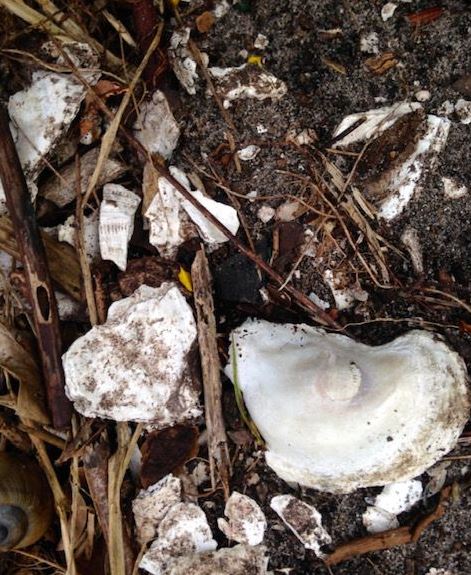
Cannon Ball and Oyster Shells Found In A Backyard On A Jensen Ridge.
Find and photo by K. K.

I received the following email yesterday, along with some photos. Happy Friday, a few weeks ago we were doing some renovations to our backyard in Jensen beach and under neath an old line of bushes we found all kinds of fun treasures from the Ais Indians, which isn’t uncommon.... We routinely find mounds of discarded oysters, small pottery shards and all kinds of later years fun types of glasses. Well this day we came across a large oyster bed and a second section where they had been shaped into different shapes and what looked like a huge heavy ball of some sort.  We called around and finally a lady from the local museum at Gilbert’s House of refuge came over and said it in fact looked like a very old maybe 16th century Spanish iron cannon ball to her and it looks like we may have a bit of a mound in our backyard a place where the Ais Indian, would have a outpost for fishing and hunting trips and later on a place to be on the look out for the British or Spanish and their Indian collaborators who routinely traveled the area... I guess it’s still crazy a 450 year old cannonball was in my yard unsound until now! (My family has been in this house since 1979) I attached some pics for you to take a look at.


Exciting finds!  Thanks for sharing K. K.

While our beaches have been heavily detected, most of the inland areas have not.  There is a lot to find out there.

---


Beautiful Beach Artifacts From a Horrendous Event.

Source: See Atlasobscura.com link below.

Wannier had been studying beach debris from different areas in order to compare the health of different marine ecosystems, when some particles from the Motoujina Peninsula struck him as unusual. Next to particles generated by plants or animals, these were “aerodynamic, glassy, rounded”—they reminded him of what he had seen in sediment samples from the Cretaceous-Paleogene (K-Pg) boundary, the geological marker of the mass extinction that erased the dinosaurs around 66 million years ago. 

But these particles from the Motoujina Peninsula were also notably different in several ways from the K-Pg particles: Some were rubbery, others had multi-layered glass shells. The variety reflected the wide range of materials present in the particles, identified under electron microscope at the University of California, Berkeley. X-ray experiments were also conducted at Lawrence Berkeley National Laboratory, which proved useful in analyzing the formation of the debris.* The range of materials is just one indication that the particles formed as a result of the Hiroshima bombing. An urban center presents a wider variety of materials—such as concrete, marble, stainless steel, and rubber—than a desert test site like Trinity, in New Mexico, where the first-ever nuclear explosion was tested. The resulting particles from that test, called trinitites, are notably less diverse in their composition than what Wannier and his colleagues are now calling “Hiroshimaites.” The presence of anorthite and mullite crystals in the particles, meanwhile, suggested that they had formed in temperatures hotter than 3,300 degrees Fahrenheit, or 1,800 degrees Celsius...
Here is the link for the rest of the article.

https://www.atlasobscura.com/articles/found-glass-fallout-from-hiroshima


---

I lost interest in the Discovery Channel's Gold Rush TV show years ago, however I caught a few episodes of Gold Rush: Parker's Trail last night and was glad I did.

Unlike the History Channel's three "Curse" treasure shows, the Parker's Trail episodes, filmed in New Guinea, illuminated the human condition.

The alchemy of treasure hunting is the transformation and purification of the hunter.  That was made clear as Parker and his crew shared blood, sweat and tears with the native populations and were refined in the process.  Meaningful and worthwhile TV!

---

The tides are big now, but the surf remains around two-feet.  The wind is mostly from the south.

Happy hunting,
TreasureGuide@comcast.net