Showing posts with label shards. Show all posts

Monday, June 1, 2020

6/1/20 Report - Manila Galleons and Archaeology. Porcelain. Beach Cusps or Scallops.


Written by the TreasureGuide for the exclusive use of treasurebeachesreport.blogspot.com.

People find blue and white shards on the Treasure Coast 1715 wreck beaches and wonder if they might be Kang Xsi.  I get a lot of questions about that and in the past have posted some information about Kang Xsi, including  tips on identification.  Below are two intact Kang Xsi (various spellings) cups that sold in the recent Sedwick auction for $700 plus buyer's premium.  We usually just find shards on the beach, but they can be worth a little too, especially when attractively mounted.

Here is the Sedwick lot description for the two cups.

Intact blue-on-white Chinese porcelain cup with handle, Kangxi period, ex-HMS Winchester (1695), very rare provenance and condition. 72 grams, 2-1/2" tall and 2-1/8" in diameter. A lovely little piece with nothing missing (the handle manufactured separately and applied or possibly re-applied after glazing), the glaze worn away but with clear flowers in vase on balcony design on exterior, highly desirable as the only intact specimen found on this rare wreck. From the HMS Winchester (1695), with photo-certificate.


I found a good book with a lot of information on Chinese porcelain and the Manila galleons.  The title is Archaeology of Manila Galleon Seaports and Early Maritime Globalization, Part II.

That resource contains tons of photos, including the photo below of a wreck still containing a cargo of Chinese porcelain.


Source: Academia.edu link below.


That photo reminds me of the fellow who found a stack of plates recently exposed by new erosion to a wreck beach and didn't pay much attention to them. When he learned they could be valuable, he returned to find them, but couldn't.

During the sixteenth to nineteenth centuries, the Spanish navigators established and operated the Manila Galleon maritime route which connected East Asia and New Spain in the American continent. The galleons sailed across the Pacific via the hub seaports and trade centers of Manila in the Philippines and Acapulco in Mexico, forming a prosperous sea route for more than 250 years. This pioneering navigation of pan-Pacific regions promoted early global maritime trade as a new maritime Silk Road between the East and the West...

The Spanish conquest of the Philippines began with the arrival of Ferdinand Magellan in March 1521 (Pigafetta 1969). When Magellan was killed in April 27, 1521 by a local chieftain in the island of Mactan by the name of Lapu-lapu, the remaining Spaniards hastily left and went back to Spain. It was not until exactly 44 years after the death of Magellan that another expedition arrived in the Philippines (Cebu) under the command of Miguel Lopez de Legaspi, with specific instructions from the King of Spain to find the return route from Manila to New Spain (present day Mexico). The discovery of the tornaviaje or the return journey from Manila to Acapulco by Fray Andres de Urdaneta, Legaspi’s pilot and navigator in 1565 completed the maritime route that was later utilized by the Manila-Acapulco Galleon Trade (Schurz 1985). The first few galleons left from Cebu until Legaspi transferred his capital to Manila, leaving Cebu in economic disarray (Fajardo 2018). The galleon trade represents one of the earliest manifestations of economic globalization where Asia, the Americas and Europe were linked together through maritime high ways. 


The Galleon trade fostered both economic and cultural exchanges between the Philippines and Mexico, which can be observed up to this day (INQUIRER.net US Bureau 2017). The Manila-Acapulco galleon trade route was operational for 250 years (1565–1815) where merchant ships traversed more than 18,000 km across the Pacific Ocean from Manila to Acapulco and vice versa. At the western terminus, Manila became the world’s premier entrepot during the sixteenth and seventeenth centuries that linked peoples, cultures and material goods between Asia and the Americas (Schurz 1985; Fish 2011)...

I highly recommend reading this lengthy document.

Here is the link.

https://www.academia.edu/41712660/The_Chinese_Porcelain_from_the_Port_of_San_Blas_Mexico?email_work_card=title

Not only did the Manila galleons distribute items that ended up on the 1715 Fleet and Treasure Coast beaches, but Spanish colonial items also ended up in the ports of Asia.

Source: See academia.edu link above. 

---

In the past I received questions about how scallops or cusps are formed on the beach.  Here is an illustration that explains that.


---


Gold has been doing well.


The stock market is up this morning, which is really a statement for all of the positive things going on with economy, space exploration and pharmaceutical industry.


The surf is small today but will increase tomorrow.  The wind has already changed.


Source: MagicSeaWeed.com.

TreasureGuide@comcast.net


Saturday, July 20, 2019

7/20/19 Report - Artifacts Found by Kayaker. Super Bowl Ring Pawn Attempt. Battle of Waterloo Artifacts. Apollo 11.


Written by the TreasureGuide for the exclusive use of treasurebeachesreport.blogspot.com.


Items Found by Kayaker.
Source: See TheGuardian.com link below.

Objects from a possible Roman shipwreck have been found off the coast of Kent in one of the most unusual archaeological finds in living memory.

The chance discoveries were made by a kayaker in the sea off Ramsgate. The tide was low enough and the water clear enough for him to reach down and pull out beautiful cobalt blue glassware and high-status Roman pottery, called Samian ware.

Mark Dunkley, a marine listing adviser with Historic England said it was the sort of find which just did not happen in the UK. “It is the rarity of the material and the quality of the material that is really significant. In my experience this stuff just does not exist in an underwater context anywhere around Britain...
For more: https://www.theguardian.com/uk-news/2019/jul/17/kayaker-finds-rare-roman-glass-and-pottery-off-kent-coast

One good thing about glassware and potterys is that you can often find it when conditions are not good for finding things like coins.

---


An employee of a Tempe, Ariz. hotel was arrested trying to sell stolen Super Bowl rings belonging to Mark May at a pawn shop in Las Vegas, according to Joe Enea and Shane Dale of ABC 15...

Behnert allegedly tried to sell the pair of rings for $12,000, which raised immediate questions by the staff. Considering a single 2006 Indianapolis Colts Super Bowl ring issued to defensive lineman Montae Reagor is currently listec by the store for $80,000 and a 1989 Denver Broncos AFC Championship ring issued to defensive lineman Greg Kagan is listed for $60,000 the asking price for the rings was understandably curious...

For more: https://www.msn.com/en-us/sports/nfl/pawn-stars-shop-helps-nab-thief-trying-to-sell-mark-mays-stolen-super-bowl-rings/ar-AAEvu09?ocid=spartandhp

Asking too little can raise suspicions, yet I suspect there was more to it than that.

---

The first ever excavation of the main allied field hospital at the Battle of Waterloo has uncovered sawn-off limbs and musket balls fired during a previously unrecorded fight on the steps of the farm where the Duke of Wellington’s medics worked...

The heavy concentration of balls found at the site, fired both from the allied Brown Bess infantry muskets and the smaller calibre French weapons, suggests that a fight also took place there, potentially after Napoleon’s generals ordered a cavalry charge on the grounds of Mont-St-Jean, now an orchard, which lay about 0.3 miles (600 metres) behind the main allied line...

For more: https://www.theguardian.com/science/2019/jul/17/excavation-of-waterloo-field-hospital-unearths-limbs-and-musket-balls

---

Soldier From Battle of Waterloo Identified.


Source: See Archaeology.org link below.

,,,  “I think this is a unique case,” he says. “We excavated 120 trenches in this area, covering more than half an acre, and found almost nothing and no other remains.” In fact, the soldier is not just the only one to have been found in this area—he is the first and only British soldier to have fought and died at Waterloo ever discovered on the site. (Another soldier was supposedly found in the early twentieth century; however, later DNA analysis showed that the remains came from two different people and that that “soldier” was a forgery.) Although the soldier’s head and one of his knees were destroyed by a bulldozer, and some of the bones of his hands and feet were damaged either by a plow—the area has long been a wheat field—or perhaps by a battlefield explosion that tore them away, the skeleton is remarkably intact. Bosquet is able to say that he was between 20 and 29 years old, about five feet three inches tall, with a slender frame.... 

Source: See Archaeology.org link below.


No new storms forming and no significant change to Treasure Coast beach detecting conditions.

Happy hunting,
TreasureGuide@comcast.net


Saturday, May 18, 2019

5/18/19 Report - Exciting Treasure Found in Jensen Backyard. Beautiful Artifacts of the Atomic Age. Alchemy of Treasure Hunting.


Written by the TreasureGuide for the exclusive use of treasurebeachesreport.blogspot.com.

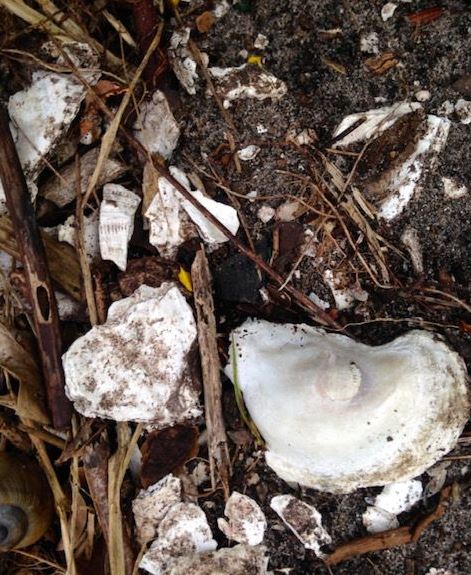
Cannon Ball and Oyster Shells Found In A Backyard On A Jensen Ridge.
Find and photo by K. K.

I received the following email yesterday, along with some photos. Happy Friday, a few weeks ago we were doing some renovations to our backyard in Jensen beach and under neath an old line of bushes we found all kinds of fun treasures from the Ais Indians, which isn’t uncommon.... We routinely find mounds of discarded oysters, small pottery shards and all kinds of later years fun types of glasses. Well this day we came across a large oyster bed and a second section where they had been shaped into different shapes and what looked like a huge heavy ball of some sort.  We called around and finally a lady from the local museum at Gilbert’s House of refuge came over and said it in fact looked like a very old maybe 16th century Spanish iron cannon ball to her and it looks like we may have a bit of a mound in our backyard a place where the Ais Indian, would have a outpost for fishing and hunting trips and later on a place to be on the look out for the British or Spanish and their Indian collaborators who routinely traveled the area... I guess it’s still crazy a 450 year old cannonball was in my yard unsound until now! (My family has been in this house since 1979) I attached some pics for you to take a look at.


Exciting finds!  Thanks for sharing K. K.

While our beaches have been heavily detected, most of the inland areas have not.  There is a lot to find out there.

---


Beautiful Beach Artifacts From a Horrendous Event.

Source: See Atlasobscura.com link below.

Wannier had been studying beach debris from different areas in order to compare the health of different marine ecosystems, when some particles from the Motoujina Peninsula struck him as unusual. Next to particles generated by plants or animals, these were “aerodynamic, glassy, rounded”—they reminded him of what he had seen in sediment samples from the Cretaceous-Paleogene (K-Pg) boundary, the geological marker of the mass extinction that erased the dinosaurs around 66 million years ago. 

But these particles from the Motoujina Peninsula were also notably different in several ways from the K-Pg particles: Some were rubbery, others had multi-layered glass shells. The variety reflected the wide range of materials present in the particles, identified under electron microscope at the University of California, Berkeley. X-ray experiments were also conducted at Lawrence Berkeley National Laboratory, which proved useful in analyzing the formation of the debris.* The range of materials is just one indication that the particles formed as a result of the Hiroshima bombing. An urban center presents a wider variety of materials—such as concrete, marble, stainless steel, and rubber—than a desert test site like Trinity, in New Mexico, where the first-ever nuclear explosion was tested. The resulting particles from that test, called trinitites, are notably less diverse in their composition than what Wannier and his colleagues are now calling “Hiroshimaites.” The presence of anorthite and mullite crystals in the particles, meanwhile, suggested that they had formed in temperatures hotter than 3,300 degrees Fahrenheit, or 1,800 degrees Celsius...
Here is the link for the rest of the article.

https://www.atlasobscura.com/articles/found-glass-fallout-from-hiroshima


---

I lost interest in the Discovery Channel's Gold Rush TV show years ago, however I caught a few episodes of Gold Rush: Parker's Trail last night and was glad I did.

Unlike the History Channel's three "Curse" treasure shows, the Parker's Trail episodes, filmed in New Guinea, illuminated the human condition.

The alchemy of treasure hunting is the transformation and purification of the hunter.  That was made clear as Parker and his crew shared blood, sweat and tears with the native populations and were refined in the process.  Meaningful and worthwhile TV!

---

The tides are big now, but the surf remains around two-feet.  The wind is mostly from the south.

Happy hunting,
TreasureGuide@comcast.net

Wednesday, February 13, 2019

2/13/19 Report - If You Want To Find More, Try Sifting. More on the Melborne Artifact.


Written by the TreasureGuide for the exclusive use of treasurebeachesreport.blogspot.com.

Finds Found by Sifting an Old Home Site
Finds and photo by Russ P. 
I received this photo of finds that were made by Russ P and his sons by sifting an old home site.  Here is what he said.


... I took my boys sifting this morning at a trashy old house site. The finds pictured are fairly typical, in variety and amount. One of my sons likes to collect the colorful ceramic shards.

The aspect of sifting I think I enjoy most is seeing everything.

There is a Buffalo nickel and a couple of wheats...

Thanks Russ.

Russ has conducted experiments in which he recorded finds from lots that were detected several times and the sifted.  His experiments show that metal detecting only results in a fraction of the coins that can be found at a site.

Take a look at the following link and some of my other posts on sifting as compared to metal detecting.


I highly recommend sifting if you want to get more of what a site holds.

---

Here is more on the artifact that was originally erroneously referred to as an "Incan" funerary mask.  This article is by Rick Neale of Florida Today.

MELBOURNE BEACH — An undersea treasure hunter has discovered a possible ancient Peruvian artifact near Melbourne Beach that may have been transported by the doomed 1715 Spanish Plate Fleet.
"I thought it was scrap. I thought it was a NASA scrap, honestly. I thought it was a piece of an aircraft," said Mike Torres, chief technology officer of Seafarer Exploration. He found the item Jan. 14 in pre-dawn darkness.
Measuring about 10 inches across, bordered with intricate patterns, the circular copper relic features an image of a bird-like figure. John de Bry, director of the Center for Historical Archaeology in Melbourne Beach, said the object may have once been gold-plated...
Here is the link to read the entire article.

https://www.tcpalm.com/story/news/local/florida/2019/01/22/treasure-hunter-discovers-possible-ancient-artifact-near-melbourne-beach/2648527002/

It seems that some of the inaccuracies that were in earlier reporting have been cleaned up.

For one thing, the artifact is no longer referred to as "Incan" but rather a Peruvian artifact.  As I posted in this blog before, the determined age of the item did not match with the period of the Incan civilization.

You can find what I've previously posted concerning this artifact by going back a few days in this blog.  There were many questions about the find.


X-ray fluorescence reveals exact origin of porcelain recovered from the ocean floor. 
Here is the link for that article.


---


Looks like we'll have a little increase in the surf later Wednesday and Thursday.  I don't think I'll get a chance to check it out.

Happy hunting,
Treasureguide@comcast.net


Wednesday, August 15, 2018

8/15/18 Report - Latest 1715 Fleet Treasure Finds on the Treasure Coast. A Good Book To Help You Identify Valuable Modern Coins.


Written by the TreasureGuide for the exclusive use of treasurebeachesreport.blogspot.com.

Four Reale Found by Cole Smith
Photo submitted by Captain Jonah Martinez
I just received photos of some nice new 1715 Fleet finds made by the crew of the Bottomline working on the Treasure Coast.  First is a four reale found by Cole Smith.

Other Side of Same Four-Reale Found by Cole Smith.
Photo submitted by Captain Jonah Martinez.
Here is a nice big piece of an olive jar.

Olive Jar Shards.
Photo submitted by Captain Jonah Martinez.

Silver Candlestick Base Found by Larry B.
Photo submitted by Captain Jonah Martinez of the Bottomline Salvage Vessel.
This year we've had some good calm seas on the Treasure Coast.  That isn't especially good for beach hunting, but it is good for the salvage guys.

Thanks to Jonah for sending the photos, and congratulations to Larry and Cole for the good finds.  Its a lot of hard work out there.

---

I've been looking at my coin finds and using a book that I recently got.  The book is Strike It Rich With Pocket Change by Ken Potter and Brian Allen.  While I haven't yet struck it rich with my change, the book is organized well and makes it easy to identify error coins when you do have them.

Like with most anything, valuable examples are rare, so unless you are extremely lucky, you'll have to scan a lot of coins before hitting the big one.

The thing that makes this book so handy is that it is organized by date and denomination and has lots of clear pictures to show you what to look for.

It is amazing how many big money errors there are, yet how hard they are to find.

This book starts with Lincoln Memorial pennies and covers other modern denominations.

Unfortunately, many of the coins found while detecting are not in good shape, which makes it difficult to identify true mint errors and reduces the value if they are found.

I also check the coins I receive in change.

---

The disturbance in the middle of the Atlantic that I've been talking about has strengthened, but it is heading away from us.

The surf is still down around one or two feet on the Treasure Coast.  We're also still having negative tides.

Happy hunting,
TreasureGuide@comcast.net

Monday, July 23, 2018

7/23/18 Report - Cache Hunting: Tips and Misconceptions. Fisher Organization Salvage Activities.


Written by the TreasureGuide for the exclusive use of treasurebeachesreport.blogspot.com.

I've written about a couple of Florida cache finds this year.  Caches are found, but not real often.

Hunting for a cache is different than hunting for individual coins or pieces of jewelry, and a lot of what you read about how to find a cache is wrong.

The first thing about cache hunting, is you have to have reason to be looking for one.  If you just go out and cover a lot of ground, you might eventually find one, but the odds are very long against it.

Caches are rare, so it helps if you have reason to believe there might be one.  Of course if you are hunting the right kind of place, for example a historic home site, you should be aware that there is always the possibility of a cache being present.  If you don't want to miss any possible caches, you want to alert to a variety of types of targets that you otherwise might discriminate out.

If you read most articles about cache hunting, you'll probably read about things like two-box detectors for detecting really deep targets.  For many caches, a regular detector will work just fine if you aren't using too much discrimination.  The idea that every cache is going to be buried ten feet deep just isn't true.  People don't have to dig down ten feet to hide a cache.  There are other things that will hide a cache as well or better than a few feet of earth.

Someone who buries a cache, will usually hide it where they think they can find it again.  That means that the cache will be near landmarks or features - perhaps a tree, wall, fence or walk.  That can cause a problem for the detectorist.  They will not be able to detect the area well either because of physical obstacles, like walls, or noise from rebar or buried cables.  You can't detect with a two-box detector in small areas or around other big metal items.

The caches that I'm most familiar with were buried in canning jars, not treasure chests.  One cache was distributed around a home site with individual jars placed in different areas.  And each jar contained different kinds of coins.  You don't know what the container might be so you don't want to discriminate iron or a lot of other metals

If you've been hunting very long, you can probably easily tell the difference between a small surface target and a deeper large target from the sound of the signal.  You can't pay too much attention to your meter.  Many caches will give mixed signals because there can be signals from the container as well as the coins or whatever else is in the container.  They can be quite a mixed bag.

---

A very dark two carat emerald was discovered on 7/11/18 while the Magruder was working Emerald City.

The Magruder will be going back to the site of the Margarita to dig the virgin area on the northern trail near where the gold chalice was found years ago.  They will be using an airlift to excavate holes in the bedrock.

The Margruder was finding Ming Dynasty blue and white porcelain and olive jar shards on the Atocha site.

The Fisher organization will also be returning to the deep target site with Dolores.

---

I think it is amazing how little coins have changed over the past thousand years.  I guess they were well-designed for the job and worked well.  Mostly flat and round with designs on two sides.  It is fairly obvious what works well about that.

Anyway, I think coins will be going away before long.  Canada quit producing the-one cent coin in 2012.

Keys had a long run too, and are disappearing.

---

We had a nice west wind this morning, but there are no storms around, and the surf is only one to two feet.

Happy hunting,
TreasureGuide@comcast.net

Saturday, December 30, 2017

12/30/17 Report - Increasing Surf Along Treasure Coast and Beach Photos. Shards. # 5 Most Popular Post of 2017.


Written by the TreasureGuide for the exclusive use of treasurebeachesreport.blogspot.com.

Pepper Park Yesterday Morning.
Photo by Alberto S.
Alberto S. visited Pepper Park and Fort Pierce South Jetty Beach yesterday morning and sent these photos. 

Fort Pierce South Jetty Yesterday Morning.
Photo by Alberto S.
Since the higher surf had begun I wanted to see what was happening at the beach, so I went out yesterday afternoon to take a look.  Below is what I saw.

John Brooks Beach Yesterday Afternoon Before High Tide.
Frederick Douglas Beach Yesterday Afternoon Before High Tide.
You can see that at both John Brooks and Frederick Douglas the water was getting up over all the newly accumulated front beach.  It was getting as high as it has been for quite some time and it was not high tide yet.

Frederick Douglas Yesterday Afternoon.
You can see the sand along the berm of the front beach here.  That irregular spot to the left is an area that has been interesting for months now.

The water is getting high enough that there might be some spots that open up at some other beaches after the next high tide or two.

---

As you probably know I have been listing the top ten most popular posts of 2017.  It has helped me get an overall perspective on the year and what has been most interesting to the blog's readers.

My number five most popular post of the year was another one of the September posts having to do with Hurricane Irma.  As I said before, five of the top ten posts were done in September.  That was a busy time for Treasure Coast detecting this year.

Number 5 was the 9/12/17 post on some of the first Hurricane Irma finds that were reported.  Below is that link.

http://treasurebeachesreport.blogspot.com/2017/09/91217-report-early-irma-treasure-coast.html

A lot of musket balls and lead were found after Irma.

---

Consensus on the ceramic pieces found by Gaylen and shown in yesterday's post seems to be that they are not from old shipwreck pottery.  I am always very hesitant to evaluate pieces like that from just seeing photos, and other readers felt the same way, however, they do not look like either olive jar shards or majolica.  My first impression, though I was hesitant to say anything on that basis alone, is that they look too hard and dense and the edges are too sharp.  I was waiting until I studied it a little more before I said anything specific, but the responses I received via email seemed to be in line with my first impression.  I hope to take the time to study those pieces a little more so I can be more specific and perhaps show some examples of the real thing and how they differ.

You might look at my 11/18/12 and 11/19/12 reports, for example.  I am obviously far from an expert on shipwreck pottery or ceramics, but you have to start somewhere.

Here is the link to the 11/18/12 report.

http://treasurebeachesreport.blogspot.com/2012/11/111812-report-sherds-or-shards-water.html 

Of course there are books and resources that you can consult that are much more authoritative and thorough.

---

The most important topic today is the surf.  As I mentioned yesterday, it is getting bigger and hitting higher up on the beach.  Some spots might open up.

Here are the surf predictions for the next week.

Source; MagicSeaWeed.com.
Happy hunting,
TreasureGuide@comcast.netn

Wednesday, October 19, 2016

10/19/16 Report - T. C. Beach Conditions Rating Is 2. Sedwick Auction Online. Kang-Hsi From Bees Wax Wreck.


Written by the treasureguide for the exclusive use of treasurebeachesreport.blogspot.com

John Brooks Beach Yesterday Near Low Tide 
Yesterday I mentioned the bigger surf and higher tides.  I raised my Treasure Coast Treasure Beach Detecting Conditions Rating to a 2.  I had dropped it to a 1 for a couple of days.

Eroded Dunes Yesterday Afternoon.
Although there isn't much in the way of cuts and most beach fronts on the Treasure Coast are mushy. as you can see in the picture above, the high water got to the dunes and caused some erosion there. That is part of the reason that I increased my beach conditions rating to a 2 again.

The surf is supposed to be higher today so it should be hitting the dunes at various places around the Treasure Coast again.

---

The Sedwick Coins auction number 20 is now available online.

Here is the link.

http://www.sedwickcoins.com/ta20/catalog.htm

In that auction are five nice balance scales.  You might remember the silver mystery item that I've posted a few times, including the following picture posted in my 9/26/16 post. Although I think it could be a scale weight, I'm not totally sure.  The shape is odd and it is not shaped well for stacking.


One of the scales in the auction is the one pictured below.

Scale listed in the Sedwick Coins Auction # 20
The weights in this set are for gold coins of various denominations, such as "ten dollars, "twenty dollars," etc.  There would be no need for stacking these weights, so one more doubt about my mystery item being a scale weight has been removed. at least in my mind.

If it is a weight for a coin scale, I need to identify coins that weigh ten grams like the mystery item. If I can do that, I'd be pretty confident that it is a coin scale weight,

Internet auction catalogs are excellent research resources.  They provide more fine examples and easier access to certain types of information than most museums.

---

You've probably heard of the Bees Wax Wreck.  It is in California, not anywhere near the Treasure Coast.

The other day I talked a little about Kang-hsi porcelain, which originated in China but was found on 1715 Fleet wreck sites.

There is an excellent web site for the Bees Wax Wreck, which shows among other things, a fascinating picture of what appears to be Kang-hsi porcelain shards that were turned into arrow heads by the native populations after the wreck, as shown below.

Shards Turned Into Arrow Heads.
Source: web site listed immediately below.
Here is the link to that excellent web site.

http://www.nagagroup.org/BeesWax/gallery/gallery.htm

---

Happy hunting,
TreasureGuide@comcast.net

Monday, April 21, 2014

4/21/14 Report - Beach Conditions This Afternoon, Two Found Rings, Identifying a Spanish Shipwreck and Spanish Colonial Shards


Written by the TreasureGuide for the exclusive use of treasurebeachesreport.blogspot.com.


One Treasure Coast Beach Just After High Tide.
The surf increased some today and the wind was coming out of the North.  As a result I wanted to get out and take a look at what was going on the beach before I finished this post. 

I did take a look just after high tide this afternoon, and despite the wind direction and increase in surf, the swells were not coming in at much of an angle, and most importantly, it was not removing any sand.  In fact, as you can see from the photos, there was a lot of seaweed on the beach - usually a bad sign.

I took a look at four different beaches and they all looked pretty much alike.  There might be some slight erosion out there somewhere, but I didn't find it this afternoon.

Everything I saw looked poor.   Not even any shell piles to look through.

Here is a quick video showing the beach and wave action.  It was just after high tide.


Most of what follows was posted earlier today before I got out to the beach.


The local Channel 5 News gave a news story about a ring that was lost at the beach and then found and returned two years after it was lost.  Instead of this ring being found and returned by a detectorist, this ring was eye-balled by a lady at the beach.  I think the unusual engraving inside the band is one thing that helped this ring get returned after it was posted on facebook.

Here is the link.

http://www.wptv.com/news/local-news/water-cooler/jenn-bircham-sarah-greg-lindsay-wedding-ring-lost-at-the-beach-returned-to-owner-two-years-later


An Easter miracle story of a wedding band lost and found one year later.

http://www.inspire21.com/stories/holidaystories/TheEasterMiracle


It can be difficult to find the identity of a shipwreck, especially a wreck that is hundreds of years old.  We know the names of the Margarita and Atocha.  Those are two very famous wrecks from the 1622 Tierra Firma Fleet, but there were other smaller ships in that fleet that were not as valuable and not carrying the Crown's property and so weren't as well documented.   It could be especially confusing because a ship was often referred to by different names or referred to by the name of the owner or captain.   Multiple vessels also carried the same name.   All of that can make it very confusing and can make it very difficult to identify a particular wreck.

Below is a link to an article found on the Odyssey Marine web site which shows how they attempted to identify the wreck of a small navio from the Tierra Firme fleet that was lost off the Florida Keys on the 5th of September in 1622.  This paper has a lot of good reading for anyone interested in the shipwrecks of the Keys.  Many shipwrecks are discussed.   Here is one little sample from the paper.

The Rosario was subsequently located by a salvage operation on 24 September 1622 “grounded on one of the keys”.  All the crew and passengers were saved and the wooden structure above the waterline burned to expose the treasure within the hull, resulting in the recovery of all the silver and 20 pieces of artillery (AGI Santo Domingo 132; Lyon, 1989). Following the salvage of equipment valued at more than 6,000 or 7,000 ducats, another report confirmed that Vargas “began the operation of salvaging the silver, first setting fire to the galleon, to burn it down to water-level.  In this way he recovered all the treasure, artillery, and copper which she carried and brought it all back... 

Here is the link.

http://www.shipwreck.net/pdf/OMEPapers28-2013.pdf


Not long ago we had some good samples of beach shards.   Here is a good article on Spanish colonial shipwreck pottery and ceramics.

http://www.shipwreck.net/pdf/Kinglsey.pdf


The surf on the Treasure Coast should be a touch higher this evening and still coming out of the North.  At least that is what the surfing web sites are predicting.

I've been doing some study on some other stuff that I might have ready for you tomorrow or some other day.


That's all for today.

Happy hunting,
TreasureGuide@comcast.net

Sunday, November 18, 2012

11/18/12 Report - Sherds or Shards & Water Getting High on the Beach


Written by the TreasureGuide for the exclusive use of treasurebeachesreport.blogspot.com.

Six Different Treasure Coast Beach Shards
I looked it up.  My dictionary says that sherd is a variation of shard.  Some people say one and some the other, but there appears to be no difference.

As I said a few days ago, someone asked how to identify a shipwreck shard on the beach.  I wish I knew.  I've studied it a lot but still know very little about it.  It isn't easy.

First off, a shard is a piece.  So when we see a shard on the beach, we're just looking at a piece, and very often it is a small piece.  Furthermore, the shard has often been tumbled in the sands of time until it has become a smoothed out lump with a worn surface.

As with any item, one of the first things to do is to look for any man-made marks.  Look at the shard closely, carefully, and at different angles. 


Heavy Shard With White.
Unfortunately we don't usually have either the background or equipment to do a scientific analysis of our finds, and sometimes that is what is required.  However, if you read and look at a lot of different photos and examples you will learn to identify some pieces.

People can easily mistake pieces of modern clay items like drain pipes or roofing tiles for old pot shards.  I recently discovered one thing that will help you tell the difference.

Same Shard.  Notice Lumps and Large and Small Holes.
If you look at how those modern items like roof tiles are produced, you will find that they are extruded into molds.  The material is pushed under pressure and looks something like coprolite (dinosaur doodoo or fossil dung).  It has that toothpaste look.  (Did you know that the the tooth paste tube was invented after a man observed a horse's anal sphincter in operation?)  OK, lets get our mind out of the cesspool now!

Below is a photo of a broken piece of drain pipe.  You might be able to see in the photo how the material looks like it has been pushed through small openings and how it seems to be composed of a number of tubes of paste smashed together.  You can see striations when you look at the broken edges very closely.  Of course, it is easier to see in real life.

You do not see the same signs of extruded material on pieces that were produced on a wheel or by hand.  For me, that has become one of my best first clues to distinguish between modern items like modern roofing tiles and older items.  The modern items also seem to have a much heavier glaze, which I guess you would expect from their intended function and also the fact that if we are talking about beach finds, the older items were probably tumbled much longer.

Speaking of color - olive jars come in a variety of colors.  You might see anything from orange to beige or tan to whitish.  The archaeology journal articles that I've read bears that out.  They also tell what type of clay was used.  Kaolite was one, for example. 

Piece of Broken Red Drain Pipe Showing Extruded Material

Concerning the white layer that is sometimes seen on the outer surface olive jars, I've seen it discussed as being an intentionally applied layer, the result of the firing process, or the result of a reaction with salt water.  It seems there are a lot of ideas on that.

There are a lot of different types of ceramics you can find on the beaches.  From shipwrecks there are anything from olive jars, to bowls, to galley bricks and tiles.  And you can also occasionally see Native American shards as well as much more modern pieces.

Take a look at size and shape and try to figure out the type of vessel and its function.  Take a look at its composition and see if you can tell how it was made.  And also consider what else has been found in the area.  Are there other pieces that might be related that help give a more complete picture? 

If you look at a lot of different examples, both old and new, you will learn to identify some pieces, but like I said at the beginning, it isn't easy, and sometimes it might be impossible.  One thing for sure is that you'll learn a lot in the process.

If you need to correct anything I said today, please feel free. 

If you look at the photo at the top of the page, the most left item in the top row, could be either a piece of a brick or a heavy rim.  I'm guessing the second right now from the shape.  (I've seen complete galley bricks on the beach.)

The third item in the top row has some remaining glaze in the corner, as does the small reddish item beside it.

The first item in the bottom row has a straight line running across it.

The black item, I take to be Native American.  I have also seen a black check-stamped shard on the beach.


I just got back from the beach.   The water is getting up there.  It is not as high as it got during Sandy, but pretty high.   It is not a dune banger yet, but the water is hitting the toe of the dunes in at least one place that was heavily eroded during Sandy. 

You might want to start checking spots that produced during Sandy but that didn't refill since. 

I'm not ready to issue an upgrade in conditions yet, but if the water gets much higher, I probably will.

Overall, conditions remain poor, but it won't take much more for us to be in the money again.

I'll be watching closely.  The swells are supposed to be a bit higher the next couple of days, and that combined with the higher tides we've been having might just do the job.

Happy hunting,
TreasureGuide@comcast.net