Wednesday, September 18, 2019

9/18/19 Report - Hurricanes Humberto and Jerry. Erosion in Jupiter Area. Silver Find From Vero Area. And More.


Written by the TreasureGuide for the exclusive use of treasurebeachesreport.blogspot.com.

Source: nhc.noaa.gov
Look at that!  Humberto hasn't completely left yet, and it looks like there will be a Hurricane Jerry headed in this general direction.


Source: nhc.noaa.gov

That could send us even more surf.

I haven't been out and around much yet, but hope to get out this afternoon and should be able to give you a beach conditions rating later today.


With Jerry following Humberto, we might get continued higher surf.


Eroded Beach in Jupiter Area
Photo by Jerry P.
Jerry said he used Ventusky.com, which you'll find on my first blog page, to find an area where conditions might be good, and he found this nicely eroded area.\

Thanks for sharing Jerry.  Very good use of Ventusky to find a good detecting site!

---

Here is one nice find from the Vero area.

John E. said, I’m stumped on this one.... exact size of a dime , registers a 21 on equinox 800..... found in about 14 in deep wet sand on treasure beach in vero, can anyone identify?

John E


Find and photo by John E.
He said the words above the star are FRIAY LIBER.

Other Side of Same Coin
Photo by John E.
I'm pretty sure it is a centavo from Cuba and can almost make out a date below the star.  I'd also guess it is silver.  Looks like it to me.   A little research should provide the denomination.

Thanks John.  Nice find!

---

Here is an interesting email message I received from Southern Digger concerning a link I posted yesterday.


Hello TG 

Been awhile corresponding but still following up. Archeological site locations on Hutchinson Island and elsewhere along the beaches is no big secret. I recall an old beach mound near the now closed Indian River inlet. I believe some of it has since been washed away. Years ago, a friend and I hiked to a hammock Island near Round Island Park, long before this hammock was developed. We used machetes to cut in to the center, finding old metal rods with eyelet ends which appeared to be from old sailing ship mast supports. Why they ended up way back of the beach we never could determine, unless a camp was made thereon by some 1800's shipwreck survivors.  Also, prehistoric evidence was everywhere. Thought it was interesting and a possible site to return to, we never did, that is until major changes took place thereon. Since then, the under-story was cleared and Univ. of Maryland (I believe) did an archeo survey on the hammock. I was invited to return after that, and did so--still seeing prehistoric evidence in abundance scattered everywhere. This was my last visit when construction began thereon for some type of structure. Another archeo site way to the south exists behind the beach at the water plant. I was asked to direct the Archeo. survey via an Env. firm I worked for at the time--but turned it down and recommend someone else because the end of the survey results and how the report should read were told to me before the project even started. In effect, regardless or not if there are burials. the site would be dozed and built upon. I turned it down even though I would be hired to direct the project because, at the time, I was being trusted on several other volunteer archeo. projects to the south which did not involve the Env. firm; and, I did not want a reputation of being a sellout for the $$$$ and destroy possible burials. That is a strict policy I adhere to to this day because I have seen way to much archaeological and historical sites destroyed and developed in which I had no control over or the power to prevent it from occurring. That is the nature of land development and the destruction of Old Florida. 

Thanks Ken.

--

I hope to get out this afternoon. I expect to be able to post a beach conditions rating after that - maybe later today.

At this point I am expecting a few reales to be found this week.

---

PM Update.

I looked at a few beaches in the Vero/Sebastian area and saw nothing encouraging at all.   I'm expecting fewer finds now than what I just said above.

Happy hunting,
TreasureGuide@comcast.net

Tuesday, September 17, 2019

9/17/19 Report - Hurricane Humberto and Developing System. Martin County Beach Discovery. Detectorist Sued.


Written by the TreasureGuide for the exclusive use of treasurebeachesreport.blogspot.com. 

Source: nhc.noaa.gov

Hurricane Humberto is slowly moving away while another system heats up in the Atlantic.  It might come this direction.

Expect more high surf through the week.


Source: MagicSeaWeed.com


So far this week I've not seen any cuts on the South Hutchinson Island wreck beaches.

John Brooks Monday PM.

There was a nice little flat area near the water at low tide.  There were very few shells.


John Brooks Monday PM

John Brooks Monday PM.


A possible Native American burial site was discovered by a detectorist on Hutchinson Island in Martin Country after Hurricane Dorian.

Here is that link.

https://www.wptv.com/news/local-news/martin-county/possible-indian-remains-found-on-hutchinson-island-following-hurricane-dorian

Thanks to Jorge Y.

---


The Church of Scotland is sueing for a share of a $2.5 million Viking treasure trove unearthed by a detectorist on church land.

Here is that link.

https://www.cnn.com/travel/article/church-viking-treasure-trove-intl-scli-gbr/index.html

---

I was surprised to discover that a couple of the modern coins I picked up Sunday were wheat cents.  The one I could read was 1930-something.


With Humberto still producing surf for the Treasure Coast and another system coming this way, you should remain alert for any changes.

Happy hunting,
TreasureGuide@comcast.net

Monday, September 16, 2019

9/16/19 Report - Big Surf Predicted For a Few Days as Humberto Moves Away. Usefulness of Target ID Numbers.


Written by the TreasureGuide for the exclusive use of treasurebeachesreport.blogspot.com.

Source: MagicSeaWeed.com.
Look at that!  If the predictions are correct you can expect four days of increasing surf and some pretty high surf for a few days.  On top of that, the swells are going to be coming from the north for a good while.  There is a heck of a lot of sand that needs to be moved, but we might get some openings.

Source: nhc.noaa.gov
Humberto did not move north and away from us as expected.  Looks like it will move more east rather than going north.  And there is still that system out in the Atlantic that is getting more organized.

Source: nhc.noaa.gov
 When it comes to shipwreck beach finds, the vast majority occur on a few days.  Yes there are those days when a few scattered finds might be made, but there are many more days and months when none are made.  And of course, there are those rare times when a lot of finds are made.  Everybody remembers those, and the stories are retold for decades.

When it is hot, it is hot, and when its not, its not.  That means you can't afford to miss those few special times when the window of opportunity opens.  You have to somehow endure and make the best of those long periods in between.

---

As you might know, I have long been a big advocate of digging everything.  I've explained my reasons in the past.  Those reasons include (1) the inability of any metal detector that I know about to accurately enough identify a broad range of targets, including some very valuable targets, and (2) the time wasted trying to identify buried targets before digging when it takes only seconds to actually dig them, and (3) the fact that you can drastically reduce the number of junk targets if you know something about target distribution patterns on a beach.  I also know that some people do not have the desire to dig trash even if it means missing valuable targets and some people have physical limitations that they must accommodate, so I am by no means saying that discrimination should never be used, but it should be done only with a full awareness of the risks.

With that background, I have been exploring the Equinox metal detector and video target ID generally.  I believe my conclusions can be generalized to many detectors even though I am using the Equinox for the majority of my tests.

I haven't used target ID very much, but I have spent lot of time listening to the audio signals of a wide variety of metal detectors and believe you can often tell a great deal about a buried target from the audio signal alone.

In my 9/11 post, I reported on a brief ground test that I conducted with the Equinox on a few gold objects and questioned the usefulness of the displayed numbers.  A couple readers sent links to videos showing the target ID numbers produced by the Minelab Equinox for a variety of objects, including many pieces of gold jewelry.  While I prefer to conduct my own tests for a variety of reasons, one reason being that not all detectors of the same make and model will always perform exactly the same, I took a look at those videos, which basically confirmed the opinions I got from my own very limited tests. 

One of the videos showed that gold rings and other gold items can produce numbers anywhere from the low end of the range to the high end of the range and everywhere in between.  To give one example, a few small gold rings produced exactly the same number as an aluminum pull tab.  One YouTuber that conducted an extensive test explained that you have to dig it all with the Equinox and showed why.   See https://www.youtube.com/watch?v=SsgspduZA_8 

The videos I viewed were slightly flawed, but I believe were basically correct in their conclusions.  They would run the coil past the object or the object past the coil directly under the center of the coil at what appeared to be an inch or so.  That is not what typically happens in the field.   In the field there is ground mineralization, objects are at different depths and laying at different angles, the coil is moving at different speeds and the object is seldom under the sweet spot of the coil.  I have not systematically tested the effect of all those things, but I have observed that some of those things definitely affect the readout.  I hope be able to be much more specific about that in the near future.  I know that the numbers are not very consistent in some environments.

While at this point (with me having very little personal experience with the Equinox) I have concluded that the visual target ID numbers have very limited utility for discriminating objects if you don't want to miss anything good, but I do think the numbers will be of some help, especially, when combined with other information, including the audio signal and some level of knowledge of the type of items that are most likely in the area.  I expect the numbers to be more useful when combined with other information but of very little help when used as the sole criterion for deciding whether to dig or not unless you don't mind missing valuable targets.

Being much more experienced with interpreting audio signals than display meters, I feel like I can get some good information about a target from the audio signal and it seems to me that the audio signal produced by the Equinox contains a lot of information.  I expect to learn to better interpret the audio signals as I gain more experience.

I know that it is often possible to get an idea of the shape of an object from the audio signal.  The easiest example, perhaps, is that of a long elongated object such as a nail.  I think I'll also be able to reliably distinguish other shapes by simply listening to the audio signal of the Equinox.  

Just the other day when doing a ground test with four gold objects, I noticed how a ring with a larger amount of mass on the one side made a different signal when swept over from different angles.  With some additional experimenting I think I might be able to tell an open object, such as a ring, from an a solid or closed object, such as a coin or round charm.  I need to study that more.

So far my conclusion is that you cannot use the target ID numbers alone on the Equinox, and probably no other metal detector, without a strong risk of missing valuable targets.  There is no doubt that you can use target ID numbers to avoid digging a lot of junk, but you will also miss a lot of good targets.  While the target ID numbers on the Equinox, are not as helpful as I hoped, the Equinox does provide a lot of benefits and will find a definite place in my arsenal or metal detectors.  So far I am impressed by its extremely light weight, stability in salt water environments, and good sensitivity to small and deeper targets.

Thanks to those who sent me the links to Equinox target ID tests.

---

Keep watching the weather.  I'll try to keep you informed on beach developments.

Happy hunting,
TreasureGuide@comcast.net

Sunday, September 15, 2019

9/15 Report - Photos From Around the Treasure Coast and More High Surf Predicted.


Written by the TreasureGuide for the exclusive use of treasurebeachesreport.blogspot.com.

John Brooks Saturday Evening
I got out last evening just before dark to look at a few beaches.  Here is John Brooks.  There was no new erosion there.  There was none at Frederick Douglass either.


John Brooks Beach Saturday Evening.


Turtle Trail Saturday Morning.
Photo by DJ
DJ took these photos of Turtle Trail on Saturday.  It looked better than what I saw on South Hutchinson Island.  Note the increased slope on the front beach.

Turtle Trail Saturday Morning.
Photo by DJ
DJ also sent the following photo from Rio Mar.  It also has a slope on the front and some black sand.

There is still a lot of sand there.  I can remember when there were a bunch of huge concrete blocks showing there and the beach was cut back into the dunes.


Rio Mar Saturday.
Photo by DJ


Vero Near Mulligan's 
Photo by Gaylen C.
Galen C. sent these photos of the Vero area.  People sometimes forget that silver reales have been found in that area.  I remember one found right in front of the Holiday Inn.


Vero Boardwalk
Photo by Gaylen C.
There has been a lot of talk about the Vero Boardwalk.  There has been erosion there for quite a while.


Source: nhc.noaa.gov
Humberto is moving away from us, and the other system in the Atlantic is still far away.


Source: MagicSeaWeed.com

The surf predictions don't look bad.  If they are correct, we will be getting some higher surf for an extended period.  Tuesday or thereabouts, we'll be getting some north winds.  All of that surf should help some.

Beach conditions have been generally poor for a few years now.  All of the sand from the beach renourishment projects has not helped.  Most beaches still have a lot of sand.

The Vero area looks a touch better than the South Hutchinson Island beaches.

There are still places out there where there has been enough sand moved to uncover modern items.  Last night after checking out John Brooks I stopped a little to the north on the way back and quickly picked up 19 modern coins in a short amount of time.  That was my third test of the Equinox in the field.  I only dug coins.  I didn't dig one piece of junk, and I didn't dig anything better.  I was moving ridiculously fast.  It wasn't a fair test.  My wife was with me and it was getting dark and we got hit by a passing rain shower.  I could have easily missed a piece of gold or something.  It has been surprising me how many modern easy modern coins are out there to be found.  I guess folks are focusing on shipwreck stuff even though they have been difficult to find.

Thanks to all those who sent photos.  You make this possible and help everybody.


Happy hunting,
TreasureGuide@comcast.net


Saturday, September 14, 2019

9/14/19 Report - Tropical Storm Humberto and Higher Surf Predictions. My Second Field Test With The Equinox: Finds and Thoughts.


Written by the TreasureGuide for the exclusive use of treasurebeachesreport.blogspot.com.


Source: MagicSeaWeed.com

I'm leading with the surf this morning.  I don't often do that, but the predictions at this point look encouraging.  Not only is the surf supposed to be high, but it lasts for a while.  That is something we've been missing, especially with Dorian.  It would be nice if that is what we get.

Source: nhc.noaa.gov

The map is really lighting up.  We now have a tropical storm named Humberto, that is supposed to become a hurricane, however it will be staying out in the Atlantic.

Source: nhc.noaa.gov
That doesn't mean it won't sent some surf this way, but MagicSeaWeed is evidently counting on some surf from other sources as well.  We'll see.

From what I've seen of the beaches so far, which is limited to South Hutchinson Island, I'm not increasing my beach conditions rating yet.  The shipwreck beaches that I looked at yesterday showed no erosion.

After looking at John Brooks and Frederick Douglass I looked for a beach where I could get a little productive practice with the Equinox.  The first one I looked was no better than the wreck beaches, but then the next one after that looked more promising.  It had a low scooped out front, so I looked like a good place to get in some practice.

Here is the result of about an hour of hunting in the wet salt sand.

Coins and Small Gold Band Found Yesterday.

I found the coins and ring shown above while only digging three junk targets - a sinker, piece of copper, and a lapel pin back.  As I've always said, targets are not distributed randomly, and if you pick the right areas to search, you won't be bothered by a lot of junk.

The targets were arranged in a fairly narrow line, with one exception.  One of two nickels was found closer to the water than the other items.

Even though I would call it a coin line, the targets were pretty far apart - maybe five to ten yards on average.  Still, by focusing on the coin line I was able to find targets quickly enough to get in some good practice with the detector.

One thing I observed was that the nickels and ring both showed a 13 on the target ID meter.  That is the same number that I've also seen for some pull tabs.  Once again, that points out the danger of using target ID numbers as the sole criterion for deciding whether to dig or not.

In my 9/11 post, I questioned the reliability and accuracy of the target ID numbers.  In the near future I'll have a lot more to say about target ID numbers and making dig/no-dig decisions.

Joe D. offered the following observations.

   I agree with you on the conductivity numbers on the Equinox! I have the 800 that i got in January! I don't pay a whole lot of attention to them! I use the 5 tone setting, and rely more on the sound to locate and identify targets! I'm far from being proficient with it yet, but i like the small targets i can now find, over the Garrett AT Pro! It seems to also do much better in the wet beach sand; less falsing! I also like the Equinoxes DD coil , over the Garett version! Its more responsive! Or maybe the Equinoxes software and hardware make better use of the configuration! I have bought a few accessories for the Equinox; most recently a new telescoping shaft from Detecting Innovations! Now my Equinox will fit into a backpack! I also got a silicone cover and ties that also came with a silicone handle gasket that keeps water from entering the battery compartment! I haven't had it under water yet, but i can probably double my depth safely with these installed!
Thanks Joe.

Joe also sent me a link to a video on target ID numbers.  I'll present when I get into the subject of target ID numbers again.

---

The Atlantic is active now, so keep watching.  I'd like to get some beach reports from the Vero/Sebastian areas.

Happy hunting,
TreasureGuide@comcast.net

Friday, September 13, 2019

9/13/19 Report - Updated With Beach PM Beach Photos. Tropical Storm Nine to Hit Florida Soon. East/Northeast winds and 4 -6 Foot Surf.


Written by the TreasureGuide for the exclusive use of treasurebeachesreport.blogspot.com.

John Brooks North Friday Afternoon.

I went out to take a look at the South Hutchinson Island beaches this afternoon.  There was no new erosion to the shipwreck beaches.  You can see John Brooks above and below.

I don't know why the photos are not in color.  I'll try to correct that.

John Brooks South Friday Afternoon.
Frederick Douglass was very similar.  No new erosion.

Frederick Douglass Beach Friday Afternoon.

Frederick Douglass did seem to have a little flat area in front of the beach.

Surf At Frederick Douglass Friday Afternoon.

I went to another beach to give the Equinox its second field test.  More on that some other time.

I'll keep watching for the effects of Tropical Storm Nine.

I'd like reports on the Vero/Sebastian beaches.

------

Source; nhc.noaa.gov
It looks like we'll get at least a piece of Tropical Storm Nine, which is now over in the Bahamas.  

Expect tropical storm force winds and rain this weekend.

Source: nhc.noaa.gov

I hope to get out later to take a look.

Right now it looks like the wind is East/Northeast and the surf shoiuld be running around 4 - 6 feet.


Source: MagicSeaWeed.com.


I expect to have more for you later, and might be adding to this post from time to time.

Happy hunting,
TreasureGuide@comcast.net


Thursday, September 12, 2019

9/12/19 Report - Coil Awareness and Gridding. Could Be New Storm Forming Not Too Far Away.


Written by the TreasureGuide for the exclusive use o treasurebeachesreport.blogspot.com.

Source: nhc.noaa.gov

Here is one to watch.  The one nearest to us will likely strengthen and could become a tropical storm in the next day or two.  I'll be keeping an eye on that one.

--


Detectorists often talk of gridding.  I take that to mean that they thoroughly and systematically covered an entire area inch by inch, not leaving any part of that area uncovered.  Sometimes they don't mean it that way.  Sometimes they mean what I would only call a lose grid, which may not cover every inch but still employs an up and down and back and forth pattern.

Above you see what I would call a grid pattern.  The detectorist would start at bottom right and work bottom to top sweeping the coil right to left and left to right up the first column and then moving over and coming back down the next column, repeating that until the entire area of interest has been covered.

If you have a ten inch double-d coil, each step you take before changing the direction of your sweep should be ten inches or less, otherwise you would be skipping some area in your grid.

When I'm not worried about covering every inch, such as when I am just sampling an area, I might call that a lose grid.  When I do that, I'm OK with missing a little.  I'm just scanning an area to see how promising it might be.

The illustration above is unrealistic in several respects.  First, it would be very difficult to make such perfect straight passes with a metal detector coil.   That would be quite unnatural and would require you to move very slowly, deliberately and unnaturally.  The natural swing would be an arc - not a straight line.


The illustration immediately above is not totally accurate either, but shows what would be a more typical arc-shape coverage pattern.   The red arrows point to some of the ground that is not covered by the detector coil.  If you walk faster and sweep while moving, you'll miss more ground.  It takes a lot of discipline to not miss skip any ground.

It can be surprising to learn how much ground you are missing.  I recommend throwing a target or two over your shoulder and then turn around and detect without looking at the ground.  You might be surprised by how often you miss an easy surface target.  I've demonstrated that to myself on multiple occasions over the years.

In actual practice, if you are holding your metal detector with your right hand, the arc would be tilted more to your right side.

The primary pivot point for the arc of your coil sweep would probably be your shoulder.  Often your elbow will be another pivot point, and also your waist.

If you consider how you actually swing your detector, you would not be walking down the middle of the path covered by your coil because the more of the arc would be to your right if you are holding the coil in your right hand.

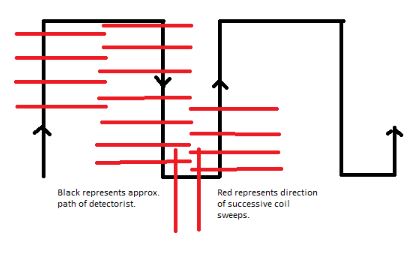
The following illustration shows how your sweeps will be more to the right if you are holding your detector in your right hand.  To cover the entire area well, the distance between your north and south paths will not all be equal.  The first north and south paths are farther apart than the first south and second north path because the sweep is longer on the right of the detectorist.
Path Adjusted For More Complete Coverage Without Much Overlap


Here is an rough illustration of what I would consider a fairly normal sweep.


Note how much more of the sweep is to the side of the hand and the greater length of the sweep on the right partly due to the north to south movement of the coil as well as the east west movement.  That can be used to advantage when are walking parallel to a cut.

Of course different people will have a different sweep and may vary their sweep at different times.   I find it useful to be aware of how I am sweeping and will change it for different situations.

By paying attention to the biomechanics, you might be able to hunt tighter, longer, without becoming tired so soon, and [prevent overuse injuries.

There is also the matter of the vertical movement of the coil, which is just as important.  It is not uncommon for people to lift the coil at the end of sweeps.  That can cause more false signals and reduce depth to the extent that targets are missed.

The type of sweep you use is up to you and might change with the situation, but I think it helps to be aware of your sweep pattern.  You might want to take your detector out to the beach and sweep it on the dry sand just to see the pattern you make.

I'm sure nothing I said today is very surprising, but it is one thing to know something and another to apply it.  I have to remind myself once in a while.

--

Terry asked me if that wasn't a Mexico style cross on the reale I posted the other day.  I took another look, and it does seem to be the Mexican cross.  I thought it might be a Potosi reale before taking a closer look.

Thanks Terry T.

---

Keep watching the Atlantic.

Happy hunting,
TreasureGuide@comcast.net