Showing posts with label Barber dime. Show all posts

Thursday, September 27, 2018

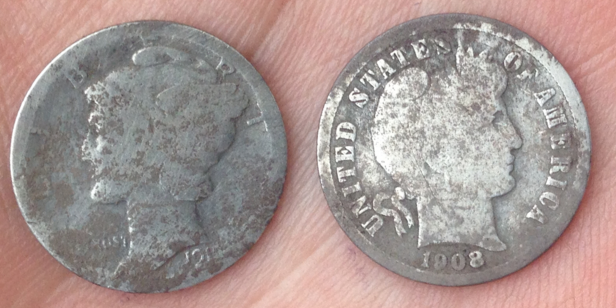
9/27/18 Report - Nine Foot Surf Possible This Weekend. Barber Dime From Rio Mar. People On the Galleons.


Written by the TreasureGuide for the exclusive use of treasurebeachesreport.blogspot.com.

Very Sharp 1915 Dime Once Found at Rio Mar
This dime is very sharp.  It was evidently almost like new when lost.  Look at the sharpness of the details.

You can often get an idea of a where a coin has been by just looking at it.  This one probably spent most of it's life in the dunes.  It doesn't take much salt water exposure to blacken a silver coin, but it evidently was not in the surf.  The details are too sharp for that.

Too bad about the surface oxidization, it would otherwise grade very well.  As it is, most coin collectors would not have much interest in a coin like this.

---

One day I talked a little about the variety of,people that would be on a galleon, from all the way at the top rank down to the cabin boy, but did you know that on warships there was a trumpeter?  In the sixteenth century there would be as many as six trumpeters on a warship, but by the seventeenth century there would be just one.

During battles, the trumpeter would stand on the afterdeck near the poop lantern and play continuously.  When there was no battle, he would play mornings and afternoons and at official ceremonies.

Galleons required a lot of maintenance on long voyages.  Of course skilled workmen were needed on each galleon.  They included carpenters, caulkers, a cooper, etc.  There was also a skilled diver.

The skilled workers had to supply there own tools and make repairs.  Even when there was no battle, rough seas could damage caulking.  Twice a day the caulker inspected the pumps and reported their condition to the captain and pilot.

During battles, the carpenter and caulker stayed below decks and repaired any damage from artillery.  They also worked on the ships during careening between voyages along with local workmen.

You can think of treasure and Spanish galleons and overlook the logistics and all of the daily duties that were conducted by the people on board.  It was no walk in the park.

If you are interested in learning more about that, and everything that went into the building of a galleon in the seventeenth century, I recommend Carla Phillips' book, Six Galleons for the King of Spain.

---

Last weekend the 4th Annual Pirate Fest was held in Vero.  Alberto S. said a there was a nice crowd and lot's of fun especially for the little ones, even a cannon demonstration. Carl Fismer was promoting two books and a sunken treasure workshop in Islamorada in October which includes dives to 2 wreck sites.  

I missed that one.

---

Kirk is still a tropical storm and headed towards the south Caribbean.


Source: nhc.noaa.gov
I'm hoping for some cooler weather.

It looks like a big Treasure Coast surf will be coming this weekend.
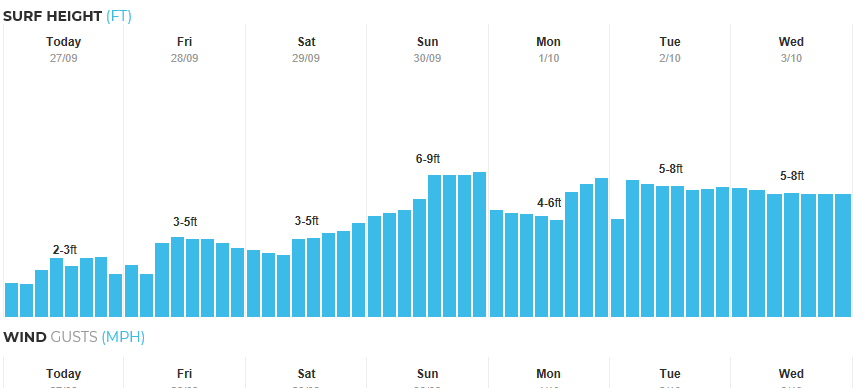


Source: MagicSeaWeed.com.
Happy hunting,
TreasureGuide@comcast.net


Monday, July 30, 2018

7/30/18 Report - One Find. Database of Ancient Finds. How To Identify Valuable Modern Coins.


Written by the TreasureGuide for the exclusive use of treasurebeachesreport.blogspot.com.

1899 Barber Dime
Found on the Treasure Coast


Silver 19th century coins are often heavily worn like the one shown above.  It seems they were kept in circulation a long time.  As you might guess from its appearance, although it is a Treasure Coast find, it was not found on the beach.  

In this condition it might be worth around four dollars.  If it was in much better condition, it might be worth over a hundred dollars.  That doesn't seem like much when you consider how long it was lost and the difficulty of finding one in the field.  

---

Here is an interesting British metal detecting club web site including a database of interesting ancient finds.  There are many individual finds along with some hoards.

http://www.colchestertreasurehunting.co.uk/H/hoardandtreasure.htm

I think someone sent me this link back a while ago.  Sorry I forget who now.

---

I found a very good pdf document about how to identify valuable coins.  You can find them in pocket change or in your goodie box.

Here is the introduction just to give you an idea what it is about.

Almost everyone has a box, can, jar, or piggy bank full of spare change. Who knows what treasures might be found in this change? And how do you tell the difference between ordinary change and a collectible coin? Is it possible to find something worth more than face value? Yes, it is! Even better, you might be able to make some money from your pocket change.

Numismatics is the study and collection of various forms of money throughout history. It is an intriguing and rewarding hobby. Numismatists can do well given the opportunity by examining many different coins to notice differences — including comparisons among coins with the same denomination. There are subtle variations — even among coins with the same year and mintmark — and recognizing these distinctions can pay off handsomely.

A numismatist becomes skilled through years of study, but eventually the effort becomes worthwhile and it’s possible to find real treasures in your change. New collectors may become discouraged if they don’t make exciting finds right away, but patience has proven to be a valuable trait toward becoming a successful collector. Many treasure hunters say it’s not about having the treasures, it’s about finding them – the thrill of the hunt.

The guidelines provided here are intended to assist the beginning collector.

Here is the link if you want to read the rest of the 26 page document.
https://www.money.org/uploads/treasures/TreasuresPDF.pdf

___

The mind is amazing thing.  There are rare occasions when you can recall the smallest details from the most distant times.  As crazy as they might seem, dreams seem to play an important roll in taking you places in thought and feeling that you don't normally go in normal waking consciousness.  I often awake and see things differently or feel differently about things after reflecting on my dreams.  Sometimes I'm motivated by dreams, like when I wake up from a dream of finding a lot of treasure of one type or another.

Last night I dreamed I was at grandmas house, where I spent my first five years before my dad and mom built their own house.  It has been a long time since I was there and grandpa and grandma are long gone.  Grandpa and grandma were there, of course.  I hadn't seen them in quite a while.  A couple of their friends that usually visited on holidays were also there and sitting on lawn chairs in the back yard, as they often did.

It wasn't one of those real crazy dreams - just a nice visit with the past and some of the people I miss the most.  It was a little strange - but not very, as dreams are judged.  More than anything, it brought back memories.   It is surprising how much detail is stored away deep down in your brain somewhere.  You normally just can't recall a lot of what is there.

As I entered their house, I went to turn on the light over their driveway.  There were two light switches beside the cellar door.  At first I hit the wrong switch and the cellar light came on.  That is the exact position where those two switches actually were.  I remember that now even though if you asked me before the dream, I would never have been able to remember that.

So what does that have to do with treasure hunting?   No matter what the task is, you have more knowledge than you realize.  Some of it is unconscious.  You can use that.  Some people call that intuition.  It is based upon unconscious or subconscious knowledge.  There is a difference between the two, but that isn't important now.  My point is that your dreams can provide deeply moving experiences and provide greater access to knowledge and provide insight and intuition.  And secondly, you probably know more than you think you do if you can only access it.

---

Nothing new with the beach conditions.  I'll keep watching for storms or changes.

Happy hunting,
TreasureGuide@comcast.net

Sunday, May 28, 2017

5/28/17 Report - Understanding How Nature Creates Treasure Caches. The Importance of Visually Scanning Treasure Sites.


Written by the TreasureGuide for the exclusive use of treasurebeachesreport.blogspot.com.

Finds and photo by Russ P.
Note the Barber Dime and Other Old Coins.
Russ sent me a great email in response to my 5/23 post in which I wrote on the subject, "You can't accomplish what you can't imagine."  Here is what Russ said.

Hope you are doing well.  Enjoyed your column yesterday *  I found it to be dead on.
I first detected between the years 1984-1989.  Though my area was moderately hunted, I never met any other detectorists.  However, I read a lot of the treasure magazines that were available.  I spent way too much mental time lamenting that I wasn't in one of the "good" areas that produced great finds featured in the articles or wishing that I would have gotten into detecting in the 1970's before everything was hunted out!  I'm embarrassed by my mindset, looking back.  I found 26 silver coins in those five years, the oldest 1936.
When I was reconsidering the hobby five years ago, the big question in my mind was if there were any finds left.  I almost did not purchase a detector because of that concern.  However, I'm glad I did.  I am primarily interested in old coins and my current finds far outstrip those finds from the 1980's, including finds that I make without even using a detector, despite hunting in the same general area that I felt was hunted out in the 1980's.
The fact is that some  detectorists find much more than others.  Even if someone does not find more than you, there may be something to learn.  If you had been showing up at my club (though I'm not in one!) with all those finds, I would have been picking your brain for something to apply to my detecting situations.
I don't watch many youtube find videos, but occasionally I'll watch the innovative aquachigger.  This video made me think of your blog, as it demonstrates many of the points you make.
He goes to unfamiliar territory in Texas, I think, to fossil hunt on a river with a local buddy.  However, he happens upon a collection of iron junk that he quickly realizes has been "sorted" by the river.  He then goes on to eyeball some great coins.  The local guy, who hunts the river for fossils all the time, has never found a coin on the river!  Aquachigger finds a handful, by eyeballing, on his first trip.  There are so many lessons here, but perhaps the biggest is there is a reason why some folks find more than others and it is almost never due to luck.
I'm sending you a picture of my morning finds in an hour hunt.  It is a lot I've been to several times, finding only a couple of wheats and a few marbles, but clearly with more potential.  Conditions changed so I returned.  This is the most marbles I've found in an outing and some are in terrific condition.
Take care,

Thanks Russ.

If you watch that video, you'll see how the fellow found old silver coins without using a metal detector.  The video provides some very good tips.

In the past I've talked about eye-balling a lot.  Closely inspecting the area is always a good first step.  You can visually scan a lot of ground quickly.  That will help you get some good ideas on where to spend your with a metal detector.

Below is an area that I hunted briefly about a week ago.


Back maybe ten or more years ago, this structure was buried.  I could see something was there but I didn't know what.  I could just see a few very small pieces sticking out of the sand. I could detect big iron and more to the right of what you see in the photo, I could see a little of what were obviously large slabs of concrete sticking out of the sand  The structure that you see in the photo was not visible at all.

When I last detected the area I found some iron  along with a few badly corroded and encrusted coins.  Also some sinkers and bullets.

You should be able to imagine the path of coins as they would travel over the years. Some of those eroding out of the sand to the right of the picture, assuming they were there to begin with, would be caught by the structures, settling into the crevices and around the structures.  The water would rush around those things, and the objects would stop where ever they got caught or settle into dips or crevices.  When they get covered they won't move for a while until they get uncovered and the water rushes over them again.  Then they'll either be washed out or sink deeper as the sand washes away. The deepest they will sink will be lowest point that the sand was eroded.  The covering and uncovering can happen many times, but they'll only move when exposed and they'll only sink to the lowest surface area created by the erosion.

If there were any items lost before the structure was created, they might still be near the bottom of the structure.

In the above picture you can see a depression around the posts at the front of the picture.  That depression is caused by the water rushing around the posts.  Coins, or whatever, that are washed out of the bank and down the slope can be trapped in depressions like that and remain there until the sand erodes more or the force of water increases enough to wash them out, which of course, would also move more sand.

Unfortunately you won't be able to detect very close to the structures.  To complicate matters, there are plenty of iron bolts and nails.

The only way you can get to the accumulated items, is to remove the sand or wait until erosion moves the sand again.

Older items will tend to be deeper because they would have been can sink deeper every time the sand is eroded to a deeper level.

More recently lost items will be very near the surface, depending upon how far the sand eroded in the recent past.

There are two big points that I want you to get today.  One is the value of eye-balling, and the second is the importance of understanding how water moves sand and other items.  If you understand that, you can figure out where things will accumulate.

---

On the Treasure Coast, the surf is going to be smooth, the tides big and the weather hot.  We'll have some nice negative tides.

Have a safe weekend.

Remember.

By the TreasureGuide@comcast.net

Thursday, January 28, 2016

1/28/16 Report - Old U. S. Coins and Veteran's Commenmorative Medal Finds From Inland Sites.


Written by the TreasureGuide for the exclusive use of treasurebeachesreport.blogspot.com. 

Couple Nice Finds by Dan B.
These are inland finds.  As often happens with worn Mercury dimes, the last digit is unreadable.  As you can see, the Barber dime is a 1908.

Nice finds Dan.

---

William M. also has been hunting inland and making nice finds.  Here is a nice Barber quarter.

1898 Barber Quarter Found by William M.


Back of Same Quarter.

Veteran's Commemorative Medal
Found by William M.

Other side of same medal shown
at right.

William also found this medallion.  The front (right) reads, "Honoring The American Veteran."

William found some other good items along with these.

The medal is obviously not as old at the Barber quarter.  Great finds!


Thanks to Dan and William for the find photos!

---

It isn't easy to find old U. S. coins on Treasure Coast beaches.  As I stated, those shown above were recently found at inland sites.

As strange as it might seem, it is easier to find 18th century Spanish coins on most Treasure Coast beaches than it is to find U. S. coins from the 1800s or even early 1900s.  Our beaches were not heavily populated in the 18 and early 19 hundreds.

I've seldom seen old U. S. coins that appeared to wash up onto our local beaches, and those were usually barely recognizable.  Of the Barber and other older coins that I've found on Treasure Coast beaches, most seemed to come out of the dunes rather than being washed up.  

I spent one very good day years ago digging many old U. S. coins that washed out of the dunes at Jupiter Inlet.  I thought it was a little strange that I didn't hit any Spanish cobs that day even though cobs did wash out of the same dunes at other times.  That was back before the Jupiter wreck was located and salvaged.

---

Very rainy the past couple of days.  We'll have a few days of small surf now.

Happy hunting,
TreasureGuide@comcast.net

Friday, January 22, 2016

1/22/16 Report - Two Million Dollar Dime. Tiffany Gate Link Ring Cleaned. Safety For Using Muriatic Acid.


Written by the TreasureGuide for the exclusive use of treasurebeachesreport.blogspot.com.


This 1894 S Barber dime was sold at a Heritage Auction on January 7, 2016 for nearly $2,000,000.  Only ten of these are known to exist.

Here is the link for more about that.

http://www.coinweek.com/auctions-news/1894-s-barber-dime/


---

Yesterday I talked about cleaning encrusted coins.  Things besides coins need cleaning.  Rings and other things can be encrusted too.

Silver Tiffany Gate Link Ring.
Find and photo by Robert H.
Notice the Tiffany and Co. mark and the silver mark.

Gate Link Ring After Cleaning.
Photo by Robert H.
That is a unique ring.  Very nicely cleaned.  A used ring like this would probably sell for nearly $400.

Tiffany Ring on Sizing Mandrel.
Photo by Robert H.
Bill Popp, who originally explained the Muriatic Acid cleaning method for this blog, sent an email and said, " ... muriatic acid at room temp does not attack copper, silver or gold... Any other metal coin may be junk anyway (aluminum?)..."


I didn't mention gold because it rarely needs cleaning, although old pieces will occasionally collect a little coral or something.  If the crust is only light, I'd probably let it stay. It depends.

Thanks for sharing Robert and Bill.


I should remind you that Muriatic Acid is a strong acid and requires safety precautions.  Wear protective gloves, goggles and do not breathe the fumes.  Do not use it in the house or around furniture or other items that can be damaged.  Do not get it on your skin.  Store it safely.

Here is a web site explaining the safety precautions.

http://www.doityourself.com/stry/10-muriatic-acid-safety-tips#b


Muriatic Acid is used to maintain swimming pools and can be purchased at pool supply stores.

---

The weather is changing.  This morning the wind was more from the south, but now it is more from the west.

The surf will be small this weekend, but increase Tuesday.  The tides are decent, with negative lows.

Happy hunting,
TreasureGuide@comcast.net


Thursday, May 14, 2015

5/14/15 Report - Breaking Out Of The Rut And Beating The Crowd. Prospecting For New Metal Detecting Sites. Barber Dime Find.


Written by the TreasureGuide for the exclusive use of treasurebeachesreport.blogspot.com.

!904 Barber Dime Find
Find and photo by Dan B.
Sometimes it might seem like there are too many people with detectors these days and that every good place has been cleaned out.  There are a lot of guys with detectors, but the fact is that most of them are hunting the same few spots. It's true! If you stop at some beaches any day of the week, you'll see one or two other detectorists and sometimes six or more.  

Dan B. found the nice 1904 Barber dime shown here.  Really neat!  Besides sending the photo of his recent find, Dan  mentioned something that I talked about before.  It is something that helped him, and it might help you too.

Here is what Dan said.

 I remember what you once said about barriers or things that guard good targets. Like depth, a tree, or weather, etc.

It has served me well to actually go looking for "the dragon" that signals a possibly hidden spot.  It is really about determination and creativity.

Same Dime
Find and photo by Dan B.

I did say that, and it is true.  While there are a lot of guys out there detecting, most of them are doing the easy thing.  They go to a place where they can park their car and walk across the walkover and start detecting.  It doesn't take much time or effort.  

The guys that are finding the most are spending the most time detecting, but they are doing something else as well.  They go a step or two beyond what most people are doing.

One guy I knew was good in the water.  He was very fit and an expert at what he did.  He would swim across the intercoastal if that is what it took.  As a result he found and detected good places that he had all to himself.

Others weren't so good in the water, but would walk miles to get to a good spot.  That is how they took it to another level and beat the crowd.

I know that not everybody is able to do that kind of thing, but many just aren't willing.  That is one of the biggest differences between the guys that make more finds and the others.

In many cases, it just takes a little additional effort.  In some cases, it takes a lot.

Don't get me wrong.  If you detect for a little casual entertainment and want to get out there and relax, there is nothing wrong with that, but don't expect to get as much as someone who is dead set on coming back with something very nice and spends the additional time and puts in the additional effort.

I remember one day when I was determined to get a piece of gold.  I wasn't having much luck that day either.  I started in the morning and it took me to near sundown to hit that piece of gold.

I'm not like that anymore.  I'm much more casual about things.  Back then I was trying to see what I could do.  Now I know what I can do and what it takes, and I'm not as driven.  If I really got interested in doing something in particular, I could be just as intense again, but usually I don't need to.   

In Dan's email he mentioned an ant hill, which is where he found the dime.  Anything that can discourage others can protect a treasure for you.  It can be weeds, bushes, distance, weather, hard rocky soil, muck or mud, trash or whatever.  Anything that will discourage the crowds provides an opportunity - if you are willing and able  to overcome it.

I remember my first introduction to fire ants.  It was while digging a target.  Now it seems I'm almost immune to fire ants.

By the way, in the past year I've seen three Coral snakes.  Watch out for anything venomous.

When people are going through one of those inevitable dry spells, which are bound to happen from time to time, the first thing they start to question is their detector.  If you do some simple tests like those I've described in the past, you can quickly tell if your detector is performing well enough. The problem is seldom the detector though.  More often you have fallen into a rut, doing the same old things at the same old places time and time again.  Yes, conditions play a part in it, and to some extent luck, but when you have been striking out on a regular basis, it is always a good idea to try something different - something that will separate you from the pack, and maybe something you've never tried before.

Believe it or not, despite the number of other detectorists, there are still good spots out there that you can have all to yourself if you are willing to invest some time in exploring new areas.  When you explore new areas, you might strike out nine times out of ten, but that one hit will be worth the effort.  It can pay off for years to come.

Don't think that just because you didn't find anything the first time you visited a new spot that it is no good.  There are always the current conditions to take into account.  It will often take a few visits to identify a good new spot.

When I was hunting hot and heavy down south, I hunted some of the same spots as everyone else, but I also had a number of spots that I had very much to myself.  I would visit them over and over and never see anyone else there.  They really weren't all that difficult to find either, but they did require some prospecting.  

When conditions won't change for the better, you might have to.

On the Treasure Coast expect something like a two foot surf for a few days.  Nothing better in sight real soon.  We do have a nice negative tide though.

Happy hunting,
TreasureGuide@comcast.net

Monday, December 15, 2014

12/15/14 Report - Proper Respect For History & Religious Artifacts. Deadiest San Fran Shipwreck Found. Barber Dime.


Written by the TreasureGuide for the exclusive use of treasurebeachesreport.BlogSpot.com.

Barber Dime
Find and photo by Dan B.


This is the first Barber found by Dan B.  

Congratulations Dan!


---------------


You might know of Laura Strolia, author and researcher.  I've posted some of her articles before and mentioned her book The Marigalera of the 1715 Fleet.  Here is a new article from Laura that addresses the subject of religious artifacts, such as those from the 1715 wreck sites.  I also once posted an article she wrote about the Pelican of Piety.

-----------------

Around the bend is the 300th year anniversary of the 1715 fleet disaster, a time when people will stop and reflect on the tragic event that took so many lives.  Stimulating thoughts about history requires stories of the past to be presented in truth and with integrity.  Over the decades the 1715 fleet story has been told with little or no corresponding references and sources.  Names and details have been lost or exaggerated, and assumptions have been made with false or incomplete premises, thus creating the framework for pieces of fiction. 

Recently, a published article about the 1715 fleet named a certain passenger who was on one of the ships, Pedro Colarte y Dowers, the first Marqués del Pedroso.  This nobleman was indeed a successful Flemish merchant and art collector, as stated in this magazine account.  There is, however, a major problem to bring to light.   Pedro Colarte was never on the 1715 fleet because he died in 1701.  The young Colarte moved to the city of Cádiz, Spain, in 1649.  He then married, started a family, and his son, Carlos Francisco, was born in 1654.  He was made a knight of the Spanish Orden de Santiago in 1663, and passed away around the age of 70. 

In another section of this publication, it was said a recently discovered religious reliquary pendant, mistakenly identified as a pyx, was going to the Vatican in 1715.  To make an assumption as this, especially when dealing with religious artifacts that represent the very heart of the Holy Faith, shows a lack of respect and an absence of valid research.  To some it may even reflect ulterior motives associated with dollar signs.

It is worth noting that objects of devotion that have been “blessed” should never be sold, improperly used, or “thrown out.”  They have been solely dedicated for divine veneration or worship to God.  Father William Saunders of Our Lady of Hope Church, Potomac Falls, VA, makes some good points.  “Living in a society where things have become so disposable, we must differentiate from trash those religious objects that have been blessed and dedicated to God for sacred use.  My heart breaks every time I enter an antique store or look on EBay or another website and find a chalice, a reliquary (sometimes still containing a relic), vestments, and other objects that were once used for the holy Mass. …The owners should have tried to find these religious objects a new home in a mission church or disposed of them in the proper way.”

To conclude, written history is not about random words found on paper.  The content should reflect a certain culture while revealing the many material objects of earlier days, thus touching the reader on an intellectual, emotional, or spiritual level.  Our passion should lie in getting the history right for future generations.  Concerning those people who traveled on the fleet, or had any connection or ties to it, shouldn’t we make a conscious effort to keep their memories true to their past existence? – Laura Strolia

Sources:  Brown, Jonathan. Painting in Spain: 1500-1700. New Haven: Yale UP,    1998.
              Moreri, Louis. El gran diccionario historic, o Miscellanea curiosa de la  Historia Sagrada y profana… Paris, 1753.


-----------------

Here is a Yahoo News article about what has been called the deadliest shipwreck of San Francisco.

In dark waters just outside the Golden Gate Bridge, archaeologists have pinpointed the final resting place of the worst shipwreck in San Francisco's history. 

New sonar maps show for the first time the mud-covered grave of the SS City of Rio de Janeiro, nearly 300 feet (91 meters) below the surface. The steamer sank on Feb. 22, 1901, just before reaching its destination, with 210 people on board, most of them Chinese and Japanese immigrants...

Here is the link for the rest of the article.

http://news.yahoo.com/golden-gates-deadliest-shipwreck-located-175612345.html

------------------

On the Treasure Coast we have something like a 2 - 3 foot surf now.  Towards the end of the week it will down around one foot.

Happy hunting,
TreasureGuide@Comcast.net

Thursday, April 10, 2014

4/11/4 Report - Old US Coin Bonanza Including 21 Over One Hundred Years Old Taken From One Site


Written by the TreasureGuide for the exclusive use of treasurebeachesreport.blogspot.com.

Barber Quarters, Dimes, Mercury Dimes, Indian Heads, Buffalo Nickles, etc.
Finds and Photo by Russ P.


I received an email from Russ P. who shared about finding one of those sites that detectorists dream about.   In the process he recorded several big personal firsts!

Here is Russ' description.

I thought you might like this story, though it involves a mainland site.

I happened upon a site next to a building that used to be an old A&P.  The concrete parking lot had been removed at least a week or so.  I was disappointed to immediately notice that someone had been there first, as there were a few scattered holes down the middle of the site with the dug metal junk beside.  I was not very optimistic and debated even pulling out the detector, especially since it seemed the prior detectorist had left without finding much.

What followed was the most thrilling few hours of detecting time that I've had as I realized that I had found, for the first time in my experience, a nearly unsearched site with access to much older coins.  I had a taste of what it must have been like for those detecting in the 1970's and early 1980's. 

I spent five hours the first day.  It was not a large site, probably just 30 by 100 ft, but I go slow and there was a lot of iron.  I actually moved faster than I would have liked towards the end, but still I felt like I covered the ground fairly well.  My coin totals blew me away, with 45 coins earlier than 1945 and twelve silver coins.  One was a 1915S Buffalo.

I returned a second time for just one hour and worked a few of the planters and other poorly accessible areas and found six more pre-1945 coins including an indian-head.

Taking some advice from your blog, I switched to a smaller coil and returned for a third time.  I then covered the ground by swinging the coil at 90 degrees to the angle of my initial coverage.  I only had two hours, so spent them in the areas of previous highest yield.  There had been no further disruption to the site, so I was stunned to find eight more old coins, including three silver.

Then it got really interesting.  I returned for a last time after final preparations had been made for the new pavers.  Excess concrete from the newly poured curb (which was poured prior to my first visit) had been scraped from the edges.  I covered the entire site again, finding twenty-three more old coins, with six silver.  I found my second Barber quarter at the site in a spot that I am certain I passed over with the coil twice in earlier searches.  

I learned so much in those few days. It was an area small enough that I could cover well, but I now believe, because of this experience, that there are truly no completely cleaned out sites.  I would work that site a dozen more times if I could as I firmly believe there is a lot left.  Unfortunately, it is now covered with pavers so I'll have to be very patient.  Maybe in a couple of decades I'll have a second chance!

There were many first finds for me at the site, including these highlights:  first Barber quarter (I found two), first double-digit silver day, first V-nickle with legible date (I found nine). Twenty-one coins were older than one-hundred years. 

In hindsight, there were several techniques that led to additional finds: extreme persistence once the site is known to be productive, covering the same ground repeatedly from different angles, switching coils, removing surface iron.  All of those techniques have been mentioned in your blog, so thanks for those tips.  I would have liked to have dragged a magnet and used a different detector but just ran out of time.  I'm convinced that I would have made additional finds had I done so.

I've included a picture of my uncleaned finds from the first day.  I'll send two further pictures of the finds cleaned.

Russ P.

I showed those two photos of the cleaned coins that Russ sent.

Thanks for sharing Russ!
 
More Silver Finds by Russ P.
 

There are several lessons that you can get from Russ' experience.   Here is a big one.  Don't give up on a site when you get there and see holes where someone has already been and found junk.

Many detectorists have no tolerance for junk and give up on excellent sites way too soon simply because they find junk.

You will often find the junk first.  Junk is often big and often is close to the surface.  As a result, if you are not an experienced detectorist, you will find the junk first.   If you give up after finding the junk, you won't get to the good stuff.

Many good targets will be masked by the junk.  It can be worth the time to remove some of the junk to see what might be in between the junk or under the junk.

An inexperienced detectorists will often leave a lot of big holes and dig a lot of junk while a lot of good targets remain.   Don't be fooled by those holes.  Check to see what remains.


Another good tip that this story bring out is to watch for special opportunities.  They usually are times when the soil or sand has been moved a lot, either by man or mother nature.   Always keep your eyes open for those special opportunities.  And when they occur, take advantage of them.  You never know how long they will last or what will end them.  The window of opportunity can close as quickly as it opened. 

I remember one particular time when Mother Nature slammed the door shut.   I had spent a little time on each of the two previous days at one water site, when the second evening the wind changed direction and the targets that were all over the place disappeared by the next time I visited.  The change in weather took a site that had hundreds of targets and completely shut the door.  In retrospect, I realize that I should have worked the site harder while it was producing. 


Online bidding has begun for the Sedwick Coins auction # 15.  Some lots already have bids.

http://auction.sedwickcoins.com/Treasure-World-U-S-Coin-Auction-15_a20264?p=1&ps=50&m=all&ca=860000&so=1


The tides on the Treasure Coast have been close to normal lately.  The big tides that we had a while ago are over for the time being.

The wind Friday will be directly out of the East and the surf will be down around two or three feet.  That won't do anything to change our poor beach detecting conditions.

Happy hunting,
TreasureGuide@comcast.net

Saturday, April 5, 2014

4/5/14 Report - Barber Dime, Small Gold Ring, $40 Million Chicken Cup, Wood Butter Bowl & Multi- Million Dollar Chicken Cup


Written by the Treasureguide for the exclusive use of treasurebeachesreport.blogspot.com.

As you know the beaches haven't been great lately, but like I said yesterday, things are still being found. 

William M. has been off-beach and making a lot of very nice finds.  Here is one.

Photos by William M.
1907 O Dime Found by William M.


Good detail.  Nice condition.   Obviously circulated, but while that might reduce the price, the smoothing from handling makes it all the more charming to me.

Here is a good table of Barber dime values.

http://values.hobbizine.com/barber-dimes.html

It isn't nearly as old as some of the shipwreck cobs you might find, but it as valuable as some cobs.

Way to go William!


When the beach conditions are poor I often revert to hunting modern items.   That hasn't been too good on Treasure Coast beaches lately either, but when beach conditions are poor water hunting can be fairly easy even though the spots that aren't buried in sand can be hard to find.

Here is a very small 10K ring that was found yesterday.  It must be a child's ring. 

It is only 1 gram of 10K gold.  Gold rings that small are often missed by many detectorists, especially if they are using too much too discrimination, and it doesn't take much to be too much.

I like the nice delicate design.  As I've said before, I like finding the small items.  If you are finding the smalls, your detector settings and technique is probably pretty good.

The ring has a little sand encrusted in some of the depressions yet.


I ran across a web site the other day that I wish I could find again.  A fellow was showing a collection of old items that had been repaired long ago.  The repairs were old repairs and it was fascinating to see the old techniques of repairing things.   These days most things just get thrown away instead of being repaired.

If anyone knows the web site I'm talking about or a familiar one please let me know.

For example, they had a copper kettle and showed how it was repaired.

Below is an old wood butter dish.  I would say it is 19th century.  I really like it even though it is needs a lot of help.  In the picture it is sitting on an old sewing cabinet.

Old Wood Butter Bowl.
 Notice the cracks.  It has some gunk on it that needs cleaned off.

Below is a close-up of an old repair that was made to the bowl.

They drilled a hole on each side of the crack and threaded a wire through the hole and twisted it tight.  That was evidently done a long time ago.


Close-up View of Wire Repair on Cracked Wood Butter Bowl

When I grew up most of the local families out in farm country still had a butter churn even if they didn't use it anymore. 

I don't doubt that this bowl was actually used for making butter.

The fact that it was heavily used and repaired makes it all the more charming to me. 

You can see how it was worn by much handling over the years - more interesting to me than an unused mint item.


On the other end of the spectrum, there is a "chicken cup" being sold by Sothebys that was made in China just before 1500 AD that is expected to sell for tens of  millions of dollars.

The reason I mention the "chicken cup" is that people sometimes find shards on the Treasure Coast, including occasionally some Kang-Xsi porcelain which was carried on the 1715 Fleet.  You therefore might want to know something about how to identify items like that.   It can be difficult to identify shards, but there are some easy-to-identify features of fine Chinese porcelain.

Fine Chinese Porcelain "Chicken Cup"
There are only four authentic "chicken cups" known to exist and that is one reason they are worth millions of dollars.   There are many fakes.

When I saw the picture of this "chicken cup" I could immediately see many of the features that are common to fine antique Chinese porcelain including Kang-Xsi. 

If you study examples like this you will be better able to identify them if you see them on the beach.

Most of the pieces of Kang Xsi you might find will be blue and white.  Pieces with additional colors can be more valuable. 

Notice the shade of blue.  That is typical.  So are the flowing hand-painted lines.  They have a distinctive look.  Also, porcelain like this will be very thin and delicate looking and very white. 

With a little practice you can learn to identify pieces like this pretty well.  

Inexpensive 19th century pottery  is typically much thicker, of courser grain and if broken is yellowish or beige instead of white on the broken edges.

I'm definitely not an expert on this and might not be using the correct terms but from observation have learned how to tell the difference between common colonial ceramics and Chinese porcelain.


I did a few posts on beach dynamics.  I received some correspondence on that, but I don't know how helpful it was to you all.   To me it is very important knowledge and helps me to quickly tune into the hot spots on a beach.  It isn't easy to explain, but it is very important.


I also hope you appreciate the bibliography on Spanish colonial America that I posted.  That to me is very valuable.


On the Treasure Coast the winds will be mixed today.   The surf will be up around three or four feet this weekend, diminishing next week.

Happy hunting,
TreasureGuide@comcast.net


Saturday, January 29, 2011

1/29/2011 Report - Barber Dime & Other Old Coins From the Port Salerno Area


A Few Nice Metal Detector Finds.

Photos submitted by Mike T. who found these items.

Since shipwreck beach conditions haven't been very good lately, a few times I've mentioned the idea of hunting some different places and going after different types of things. Doing some different things every once in a while can improve your chances of success and you'll learn some new things in the process. In sports they call that type of thing cross training.

One of the guys I talked to on the beach a couple of days ago was from Arizona and mostly hunted ghost towns. He said he missed finding silver dollars and things like that.

Everyone, I think, has a special interest in a particular kind of treasure. For some people it is gold and diamond jewelry, for others it is old coins, for others it is gold nuggets, others like fossils or Indian artifacts, and for others it is shipwreck treasures. But for treasure hunter there alwasy seems to be one type of treasure that gets them most excited.

What you hunt to some extent is determined by where you live and what you know about that can be found in the local area. When I was talking to the fellow from Arizona, I pointed out that there were a couple of 17th Century shipwrecks just a short distance from where we were. He thought you would have to get in the water to be able to get anything off of those shipwrecks. You certainly have a better chance at things like that with a salvage boat, blowers, tanks etc., but sometimes things like that do wash up onto the beaches.

But the point I wanted to make is that most people focus on one or two specific types of treasure, and most people know about those types of treasures and how to hunt them, but they don't know as much about how to hunt other types of things.

Hunting coins is definitely much different from hunting fossils or Indian artifacts. You can use a metal detector to find coins but fossils can't be detected with a metal detector. You have to use other techniques to find them. You have to develop a different set of skills and a different knowledge base to do well hunting fossils or Indian artifacts.

You'll probably be best at finding what you hunt the most. But if you hunt other types of things and do other types of hunting, you'll learn things that can help you no matter what you hunt. You can always learn something from one type of hunting that will help you with another type of hunting. That is one reason, I recommend doing something different every once in a while.

Mike said that in South Stuart near Port Salerno ...there is quite a bit of history dating back the early 1900’s due to the railroad, the fishing industry and of course pineapples. Over the last few months Martin County has been making improvements in the downtown and waterfront areas of Port Salerno. This included adding some water lines, drainage and most specifically digging up an old alley between the current Post Office and one of the oldest buildings in town. In the early 1900’s this dirt “alley” was used extensively as a means to get fish from the fish houses down on the Manatee Pocket up to the railroad for shipment. So when the County started digging up this old alley way I just couldn’t believe it! What an opportunity to hunt some well traveled ground that might hold some treasures from long ago.

Fortunately the contractor was slow and made a number of mistakes along the way which gave me ample opportunity to hunt it on a number of occasions at different stages and depths of digging. As you can see from the pictures included there were some treasures there indeed and I'm sure many more which are now covered in concrete for another 100 years. The venture yielded a 1912 Barber Dime in excellent condition, a1902 Indian Head also in excellent condition, a 1945 East Indies Penny and several wheat cents and of course quite a number of modern coins as well. One of the most interesting things was an original COTY lipstick case circa 1920’s. Unfortunately it was a bit damaged but it has a beautiful design etched into the case and it still has lipstick in it! There were also a number of old bottles found too which was really cool to see and of course due to the fact that it is a fishing village we must have dug at least 10lbs of old lead sinkers from all the old fishing nets. There was no shortage of trash either which called for the use of a 6” coil and what a difference that made in picking out the good stuff!

I must say though that one of the best treasures I found in all was meeting a fellow treasure hunter named John who was visiting from the North East. I was a really pleasure meeting someone else with the same enthusiasm for finding “stuff” as me!


Thanks for the story Mike. It should give some people some hints.

Even though Treasure Coast residents hunt the shipwreck beaches a lot, there are other places to detect on the Treasure Coast. In fact I've mentioned the Bulldozer Hoard that was found on the mainland near Sebastian. I'm sure there are other mainland Spanish Colonial coins to be found as well.

Mike noticed the construction that was going on in an area with a lot of historic activity. It is good to take notice whenever old ground is being turned up. That can bring old treasures into detecting range just like erosion can uncover old coins on the beach.

To summarize my two main points today, first is try new things and places occasionally, and second, always watch for newly disturbed earth, no matter what the cause.


Forecast and Conditions.

Not much new to talk about here. The wind is from the northwest and the seas are calm and will remain calm for a few more days. That means no significant change in beach conditions.

The low tide areas are still pretty accessible. I noticed that the second low tide today will be the lowest.


Happy hunting,
TreasureGuide@comcast.net