Showing posts with label SS Central America. Show all posts

Tuesday, December 10, 2019

12/10/19 Re;port - Rare Mint Error Coins Found on SS Central America. Finds and Friends. Palladium Coins, Jewelry and Investment.


Written by the TreasureGuide for the exclusive use of treasurebeachesreport.blogspot.com.


Nine Rare 1856-S/s Quarters Discovered In SS Central America Treasure.


The fabled SS Central America, the famous "Ship of Gold" that sank in 1857 carrying tons of California Gold Rush treasure, continues to surprise and delight the numismatic world...

Here is the link for more about that.

http://www.coinnews.net/2019/12/03/nine-rare-1856-s-s-quarters-discovered-in-ss-central-america-treasure/

Interesting that they found mint errors on coins that were already rare and historic because of their age and association with the SS Republic.

---

I'm not much of a coin collector.  I don't buy coins.  I like finding coins - even in parking lots.  I check my change, and of course I dig up a lot of coins.

One thing I don't like about the coin collecting hobby is the extreme emphases on condition.  A barely discernible difference that most people can't even see with the naked eye can result in a huge difference in value.  People will pay thousands or millions of dollars for an encapsulated coin that they can't even touch.  

Personally I like coins that show some age and wear.  They've been used and handled.  In my opinion, the wear and patina makes them more appealing.  It tells something of their journey and story.

To be special to me, a find of any type doesn't have to be rare or valuable or highly sought after.  It just has to be meaningful in some personal way.

I've received some very nice coins as gifts.  They are nice enough.  They are shiny and new, some even beautiful to look at, but still something is lacking, and it isn't entirely because of the sealed containers.

There are millions and millions of different kinds of coins.  There are seemingly even millions and millions of rare coins, but a coin is just one more of the millions until it somehow becomes special to you.   Maybe it is the "perfectness" that makes it special to you.  Maybe it is the story behind it - maybe a pirate or treasure story.  Maybe it is something very personal.  Maybe it is just the fact that you are the one that found it.

I just realized that finds are a little bit like friends.  There are millions upon millions of people in this world, but each one is unique. They might not be perfect in every way.  You don't know everything about them, and you continue to learn more about them.  There are probably some things they don't want you to know, but you can accept them the way they are.  They always come with a history and a story.  But the more you get to know them, the more you appreciate them.  And when you find a friend, their story becomes part of your story and that makes them special to you.

---


Currently selling for nearly $1900 per ounce, as an investment palladium (Pd) has been outperforming gold and silver.  While the primary use of palladium is in automobile manufacture, it is also used in jewelry and Canada produces palladium coins.

Here are some facts about palladium presented by Monex.

  1. Palladium is the least appreciated of the four precious metals as an investment, but
  2. Palladium prices have appreciated more than the more popular precious metals over last ten years.
  3. Congressional approval has paved the way for the first Palladium Eagle from the US Mint.
  4. US Mint's Palladium Eagle will use the famed “Mercury Head” dime obverse design.
  5. A United States palladium coin will endorse the metal as an alternative bullion investment.
  6. Recent advances in Selective Catalytic Reduction reduces the quantity of palladium per vehicle.
  7. During a temporary supply squeeze, palladium prices exceeded gold prices, reaching $1,000 per ounce.
  8. South Africa mine production fell over most of the past decade, and is projected to decline further.
  9. For the most part, palladium is produced as a by-product of other mining.
  10. About 40% of the worlds mining supply comes from just one Russian company, Norilsk.

Palladium jewelry will often be marked PD950.

---

The surf will be running around three of four feet on the Treasure Coast for a few days.

Happy hunting,
TreasureGuide@comcast.net

Friday, March 17, 2017

3/17/17 Report - New Margarita Finds. Industry Shipwreck and St. Augustine. SS Central America Search Strategy.


Written by the TreasureGuide for the exclusive use of treasurebeachesreport.blogspot.com.

Beach Renourishment Begins At Jupiter Beach South.
Submitted by CladKing.
Thanks CladKing.

---

The sea is usually rough in the keys in March, however the Mel Fisher organization reports some very nice finds were made recently during a calm spell by the Sea Reaper on the Margarita site.  Exploring a less explored area to the east, a variety of artifacts were found including a large encrusted iron pot.  A iron key and a sword handle was found the next day a little distance away.  These new finds added new possibilities to what is known about the distribution of wreckage.
A second iron pot was found the next day nearly a half mile away, but in a direct line with the first.  It appears that a second scatter lies parallel to that previously plotted.

Here is a three-legged 18th century iron cooking pot from the Industry shipwreck off St. Augustine.
Source: TAMU Dissertation.  See link below.

The pot shown above is not one of those found on the Margarita site. The photo is from a 2005 dissertation by Marianne Franklin entitled BLOOD AND WATER; THE ARCHAEOLOGICAL EXCAVATION AND HISTORICAL ANALYSIS OF THE WRECK OF THE INDUSTRY, A NORTH-AMERICAN TRANSPORT SLOOP CHARTERED BY THE BRITISH ARMY AT THE END OF THE SEVEN YEARS' WAR: BRITISH COLONIAL NAVIGATION AND TRADE TO SUPPLY SPANISH FLORIDA IN THE EIGHTEENTH CENTURY. (More on recent Margarita finds below.)

Franklin's dissertation is something that anyone interested in 18th Century Florida will want to read. It gives a good history of St. Augustine (one of the best I've read) and especially how they were provisioned, both legally and illegally. The Lawrence family of New York was one big player.

The dissertation provides a lot of information on Spanish St. Augustine and how they were supplied by British ships, the Industry being one that sunk outside of the inlet to St. Augustine. Also covered are the artifacts. A good bibliography can be found at the end.


Here is the link.
http://nautarch.tamu.edu/pdf-files/Franklin-PhD2005.pdf

Picture of a Similar Iron Pot In a Ship's Hearth.
Source: TAMU  link immediately above.
--- 

Here is another good read.  It discusses the search for the SS Central America.  It is not about what happened when the wreck was found - just search strategies prior to the location of the wreck.

Here is that link.

http://www.columbia.edu/~dj114/SS_Central_America.pdf

---

Well the surf is still small along the Treasure Coast.  The tides have also decreased.  Not much hope for much improvement over the next few days.  It is however an chance to check the low tide area.

I expect a lot of beach renourishment this summer.  It has started, but there is more to come.

Happy hunting,
TreasureGuide@comcast.net


Monday, September 15, 2014

9/15/14 Report - Treasure Hunter Last Seen in Vero Being Sought By Feds. Edouard Heads North. Solar Storms. Hurricane Hits Cabo. Nice Calm Ocean.


Written by the Treasure Guide for the exclusive use of treasurebeachesreport.blogspot.com.


Predicted Track of Edouard.
Source: www.nhc.noaa.gov
If you noticed more noise in your ear phones than normal lately it could be from the combined effects of two solar storms that hit the earth Saturday.

I have been noticing more noise for at least a couple of weeks now.  I don't know if it is because of the solar storms or not.

Up North the  aurora borealis was brilliant.  (If you've never seen that, it is something to see.)

The following CNN article says, Solar storms can knock out power, interfere with GPS and radio communications -- including those on commercial airliners -- and damage satellites.

Here is the link.

http://www.cnn.com/2014/09/11/tech/innovation/solar-storm/index.html?hpt=hp_c2

There are places on some beaches where your detector will normally chatter a lot as the result of radio or other electromagnetic interference.  Sometimes it seems to be coming from a particular building or radio tower.   Some of those places I've noticed causing detector noise for decades.


There was a guy that told me he thought his detector worked best on the beach front when he swung the coil parallel to the beach.  He thought it was because of the earth's magnetic field.  It is much more likely that he did better when swinging the coil north to south because the water creates salt lines and sand ripples that run along the beach.  


It wasn't long ago that I posted links to reports published by Odyssey Marine Explorations describing the salvage of the SS Central America.  It appears that the fellow that originally salvaged that wreck has disappeared.  He was last seen at a mansion in Vero Beach, but the feds don't know where he is now.  He took off with millions of dollars of gold coins and treasure and evidently didn't pay his investors.  It reads like a made-for-TV story.  Very interesting read!

http://news.msn.com/in-depth/feds-chase-treasure-hunter-turned-fugitive

Thanks to James H. for sending me that link!


This morning the water was calm along the Treasure Coast.  Very pleasant weather!  Visibility in the water was very good.

Here is one local beach near low tide this morning.   Notice the sand bar that formed on the front of the beach.


A few coins were found along the dip.    Nothing in the middle of the bar, as you would expect.

At another beach with a similar bar on the front of the beach, objects were found in the shallow water.  They were mostly recent drops, but did not seem to be sinking rapidly.  The currents there were very gentle, and that is also where the sand that made the bar was coming from.

I always like a beach with some features.   The features help you to see how things are shaping up and that will give you a good idea about where to spend your detecting time.

Some of my finds this morning were obviously very recent drops, while others appeared to have been out there a little longer. 

Take a good look at objects to try to determine how long they might have been there.   That type of information can be a big help.  

Happy hunting,
TreasureGuide@Comcast.net

Monday, September 8, 2014

9/8/14 Report - Great Finds on the SS Central America. Odyssey Marine Reports. Gold Coins and Artifacts. More On Beach Dynamics.


Written by the TreasureGuide for the exclusive use of treasurebeachesreport.BlogSpot.com.


A Few of the Gold Coins Salvaged From The
SS Central America July - Aug.
Source: See link below.
Odyssey Marine Explorations has been working on the SS Central America.  They have been recovering a lot of gold and artifacts and doing a lot of research.  They provide monthly reports on their web site, which I find both fascinating and informative. 

The reports show site maps with artifact distributions, photos of the site, items recovered, and even experiments conducted in the process, such as one experiment that studied how wood deteriorates on the ocean floor.

In the June/July report you will read about how they recovered loose gold that was lost in the wreck.  The gold was being returned from the gold fields when it was lost when the ship went down.  Now they are mining it for a second time, this time from the bottom of the sea.

I think it is interesting that they are using a dredge and a sluice, very much like the sluice that might have been used by the original miners.


I've mentioned before about the gold dust in the ocean off of Rio Mar.  At least one attempt was made to recover it, but it was very difficult and not very effective.


Source of photo: Odyssey report link.
I also find the idea of twice-found objects interesting.  I've mentioned an escudo that was mined and minted in Mexico, then lost in a shipwreck, then salvaged and put on another ship which sank, salvaged and sold, and then lost by whoever purchased it before I found it.  In other words, it was lost in the water and found three times.


Below is the link to the Odyssey Marine June16 to July 15 report.

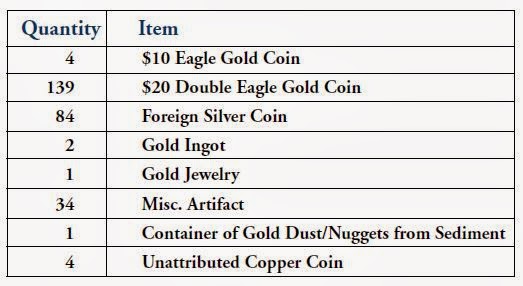
Also below is the summary of finds for that period.

To the left you see a photo of the sluicing operation on board the salvage ship.

http://www.shipwreck.net/documents/OMECourtReport14-3_000.pdf


Summary of Finds From the June - July Odyssey Report.
Source: Odyssey report link above.


And here is the link to their July 16 - Aug. 15 report.

http://www.shipwreck.net/documents/OMECourtReport14-4.pdf


They found a lot of coins during that reporting period.

Below is a photo of a neat pin manufactured from a gold nugget found in the gold fields.\

The report and nugget pin are both from the July16 - Aug. 15 report.


As you know I've done a few posts giving the results of some observations I made on how objects sink at the beach. 

Here is what Bill F., our resident oceanography expert, sent via email concerning objects sinking.

Why do objects sink rapidly?  Look at our beaches..coarse material, or
in some cases, stuff from offshore pumped onto our beaches.  Both of
these materials create a relatively steep beach front.  The high
velocity incoming wave moves material toward the shore. and it drops
out of suspension as the water velocity drops, forming a steep beach.
Now, another aspect takes over.  The water soaks into the coarse
substrate, with very of the wave actually running back out.
Basically, the beach surface churns in place, and the water slowly
returns to a lower elevation.  You've probably seen it running out of
the upper beach at low tide, usually along a line of denser material.

I'm sure you've encountered this well packed shell layer under all
this loose top material.  That's where objects will settle to.

Wave action moves a tremendous amount of material.  If you draw a line
from the dunes to the water, sand will move north and south across it,
but the NET TRANSPORT will be as much as 400,000 cubic yards SOUTH in
our area.

Bill
Thanks Bill!


On the Treasure Coast we still have a very small surf.  We'll have that for at least a few more days.

At least the tides are getting little bigger.  I suspect the rain kept a lot of beach goers from going to the beach this weekend.

There isn't much to be concerned with in the Atlantic.

Happy hunting,
TreasureGuide@Comcast.net


Friday, July 25, 2014

7/25/14 How Not To Miss Gold: Detector Mode Test Results. Saga of the Central America.


Written by the TreasureGuide for the exclusive use of treasurebeachesreport.BlogSpot.com.

Sample Gold Items For Detector Test
There is no detector that can identify any and every type of relic, watch, ring, or whatever with 100% accuracy. I am certain that you will miss some very good things if you simply pass over items because of how they display on an ID screen or because of the audio tone. You have to make a calculated decision concerning how much of what you are willing to miss. 

It is relatively easy for a detector to correctly identify modern US coins.  They can do that well, but the question is, is that what you really most want to find.

Not very long ago I talked about making those decisions in my post on Math for Metal Detecting.  I pointed out how a single good find can be worth more than hundreds or even thousands of coins.

Whatever your decision making process, there is little that is more important than actually knowing your detector, especially how it reacts to high value targets such as gold.   And there is no better way of getting to know your detector than working with known test targets.  It doesn't matter if you are hunting cobs or modern gold, you absolutely need to know how your detector responds to the items that you really want to find.

I did a field test of the ACE 250 not long ago.  It is a low-cost discriminating detector, that in my opinion is a very good detector for the price.  I used it for the following test.  I wanted to see how well it identified various samples of gold jewelry.   For me, these types of tests are mandatory for any detector that you want to use.

I got a sample of gold items that varied in size and weight for the test.  They are pictured above.  I labeled them 1 - 5 going from left to right in the picture.

The first thin ring weighs .04 troy oz.   The second weighs .09 troy oz.  The second is smaller but wider than the first.  The third weighs .23 troy oz., and the forth, .27.   The fifth is a bracelet weighting .67 oz.

The ACE 250 has five hunting modes;  coin, relic, custom, jewelry and all metals.  I tested the Coin and Jewelry modes first.

I put the targets on ground that I have used many times in the past (so I know it is clean) for such tests and ran my coil over the test targets.

In Coin mode the small rings labeled 1 and 2 were identified as nickels.  Fine!  You might think you are digging a nickel and be surprised to find a small gold ring.  No big problem.

Still in Coin mode, items 3 and 4, were not detected at all.  By that I mean there was no audio tone.  

I ask you, would you rather detect a clad coin or the average size gold ring?   If you don't want to dig anything but coins, that is fine, but realize what you might be giving up.

Still in Coin mode, the bracelet (item 5) was identified as a nickel.   Hope you are digging nickels if you go over a bracelet like that.

In Coin mode, you will dig smaller gold items that display as nickels.  You will, however, miss larger gold that falls in the pulltab range.

In Jewelry mode item 1 jumped back and forth between nickel and foil on the ID display screen.  Item 2 was identified as a nickel again.   Items 3 and 4 were identified as pull tabs.  And item 5 was identified as a nickel again.

If you want to find gold in Jewelry mode, you should be digging nickels, foil and pull tabs. 

This test was done using one particular detector.  Results with other detectors can vary, but these test results should show you how important it is to know your detector.

To summarize, if you were using either the Coin mode or Jewelry mode, you very well might have missed items 3 and 4.   That is two out of five gold items.   And they are pretty typical rings, which makes it even more important.

In Coin mode, you would not have detected them, and in Jewelry mode you would have misidentified them.

A lot of guys use Jewelry mode rather than Coin mode when hunting and say they find more coins in the Jewelry mode.  The Jewelry mode does not discriminate (eliminate the audio tone) for as many non-coin items. 

In this test it should be noted that I'm using a best-case scenario.  Items were on the surface and not near other items or junk which could have added additional mistakes.  Also deep items in the field may not be identified exactly the same as shallow items.

As I explained when I talked about Step Searches, I would not exclusively use a single mode on a promising area, but would switch modes and also detectors and cover the same ground multiple times.   What one detector or search mode misses another might not miss.  That is one big reason for going back over the area after having analyzed the area and likely targets.

This inexpensive detector has already found good numbers of coins missed in areas heavily hunted by much more expensive and powerful detectors.  Each different type of detector has its own specific strengths and weaknesses.  That is another good reason for searching the same area multiple times with different detectors.

Some detectors are very sensitive to electric lines and underground cables, for example.  Some are good at target separation.  There are different things that will allow one detector to find what another, even another more powerful detector, will not find.

I found this test enlightening and hope you did too.

I'll cover the Relic and All Metals modes tomorrow.


The site of the Central America had not been worked since 1991 until a court-appointed receiver awarded a contract to Odyssey Marine Exploration to salvage what remains on the Central America with the hope of obtaining more treasure and paying back investors.  Odyssey Marine has since recovered 43 solid gold bars, 1,300 $20 double eagle gold coins, and thousands more gold and silver coins.

Here is the link to that interesting story.

http://www.therepublic.com/view/story/ea11e3bb7d9f45c9b6abb503cb9a42b3/US--Treasure-Dispute


On the Treasure Coast we're still stuck with a South wind and East swell and only a one foot surf.  That has been the pattern for a long time now.  Still watching for a change.


I think this was a very useful post.  I hope you think so too.   It explains in an empirical way much of what I talk about.  More tomorrow.

Happy hunting,
TreasureGuide@Comcast.net


Tuesday, May 6, 2014

5/6/14 Report - 1000 Ounces of Gold Recovered on a Reconnaissance Dive on the SS Central America & More Poll Discussion

 
Written by the TreasureGuide for the exclusive use of treasurebeachesreport.blogspot.com.


SS Central America
 

Here is a little from a May 5 Globe Newswire story that one reader forwarded to me.

It says,  Odyssey Marine Exploration, Inc., a pioneer in the field of deep-ocean exploration, recovered nearly 1,000 ounces of gold during the first reconnaissance dive to the SS Central America shipwreck site on April 15,2014.

Recovered gold included five gold ingots and two $20 Double Eagle coins (one 1857 minted in San Francisco and one 1850 minted in Philadelphia). The gold ingots were stamped with assayer's marks and weights that range from 96.5 to 313.5 troy ounces.

That was recovered during a two hour reconnaissance dive without any excavation!  It was all in plain sight.

This dive confirms for me that the site has not been disturbed since 1991, when I was last there," said Bob Evans chief scientist/historian for RLP.

Here is the link for more of the story.

http://www.nasdaq.com/press-release/gold-recovered-during-first-reconnaissance-dive-indicates-ss-central-america-has-not-been-disturbe-20140505-00368#ixzz30wy5MvLM

So that was that was 23 years ago and remained safely underwater without looting or any other major disturbance.

Odyssey stock has not been doing very well this year but maybe this news caused a little increase, or maybe it was totally unrelated to the news story.

So that was that was 23 years ago that it sat safely underwater without looting or any other major disturbance.
 
 
OMEX stock prices over last five days.
 

Wikipedia says, SS Central America, known as the Ship of Gold, was a 280-foot (85 m) sidewheel steamer that operated between Central America and the eastern coast of the United States during the 1850s. It was originally named the SS George Law, after Mr. George Law of New York. The ship sank in a hurricane in September 1857, along with more than 550 passengers and crew and 30,000 pounds (14,000 kg) of gold, contributing to the Panic of 1857.

I started to talk about the results of the most recent blog poll yesterday, and it appears that about half of the people that responded to the poll detect more than one type of site.  A lot more detect on an ocean beach than detect in the ocean.

A relatively small number of people who responded detect along or in inland waters.  Less than 10% of the respondents said the detected along inland waters, and less than 10% said they detected in inland waters.

I always enjoyed detecting inland waters.  There are some old abandoned beaches on inland waters that are good for detecting.  And there are some where the main beach used to be at a different place from where the main beach is now.

I can think of a few right off where I detected in the past and it looked like everybody always swam and sun-bathed at one part of the beach, but in older times the main location was actually elsewhere.  By looking at it you would never guess where the main beach used to be.  It can pay to go around and detect some of those overgrown areas that don't look like anyone had ever been there.  Don't miss those overgrown and over-looked areas.

I remember when I visited a park out in the Everglades back a number of years ago and turned my detector on and the first signal I got was a wheat penny.  It didn't look like there would be anything there.  There were no other people when I was there and it looked like there never had been many people there, however that was wrong.

You might be surprised sometimes by where things used to be and where old items still remain waiting to be found.

I've detected along rivers in Alabama where there were hotels that no longer exist and a number of lakes in Minnesota, to give just two examples.  I like those kinds of places.   There are plenty of beaches besides ocean beaches.

Almost as many of the respondents said they detected a dry land site as the number that detected an ocean beach (42% and 46% respectively).  Of course there are a good number of readers of this blog who do not live near an ocean.  Others detect land sites by choice.

I've shown in recent weeks a number of very good finds that came from land sites.  It is always a good alternative but for best results some research is necessary.

About one third did not detect at all this month.  I don't find that surprising either.  People have stuff going on and it has been quite a while since beach conditions have been good.  There are still modern items to be found on the beach even if conditions aren't good.\


On the Treasure Coast the surf is pretty flat.  And on top of that the tides are pretty flat now.

Don't expect much help from Mother Nature on the beach anytime real soon.


Happy hunting,
TreasureGuide@comcast.net

Wednesday, April 16, 2014

4/16/14 Report - Odyssey Marine, SS Central America, Copper Sheathing, Northeast Wind & Erosion


Written by the TreasureGuide for the exclusive use of treasurebeachesreport.blogspot.com.


Treasure Coast Beach This Afternoon.


We had a good northeast wind on the Treasure Coast this morning.   That surprised me a little.  After watching it a while, I thought I should go check out the beach even though the surf was supposed to be small.
 
This picture shows the same beach that I showed yesterday.  The top cliff is from yesterday.  The bottom cliff is from last night, or more likely, this mornings high tide during the northeast wind.
 
You can see that a foot or more of sand got removed since yesterday, and this wasn't the most eroded spot.


Same Beach Just a Little North.
In some spots more sand got removed today.  The second picture shows where there was about a four foot cut.  It ran a good distance too.  It was about a two foot cut yesterday and two more feet gone today.
 
This cut beach that I'm showing was the most cut of any that I saw today.  Other beaches were nothing like this one.
 
I checked it out simply because the wind looked promising.  There were very very few signals though.  I'm not going to increase my beach conditions rating despite the sizable cut on this one beach.  I will however issue an alert.  If things continue to improve we might get into something.


Tonight the high tide will be higher than normal.  If the wind remains favorable that should help.  Thursday we're supposed to get up to a six foot surf and again Sunday.   That could do some good.

Odyssey Marine Explorations had a profitable year.  They will be salvaging the SS Central America which hasn't been worked in a decade due to court proceedings.

Here are a couple of paragraphs from an Odyssey press release.

The SS Central America was a wooden-hulled, copper-sheathed, three-masted sidewheel steamship launched in 1852 as the SS George Law. The ship was in continuous service on the Atlantic leg of the Panama Route between New York and San Francisco. Owned and operated by the United States Mail Steamship Company, the SS Central America was caught in a hurricane and sank on September 12, 1857.

When it was lost, the SS Central America was carrying a large consignment of gold for commercial parties, mainly in the form of ingots and freshly minted U.S. $20 Double Eagle coins. Because of the large quantity of gold lost with the ship, public confidence in the economy was shaken, which contributed to the Panic of 1857.

Here is the link for more about Odyssey and their projects.

http://ir.odysseymarine.com/releasedetail.cfm?ReleaseID=831011

Did you notice that the SS Central America was copper-sheathed.  That practice started in the mid 18th Century.  So if you are finding copper hull sheathing it is from a wreck of that time or later and not earlier vessels such as those of the 1715 Fleet.   Of course, earlier wrecks do have copper items other than sheathing but copper sheathing would be later.

It can help a lot to know the approximate dates of things like that.

There is one beach on South Hutchinson Island that produces a lot of copper sheathing yet today.  I suspect a later shipwreck is there, in fact I think there is a mixture of wrecks there, but some of the copper bits could also come from things other than shipwrecks.  There is a lot of varied history there.

Here is a link to a site that gives some information on copper sheathing.

http://www.copper.org/education/history/60centuries/industrial_age/copperand.html

Later tin was mixed with the copper resulting in "Muntz metal."

Copper or copper alloy sheathing was no longer used on larger vessels after steel hulls became common, but it was still used later on smaller vessels.


Leo L. had this to say about Dan B.s key from yesterday's post.

Well the keys are likely from Allegheny County in Pennsylvania maybe likely keys from the jail?? or government building.


If the wind doesn't switch, and I think it will, we might get a beach conditions upgrade before long.

The trouble we've been having this year is the fronts have been moving through quickly and when the wind is right, it changes too soon and the cuts fill back in.

Happy hunting,
TreasureGuide@comcast.nt


Tuesday, March 4, 2014

3/4/14 Report - Pirate's Lair, $10 Million Gold Coin Cache Stolen, and Odyssey Marine Contracted to Work On SS Central America


Written by the TreasureGuide for the exclusive use of treasurebeachesreport.blogspot.com.


Steps Up To 17th Century Pirates Lair
Source: Livescience,com.


What would the ideal pirate lair look like?   Think 1600s.

What would you want?  Remote location?  Good view of the sea lanes?  Protected access for coming and going?

Well this might be it.  Everything I imagined.

Here is what the following linked article says.  An alliance of pirates preyed on ships laden with treasure, outmatched Britain's Royal Navy, elected their own admiral and, ultimately, were destroyed in a cataclysmic battle against a Dutch fleet in 1614.

They were a pirate alliance which operated on the southwest coast of Munster, Ireland, in the early 17th century, and now new archaeological and historical research reveals new details about their adventures.

Here is the link for more about that

http://www.livescience.com/43696-17th-century-pirate-alliance-uncovered-in-ireland.html

And here is the link for more photos.

http://www.livescience.com/43693-photos-17th-century-pirate-alliance.html


The 10$ million dollars worth of mint-condition gold coins that were found buried under a tree may have been stolen from the mint in 1899.  If that is the case, the finders won't be able to keep the coins but might get a finders fee.  Bummmmer!

I wonder what is going to happen to those coins.  They'll probably disappear into some government black hole.

http://www.aol.com/article/2014/03/04/10m-in-gold-coins-found-in-yard-might-be-linked-to-1899-heist/20842614/


Odyssey Marine Exploration has been contracted to conduct an archaeological investigation and salvage whatever remains of the cargo from the SS Central America shipwreck off the coast of South Carolina.

You probably know something of the SS Central America.  It has been well publicized and you'll see ads for the sale of its gold coins and other salvaged items.  It sank while returning from the California gold fields.

Here is the link for more about the new deal with Odyssey Marine.

http://www.globenewswire.com/news-release/2014/03/03/614960/10070736/en/Odyssey-Marine-Exploration-Selected-for-Recovery-of-SS-Central-America-Gold.html


I've talked about the storms hitting the United Kingdom this year.  Everything from WW II bombs to ancient forests are being uncovered.

Here is a link for more about that.

http://www.livescience.com/43761-storms-reveal-bombs-ancient-trees.html


We're have absolutely beautiful weather on the Treasure Coast if you are thinking about playing on the beach, but if you wanted to detect the beach for old things that is a completely different matter.

The surf will be up to around four feet.  And the tides are big because of the new moon.


Happy hunting,
TreasureGuide@comcast.net