Showing posts with label cleaning coins. Show all posts

Friday, March 20, 2020

3/20/20 Report - More Experiences Cleaning Found Silver Cobs. Sneezing Into The Infosphere. More Beaches Closed.


Written by the TreasureGuide for the exclusive use of treasurebeachesreport.blogspot.com.

Eight Reale Found About a Year Ago.
Find and photo by Terry S.

One of the main points I want to make today is that all encrustation is not the same.

Another thing I want to mention before I really get started is that Bill P's method of cleaning silver coins first appeared in this blog about ten years ago.  It somehow got deleted and so I was glad he wrote it up again for posting this year.

I have used Muriatic acid for cleaning coins for I'd guess at least thirty years.  The first instance I recall, I ruined an upholstered dining room chair, which is what made it so memorable, I guess.  Although Muriatic acid (hydrochloric acid) will ruin things like that, I have never done damage to a silver coin or medallion using that acid.  Bill assured me it was safe on silver before I was sure of that.  It has proven out like Bill said, but you have to make sure the object is silver, because other metals will be affected differently.  For example, Muriatic acid will eat away at the surface of a bronze item, but my experience has proven Bill right and I have left silver items in Muriatic acid for days with no bad result.  However, just to make absolutely sure nothing bad is happening, I still monitor progress.  It is possible, for example, to have an object made of some other metal or alloy and not know it.

Terry took this encrusted eight-reale that had been sitting around for a year of so and "dipped" the coin in a 50/50 solution of Muriatic acid, followed by a water rinse and then used a baking soda paste.  Below are the results.

Same Eight-Reale Shown Above But After Cleaning.
Photos by Terry S. 

With a quick dip producing such good results, Terry was ready to try the acid treatment on his more recent find.

Terry said, Here is the early 1500’s coin after we dipped in the muriatic acid. When we put the first coin in the solution it bubbled like mad and the solution even changed color. When we put this coin in there was very little action and very few bubbles. I even tried the saliva and tin foil and didn’t see much improvement and finally resorted to a baking soda paste and a tooth brush with some results but no where near the results we got with the 8 reale.

Some more of the encrustation came off but no where near what needs to be removed...
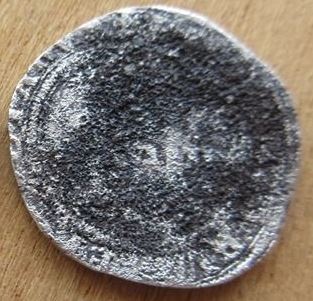
A Recent Find Uncleaned.
Photo by Terry S.

Some coins will require a longer immersion than others.  Many, if not most, will require more than a dip.  I've had some that required days.  It depends upon the type and amount of encrustation.

I've also had coins that were not affected at all by immersion in Muriatic acid.  They had a dense clay crust that the acid would not penetrate.  But that is unusual.  When the crust was broken, it fell off nicely and showed the impression of the features of the coin as if the crust had been a plaster cast.  To repeat the point I started with, all encrustations are not the same.

I personally feel very confident about immersing coins known to be silver in Muriatic acid for long periods, but just to be sure I didn't make some kind of mistake or something, I still check the progress occasionally.

The coin shown immediately above would probably benefit from a longer soaking.  Assuming the coin is really silver, I'd be more concerned about a toothbrush than the acid.

---

Just to give credit where it is due, Bill P. is the one that wrote the detailed instructions I posted for using Muriatic acid to clean silver coins.  I originally posted those instructions about ten years ago but lost the post, so republished the instructions again in this blog not long ago.   When I was still occasionally using other methods, including electrolysis, Bill encouraged me to use Muriatic acid instead of electrolysis.  After years of additional experience, I can say Bill was right all along and deserves much credit.

Thanks Bill!

---

Social media sneezes words, images and ideas into the infosphere.  Some catch on and get retransmitted and become part of the common vernacular.  Some are used only in smaller specialized communities.

I've always been interested in psycholinguistics and trends in language patterns and usage.  I've mentioned my distaste for ambiguous over-used terms such as "existential threat," for example.

I remember using the equivalent of what we now call email and forums back in the late 1970s, when I was working for a company that had a very advanced international computer network.  I remember  thinking about conducting studies on how computer networks affect how people communicate.  Unfortunately I didn't do those studies.

Since I've been doing this blog I've seen the language used by the metal detecting community evolve.  It is natural for language patterns to evolve, but I believe this blog has played a significant roll in that evolution.

I remember when I was interviewed by a reporter from CNN and used the word detectorist.  She stopped and said, "Did I hear you use the term "detectorist.""  At that time the word was not as commonly used as it is today, and I believe some of that has to do with this blog.

As I recall, most people used the word "real" instead of "reale."  I thought "real" could be confusing, and I also thought the Spanish word seemed more authentic, so I always wrote the word with the final e.  It seems that spelling is now much more common than it was ten or twelve years ago.

I also never saw terms such as "coin line" used in the earlier metal detecting literature.  It certainly was not defined in the detailed way that I defined it. I've tried to find that term used in the detecting literature before I defined it in this blog and have not found any earlier instances.

Even if I could not claim that this blog has introduced new terms and ideas, I can definitely say that it has advanced the discussion in numerous ways.

---

The Washington Post is yelling "fire" in a crowded theatre and loving it!

If you listen to the media reports - and it's hard not to - it is beginning to sound more like an unbelievable horror movie.  A recent Washington Post story, Coronavirus Will Radically Alter the U.S., describes an overwhelmed healthcare system and 1.1 million American deaths.  No matter what you think of the Post, the story stokes fear while the subtle rewording in the headline suggests a thinly veiled satisfaction that President O'Bama's promise to fundamentally transform America will finally be ushered in by a catastrophe too good to waste.

---

Every thing seems new to people who haven't seen anything like it before, which is why studying history adds important context.

The Spanish Flu (January 1918 – December 1920) was an unusually deadly influenza pandemic, the first of the two pandemics involving H1N1 influenza virus with the second being the swine flu of 2009.  The Spanish flu infected 500 million people around the world, or about 27% of the world population of between 1.8 and 1.9 billion. The death toll is estimated to have been anywhere from 17 million to 50 million, and possibly as high as 100 million, making it one of the deadliest epidemics in human history. Historical and epidemiologic data are inadequate to identify with certainty the pandemic's geographic origin.

The world was very different then.  A much larger part of the population lived in rural areas, and the medical profession was much less advanced.  My grandparents survived that one.  They mostly took whiskey and sugar, and put a sign in their window or on their door saying they were quarantined.

Then the swine flu, 2009 - 2010, killed nearly 12,500 in the U.S., but we heard almost nothing about it compared to Coronavirus.

---

Many beaches have been closed.  Unfortunately I can't provide an updated list, but  I heard more were closed last night.

This might be a good time to explore new areas, do some testing or research finds.

Be blessed,
TreasureGuide@comcast.net

Thursday, March 5, 2020

3/5/20 Report - Wreck and Artifacts of the Erebus. Squire Pope Manor Explored. Too Much Cleaning Spoils The Coin.


Written by the TreasureGuide for the exclusive use of treasurebeachesreport.blogspot.com.

Four-Reale Cleaned By Electrolysis
Photo by JamminJack

JamminJack has provided photos of some nice coins that he cleaned with Muriatic Acid.  Here is a four-reale that he cleaned using electrolysis.

Jack said, "When we used to find clusters or heavily corroded reales, most of the time they were sold as is. Back then, an encrusted coin would bring a higher value with the mystery of possibly having a date, full shield, etc. Now it seems a cleaned coin is worth more!"

 "This 4 reale was heavily encrusted. The smooth areas are very thin. Possibly, a "razor" coin, but exstensive electrolysis and scrubbing the coin removed more surface then needed.

Same Four-Reale Cleaned By Electrolysis

Thanks Jack for reminding us of the dangers of electrolysis when over done.

If you look at the Sedwick auctions, you'll see some coins that were sold as clumps and brought good prices.

Jack, like the author of this blog, prefers coins under-cleaned rather than overcleaned.

---

Source: See CBC.CA News link below.


Here is a very nice article on the salvaging of the wreck of the Erebus complete with photos of recovered artifacts.

Here is a short excerpt from an article about the HMS Erebus.

Epaulettes that came from a lieutenant's uniform were found on the lower deck of Erebus in September 2019. The upper part of each epaulette is made of twisted, gold-plated silver wires over sheet metal. (Photo: Marni Wilson)

Items recovered included epaulettes from a lieutenant's uniform and ceramic dishes. The epaulettes, Bernier said, were found in a drawer filled with a lot of sediment but otherwise empty of artifacts, leaving the impression that they were abandoned.

"On the flip side, in the ship's pantry, there's barely any sediment, because the density of the objects is so big. You would have plates stacked up 13 high."


And here is the link if you want to read more about that.


https://www.cbc.ca/news/canada/erebus-wreck-exploration-franklin-expedition-mystery-artifacts-1.5469843

---

Local archaeologists believe they’ve uncovered remnants of the original Squire Pope manor at Wright Family Park, a discovery that would debunk a generations-old belief that all traces of the historic Bluffton structure were lost to time, erosion and the 1863 Union Army “Burning of Bluffton.”
Town officials say that last fall, Heyward House volunteers — representatives of the town’s historical preservation society — came upon very old bricks while metal-detecting on the Wright Family Park lawn at the end of Calhoun Street.
The breakthrough launched archaeological work on the property...
Here is the link for more about that.


---

Source: MagicSeaWeed.com

It looks like the surf will be higher this weekend.

Happy hunting,
TreasureGuide@comcast.net

Friday, February 7, 2020

2/7/20 Report - Cleaning Coins: Method for Cleaning Silver Cobs and Method for Cleaning Clad Coins.


Written by the TreasureGuide for the exclusive use of treasurebeachesreport.blogspot.com.

Typical Treasure Coast Beach Morning of 2/7
I took a look at the beach this morning and was not surprised at all.  The front beach has been building during the last few days.  The middle and back beaches have not been touched lately.


Typical Treasure Coast Beach Morning of 2/7. 
---


Alberto S. provided the tested the following method for cleaning clad coins and provided the instructions.

Rock Tumbler Used For Cleaning Clad Coins.
Photo by Alberto s.


I received a gift from my wife this past Christmas, a rock tumbler from Harbor Freight, I believe is the one you mentioned in previous posts. I finally decided to give a try using a recipe from a you tube video on the subject of cleaning clad found at the beach. 

Coins Tumbled For Two Hours.
Photo by Alberto S.

The recipe calls for a 2 hour pre-wash with water and regular fish tank gravel and then a 2 hour wash using table salt, dish washing liquid, vinegar and CLR which is the solution for removing calcium, lime and rust. I tried it on some nickels(one penny in the bunch) and the results were pretty good, see the photo above.

Same Coins After Second Two-Hour Wash.
Photo by Alberto S.

One thing I did  notice on another batch of nickels that if once removed from the tumbler after the second wash and the coins are not washed with fresh water soon after and removed from the gravel to dry they will develop some stains, which I think might be from the CLR solution not sure. Anyway, thank you for the tip about the tumbler, works really good.


Hope you  are having a great day.

Alberto S. 


---


Below is a method Bill P. describes for cleaning silver cobs.  I've also used it with good results.


Bill's Silver Cob Cleaning Method


Use this method at your own risk. This writer accepts no responsibility for misuse or ignorance or neglect for any person or party and for informational purposes only.


 This process uses diluted Muriatic Acid which is commonly used around swimming pools. It can be purchased pretty much anywhere pool chemicals are sold.


 A few precautions must be addressed first though. Here is a link to Bob Vila's Info on this acid https://www.bobvila.com/articles/muriatic-acid/ .


 As stated in the Bob Vila article, I cannot emphasize enough that water should NEVER be poured into acid to dilute it. The reverse is the only way it should be done...acid into water. This acronym should be in the forefront of your thoughts when using any acid...AAA - Always Add Acid!


 How to neutralize acid; baking soda neutralizes acid very quickly so make sure you have enough on hand.


 Muriatic acid is readily available at most home improvement stores in ½ and 1 gallon sizes. It is typically a 31% strength from the bottle. I generally cut this in half to roughly 15% strength and it seems to work perfectly but you may want to experiment (again, AAA).


 I suggest that you treat one cob at a time. I use a shot glass so not much acid is required. Place the appropriate amount of acid into the shot glass and gently place the cob into the container(no splashing please). Depending on how heavily it's encrusted, it should start fizzing immediately. It may take several treatments to dissolve the encrustation but in my experience once is enough.


 Remove the cob from the solution and if you only have one cob, neutralize the acid in the glass and on the cob at once. The cob will have a dull gray color.


 Next take a small amount of baking soda (not baking powder), place it in the palm of your hand, add a couple drops of water to make a paste. Then gently rub the cob between your fingers until a bright silver sheen is revealed. It's that simple.


 In the case of stubborn encrustation there is another method that works although not as reliable as the acid treatment. However it is much safer because there are no caustic chemicals involved.


 You will need baking soda, aluminum foil and hot tap water. Make a paste with the baking soda and water, fold a small piece of foil in half, fill the folded foil with the paste and sandwich the cob in between. The whole thing may become warm as the aluminum and baking soda react. There also may be some fizzing. Once this is complete, you polish the cob as previously stated.


 It is my belief that using electrolysis can damage a cob. Years ago I watched a video when the early 1715 salvors were attempting to clean clumps of encrusted cobs. They dumped the clumps into a tub and poured muriatic acid over all of it. I never saw the finished product I'm sure it was effective.


You may want to try this first on a common silver coin instead on a cob...for your own peace of mind.


Silver and copper are insoluable in dilute Muriatic acid at room temperature.


Give it a shot!
Bill P. 

---

I've used both of the methods described above with good results.  Most recently I cleaned some cobs using acid and baking soda.

I plan to post these instructions for easy access my reference list.


Source: MagicSeaWeed.com.


As you can see, the surf will increase a little this weekend.

The tides are getting higher too.

Happy hunting,
TreasureGuide@comcast.net

Friday, January 17, 2020

1/17/20 Report - Treasure Auctioned by Ward Estate. Nice Dated Four-Reale. Electrolysis. Frederick Douglass Report.


Written by the TreasureGuide for the exclusive use of treasurebeachesreport.blogspot.com.

1702 Four Reale
Photo by JaminJackUSA
I received the following message along with coin photos form JaminJackUSA.

I had the pleasure of meeting a member of Bruce's family metal detecting at Turtle Trail many years ago. They were fascinated that I knew who he was and knew him when I was younger. I actually met him on a beach in late 60s in Ft. Pierce. He even showed me where and how to identify shipwreck coins. This beach back then was called Colored Beach, now known as Douglas Beach.

Now to the present. I was tipped off about his estate going to an auction. (Bruce had moved away from Ft. Pierce area, and eventually passed away years, ago.) There were flintlocks, cannon balls, a caravacas cross, and 100s of encrusted coins. Few were clean, but most were in clusters, etc. There were 8s, 4s, 2s, 1s, and halves!

Below is one of the coins that has been through an electrolysis process. At the time I am just trying to clean the lots I won. Later, I may sell some of them.


Dated 1702 Four Reale
Photo by JaminJackUSA


What a shock and extremely rare! I have found a few 1 reales from Charles II, but never a 4 reale Phillip V!! 

And below is a photo of an electrolysis setup from JaminJack.


Simple But Effective Electrolysis Setup Using Battery.
Photo by JaminJackUSA


COA From Estate Auction.
Photo submitted by JaminJackUSA

---

Frederick Douglass Beach Early 1/17
Photo by Steve M.

Steve M. sent the following message along with the photos from Frederick Douglass beach.

 We hit Douglas Beach today Thursday, around 8.   Washed down wall since last week.   Very Shelly only found tiny bits of aluminum beer cans , and rusty nails.   Beach still convex.   Surf about 2-3 foot.


Frederick Douglass Beach Early 1/17
Photo by Steve M.

Frederick Douglass Beach 1/17
Photo by Steve M.

Steve also sent photos of the kinds of things he's been finding at Frederick Douglass such as those on the plate below.  

Shells and Things From Frederick Douglass Beach.
Photo by Steve M.

He said he looks for all kinds of things while detecting, including shells, fossils, sea glass, and old artifacts, such as pot shards.  I very much advocate that.  Not only are the other items interesting on their own, but they can give you valuable clues.

Thanks for sharing Steve.

---

I had some other topics that I started but I put them off for a short while because I've been getting timely beach photos that need to be posted while they are current.  That's great.  I'll have time to continue the other topics in the near future.

This morning the wind started and undoubtedly the surf is building.  We will have that higher surf for not much more than a day.

Source: MagicSeaWeed.com

Happy hunting,
TreasureGuide@comcast.net

Thursday, October 24, 2019

10/24/19 Report,- The Havering Hoard. Wood Find. Wheat Cents. About Cleaning Coins.


Written by the Treasureguide for the exclusive use of treasurebeachesreport.blogspot.com.

Source: BBC.com (See link below.)

The group of 453 artefacts found in Havering, east London, is the third largest ever discovered in the UK...
The find, which dates from between 800BC and 900BC, was officially declared treasure by a coroner earlier this year.
The discovery, dubbed the Havering Hoard, was uncovered last September, and will form the centrepiece of a major exhibition from April.
Archaeologists believed the manner in which the weapons had been so carefully buried in groups close together suggested the site could have been a metal workers' former vault or an armoury recycling bank or exchange...

Here is the link for the rest of the article.

https://www.bbc.com/news/uk-england-london-50097646

---

Wood Found by DJ Sunday
Find and photo by DJ
DJ said, "... it has several round holes and pieces of metal showing. The close up shows two pieces with the wood grain running at right angles."

Interesting.
--- I've mentioned recently about finding a wheat penny in change received at a Walmart a couple days ago. I was surprised to get another wheat penny in change just yesterday at a store about 20 miles away from the Walmart. That is two wheats in my last two shopping trips. Pretty unusual. Below are the two wheats I received in change. The one most recently received is on the right.
Two Wheat Pennies Recently Received in Change.
In a recent post I mentioned a few ways I think old coins end up in circulation. I thought of one more. Spome of the members of CoinCommunity.com mentioned that they sometimes return coins like that to circulation just to stimulate interest in the hobby. The coins shown above appear to me to have been harshly cleaned. You'll notice the very bright high spots that look like they have been really scrubbed. The 1950 D is in worse condition with surface pitting and also a strange patina on the depressed surfaces. It also has some green crud in tight protected areas. You can see that best in the photo on the right behind Lincoln's collar. In my opinion, it does not look like these coins were not owned by a serious collector, but perhaps dug. I doubt that any kind of serious collector would so harshly clean the coins. The one on the right with the surface pitting definitely looks like a dug coin to me. What do you think? Having received two wheats in change in such a short time span makes me wonder if there were a lot of wheats recently put into circulation by someone. Seems pretty unlikely to be coincidence, but it is possible I guess. If you are wondering how often it might happen by chance, I found a blog post where a fellow purchased 48 rolls of pennies in 2014 and recorded what he found. Here is what he said. I went to the bank and got $24 worth of pennies (48 rolls of 50) and sorted them.  On average there were 13.4 pre-1982 pennies in each roll, in percentage terms, 28.4%.  Some had as many as 20 and some had as few as 7.  There were also 5 wheat sheaf pennies in the lot and 10 Canadian cents.

Since that was done five years ago the odds might have changed some.

Anyhow the odds of finding a wheat cent in circulation, according to the experiment, is 5 in 2400 or 1 in 480 pennies.  Canadian cents were more likely than the wheat cents at a that time.  I understand that Canada no longer mints pennies.

Here is the link to that article.
http://mattbussey.com/how-many-pre-1982-copper-pennies-are-still-in-circulation/
Here is an article about cleaning coins. Among other things, it tells how to tell if a coin has been cleaned, which they say should almost never be done.

Here is how they say you can tell if a coin has been cleaned.
A cleaned coin will have a dull, bright look – one that on a well-circulated coin would seem unnatural.
Old pennies that have been worn should not look bright orange and have flashy surfaces. Old, worn pennies should be medium to dark brown in color and have virtually no reflectivity on the surface at all. 

Old silver coins will look grey in color with darker patination around the devices, such as the lettering, date, and main design elements. A flashy, white silver coin that has clearly been worn is a clear giveaway that it has been cleaned. 

Uncirculated or about uncirculated coins should have lustrous surfaces and radiating lines that reflect shimmers of light in a cartwheel pattern as the coin is turned or rotated. 

The luster of a cleaned coin will be severely impaired, if not lost altogether. Therefore, if an uncirculated coin has been cleaned, the best way to tell is to see if it has any cartwheel luster. If it doesn’t, then don’t buy the coin.

Older coins that have been cleaned in the past may show evidence of a past cleaning in a few key ways:

Crud around design elements and lettering
Evidence of heavy, dark toning on some parts of the coin but not on others
Dull appearance in the fields


Here are a few occasions when they say it might be advisable to clean a coin.

(1) The coin has ugly and potentially damaging green polyvinylchloride (PVC) goo from an old plastic coin holder.

(2) The coin has loose dirt and debris on it. 

(3) An ancient coin needs cleaning for proper attribution or identification.

Here is that link.
https://coins.thefuntimesguide.com/cleaned-coins/ ---
Source: nhc.noaa.gov
Not much going on except for one undeveloped system down in the Gulf.
Source: MagicSeaWeed.com
Not much surf in the forecast either. Happy hunting, TreasureGuide@comcast.net