Showing posts with label wood. Show all posts

Thursday, October 24, 2019

10/24/19 Report,- The Havering Hoard. Wood Find. Wheat Cents. About Cleaning Coins.


Written by the Treasureguide for the exclusive use of treasurebeachesreport.blogspot.com.

Source: BBC.com (See link below.)

The group of 453 artefacts found in Havering, east London, is the third largest ever discovered in the UK...
The find, which dates from between 800BC and 900BC, was officially declared treasure by a coroner earlier this year.
The discovery, dubbed the Havering Hoard, was uncovered last September, and will form the centrepiece of a major exhibition from April.
Archaeologists believed the manner in which the weapons had been so carefully buried in groups close together suggested the site could have been a metal workers' former vault or an armoury recycling bank or exchange...

Here is the link for the rest of the article.

https://www.bbc.com/news/uk-england-london-50097646

---

Wood Found by DJ Sunday
Find and photo by DJ
DJ said, "... it has several round holes and pieces of metal showing. The close up shows two pieces with the wood grain running at right angles."

Interesting.
--- I've mentioned recently about finding a wheat penny in change received at a Walmart a couple days ago. I was surprised to get another wheat penny in change just yesterday at a store about 20 miles away from the Walmart. That is two wheats in my last two shopping trips. Pretty unusual. Below are the two wheats I received in change. The one most recently received is on the right.
Two Wheat Pennies Recently Received in Change.
In a recent post I mentioned a few ways I think old coins end up in circulation. I thought of one more. Spome of the members of CoinCommunity.com mentioned that they sometimes return coins like that to circulation just to stimulate interest in the hobby. The coins shown above appear to me to have been harshly cleaned. You'll notice the very bright high spots that look like they have been really scrubbed. The 1950 D is in worse condition with surface pitting and also a strange patina on the depressed surfaces. It also has some green crud in tight protected areas. You can see that best in the photo on the right behind Lincoln's collar. In my opinion, it does not look like these coins were not owned by a serious collector, but perhaps dug. I doubt that any kind of serious collector would so harshly clean the coins. The one on the right with the surface pitting definitely looks like a dug coin to me. What do you think? Having received two wheats in change in such a short time span makes me wonder if there were a lot of wheats recently put into circulation by someone. Seems pretty unlikely to be coincidence, but it is possible I guess. If you are wondering how often it might happen by chance, I found a blog post where a fellow purchased 48 rolls of pennies in 2014 and recorded what he found. Here is what he said. I went to the bank and got $24 worth of pennies (48 rolls of 50) and sorted them.  On average there were 13.4 pre-1982 pennies in each roll, in percentage terms, 28.4%.  Some had as many as 20 and some had as few as 7.  There were also 5 wheat sheaf pennies in the lot and 10 Canadian cents.

Since that was done five years ago the odds might have changed some.

Anyhow the odds of finding a wheat cent in circulation, according to the experiment, is 5 in 2400 or 1 in 480 pennies.  Canadian cents were more likely than the wheat cents at a that time.  I understand that Canada no longer mints pennies.

Here is the link to that article.
http://mattbussey.com/how-many-pre-1982-copper-pennies-are-still-in-circulation/
Here is an article about cleaning coins. Among other things, it tells how to tell if a coin has been cleaned, which they say should almost never be done.

Here is how they say you can tell if a coin has been cleaned.
A cleaned coin will have a dull, bright look – one that on a well-circulated coin would seem unnatural.
Old pennies that have been worn should not look bright orange and have flashy surfaces. Old, worn pennies should be medium to dark brown in color and have virtually no reflectivity on the surface at all. 

Old silver coins will look grey in color with darker patination around the devices, such as the lettering, date, and main design elements. A flashy, white silver coin that has clearly been worn is a clear giveaway that it has been cleaned. 

Uncirculated or about uncirculated coins should have lustrous surfaces and radiating lines that reflect shimmers of light in a cartwheel pattern as the coin is turned or rotated. 

The luster of a cleaned coin will be severely impaired, if not lost altogether. Therefore, if an uncirculated coin has been cleaned, the best way to tell is to see if it has any cartwheel luster. If it doesn’t, then don’t buy the coin.

Older coins that have been cleaned in the past may show evidence of a past cleaning in a few key ways:

Crud around design elements and lettering
Evidence of heavy, dark toning on some parts of the coin but not on others
Dull appearance in the fields


Here are a few occasions when they say it might be advisable to clean a coin.

(1) The coin has ugly and potentially damaging green polyvinylchloride (PVC) goo from an old plastic coin holder.

(2) The coin has loose dirt and debris on it. 

(3) An ancient coin needs cleaning for proper attribution or identification.

Here is that link.
https://coins.thefuntimesguide.com/cleaned-coins/ ---
Source: nhc.noaa.gov
Not much going on except for one undeveloped system down in the Gulf.
Source: MagicSeaWeed.com
Not much surf in the forecast either. Happy hunting, TreasureGuide@comcast.net

Saturday, April 27, 2019

4/27/19 Report - Beam Finds. Shipwreck or Not? Archaeology and Theory for MDing. Cookout Saturday.


Written by the TreasureGuide for the exclusive use of treasurebeachesreport.blogspot.com.

Ten-Foot Long Beam Found by Kurt R.
A couple days ago I showed this beam and asked if anyone had any ideas about it.  One person suggested a railroad tie, but the other end is V-shaped and it has a lot of other cuts and holes that I wouldn't expect to see on a railroad tie, so I don't think that is it.

DJ found the beam shown below back about a month ago at Pepper Park after a few days of rough surf.  One of the interesting things about that beam is that it has a broken treenail in it.


Beam found by DJ (left).


Trennel or trennel being pointed out (right).


Wikipedia says, A treenail, also trenail, trennel, or trunnel, is a wooden peg, pin, or dowel used to fasten pieces of wood together, especially in timber frames, covered bridges, wooden shipbuilding and boat building. It is driven into a hole bored through two (or more) pieces of structural wood (mortise and tenon).
I also read that treenails, or trennals, were commonly used until around the 1780s.

Maybe these beams come from the same source and got uncovered last month during the rough surf.

Below is an example of a shipwreck beam with trennals.  This photo was snipped from a USF video of a shipwreck found near Jacksonville.


I really hope someone can help us out here.   I know DJ and Kurt would like the information, and I'd certainly like to learn a little something about the subject.

---

Yesterday I wrote about cannon aprons, but the discussion was about more than cannon aprons.  It was also about investigating artifacts in general.

Here is an excerpt from the Schnitzer thesis that I referenced yesterday.

As Knappett (2005:1) states: It is perhaps surprising…that archaeology, while developing ever more sophisticated methodologies for artifact study, has not yet constructed similarly sophisticated theoretical models for understanding the roles of artifacts in human societies. So complex and daunting is such a task that it must inevitably be interdisciplinary in its scope, drawing upon cognitive science, psychology, sociology, anthropology, and history.

Theory is important in all sciences because it provides a way to organize data in a meaningful way. Theories can be hypothetical or predictive. They are the overarching abstractions that form conceptual frameworks for scientific research. Archaeology is, in its strongest applications, an interdisciplinary science, and many of its theories are drawn from interdisciplinary concepts. The study of the QAR cannon aprons is no exception. According to Trigger (2006), “It is a fundamental tenet of science that nothing is significant by itself but only in relation to hypotheses; hence only theories can explain phenomena.” The goal of this project is to explain the “phenomena” that are the QAR cannon aprons using a blend of material culture theory and an adaptation of behavioral archaeology theory, as conceptualized by Michael Schiffer in the 1970’s.

 Here is that link again.

http://thescholarship.ecu.edu/bitstream/handle/10342/3842/Schnitzer_ecu_0600M_10612.pdf?sequence=1&isAllowed=y )

So what does that have to do with metal detecting?

I don't expect myself or anyone who reads this to turn into an archaeologist, but as detectorists we do find items that we want to know more about, and we can learn a lot from how the professionals investigate artifacts.

I encourage all detectorists to take a disciplined systematic approach to hunting and artifact identification.  I've had a few posts on that type of thing lately.

If you have an idea - a theory - it will help you assimilate the information and make predictions.  It will also help you develop hypotheses that can be tested.  That will help advance your understanding.

The piece of lead that I found was not hugely interesting by itself, but since it caused me to do additional research, I learned a lot from the research.  I learned about cannon aprons, but also about some other things.

I've always said that a find is more than a find.  Gaining more knowledge about a find not only makes the find more interesting, but it will sometimes point you to additional finds.

I didn't really think much about the lead find until I happened upon the cannon apron literature and saw pictures of other pieces that looked similar  I could have missed some interesting features of that find, and  I will be studying that piece more in the near future.

---

Don't forget the Treasure Hunter's Cookout Saturday.

You can find the details by using the following link.

http://treasurebeachesreport.blogspot.com/2019/04/42419-report-treasure-hunters-cookout.html

---

Happy hunting,
TreasureGuide@comcast.net

Thursday, April 25, 2019

4/25/19 Report - 1600-Year-Old Gold Coin Found by Teenagers. Mystery Items for ID. Sanded Beach.


Written by the TreasureGuide for the exclusive use of treasurebeachesreportblogspot.com.


Photo by Israel Antiquities Authority
Published by TimesOfIsrael.com

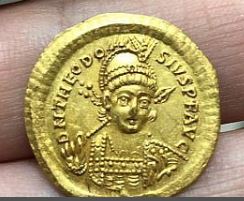
An extremely rare 1,600-year-old gold coin of the Byzantine emperor who made Jews second-class citizens in the Land of Israel has been discovered — ironically, near a new trail built in commemoration of the Sanhedrin he abolished. It is the first time this coin has been found in Israel, according to an Israel Antiquities Authority press release published on Tuesday.
In February, four trekking teens stumbled upon the coin while orienteering in the fields alongside the Zippori stream in the Galilee...

The obverse of the solidus — a solid gold coin with a weight of approximately 4.5 grams that was minted in the later Roman Empire/early Byzantine era — depicts Emperor Theodosius II; its reverse is illustrated by the goddess Victory holding the Staff of the Cross...

And here is the other side.

Photo by Israel Antiquities Authority
Published by TimesOfIsrael.com
Here is the link for more about that.
https://www.timesofisrael.com/1600-year-old-gold-coin-of-emperor-who-abolished-sanhedrin-discovered-by-pupils/

It is not surprising that a sight find would be made along a stream or new trail.

---


Kurt R. found this interesting ten-foot long piece of wood and was wondering if anyone might offer any ideas about what it might be.

Here is what Kurt said.

I love all the information that your blogs provides and it can be a great wealth of knowledge when search for things.  I was recently looking for information on large shipwreck timbers and i came across your post about coal... I found a piece a couple years ago and had no idea what it was, but low and behold the picture you posted about it was an exact replica.  Thank you for inadvertently solving that mystery for me.  Do you by chance have any insight into getting more i formation on this piece?  The size is 11"x13"x10'

---

Len M. sent me the following email and photos.

I received a very loud hit from this rock while detecting on the treasure coast.

I brought it into my garage and split part of its side off. The object had
a petroleum smell at first and it's magnetic. It's a very hard metal and
somewhat cylindrical. It measured approximately 1 1/2" in diameter and 2
3/4" length. The top side has a slight saddle depression in it as well.

I have spoken to some people and they think it may have be a part from a
boat, others think it maybe a small meteor.

Does any one have an idea what this may be?


Object Partially Removed From the Crust.


----

Mike A. who sent a picture of the cut Turtle Reef beach a couple days ago sent the following photo showing the same beach now sanded in.

Turtle Reef Beach.
Thanks Mike.

---

According to MagicSeaWeed.com, the Treasure Coast surf will be three or four feet today, decreasing a bit tomorrow.  The tides are more moderate now.

Happy hunting,
TreasureGuide@comcast.net


Saturday, March 16, 2019

3/16/19 Report - Eight Foot Surf Possible Soon. Tips for Detectorists. Who Moved My Cheese. Wood Find.


Written by the TreasureGuide for the exclusive use of treasurebeachesreport.blogspot.com.

Source: MagicSeaWeed.com
The big news for me today is the forecast.  MagicSeaWeed is predicting up to an eight foot surf for next Tuesday.  The wind will be mostly northeast and the tides are increasing too.  If that holds or gets even better we might be in for some good beach hunting conditions.

Keep watching.

---

A couple decades ago, a book entitled Who Moved My Cheese was very popular in the field of business motivation.  Despite the title, the book isn't about cheese at all, but uses two mice and two miniature people as characters in a parable to illustrate some important lessons.  Every detectorist should read that book, or at least learn the lessons the book teaches.

Doing the book a gross injustice, I'll boil it down to this - the mice lived in a maze and were accustomed to  always finding abundant cheese in a particular location, but one day when they went out to get their daily fill, they find no cheese where they always found it in the past.  They fear there will be no more cheese and blame everybody else for their failure  (thus the title Who Moved My Cheese) instead of moving on and finding a new cache.

Here are some of the main lessons from the book.  Things will change.  Change is inevitable.  Don't be afraid of change.  If you don't change you will become extinct.  Be ready to change quickly, and enjoy it again and again.

The book applies to metal detecting as well or better than it applies to business.  Things will change.  Some day you'll find that doing the same thing that was always successful in the past will no longer  work as well.  And people will think that there is no more treasure or that the beach or detecting site no longer produces.  To continue to be successful, you will have to change.  You can not keep hunting the same site, or the same kind of sites, using the same techniques and expect to continue being successful.  Be among the first to change.  Take the challenge and enjoy it.  Progressing is necessary just to stay even.

There are plenty of obstacles for detectorists, but they can and should be overcome.  Here are my four big Os - Overcome Obstacles to Open Opportunities.

An obstacle is often a sign of a new opportunities.  The obstacles don't have to be big - just big enough.  You can do well by working the places with small obstacles that no one else wants to bother with or perhaps does not know how to work.  Some that I've worked were just a little farther out of the way or covered with trash or mud or weeds or somehow not as accessible.

A lack of creativity or willingness to change can be a different type of obstacle.

If it was really easy, everybody else would do it, and sometimes it seems like they are.  If you are just doing he easy stuff, there will be plenty of others that are doing it too. If you are doing what is easy, that is one sign that it is time to start thinking about how you can take the next step.

There are always new frontiers.   And you might be surprised how much is out there to be found.  That is one reason I tell you day after day about what is being found.

I'll never forget the first time I went out on a wooded hillside in West Virginia.  Everybody said, "There is nothing there. You won't find anything."  On my first outing, I found a gold 1940 something high school class ring.  On subsequent outings, I found old coins and relics from previous centuries.

On my first outing on a Caribbean island, I found 18th century military buttons, ordnance and other relics.

But you don't have to go to distant places.   There is stuff almost everywhere.

I no longer live near the glitzy resorts of Miami where people visited and lost their coins and jewelry for over a hundred years.  I now live in an unremarkable place that has to be maintained continually just to keep it from once again becoming a wooded mass of thorns, vines and trees.  There is nothing that would suggest that anything ever went on there - certainly nothing important.  It is a place no different than millions and millions of other places.  Yet within walking distance, and without any equipment or anything other than the clothes to cover my nakedness, I've found fossils that are millions of years old, Native American artifacts, pioneer relics as well as most of the bottles and glass insulators that I've posted.  I'm just saying there is a lot of stuff out there.  I'm not talking about some world-famous treasure island where you might expect to find buried treasure galleons or the Holy Grail or Ark of the Covenant where people have searched for centuries and turned everything upside down with heavy equipment and scanned with high tech tools.  I'm talking about Anywhere USA.  You don't have to go far unless you have a particular treasure in mind.

I can't tell you all the kinds of places you should look or how you should work them,pl but they don't have to be far away.  In fact, they might be right under your nose.   Believe it or not there are more places that are unhunted than places that are over-hunted.

My main point today is that there is a lot still out there to be found, but like the book says, you might have to make some changes to find it.

---

Dale J. sent me the following photos of his find.

Find and photo by Dale J.

He said, The red circles show rusted iron, a close up of the one possible spike sticking out, there are oyster shells only on one end. Not sure how long it was washed up it was not moving in today’s small surf. This is north  of Ft. Pierce Inlet.  About 8 feet long and 12x12 inches.

Here is another look.

Find and photo by Dale J.

Interesting!  Thanks Dale.

---

Keep watching the surf reports.
TreasureGuide@comcast.net

Friday, March 30, 2018

3/30/18 Report - More On The Sifting Compared To Detecting Experiment. Intact Section of 18th Century Wreck Washes Up On Beach. Good Friday!


Written by the TreasureGuide for the exclusive use of treasurebeachesreport.blogspot.com.

Section of Old Wreck Appears on Beach.
Source: See msn.com link below.

48-foot hull of a well-preserved 18th century vessel dubbed the 'Holy Grail of shipwrecks' washes ashore on Florida beach with copper tacks and roman numeral etchings still intact...

Experts speculate that the wreck may have laid under sand offshore for years, then washed onto the beach due to storm activity, explaining how the ship remained so well preserved...

Here is the link for more about that.

https://www.msn.com/en-au/news/world/48-foot-hull-of-a-well-preserved-18th-century-vessel-dubbed-the-holy-grail-of-shipwrecks-washes-ashore-on-florida-beach-with-copper-tacks-and-roman-numeral-etchings-still-intact/ar-AAvhmGj

If you have the chance to get up there and view this before it is removed or something should definitely do it.  I don't know if it is still there.  But if you do get a chance to look at it, take a close look at all the metallic parts.  It is a good chance to learn something.

Thanks to Dean R. and Bruce B. for alerting me to this story.

When I saw that peat washed up Tuesday, I thought there was also a chance for some old wood to wash up as well.  I was in an area where wood planks have washed up in the past.

---

On 3/26 I posted a report by someone who detected a lot several times, recorded all finds, and then sifted the entire lot to find out what if anything he had missed.  The results were amazing, both in the total number of coins found on that small lot, but also the number of old coins found, and what everybody should take notice of is the low number of old coins found as the result of multiple thorough metal detecting sessions despite the large number that was in that ground.  Most people would have detected the site a few times and maybe thought they had found most of the good coins that were there and thought it was time to give up and move on not realizing how many more old coins were waiting for them there.

If you have not read the 3/26 post and the total report of that experiment, I highly recommend that you do that.  If you don't you'll be missing out on proof of what is often said and speculated about in the metal detecting community.

The person who sifted that entire lot offered the following important comments and observations concerning that experiment.


No one was more shocked by the results than me.  I suspected there was more in the ground, but had no idea of the actual amount.  When I started, I did not intend to do [sift] the entire lot, just the areas I thought would be most productive.   However,  I just kept finding more, then decided to finish the job.  

I have a few other comments.  I can't be sure, of course, but I strongly suspect that this lot was never hunted prior to the houses being demolished.  It has nothing to do with the number of finds, but much of the lot was covered in a concrete pad and for many years during the detecting era it was a dangerous area.  This would make the conclusions more valid.

A point I don't think I emphasized enough is the difficulty detecting from the surface.  The first detectorist found 8 silver coins over 2-3 hunts.  I knew there were likely some more silver dimes because he found 3 silver quarters, a silver dollar, and only four dimes.  That is a strange distribution.  I actually briefly hunted the lot before they cleared the house piles and found a couple of clad coins only.  It is just mind-boggling to me, in hindsight, that I found no old coins on my first hunt on a lot with more than 225 in the ground!  When I went back, I found a silver half and silver dime and some wheats, some of which were on the surface.  The second time I found two silver dimes.  Over many hunts before I tried sifting I never found more than 2 silver coins with the detector.  I worked that lot thoroughly and repeatedly with multiple detectors because I strongly suspected there was more there.  I remember being frustrated about it.  So even though 30% of the silver coins were found using a detector, that was after an unusual amount of detecting, including moving at a snail's pace with a small coil and my Safari from different directions.   I feel confident saying that a more common scenario would be for the lot to be detected significantly less before being abandoned in search of greener pastures.  My point is that my detected finds likely overrepresent the percentage of finds that will be found using a detector on a site with heavy trash.

Overall, it was eye-opening for me.  The results were exciting...and daunting.  I now know there are a lot of great finds still to be made, even in well hunted areas, but it might not be easy.


I added the parenthesis and bolding for clarity and emphasis.

Thanks once again to the author of this report.

People are always looking for new unhunted sites.  Many of the old sites still hold more good finds, perhaps more than you would ever imagine.  Realizing how much more might be there is the first step to getting the finds you've been missing.

---

As you probably know, Easter is on the first Sunday after the first full moon after the Spring equinox.  Yesterday - Thursday - was a full moon, and today is Good Friday, which is the perfect time to talk about crosses.

A couple days ago I showed a silver ring with a cross on it.  Alberto S. found the same ring offered by WalMart.   So it is no Tiffany or anything really old.  I had no idea that it was anything but common modern despite my joking around.

Isn't it remarkable how prevalent the cross is whenever you talk about treasure hunting.  You'll find a cross on most cobs in one form or another, as well as on rings, pendants, and other things.  You can't escape that.  And there is a reason.

Something happened that changed the world, and 2000 years later people still wear and display the sign of the cross.  That in itself is remarkable.  But what people wear is not as important as what is on the inside.

You meet all kinds of people.  There are kind generous people, and then there are grumpy demanding people.  It is the same in metal detecting as it is in the world in general.  I'm glad to say that the readers of this blog, judging from the emails I receive, are almost exclusively of the kind generous type.

Some people can't get along with anybody and they think it is the fault of everybody else.  Some are always seeking and never finding.  They are looking in the wrong place.  Others have found the secret and carry their joy with them no matter what is going on in the world around them.  They are the ones that fill the Easter baskets and scatter the eggs and rejoice everytime one is found.

---

The surf will be 3 - 5 feet today and less tomorrow and Sunday.

Happy hunting,
TreasureGuide@comcas.net

Monday, October 2, 2017

10/2/17 Report - Good Surf Today and Tomorrow. Growing Collection of Finds From One Shipwreck Site.


Written by the TreasureGuide for the exclusive use of treasurebeachesreport.blogspot.com.

Source: MagicSeaWeed.com
As you can see, we're having more good surf this week.  Today it is supposed to be  4 - 7 feet and tomorrow higher.

I normally would have gone out yesterday to see how things were progressing.  It was nice and windy and rainy.  I wasn't able to get out though, and might not be able to get out for another day or two, so I'm going by what I see on the various internet sources until I can get out to see it for myself.

Source: MagicSeaWeed.com
The swells are pretty much from the east, with a seconday swell from the south.  This is looking very much like what we've seen the past two or three weeks so far.  There is a nice high surf, but most of the other factors are less than ideal.

With some luck I'll be able to get out to take a look.

---

Various Finds From One Unknown Beach Shipwreck Site
Photo submitted by anonymous.
Some of these were posted earlier, but the collection from the site is growing.

The anonymous reader said, "Found a little sash(maybe) gadget among the digging and another small key type small gadget for a old box maybe." These were collected from the site, as the reader says, "... year after year when the "Tide Gods" throw you a bone every 12 or 15 moons." He is hoping something will be eventually be revealed that gives some hint of the age or identity of the wreck.

Below are some closer views and some of the smaller finds.

Several Iron Items Including Some Still In Wood.

Some Smaller Spikes and Things.
One of the Smaller Finds.

Another Small Find.

Another Small Find.
A lot of the time it seems you have to get some of the bigger items out of the way before you start getting the smaller items.  

Congratulations on the finds!  

I wouldn't be surprised if I receive some photos of old items from North Carolina since Maria has passed by.

---

I hope you'll add your response to the blog poll if you have not already done that.

---

Thinking of the many victims of the Las Vegas shooting.

TreasureGuide@comcast.net

Tuesday, September 26, 2017

9/26/17 Report - What the High Water Did To Some Beaches. Useful Web Site For Predicting Beach Conditions. Various Types of Finds Along the Treasure Coast.


Written by the TreasureGuide for the exclusive use of treasurebeachesreport.blogspot.com.


Frederick Douglas Beach This Morning.

Yesterday I showed the water getting high on Frederick Douglas beach.  Today I went out to see what happened.  The answer unfortunately, is very little.

I'm about to call Irma, Jose and Maria all a bust when it comes to improving metal detecting conditions.  Who would guess that three hurricanes would not produce much better beaches?  Not one of them did a lot for us.

There are reasons.  And I'm always learning.  I learned something just the other day.  Actually I already knew it to some extent, but didn't give pay take it into account enough.  There is little use to pay attention to wind direction unless it is blowing fairly hard.  Otherwise it is not going to affect the direction of the swells.

The past few days I looked at the wind direction on MagicSeaWeed, but I didn't pay enough attention to the wind speed.  I should have paid more attention to what web sites like Ventusky.com was telling me when I plotted the waves.

Below is an example.


Wave Direction.for Yesterday.
Source: Ventusky.com

What I saw at the beach yesterday and today matched what Ventusky.com said a couple of days ago (See my 9/23/17 post.). The waves, as predicted were hitting the beach straight on despite the north winds. The wind wasn't very strong, so didn't seem to have much effect.

We always talk about northeasters, but direction isn't the only factor.  The wind has to be fairly strong, otherwise they won't have a significant effect on the swells.

I think I could do this a hundred years and I would still continue to learn.

Below is another picture of a beach that I looked at this morning.


Treasure Coast Beach Tuesday Morning.

Notice the waves coming directly at the beach and all the seaweed.  The beach was building.  You could see new layers of sand on the beach.  That isn't what we were hoping for.  I'll pay more attention to the swells in the future and less to wind direction.  

I've said before that it doesn't take a hurricane and recently went over what happened during the Thanksgiving Storm of 1984.  Jon Morgan, who does the great Lets Talk Metal Detecting and Treasure Hunting podcasts, said that post was very helpful to him.  You might want to take a look at that post again.  Hurricanes don't always create good detecting conditions.  Neither does high water.

I made a few interesting finds today - at least I thought they were interesting.

I found one very big piece of wood.  It was about seven feet long.  My photo showing the entire length somehow got lost, but here are a couple photos of a section of the wood.


Large Piece of Wood Found On Beach This Morning.
 Notice the worm holes and the apparently worked surface.


Another Shot of the Same Piece of Wood.


Ballast Stone?

A couple of days ago I mentioned finding some pieces of fossilized bone.  Here is the smallest - a small vertebra.

Small Fossilized Vertebrae Shown On U. S. Nickel.

I picked up more fossils today.  They are shown below.

Fossils Found On Beach Today.

The most interesting one to me was the piece of antler.  I've found those before and always like them.

Here is a closer view of that one.

Fossilized Piece of Antler.
And here is an ever closer view that shows the nice color and texture.

Closeup of Fossil Antler.
I walked a long distance today because I wanted to check out a particular location that I have not seen for quite a while.  It wasn't much good for detecting, but I did pick up the fossils on the way.

As I often say, when conditions aren't good for finding one type of thing they might be good for finding other things.

Today I didn't do any detecting, but kept myself entertained with wood, stone, fossils and shells while I scouted a few beaches.

I'll be showing you some more things I learned tomorrow or some other time real soon.  I think that is all for today.

Happy hunting,
TreasureGuide@comcast.net


Friday, September 15, 2017

9/15/17 Report - Various Irma Finds. Bigger Surf and North Winds To Come From Hurricane Jose. Jupiter Beach Report.


Written by the TreasureGuide for the exclusive use of treasurebeachesreport.blogspot.com.

Spike in Shipwreck Wood.
Here is a nice piece of wood with a spike still in it found by one reader.  Below is another nice piece found by the same person.

Nice Piece Found by the Same Reader.
Congratulations on the great finds!

A day or two ago I showed some musket balls found on the beach by Jonah and the guys of the Captiana.  That photo showed only finds from one low tide.  There was a second group found during another low tide.  Here is that group.

Group of Musket Balls Found During One Low Tide Cycle.
Photo by Jonah M.
That is a lot of digging.  I remember when Bill was finding so many musket balls in the water during one salvage season that he quit digging them.

Trez also was there and found those shown below.

Musket Balls and Lead Finds.
Finds and photo by Trez.

Looks like they hit a munitions cache.

I received the following report from CladKing.

Took most of summer off from detecting due to heat and too much sand on beaches! South side of inlet had filled in nearly to end of jetty making fishing and surfing tough there!! 
   
And while the hurricane removed a lot of sand, it was mostly wind driven! Water did not cut dunes near inlet at all! Just flattened the renourishment sand down to a gentle slope from dune line! The dune at the Seagrape trees is now higher than before by about 4 feet due to wind driven sand! 


Jupiter Inlet Area After Irma
Photo by Cladking


Carlin park was cut back to last years storm level with rocks exposed! But both Carlin and the inlet had refilled some in the last couple of days and where mushy! 


Rocks at Carlin Park Area
Photo by CladKing
---

I don't have electricity at my house yet.  Soon, I hope.  

I had so much to do I hardly got out.  I would have liked to get out to check a lot more of the beaches and do some detecting.  That is the way it goes.  

I did hear of a few cobs finds, but not many.  I didn't get any reports from Wabasso and north and didn't get up there.  From what I've heard and seen, I would guess that most cobs came from Vero and north.

It seems that most finds were made early.  Obviously a lot of lead was found.  

Saturday the surf is going to be up to something like 5 - 8 feet.  It is supposed to stay high for two or three days, and the best part is that the wind is supposed to be from the north.

I have a lot I could talk about but I can't do it all at once.  I'll continue tomorrow and for a few more days until things settle back to normal.

Happy hunting,
TreasureGuide@comcast.net