Showing posts with label conductivity numbers. Show all posts

Tuesday, May 12, 2020

5/12/20 Report - Metal Detecting Silverware and Conductivity Numbers. Sterling Silver Finds. And Mystery Piece Identified.


Written by the TreasureGuide for the exclusive use of treasurebeachesreport.blogspot.com.

Silverware Used for Metal Detector Conductivity Readout Test.
As you probably know, I highly recommend testing your metal detector with a wide variety of types of targets so you get to know what your detector is trying to tell you.  I used the five examples shown above for a simple test I'll report on today.

From top to bottom is a two-tined for that I presumed to be made of steel.  Second is a spoon that is clearly marked stainless.  Third is a knife marked "Robeson 'Frozen Heat'".  Fourth is a fork marked "sterling" and then a marked sterling spoon.

Using the equinox the following conductivity numbers were obtained for each example, working from the top of the photo to the bottom.

Two-tined fork               -5 to -2
Stainless spoon              -5 to -2
Frozen Heat knife            2 -   5
Sterling fork                   18 - 22
Sterling spoon                28 - 32

Of course the numbers varied a little, but the above ranges are fairly good representations.  The position of the item matters, as does the shape.  

I believe the sterling spoon produced higher numbers than the sterling fork because of the flat round shaped area on the spoon.

My tentative conclusion is that you can tell the difference between an steel piece of flatware and a sterling or silver piece by the conductivity numbers.  The numbers for the sterling pieces was very much higher and in a relatively consistent range.  

I believe that experiments like this can help you better identify buried targets in the field, although when I'm in an interesting area, unless I have time constraints or something, I'm going to dig everything anyhow.

I should have included a silver plated item or two.  I might do that in the future.

---

A Couple Silver Forks Marked Sterling.

If you've been keeping up with my daily posts, you know that I've been going back and looking through some old tableware finds.  You'll find a lot of tableware if you search old home sites, and you'll find some on the beaches and in the water as well.  Some of it will be old, some fancy and some plain.  The fanciest or oldest pieces aren't always the most valuable.  With current silver prices of $15.65 per oz. or about $.50 per gram, as it was this morning, a plain piece of sterling silverware can be worth a few dollars in silver content.

The two forks shown top of this post both weigh over 1.5 ounces each.  That figures to be about $20 in silver content for each - not a big treasure, yet enough to pay for some batteries.

Sterling Silver Fork and Spoon.
The sterling fork shown above is just over 1.5 ounces and the spoon just under 1 oz.

Of course sterling silver is not pure silver -  only 92.5 percent, so you have to take that into account.

Unfortunately most tableware finds will be stainless steel or plated rather than sterling or coin silver, but the oldest or most ornate will not necessarily be worth the most.  The fork and spoon shown above look plain and modern, yet have good silver content.

As for the companies, it gets confusing.  Here is what Wikipedia says about the International Silver Company.
In Meriden and nearby Wallingford and Middletown, the companies that were banded together to form the International Silver Company included these companies: Meriden Britannia Company, Meriden Silver Plate Co. , Middletown Plate Company, C. Rogers & Brother, Simpson, Hall Miller and Co., Simpson Nickel Company, Watrous Manufacturing Company, and the Wilcox Silver Plate Co., In Hartford, the following silver companies also became part of the corporation: Barbour Silver Company, Rogers Cutlery and William Rogers Manufacturing Company. Other Connecticut companies that became part of the corporation also include Holmes & Edwards Silver Company in Bridgeport; Plate Silver Co. in Derby; Norwich Cutlery in Norwich; Rogers and Brothers, and Rogers and Hamilton in Waterbury. 
From outside New England were Manhattan Silver Plate in Lyons, New York; and Standard Silver Company, Ltd. in Toronto, Ontario, Canada. Into the 20th century, many silver designs carry either the International Silver Company brand, or the pre-existing brand continues, or both are listed as the design maker.

---

A couple days ago I posted a photo of what appeared to be an old spoon showing a globe with silverware maker's mark.  I asked for help identifying the mark and the readers of this blog came through.

Here is what they found.

American Silver Company Maker's Marks 
Found by Mike M. (left) and JorgeY. (right)


Moselle Pattern Spoon
Submitted by Dan B.
Mike and Jorge found the makers marks as shown above.  Then Dan added the photo of the Moselle pattern spoon, and Alberto looked up the patent number and found the following ad for an American Silver Company sugar spoon having the same patent number as the spoon I was asking about.

Submitted by Alberto S.

Thanks guys!  I think that nails it down.  It appears to be a Moselle pattern spoon made by the American Silver Company in the early 20th century.

As I mentioned above, it can get confusing.  The companies that made silverware were often bought out and changed names.  The American Silver Company was the result of a buyout and then later the International Silver Company bought the American Silver Company along with other similar companies.

I haven't identified any marks telling what it is made of but I assume that it is silver plated like the item shown by Alberto.  Perhaps some of the other numbers on the spoon tell that.  I'll have that tested some day.

---

The surf today is 2 - 4 feet with a northeast swell.


Source: MagicSeaWeed.com
Happy hunting,
Treasureguide@comcast.net
Friday, April 17, 2020

4/17/20 Report - Big News! Some Florida Beaches Opening This Evening. Using Metal Detecing Conductivity Numbers. Kirlian Photography.


Written by the TreasureGuide for the exclusive use of treasurebeachesreport.blogspot.com.

Beach.

This is a beach.  I thought I'd post a picture of a beach in case you forgot what one looks like.  Those were the good old days.  You never know what you've got til its gone (Joni Mitchelle song).  It isn't a new beach photo, just reminiscing.

Just after I posted this photo, I saw the mayor of Jacksonville on TV saying that he was opening beaches at 5 PM Friday.  He said he wanted people to have more space to distance and the ability to get some exercise.  He asked people to continue observing social distancing and safe behavior.

6:15 PM Update: Happy beachgoers at Jacksonville beach are delighted to have their toes in the sand once again.

In St. Lucie and Martin County today, the beach accesses were still gated or barricaded.  The boat ramps are open, and there are good numbers of people out along the river.

There is word that DeSantis will start opening Florida beaches this evening.  I don't know if that is a sure thing or how many will open.

It seems there are people starting to petition for the beaches being opened.

I did a little mucking around in a real trashy area with the Equinox, and was using the conductivity numbers to pick through a small range of items.  They were fairly high conductive items of fairly small size.  A lot of them were copper electrical components, like the ones shown below.  I was able to avoid tons of aluminum and iron.


I did pick up a copper penny that was corroded down to about half its original weight.

The conductivity numbers can be used to pickup a fairly narrow range of items, which can be helpful.

I'm also trying to get my homemade Kirlian photography kit setup so I can get some good pictures of the coronas (not the bad type).

I did a post about that before.  Here is the setup installed in an old brief case.


Polaroid film can be used to capture the aura of objects, but I'm going to attempt to do it digitally now.


See https://treasurebeachesreport.blogspot.com/search?q=Kirlian for more about that.

I think I might be able to correlate the aura or discharge pattern with what detectorists refer to the item's halo effect.

---

A lot of people read and contribute to this blog, including some of the very top salvage people to people who are thinking about swinging their detector for the first time.  I've finds showed finds from both ends of the continuum.  You might be surprised by who they are and their accomplishments.

Different types of people visit this blog and for different reasons.  Some only want to see what has been found and want to find more themselves.  But there are some, that come for other reasons.

One person, who was a salvage diver on one of the biggest and most important 1715 Fleet finds of all time told me he doesn't visit the blog to learn about metal detecting.  He said he reads the blog to learn more about living.

Another person, an author, told me how she is often inspired spiritually by the blog.

Unlike the fine authors who acknowledge this blog when they use it as a source, there is one that comes here to get ideas for his books but never acknowledges the source.

So its a very mixed bag, probably much more than you could imagine, and although I never hear from some who read this blog, I do hear from a lot of them.

Just this morning I heard from a practicing MD who has contributed to some of my featured posts in the past, and he said he found his first Barber Half this year, and found two half dollars in the same day for the first time.  Congratulations on the Barber half and double half day!

If you are easily triggered you might want to cover your eyes for the rest of this sentence, but he also lamented how people are voluntarily giving up their freedoms.  You probably won't hear me talk about that topic much in the future since it seems that some of the authorities had a change of heart and are ready to let things begin to open up before long.

The readers of this blog are varied, as am I.  Professionally I started out as a college psychology instructor.  I moved on to psychophysiological research, which included among other things a research grant from the Heart Fund to develop a constant-cuff blood pressure feedback system like ones you see in the pharmacies these days.  As computers evolved, I moved from batch processing and using keypunch and punch cards for statistical analysis, into interactive computing ( using a teletype which had a delay of a second or more between each keypress and response ) and developed what I believe to be the first programmerless CAI authoring system, Next I went into consulting and training development for about ten years, which included consulting for a variety of large organizations, including airline companies, the Navy, Federal Express, Martin Marietta and a variety of other schools, non-profits and other companies.  Eventually I returned to academia and taught computer science and education before moving to the Treasure Coast.

Here is the point of that - I always, whether in computer science, education or consulting, or metal detecting, employed the same type of analysis  and problem-solving skills. I brought the very same principles to my metal detecting that I used in my career, which is one thing that makes my approach to metal detecting a little different.  I hope that helps you understand a little better where I am coming from.

It might seem to you that I am off-topic when I am illustrating the use of the same analytical and problem solving skills in other areas.  But one of the things that is important to me is illustrating thee same types of skills as applied to a variety of situations and problems.

I am considering making some changes, but they might not be big changes.   I'm not sure yet exactly what I am going to do differently yet.

It sounds like it might not be forever before we can go to the beach again.

Trivia question:  You might have heard that Battelle is developing technology to sterilize facemasks to they can be reused.  What put them on the map?  See answer below.

Good time to research and study.
TreasureGuide@comcast.net


Battelle developed the Xerox copy machine.

I did a little work with them (very little) back in the seventies, I think it was.

Monday, March 23, 2020

3/23/20 - Tokens and Conductivity Numbers. More on Cleaning Coins.


Written by the TreasureGuide for the exclusive use of treasurebeachesreport.blogspot.com.

Selection of Tokens Used in Experiment.

As I mentioned not too long ago, I took my Equinox detector down to a very trashy spot along the Indian River Lagoon and started picking through the trash.  There is so much trash that it is very difficult to metal detect there at all.  If I was conducting a serious hunt there, I would do some site preparation and remove a lot of the trash, but picking through the trash provided a couple of benefits.  I learned more about the detector and especially the conductivity numbers by going over so many different types of targets and so much trash.

The conductivity numbers aren't of much use when you have a great hot spot -  you just dig every target.  But if you are trying to pick through trash and don't have much time, or you have some type of physical problem or limitation, you might want to do whatever you can to make the best use of your time and energy.  You probably know that I generally recommend digging everything (I won't get into all of that again now), but there can be times when it pays to discriminate.

I know the common conductivity numbers for most common coins as well as silver cobs, so I decided to experiment with a category of targets that are similar to coins, but not exactly the same.  I selected the tokens shown above from a bag of found tokens for the experiment.  The sample included (left to right and top to bottom) the following tokens: Time Out, Cloverleaf, Ice Machine, Say No To Drugs, Chuckie Cheese, Parking, Race O Rama, Cine Mark, Zone, Metro Transit, Garden State Turnpike, and Broad Causeway.

Here are the conductivity numbers I got for the test targets listed in the same order - 26, 22, 22, 22, 24, 24, 22, 23, 22, 21, 14 and 19.  Of course there was some variability.  Not all the numbers were rock solid.  But that is a fairly small range considering the differences in size and metallic composition of the tokens.  The largest token gave the highest number, but it also seemed to be made of a lighter metal.  The smallest token did not give the smallest conductivity number, although it did give the second lowest conductivity number.  Nearly eight percent of the tokens fell within the range of 21 - 24, which is a small range, and all of the tokens resulted in numbers ranging from 14 to 26.

I can think of a larger token that I could have and perhaps should have have tested.  I bet it would have produced a higher number.  Maybe I'll do that.

The range of good targets that you can encounter in the field is huge.  Gold rings can produce anything from single digits to very high numbers.  The gold ring numbers overlap with the numbers produced for coins, silver cobs and tokens.  Overall, I find the conductivity numbers somewhat useful in some situations, but when I want to make sure I don't miss anything that might be good, they are of little use.  If you are searching for a specific item or specific category of items, the conductivity numbers can be helpful.

---

I didn't know the silver coin cleaning topic would run on for so long.  I've personally used the procedure described by Bill P. for a long time with excellent results, but there are some little tweaks that people sometimes make.


A Coin Cleaned By The Muriatic Acid
Photo by JamminJack.

JamminJack said electrolysis wasn't working well on the coin shown above, but the Muriatic acid did the job.

Like with electrolysis there are a lot of  little differences in how people use the Muriatic acid .  Containers are one thing that people play with.

JamminJack said The best way I found was getting a wood clothespin and clip on edge of coin. Lay it in container so you can retrieve and stir the coin.

I often use the top of a spray paint container, as shown below.

Top of Spray Paint Can 
For Cleaning Coins With Muriatic Acid.

There are some things I like about using a spray paint can top.  One is the small inner cup.  If you have one or two half reales, just fill the small inner compartment.  You normally don't need any more acid than is necessary to cover the coin - at least to start.  No sense using a lot of it when you don't need it.

The inner cup also allows you to separate items if you are doing more than one.  That can be important if you are not absolutely certain of the metallic composition of one of the items and want to keep it separate.

But the thing I like most is you can lean the coins against the walls so that every surface of the coin is exposed to the acid.   I've just always found that type of container available, disposable and convenient.  I have a pair of needle nose pliers with rubber coated tips that I sometime use to remove the coins, but it is just as easy to pour the acid into another cup, and then rinse the coins before removing them.  The same acid can be poured right back into the cap if you want to continue the acid immersion and don't need to change the acid.

JamminJack said, The best way I found was getting a wood clothespin and clip on edge of coin. Lay it in container so you can retrieve and stir the coin.  

Good idea.

I'll just add one or two more thoughts on this topic today.

Below is a closeup view of an acid-cleaned four-reale.  I just began use of a baking soda paste but hadn't done much of it, maybe rubbing just a very few times before taking the photo.

If you look at the high (shiny) surfaces you can actually see the direction of my last swipe.  It is most clear on the finger just below center pointing right.  The stroke was top to bottom or bottom to top.  You can see the streaks of some of the soda paste that I hadn't wiped off.


Closeup of Surface Of Silver Reale After Acid Cleaning and A Little Rubbing With Baking Soda Paste.

You might think of it as a good thing or a bad thing, depending upon how you want your coin to look, but when you rub the coin with a baking soda paste, the most pressure will obviously be applied to the raised areas.  You might like that because it creates a shinier surface on the high spots and brings out the details more.

One thing I very recently discovered is that by covering the coin in a baking soda paste wrapped in aluminum foil and leaving it overnight (which I did by accident), the brightening was more uniform than when it was rubbed.  I was impressed by how well that worked, but it is up to you if you like that better or not.

---


I've been looking for pictures of centuries old screws.  Anyone know where I can find some photos?


Have you noticed that on the Yes To The Dress program that the popular mermaid style dresses often look more like manatee style dresses when they try them on?


It looks like nothing but 2 - 3 foot surf on the Treasure Coast beaches for a few more days.

Be well,
TreasureGuide@comcast.net

Monday, February 17, 2020

2/17/20 Report - Conductivity Numbers for Reales and Other Test Targets. Winding Unpaved Roads.


Written by the TreasureGuide for the exclusive use of treasurebeachesreport.blogspot.com.

Variety of Test Targets Including Among Other Types of Finds a Four-Reale and Half-Reale 

For whatever it is worth, I decided to look at the conductivity numbers for the recently found four-reale and half-reale.  I forgot what numbers they produced in the field and wanted to know that so I took them out to test along with some other targets for context.

Left to right in the photo above are the targets: (1) a 13 gram four-reale, (2) a 1 gram half-reale, (3) a small very thin bit of what looks like copper found at the same site, (4) a silver cross, (5) a silver ring, (6) another silver ring, (7) a copper alloy looking piece.

I used the factory presets, except I used the Beach 1 mode, which is what I used on the beach.

Below are the conductivity numbers that I got for each item using the Equinox 600 metal detector - the same detector that found the first three and the seventh item.

Item                                  Conductivity Reading

1.  13 gram four-reale -  29 - 31
2.   1 gram half- reale -   17
3.  very small copper  -    2
4.  silver cross             -   20-21
5.  silver ring               -   30-31
6.  oval silver ring       -   35
7.  copper alloy piece  -  20-21

I was most interested in knowing the numbers for the reales.  The reals consistently produced numbers that were distinct from most of the other targets, except the four-reale produced numbers in the same range as one of the silver rings.   The small half reale produced a very stable 17, while the numbers produced by the much larger four reale were less consistent.

I get the feeling that shape affects the conductivity number.  The more thin and irregularly shaped silver cross produced numbers that were between those of the two reales.  I should do a thorough experiment on that someday.

The conductivity numbers can be useful in some situations, but there is a lot of variability and overlap.   It seems that the position of the object and its depth can change the numbers somewhat.  And many different types of objects produce the same or overlapping numbers.

It does appear that reales will generally show conductivity numbers from around 17 and up.  I do find the numbers useful to some extent even though they may not always be precise or consistent.  Too much reliance on the numbers could be a big mistake. 

As detectorists we are always dealing with probabilities.  I would define skill as the ability to improve the probability of success through intentional action.

If there is one thing I regret not remembering from my college and professional years it is the math of probability theory and statistics.  Detectorists use a variety of types of clues or signals that if properly interpreted and used can dramatically increase the probability of success.   Although I don't actually need to do the math for field applications, it would be helpful for explanations

---

Some say heaven has streets paved with gold.  I don't really know what use I'd have for that.

I see it as unpaved roads winding up and down hills sparsely decorated at various distances by two or three tightly grouped small but happy homes built by struggling young families recently returned from the war and animated by children of various ages tumbling in the summer grass and exploring every nook and cranny of the nearby woods and streams, catching frogs and snakes or sledding in the snow.

That is what I see sometimes when I awake in the private threatre of night.  The gang is still there, just as it was.

In our plaid shirts and blue jeans, seven year-old David, a year older than I and a veteran at seven years of age, walks me down the road past the barns, farm fields and cows to my first day of school, neither one of us having any way of imagining what lies in the years ahead.   A special good fellow, I'd like to thank David for his company in those carefree days.

He's not the only one.  There was Eddie, Gary, Bobby, Loretta and Becky and others.  We shared the same hills, neighbors, schools and friends for our entire childhood.  We had a baseball team in summer, and a football team in the fall, even if we were a several positions short.

I'm sure I'm not the only one that awakens in the night and returns every once in a while to those green hills to meet old friends so many years and miles away. 

---

I've been eagerly watching the surf predictions and hoping that the predicted big surf doesn't disappear.


Source: MagicSeaWeed.com.

As of this morning, it still looks good.  Rather than decreasing, the predicted surf for next weekend has actually increased another foot.

Happy hunting,
TreasureGuide@comcast.net


Wednesday, September 11, 2019

9/11/19 Report - Exploring the Equinox With Gold Test Targets. Reader Emails. Three Systems to Watch.


Written by the TreasureGuide  for the exclusive use of treasurebeachesreport.blogspot.com.

Top: Small 2.9 gram 14K ring.
Second Row: ,.8 gram 14K charm, and thin 1.5 gram 10K bent ring
Bottom: 6.1 gram 18K ring
I did some tests with a few gold targets (shown above) and the Equinox 600 metal detector

The first thing I found is that the EQX11 Double-D smart coil that came with the Equinox does indeed have a blunt sensitivity profile as you would expect from a double-d coil.  There appears to be some center effect though.  I'll have to do more testing to be more precise about that.  I observed some interesting effects under different areas of the coil, but need to do more testing before saying much more.

I wanted to test the conductivity numbers for the different test targets to see what I could learn.  I was testing in an environment with a lot of nearby cables and electrical interference, and would like to do my tests again in a cleaner environment.

The conductivity number for the first item, the small 14 K ring, was 12.

The conductivity number for the charm 14K charm was 9 - 12.

The conductivity number for the 10 K bent pearl ring was 6 -8.

The conductivity number for the 18K band was 26.

I'm not sure how much I can make of those numbers at this point.  Will 10K gold items consistently show a lower conductivity number than a 14K item?  I'll find out before long.

I was going by the markings on the items and did not test the gold purity.  I assume they were right, but I'll have to make sure of that when I get a chance.

At this point I'm really wondering how much use I'm going to get out of the conductivity numbers.  The small gold items were producing numbers that are similar to a lot of other things, and the numbers do seem to jump around a lot.  It might just be my lack of experience with this metal detector, but I would not presently use these numbers to determine if I should dig an item or not.  They seem too inconsistent at this point.  I'll do more testing and see how it comes out.  And maybe I'll learn enough to be able to use the numbers better in the future.

While I'm not yet sold on the practical value of the conductivity numbers, with the possible exception of those in the iron range, I'm impressed by what I'm able to tell from the audio signal.  For example, standing the charm on edge results in a double blip when the coil is swept at a 90 degree angle to the edge, but very little signal when swept the same direction as the edge.  And the 14K ring made a double signal when it was turned in one direction and a single blip when turned the other.  It does seem to me like there is a lot of information in the audio signal.

I'm accustomed to using audio signals to determine the depth, size and shape of objects, so maybe that is why I found the audio signals so informative.  I'm more skilled at that.  I'm not accustomed to using conductivity numbers to discriminate.  Time will tell.

I will be doing more testing.  I have a long way to go before feeling confident that I know how to get the best out of this metal detector.  At the same time, I am growing more confident that the detector generally works well.  I have a lot of questions though about the practical value of the conductivity numbers.  Again, that might just be because I have not yet learned to use them well.  And it might also be because my tests were conducted in a difficult environment with a lot of electrical interference.

---


Here is an email I just received from Bill G. on the subject of beach closings.

My mother had a place across the street and 2 streets down from the main public beach access just south of Riomar. My understanding is all the houses have deeded right to beach access. Her access was a designated path between two ocean front condos with a boardwalk over dunes.  Back in the early 2000s I was going down to stay a few days and do some fishing (didn't detect back then, dont fish now) and she mentioned they had put up a fence and gate at her access and it was only open sunrise to sunset. Police would come by and open/close. She said she asked around and it turns out a councilman had a relative in one of the condos and they were having an issue with people sneaking in and having sex in their pool. She said he abstained from the vote for obvious reasons. If it was me I would have challenged it and made it very public. I grew up there, but no longer a resident. 


And catching up after a busy week or so, here is an email from Russ P. that I received a few days ago after I talked about the costs and risks of hurricane preparation.


I could not agree more with your post today.  

Two personal stories of the cost of 10 days of essentially fear-mongering from media, government, and forecasters:

One of my cousins owns a hardware store and lumber yard in Belle Glade, south of Lake Okeechobee.  He sold 2000 sheets of plywood on Friday.   On Saturday, people were still purchasing the more expensive finish plywood despite all the models now showing that the storm would turn north and miss Belle Glade.  He actively tried to dissuade folks from buying the unnecessary plywood because so many of the people were clearly very poor and had other important necessities to spend their money on, but people had been so worked up by a week of worse case reporting that they wouldn't hear it.  

We have a family reunion every Labor Day weekend which is one of the highlights of the year.  The event is on Anna Maria Island, south of Tampa.  About half the family did not attend (from the Panhandle), because they were so nervous about the hurricane.   We had some of the best weather and beach conditions ever, so it was really disappointing they were not there to enjoy it.

I know everyone has stories like this, but you are right on when you talk about the costs.  The economic cost is huge, but so are the intangible costs, including the stress of watching 10 days of doomsday scenarios.  

Russ


And another one from DJ.

I spent the last three days getting everything stowed away and battened down! Your right about cost! Even with a generator already, it probably cost me between 500 and a 1,000 dollars to stock up on fuel, food, etc... 

---

I couldn't really see the recent post-Dorian reale find that I posted yesterday, but at first glance it looks like it might be a Potosi two-reale.

---
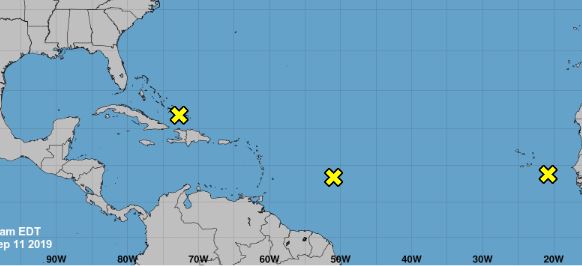
Source: nhc.noaa.gov

There is a lot to watch in the Atlantic.  The first system in line will probably not become very strong but will bring us some rain this weekend.

It is too seeon to tell about the others.

Happy hunting,
TreasureGuide@comcast.net


Thursday, August 15, 2019

8/15/19 Report - Thoughts on Mystery Find. Metal Detector Conductivity Numbers and Object Identification.


Written by the TreasureGuide for the exclusive use of the treasurebeachesreport.blogspot.com.


I posted this item found by Jerry P. several days ago.  Jerry wondered what it might be.  He wondered if it might be an ink well, but I didn't mention that in my post because I didn't want to influence you.

Someone said they wish there was an object for comparison in the photo.  That might have helped.  Jerry did say that it is about three inches around.  If by that he was referring to the outside circumference of the object, it is small.  To give you some perpective, a US quarter is very close to three inches around.

I got a lot of different ideas on this object. Mitch K., who has been very accurate with his mystery item IDs, said it is probably a pet urn.

DJ thought since bronze is non-magnetic it might have been for a compass. He also thought maybe an inkwell.

Joe D. thought it would be too heavy for a snuff box, and thought maybe it held a clock or instrument.

On the ink well idea - I think that is a possibility, but if three inches is the outside circumference, it would be smaller than most. A three inch diameter would be more typical for an ink well. A typical ink well might have an opening with a three inch circumference but the pot would typically be larger than that.

Below is an 18th century ink well set that I found online. Motice that the pots are very similar to Jerry's item.


Below is a pewter pet urn.  Pet cremation urns come in a variety of sizes and shapes and are made of various materials.

Pet Urn.

Being an isolated find and having such a common shape, Jerry's item is difficult to identify.

Here, for another example, is a salt cellar.  It definitely shows some similarities to Jerry's object.

Salt Cellar.

Unfortunately I don't think we can say what Jerry's object is, although we have some good ideas for Jerry to consider.

One thing that I noticed is the clean uncorroded hinge on the object.  That doesn't seem to suggest a lot of age to me.  I'd expect to see more corrosion from a very old item coming out of the sea.

The owner of the object, knowing more about the circumstances of the find and being able to hold it, has the best chance of coming up with an ID.  He is now armed with a variety of thoughts on the subject.  Perhaps a mark or something will show up to provide additional evidence.

---

As you know I have just started to explore the Equinox metal detector.  This morning I decided to do a few conductivity tests.  I used the same test area I've used many times before. The area is subject to various sources of electrical interference.  In fact today I started out in multi-frequency mode, but then it became noisy and I switched to 15kz, which was nice and quiet.

First I tested a zinc penny and a copper penny.  The zinc penny generally came up as 21 - 22 while the copper penny showed a conductivity of 25 - 26.

Then I tested a clad dime and a silver Roosevelt dime.  The clad dime showed very slightly higher numbers than the silver dime.  Both dimes were in the 24 - 27 range.  The silver dime might have been about one point lower on average.

Next I tested a clad aquarter and a silver quarter.  The clad quarter was around 28 - 29, and the silver quarter a touch higher, at 29 - 30.

The silver versus clad coin numbers in this test were too close together for me to draw any conclusions.  The zinc penny rang up lowest, and the quarter numbers were slightly higher than the dime numbers, while the copper penny was not very different from the dimes.

I also compared a 1967 to a 1964 half dollar.  As you might expect there was very little difference.  They were in the 33 - 35 range.

Then I checked a Morgan dollar, which showed in the 35 - 37 range.  So pretty consistently, the larger denomination coins showed higher numbers than the smaller coins even though there were differences in composition.

I also tested the two rings that I showed in recent posts.  One was the small silver turquoise ring and the other the small alloy Claddagh ring.  Both gave conductivity numbers of 24.

This wasn't an extensive or even good test.  I just wanted to get some ideas on how the specific conductivity numbers might provide helpful information, so it is too early for me to draw many conclusions.

The conductivity numbers definitely help some.  For example, you can certainly tell the difference between iron and most coins, for example, but when it comes to making more precise judgements, like the difference between clad or silver coins, I'm not so sure you can do that reliably using just the conductivity readout.  It does look like you will get a different reading for zinc and copper pennies.

People often conduct their metal detector tests with US coins, but I don't know how many people are out there looking for US coins.  I think most people are more interested in finding gold jewelry, old artifacts or other types of things.  Coins do provide convenient test objects, but one thing you probably really want to know is how your metal detector responds to the types of objects that you most want to find.

If you want to find gold jewelry, gold nuggets, silver reales, or old artifacts, the best test objects are the things most like those you want to find.  If you are after gold rings, for example, be sure to test your metal detector on a variety of types and sizes of gold rings.

Many of us hunt a variety of types of objects.  That means that you should become familiar with how your detetor responds to a wide variety of types of objects.  Want to find a Rolex watch?  I'd suggest testing your detector on watches.

---

One person hoped that Glen would keep us informed about any progress he makes on his mystery object, for example if he cleans it or gets it x-rayed or finds anything else that might be related.   When people contribute their ideas they are interested and have a little investment in an object, they would like to know what happens next.  When I take the time to answer a question for someone, I hope they let me know of any additional developments.


Expect a few more days of calm surf.  There are not storms forming yet.

Happy hunting,
TreasureGuide@comcast.net