Showing posts with label Morgan dollar. Show all posts

Saturday, October 19, 2019

10/19/19 Report - New Quarter. Paper Money Grading. Peace Dollar. Small Surf.


Written by the TreasureGuide for the exclusive use of treasurebeachesreport.blogspot.com.

You'll be seeing this quarter in your change before long.


---

You can get your paper money graded and certified too.

With an unparalleled commitment to accuracy, consistency and integrity, PMG is the world’s largest third-party paper money grading service with more than 4,000,000 notes certified. Every note that PMG grades is backed by the comprehensive PMG guarantee of grade and authenticity, which gives buyers and sellers greater confidence...

Here is the link to learn more.

https://www.pmgnotes.com/about/about-pmg/

---

I never thoroughly inspected my Peace or Morgan Dollars.  I took a good look at one Peace dollar today, a 1926 D, and it was very disappointing.  Not only is it banged up, but it was poorly struck to begin with.  It wasn't very long ago that I learned about the Peace Dollar VAMs.  Now I have more to look for.


1926 Peace Dollar.
The reverse is even worse.  It is struck so poorly you can barely read the legend.

If you compare that with the high-priced Morgan that I showed yesterday, you'll quickly see the difference.


Of course, Peace dollars are generally not as nice as Morgan's, but the 1926 Peace shown above is poor for even a Peace dollar.

---

Well it is cloudy and drizzly on the Treasure Coast today.  That is because of Nestor, which is up in  the Panhandle area.

Source; nhc.noaa.gov

We'll be having some calm surf this week.

Source: MagicSeaWeed.com.

Unfortunately the tides are small now.  I'd love to see the water back way off.

Happy hunting,
TreasureGuide@comcast.net


Friday, October 18, 2019

10/18/19 Report - Valuable Coins. Shipwreck Database. Wreck of Le Chameau. Browsing Auctions.


Written by the TreasureGuide for the exclusive use of treasurebeachesreport.blogspot.com.

1893 Morgan Dollar With Estimate of Over $70,000
Source: coinweek.com (See link below.)

As you know, I've been following the current Sedwick Auction, which features a number of 1715 Fleet coins, but there are other auctions that might you might find both interesting and informative.
Legend Rare Coins will soon be offering an extraordinary array of coins in its upcoming Regency Exclusively Legend Auction, slated for October 24. The event, to be hosted at Harrah’s in New Orleans, promises to be an extravagant affair as Legend Rare Coins auctions typically are and buyers are already gearing up for intense bidding action, with the sale’s 184 lots posted online for pre-bidding.

The auction offers a gorgeous selection of proof and mint state type coins, principally selections of high-end Barber coinage, Morgan dollars, popular pre-1933 gold coinage, and other classic pieces from the late 19th and early 20th centuries...

The auction features many rare and valuable coins including the 1893-CC Morgan $1 PCGS MS65 shown above that carries a presale auction estimate of $75,000 to $85,000.
Want to know what makes a coin so valuable?  Take a look at the examples in this auction. 
Here is the link.
https://coinweek.com/auctions-news/five-highlights-from-the-legend-rare-coins-regency-exclusively-legend-auction/

---

Auction catalogs provide a lot of information.  That is why I like to look through them.  As much as I like looking through auction catalogs, I've never bought anything at an auction.  I just can't get excited about paying more than anyone else is willing to pay for an item.  I know there are times when people don't recognize the value of an item and you might be able to get a bargain, but I'd much prefer to find items rather than buy them.  I don't like spending money or buying things, especially if the particular item or a suitable substitute might be found.   It is no wonder then that I like metal detecting.

While looking through the current Sedwick auction listings, I noticed a coin from the wreck of Le Chameau.

On August 27th, 1725, in a storm off Cape Breton, while trying to make the mouth of Louisbourg harbour, Le Chameau was swept in upon the rocky shore...

For years afterwards, legends of the treasure lingered: glimpses of silver and gold in crevices and tales of lobster fisherman pulling up a few handfuls of coins. The treasure, however, was not
located at the time.

In 1961, a discovery of cannons scattered on the sea bottom alerted Alex Storm, a diver working part-time on a fishing trawler from Louisbourg. Braving the dangerous tides and freezing waters
at Kelpy Cove, Storm carefully mapped the wreckage of the Chameau to locate the treasure compartment. Storm's discovery triggered a rising interest in the wealth of shipwrecks off Nova Scotia's waters and brought legislation to protect them...


Here is the link for more about that.

http://www.courseworld.com/wrecks/chameau.html

The Le Chameau is just a few miles north of …. you guessed it …  Oak Island.  It is just one of the many wrecks around Nova Scotia.  Below is a clipping that among other things shows a map of shipwrecks around Nova Scotia.

---


---

It seems that if you spent a while searching it would be surprising if you never picked up something related to a wreck around there.

---

Predicted Path of Tropical Storm 16.
Source: nhc.noaa.gov
It looks like the Panhandle is going to get hit by Tropical Storm 16.

The Treasure Coast is on the wrong side of it and won't be affected much.

We won't have much surf for a few days.

Happy hunting,
Treasureguide@comcast.net

Thursday, August 15, 2019

8/15/19 Report - Thoughts on Mystery Find. Metal Detector Conductivity Numbers and Object Identification.


Written by the TreasureGuide for the exclusive use of the treasurebeachesreport.blogspot.com.


I posted this item found by Jerry P. several days ago.  Jerry wondered what it might be.  He wondered if it might be an ink well, but I didn't mention that in my post because I didn't want to influence you.

Someone said they wish there was an object for comparison in the photo.  That might have helped.  Jerry did say that it is about three inches around.  If by that he was referring to the outside circumference of the object, it is small.  To give you some perpective, a US quarter is very close to three inches around.

I got a lot of different ideas on this object. Mitch K., who has been very accurate with his mystery item IDs, said it is probably a pet urn.

DJ thought since bronze is non-magnetic it might have been for a compass. He also thought maybe an inkwell.

Joe D. thought it would be too heavy for a snuff box, and thought maybe it held a clock or instrument.

On the ink well idea - I think that is a possibility, but if three inches is the outside circumference, it would be smaller than most. A three inch diameter would be more typical for an ink well. A typical ink well might have an opening with a three inch circumference but the pot would typically be larger than that.

Below is an 18th century ink well set that I found online. Motice that the pots are very similar to Jerry's item.


Below is a pewter pet urn.  Pet cremation urns come in a variety of sizes and shapes and are made of various materials.

Pet Urn.

Being an isolated find and having such a common shape, Jerry's item is difficult to identify.

Here, for another example, is a salt cellar.  It definitely shows some similarities to Jerry's object.

Salt Cellar.

Unfortunately I don't think we can say what Jerry's object is, although we have some good ideas for Jerry to consider.

One thing that I noticed is the clean uncorroded hinge on the object.  That doesn't seem to suggest a lot of age to me.  I'd expect to see more corrosion from a very old item coming out of the sea.

The owner of the object, knowing more about the circumstances of the find and being able to hold it, has the best chance of coming up with an ID.  He is now armed with a variety of thoughts on the subject.  Perhaps a mark or something will show up to provide additional evidence.

---

As you know I have just started to explore the Equinox metal detector.  This morning I decided to do a few conductivity tests.  I used the same test area I've used many times before. The area is subject to various sources of electrical interference.  In fact today I started out in multi-frequency mode, but then it became noisy and I switched to 15kz, which was nice and quiet.

First I tested a zinc penny and a copper penny.  The zinc penny generally came up as 21 - 22 while the copper penny showed a conductivity of 25 - 26.

Then I tested a clad dime and a silver Roosevelt dime.  The clad dime showed very slightly higher numbers than the silver dime.  Both dimes were in the 24 - 27 range.  The silver dime might have been about one point lower on average.

Next I tested a clad aquarter and a silver quarter.  The clad quarter was around 28 - 29, and the silver quarter a touch higher, at 29 - 30.

The silver versus clad coin numbers in this test were too close together for me to draw any conclusions.  The zinc penny rang up lowest, and the quarter numbers were slightly higher than the dime numbers, while the copper penny was not very different from the dimes.

I also compared a 1967 to a 1964 half dollar.  As you might expect there was very little difference.  They were in the 33 - 35 range.

Then I checked a Morgan dollar, which showed in the 35 - 37 range.  So pretty consistently, the larger denomination coins showed higher numbers than the smaller coins even though there were differences in composition.

I also tested the two rings that I showed in recent posts.  One was the small silver turquoise ring and the other the small alloy Claddagh ring.  Both gave conductivity numbers of 24.

This wasn't an extensive or even good test.  I just wanted to get some ideas on how the specific conductivity numbers might provide helpful information, so it is too early for me to draw many conclusions.

The conductivity numbers definitely help some.  For example, you can certainly tell the difference between iron and most coins, for example, but when it comes to making more precise judgements, like the difference between clad or silver coins, I'm not so sure you can do that reliably using just the conductivity readout.  It does look like you will get a different reading for zinc and copper pennies.

People often conduct their metal detector tests with US coins, but I don't know how many people are out there looking for US coins.  I think most people are more interested in finding gold jewelry, old artifacts or other types of things.  Coins do provide convenient test objects, but one thing you probably really want to know is how your metal detector responds to the types of objects that you most want to find.

If you want to find gold jewelry, gold nuggets, silver reales, or old artifacts, the best test objects are the things most like those you want to find.  If you are after gold rings, for example, be sure to test your metal detector on a variety of types and sizes of gold rings.

Many of us hunt a variety of types of objects.  That means that you should become familiar with how your detetor responds to a wide variety of types of objects.  Want to find a Rolex watch?  I'd suggest testing your detector on watches.

---

One person hoped that Glen would keep us informed about any progress he makes on his mystery object, for example if he cleans it or gets it x-rayed or finds anything else that might be related.   When people contribute their ideas they are interested and have a little investment in an object, they would like to know what happens next.  When I take the time to answer a question for someone, I hope they let me know of any additional developments.


Expect a few more days of calm surf.  There are not storms forming yet.

Happy hunting,
TreasureGuide@comcast.net


Friday, January 4, 2019

1/4/19 Report - Gold Trending Up. Rare Matching Pair Finds. Silver Dollar VAMs.


Written by the TreasureGuide for the exclusive use of treasurebeachesreport.blogspot.com.

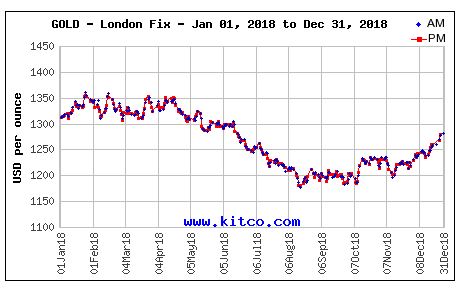
While the stock market has been going through wild gyrations, the price of gold has been doing well.  Above is the 2018 chart.  The early days of 2019 have also seen increases.  

The up-trend in gold prices started back around the end of August and has continued through yesterday, when it closed at about $1298 US dollars per ounce.  Today however it is down again.  You never know what it is going to do.

---

Some finds are rare for one reason or another.  Even though I used to target and find a lot of gold jewelry, I seldom found sets together.  There have been times though when I found a matching engagement and wedding ring.  On a few occasions I found a matching pair of ear rings.  I showed a diamond and pearl set before.

The one time that stick out in my memory when I found a matching engagement and wedding band together was in the shallow water beside a picnic area on a causeway in Pensacola.  They were only a couple feet apart.  They were the same size and design. They were gold and diamond, but fairly inexpensive.  I figured they just slipped off at the same time.  Maybe a little suntan lotion and a Frisbee or something was involved.  Who knows?  Anyway they ended up lost in the water in very close proximity.

Here is a more recent matching set found on a Treasure Coast beach.  14K with diamonds.  They were also found in shallow water very close together.  They make a more expensive set than the Pensacola set that I talked about.

Matching Engagement Ring and Wedding Band Set.

I always figured the matching earring finds were taken off together.  It is difficult to imagine a pair of those coming off at the same time.

---

Older silver dollars are also rare finds for me.  I haven't found too many, and most of the ones I did find were found together in a cache.  After finding those and doing a little research I learned just a little about VAMs.

VAMs are cataloged varieties of Morgan or Peace dollar. For each year and mint, there are varieties that are identified by characteristics that may include any of the following:


    VAM silver dollars are cataloged using a system of numbers and letters that incorporate the “VAM” name. A normal Morgan dollar or Peace dollar is classified as a “VAM-1.” Subsequent VAM dollars are recognized as a VAM-2, VAM-3, VAM-4, and so on...

The Comprehensive Catalog and Encyclopedia of Morgan and Peace Dollars by Leroy C. Van Allen and A. George Mallis.

See https://coins.thefuntimesguide.com/vam-dollars/

"VAM" is a combination of the initials of the fellows (Van Allen and A. Mallis) that extensively studied and catalogued all the Morgan and Peace dollar mint varieties in The Comprehensive Catalog and Encyclopedia of Morgan and Peace Dollars.

Some VAMS are quite valuable.

---

I added the 18th Century Material Culture Resource Center web site to my reference link list.  It is well worth browsing.

We'll have a few more days of calm surf on the Treasure Coast.

Happy hunting,
TreasureGuide@comcast.net

Sunday, December 2, 2018

12/2/18 Report - Detailed Coin Price Tables. WW II Propaganda Money. Best Information on How To Clean Your Coins and Artifacts.


Written by the TreasureGuide for the exclusive use of treasurebeachesreport.blogspot.com.

Eagle Photo by Gaylen C.
Gaylen C. caught some great eagle photos north of Fort Pierce.  Here is one.

Thanks Gaylen!


----


If you are wondering how much you should ask for a particular coin, or how much you should pay, there is a lot of detailed information you can find.  I was researching the value of some of my finds and found a site that gives a lot of information.

Here is an example of a table that I found for a 1921 Morgan dollar.


As of 2017, a 1921 Morgan dollar in VF 20 condition would go for around $28, while a PG 65 might bring $62,500.  That is a huge range that illustrates the importance of condition and rarity.

You can also see how coins increased in value of the years.  There is a big difference between the 1950 prices and 2017 prices.  There is also a big difference in the value of the dollar, which you should take into account.

While you can get some tables on the web-site you can purchase others.  That could be worthwhile if you are interested in selling or buying coins.

Here is the link.

https://www.us-coin-values-advisor.com/rare-coin-values-index.html

---

Alberto S. found some interesting information relevant to the paper money photo that I posted yesterday.  It appears to be a 1930s - 1940s Japanese ten-yen note.  But the interesting part is that they issued similar notes during the war with propaganda messages on the back.

Here is that interesting bit of WW II history.

In the summer of 1945, Japan was showered almost daily by aerial leaflets in such quantity that the Japanese people developed a kind of apathy against them. A novel approach had therefore to be sought to attract renewed attention. The ingenious idea was to reproduce the face side of the then current 10-yen banknote and replace the back by a propaganda message. For who could resist money falling from the sky?

There are four different propaganda leaflets. All have the same exquisitely lithographed front to resemble closely the genuine Japan 10 Yen 1930 banknote but with different messages on the back.

One striking difference between the genuine bills and the counterfeit is that the former has red seal on the front whereas the latter has brown seal. The other difference is that all counterfeit bills bear the serial number 450941 and the block number 1124 on the front.

The purpose of the leaflets was to stir Japanese resentment against their government and to create fear of inflation.


Here is the link.

http://nutmegcollector.blogspot.com/2011/03/japan-10-yen-1930-banknote-on-u-s.html

Here is what a genuine note looked like (same source).  Mine was torn.


---

If you want to the best information on how to clean and conserve your finds, I always recommend the TAMU conservation lab web site.

This link will take you to a document that details how to clean coins.  It might be too technical for some situations, but it is the best information.

http://nautarch.tamu.edu/CRL/conservationmanual/File13.htm

You can find detailed information on how to clean almost any artifact on the TAMU web site.  Check it out.

---

The Treasure Coast will have another few days of small surf before we get anything bigger.  The high tides are still decent, but that is about it.  Don't expect any big improvement in beach conditions real soon.

Happy hunting,
TreasureGuide@comcast.net

Thursday, August 9, 2018

8/9/18 Report - Similarities In Coins From Different Time Periods and Countries. No Atlantic Storms Other Than Debby.


Written by the TreasureGuide for the exclusive use of treasurebeachesreport.blogspot.com.

1914 Ten Dollar Gold Coin.
This found coin grades around AU50 - AU55.  It shows most wear on the high spots such as the hair above the eyes and on the reverse on the eagle's shoulder.

Yesterday I was talking about how many similar features you see on a lot of different coins from different countries.  Coins have also remained remarkably similar through the centuries.  Here is an example of how you will see the same types of things on coins from different places.

1900 Morgan Dollar.
Above is a U.S. Morgan dollar.  Notice the headband.

1939 Swiss Coin.
Here is a Swiss coin.  Notice the headband on this one and how the word for liberty is spelled out in a very similar incuse block letters.

Notice also the headband on the figure featured on the gold coin at the top of the post.

The woman on the Swiss coin looks like she could be the twin sister of the woman on the Morgan dollar.  I could give a seemingly endless list of examples showing how different coins from different places and times show remarkable similarities.

Below is a 1988 10 pesetas coin from Spain.


Spanish 1988 10 Pesetas 
See anything that you might see on a 17th or 18th century Spanish colonial coin?  Maybe the Pillars of Hercules, the crown, shield, or Plus Ultra legend?

Coins can be used to preserve history.  They often have a political purpose as well as an economic one.  When you look at a coin, whether it is a 17th century cob or a brand new proof coin, look for the message.  What is on the coin, and why?  There is a message.  Ask yourself what the message is and what was to be accomplished.

On some coins you can see that there is an attempt to promote tourism.  You've seen those, I'm sure.

I saw one coin the other day that had the message "Grow more food" on it.

Even though a lot of coins share some very common similarities, there are also some very unusual coins.  They are usually produced to make money off of collectors.

There are some coins that are in the shape of balls, cubes and pyramids, for example.  Others contain a piece of mammoth ivory, and others contain a piece of a space vehicle.  Still others are in the shape of a car or guitar and are beautifully painted.  Unfortunately I've never found any of those.

Here are some strangely shaped coins.

Some Very Unusually Shaped Coins.

Here is a link that will tell you a little about some of the unusually shaped coins.

https://www.money.org/collector/shriekengriffon/blog/odd-shaped-coins

Some small island countries such as Palua seem to make and sell some of the most unusual, evidently for income.

---

The badly corroded coin I showed yesterday is a British half penny that was made 1982 - 1984.  It is not valuable at all.

The 1949 Hong Kong Five Cents coin is not worth more than a few cents in good condition either.

The 1929 1-centavo is also worth just a few cents.  There are a few of those that are error coins, such as the 1924 4 over 3 that is worth about $65 in fine condition.

---

The surf is smooth, but the tides are big.  Today we'll have a negative low tide.

Tropical storm Debby continues to move away from us, and there is nothing else of interest in the Atlantic.

Happy hunting,
TreasureGuide@comcast.net

Tuesday, July 17, 2018

7/17/18 Report - Helpful Information and Web Sites for Modern Coin Die Varieties. Watershed Dates For the U. S. Mint.


Written by the TreasureGuide for the exclusive use of treasurebeachesreport.blogspot.com.

Reverse of 1880 Morgan Dollar Find.

Today there are some very helpful web sites.  The token catalog is the type of thing that appeals to me.  It takes a basic database program and seeks to build a comprehensive listing of tokens.  The more complete it is, the more useful it is.  It collects, organizes, and makes all the examples readily available to much of the world, and that shared data expands on the overall knowledge level concerning tokens.  

Coin collecting has been affected  by the internet in the same way.  Databases of examples and numismatic information is made available and widely shared.  The internet has also changed the market for coins, as it has for many collectibles.  Common coins aren't worth as much now because they are easily found and seem much more common than in the days before the internet.  True rarities become more desired and more expensive.  The bar is raised.  With access and knowledge, people want finer and more rare items.

As more is known, people put significance on smaller details.  Now people study not just coins of a particular year and mint, but also the various states of the die.  As a die is used, wears, develops cracks, and eventually is worn out and replaced.  You can tell if a coin is an early or late die state coin by the impression left by the die.

VAM is a Peace, or Morgan silver dollar die variety that has been identified in an all-inclusive book called The Comprehensive Catalog and Encyclopedia of Morgan and Peace Dollars by Leroy C. Van Allen and A. George Mallis. The term VAM derives from the first initials of Van Allen's and Mallis' last names. These two researchers noticed small differences between coins produced in the same year and at the same mint.

The great popularity of noting the many die varieties found, especially on Morgan Dollars, has led to the term VAM being used to describe practically any deviation from a "normal" Morgan or Peace silver dollar for that year and mint. It is now common language among coin collectors that people talk about having found a "VAM" when the variety they are referring to has not been assigned a VAM Number...
They began to photograph and catalog these differences to identify the different die varieties in the Morgan and Peace silver dollar series.

Here a the link to read more about that.

I'm a novice at studying modern coins, but I am enjoying it.

I have been presenting a variety of Philip monogram half reales and comparing them, but that is just a very basic beginning and I will never develop an extensive catalog, yet I find the comparisons interesting and enjoyable.

I found a very good web site on coin varieties.  Here are a few dates to remember.

1909 is the beginning of the modern minting process.  Prior to 1909 a partial hubbing process was utilized by the U.S. Mint. This process left the date and mintmark to be hand punched into each working die. 1909 saw for the first time, the date engraved into the master die, so that every working hub and working die carried the same date positioning. Mintmarks, however, were still applied to the working dies by hand as each branch mint had a need for dies.

1985 is when the mint began punching mintmarks into the master die.

1986 is when the mint began using a single squeeze hubbing process.

In 1990 the mint began punching the mintmark into the master die for cent and nickel coins.

In 1991 they began punching the mintmark into the master die for other denominations.

Here is the link for more about watershed dates.

http://www.varietyvista.com/Watershead%20Dates.htm

The same web site provides a long detailed list of specific die varieties.

---

We're still having some nice big tides on the Treasure Coast.  The surf is still small too, but will pick up just a little tomorrow.

Happy hunting,
TreasureGuide@comcast.net

Thursday, July 12, 2018

7/12/18 Report - Treasures of the Spanish Main and Old West - Big and Small.


Written by the TreasureGuide for the exclusive use of treasurebeachesreport.blogspot.com.


Some beach cobs are very small.  It is not uncommon for a beach cob to be as much as one third underweight.  Some cobs are so much underweight that I call them fractional cobs.  That might not be the best word to use, but some beach cobs are less than half their proper minted weight.  They corrode, flake and break.  The above cob is one such cob.  Given its small size, it is amazing that it shows much of the cross and even part of the tressure surrounding the cross.  Some more complete cobs do not show as much.

As the picture shows, this cross is only about .75 centimeters across.  The other side is close to 1.5 centimeters.  It is thin too.

Other Side of Same Cob.
As you can see, none of the monogram is showing on this side.  It looks like it has flaked off.

That is one very small cob.  It is one of four cobs found during a November hunt in 2013 and by far the smallest and most corroded.

The reason I show it is so you will be prepared for small finds.  Cobs this small can easily be missed for a variety of reasons.

To give you a comparison, here is the same small cob resting on a Morgan dollar.

18th Century Cob Resting on 19th Century Coin, Both Found in 21st Century.
Not only is the surface area of the cob much smaller, it is also a lot thinner than the dollar.

That presents a good range of targets, going from under a gram to around thirty times as much.  And of course, even larger good targets can be found, such as ingots or bars.  That can present a bit of a challenge.  Larger targets will scream out while the tiny ones might only give a whisper.

You might not think that is any challenge for you, but I remember a time when I was so focused on gold rings that I probably passed over some very good larger targets.  If you don't dig it all, you are making decisions, and it seems to me that everyone must occasionally make a mistake.  As a detectorists, you never know what you miss.  That can make you feel like you never miss anything.

I find Morgan dollars among the most attractive coins.  Cobs have their own unique appeal.  What I like about them is solving the puzzle.  They are usually incomplete and there is a lot of information to unravel.  I'll show you a couple nicer ones found the same day as the tiny one shown above and get more into that another day.

One thing I really like about the Morgan's is the attractive lettering.

Part of a Morgan Dollar Showing Lettering and Angry Looking Eagle.
Take a look at the "I" in "In God We Trust."  Very artistic.

Reverse of Same Dollar Coin.
Notice the O mint mark.  I've found more Mexico mint cobs over the years than I have coins from the New Orleans mint.

The reale elicits images of Spanish galleons and hurricanes while the Morgan dollar reminds of the Comstock Load and the Old West - treasures of different times and places.  That is part of the appeal of metal detecting.  You never know what you will find or where it will take you.

---

Source: nhc.noaa.gov
As you can see, Chris has moved northeast and the remnants of Beryl are now well out to see.  They won't do anything for us now and there is nothing new of immediate interest in the Atlantic.

The tides are pretty big today.

Happy hunting,
TreasureGuide@comcast.net


Wednesday, July 11, 2018

7/11/18 Report - 23 Morgan and Peace Silver Dollars Found. Chris Moving Off.

Written by the TreasureGuide for the exclusive use of TreasureBeachesReport.blogspot.com.

Hurricane Chris and Remnant of Beryl
Source: nhc.noaa.gov

Chris is a now hurricane movng north/northeast away from North Carolina and well off the northeast coast.

Beryl is now only a remnant and is also moving north.  It does not look like we'll get any real effect from Beryl.

We're getting a higher tide than we've had in the recent past, but not anything extraordinary.  Expect more one and two foot surf along the Treasure Coast until another disturbance comes along. 

---

Recent Treasure Coast Area Find.

The silver dollars shown above range in date from 1880 to 1928.  There are four Morgan dollars.

Mint marks include O, D and S.

They are not collector coins.  They vary in condition slightly, but are all well worn from circulation.

The most frequent date is 1922, which is also the date of highest production, so that is not surprising and supports the idea that they were taken from circulation rather than purchased as collector coins.

One thing that struck me is that they are almost the same weight as an eight reale - maybe gram less than a proper eight reale.

I really like the looks of Morgan dollars a lot more than Peace dollars.  The only thing I like better about Peace dollars is the face of Lady Liberty.

Morgan dollars were minted from 1878 to 1904, and then again in 1921 before the mints ramped up and turned out tons of Peace dollars.  They were minted to use silver from the Comstock lode and circulated most widely in the West.  They are 90% silver and weigh 26.73 grams.

Also 90% silver, the Peace dollar was to commemorate peace after World War I.  They went into circulation in January of  1922 and was stopped after 1928.  They were produced again briefly in 1934 and 1935.

---

You can really benefit from asking good questions and talking to the right people. If you ask the right questions you have a very good chance of eventually getting the right information.  The right questions will lead you down a path of continuing discovery.

There is a lot of good information that is readily available over the internet, but a lot of it isn't very good.  If you aren't careful, it is as easy to be led astray as helped by it all.

When I post an article, I usually do it for a reason other than the fact that it is just something interesting.  There are usually some good clues to be found.

Did you notice all of the amazing finds that have been found in farm fields?  I hope you didn't just read that and think how wonderful it would be.   I hope you asked yourself why that would be.  Why are so many good things found in farm fields?  How are they found?  And what it means to you, if anything?  I hope you take the time to think about the articles as you read them.

Keep an eye on the Atlantic.

Happy hunting,
TreasureGuide@comcast.net