Showing posts with label escudos. Show all posts

Friday, May 17, 2019

5/17/19 Report - Coin Varieties and VAMs. A Submerged Archaic Period Site. 1715 Fleet Escudo Values.


Written by the TreasureGuide for the exclusive use of treasurebeachesreport.blogspot.com.


Source: See VAM link below.
---

If you are looking for one thing, you might find something else.  That was the case with a diver who was looking for fossils off Venice Florida in 2016.  21 feet under water, he found an Archaic Period burial pond site.  Here is an excert about that from the Herald Tribune (link below).

SARASOTA — Native Americans in the Archaic Period in Florida used the burial ground now known as the Manasota Key Offshore archeological site as far back as 8,000 years ago, Ryan Duggins told members of the Time Sifters Archaeological Society Wednesday evening in the Geldbart Auditorium at Selby Public Library.

Prior to this, previous activity at the site was thought to date back roughly 7,000 years.

Before the rising of the Gulf of Mexico, it was a shallow freshwater burial pond similar to Little Salt Springs in North Port...


Another bit from the same article...


“This demonstrates that we can have preservation of worked wood, of cordage of burials that have survived thousands of years of storms — It’s completely unprecedented.”...

See: https://www.heraldtribune.com/news/20190516/ancient-burial-site-off-manasota-key-is-1000-years-older-than-estimated

Things can remain very much protected under sand or other materials for a long time and then suddenly be uncovered by the right set of circumstances.

It was an amateur fossil hunter that found and reported this site.  How often do we hear about  detectorists or people hunting for other kinds of treasure that make exciting archaeological discoveries?  It seems like it happens a lot, yet many in the archaeological community are always talking about looting rather than the assistance they get from the public.

https://dos.myflorida.com/historical/archaeology/projects/manasota-key-offshore/

---

We normally only scratch the surface.  That applies to a lot of things, but it certainly applies to coin collecting.  People often begin by wanting one of each date.  Then they want an example from each mint too.  Then they start getting particular about the condition of their coins and want the finest coins they can get.

As detectorists, we usually don't get too deep into coin collecting.  We're  don't buy coins, and you can't systematically dig whole sets - certainly not in great condition, even though we might occasionally find some very nice caches that can make a good collection.

As detectorists, we do find a good number of coins and can benefit from knowing enough to recognize what coins might have extra value.  I suspect that we often fail to recognize coins (and other finds) that are more valuable than we wold have thought.

In addition to all of the date/mint combinations there are also a lot of coins that are valuable because of mint errors.  I didn't know hardly anything about mint errors until just the past couple of years.  I recently reported on a penny that was worth over $20,000 because of a mint error.

There are different types of doubling and some are not worth anything.  For example, doubling due to the die bouncing when it strikes the coin is called machine doubling.  It normally does not add any value to the coin.

Doubled die coins on the other hand can be worth a lot.  That type of doubling occurs when a doubled image is on the die that strikes the coin.

I wish I knew more about that type of thing years ago.  I could have found some valuable coins, and I maybe I would have enjoyed my finds even more.

I didn't find a lot of silver dollars over the years, but because of more recent finds, I'm just starting to learn about silver dollar VAMs.  Here is a definition of VAM.

Silver dollars are created by striking metal blanks with hardened dies containing the mirror image of the desired pattern. Through careful study, slight differences can be used to identify specific dies that created the coins. Sometimes these differences occur during the creation of the dies, while other times they are caused by the maintenance or use of the dies.

Source: http://ec2-13-58-222-16.us-east-2.compute.amazonaws.com/wiki/VAM

VAMs are not obvious to the untrained eye.  You have to know what to look for, and for me, it requires magnification to see the small differences.

At the top of this post is a photo of a Peace silver dollar VAM.  The VAM is identified by the gouge and dot that the arrows are pointing to.

Just roughly I'd say there are more than a hundred different Peace Dollar VAMs.

Coin varieties and errors are something that you might want to look into.  A lot of people search and collect Lincoln cent varieties and errors.  You can get a hundred pennies to search through for only a dollar, and then turn in the ones that aren't anything special for an entirely new batch.  Or, you can just study your finds, digging the pennies instead of skipping them.  They can be valuable too.

---

One of the first things a lot of detectorists want to know when they find something is how much it is worth.  We all know that something is only worth what somebody will pay for it, but how can you get an idea of what somebody will pay?  One thing I do is check the auction sites and other on-line sites where things are sold.  If you don't have a realized price auction list, you can still sometimes get a good idea from the auction estimates, especially when an quality experienced auctioneer is the source.

In the last Sedwick auction, for example, there were six 1715-Fleet Mexico cob 8-escudos listed together.  While some were better than others, or should I say, expected to bring a higher price than others, they didn't vary a lot.  If you looked at those estimates, you might conclude, as I did, that 1715-Fleet Mexico 8-escudos in good condition might be expected to bring a bit over six thousand dollars, on average.

I know that some of my readers aren't much interested in the auctions, but the auction catalogs are really a good source of information and can help answer a lot of common questions, of which value is only one.

---

We have some decent tides now, but it looks like the surf will run around two feet for a week or so.

Happy hunting,
TreasureGuide@comcast.net


Wednesday, July 5, 2017

7/5/17 Report - Forty Years Ago: 1715 Fleet Treasure. Serious Storm Developing in Atlantic.


Written by the TreasureGuide for the exclusive use of TreasureBeachesReport.blogspot.com.

Forty years ago (Feb. 1977) Bowers and Ruddy Galleries auctioned 720 lots of 1715 Fleet treasure, mostly cobs, many gold and silver, but also some bars and artifacts from the 1715 Fleet. I decided to take a look back today.

It was in the 1950s that a hurricane ripped the Treasure Coast beaches and Kip Wagner was at the right place at the right time and started finding silver reales from the 1715 Fleet on the Treasure Coast beaches.  You know the story.  Kip and seven others formed the Real Eight Company.  Recoveries were sporadic and slow at times.  On one occasion in the 1960s, their blower exposed gold dubloons, and in 1974 another amazing day resulted in more than a thousand dubloons being recovered.

13 Pound Encrusted Clump of Pieces of Eight.
Source: 1977 Bowers Ruddy Auction Catalog.

Back in 1977 the clump of coins sold for $2000.


9.5 Ounce Gold Splash
Source: 1977 Bowers Ruddy Auction Catalog

The above gold splash sold for $2200.


37.25 Inch Gold Chain.
Source: 1977 Bowers Ruddy Auction Catalog


The gold chain sold for $2200 as well.

The auction house offered the following price guide for escudos in the auction catalog. 

Eights - $800 to $1300
Fours - $600 to $1000
Twos - $200 to $500

From a quick look at the page of realized prices, it looks like the realized prices were not far off the suggested prices.

To give some perspective, the price of gold in 1977 ran around $161.

According to one inflation calculator, it would take about $403 today to buy what $100 would buy in 1977.  That would mean the dollar was worth about four times more back then.

I was lucky to pick up the Bowers Ruddy auction catalog with realized prices in a local thrift store for $1 a number of years ago.

---

Source: MagicSeaWeed.com
This disturbance has a 70% chance of becoming a cyclone in the next 48 hours.

It is still far out there, so it is difficult to tell where it might go.  Earlier predictions I saw had it going east of us.

According to the surf predictions, we'll just get a small bump in the surf around next Wednesday.

---

I appreciated all responses to the blog poll.

Happy hunting,
TreasureGuide@comcast.net

Friday, July 15, 2016

7/15/16 Report - New 1715 Fleet Finds From The Crew Of The Capitana. Treasure Coast Waterway Cleanup.


Written by the TreasureGuide for the exclusive use of TreasureBeachesReport.blogspot.com.

July 2016 1715 Treasure Fleet Finds
Photo submitted by Captain Jonah Martinez.
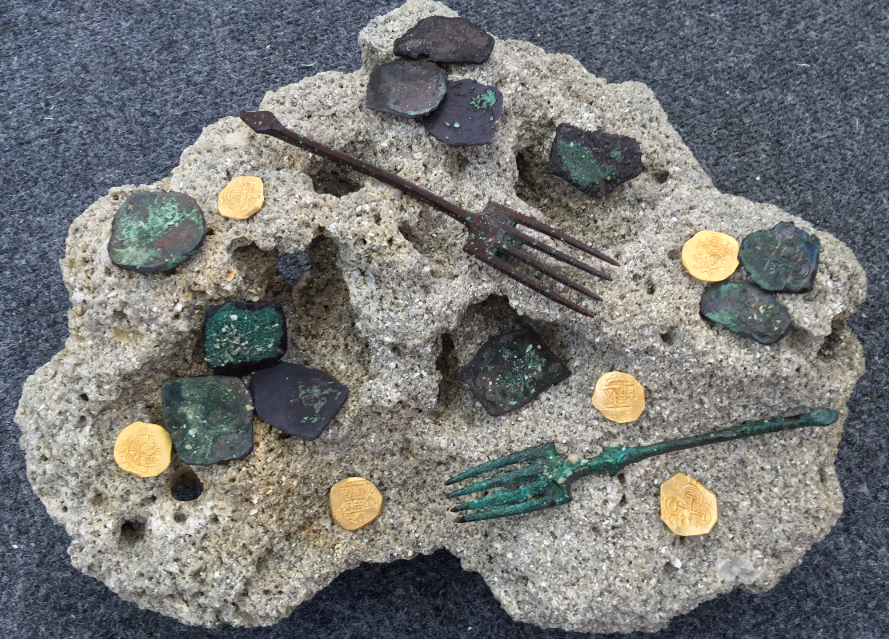
As you can see, there are two silver forks, six gold escudos, and ten silver reales.

The Capitana guys have been working long and hard through the heat this summer and it is paying off.  Every day and every find brings them that much closer to their next great find.

They've found similar forks before, as well as the reales and escudos.

There finds were from about July 4th until the 14th.

Way to go Jonah, Bill and Dan!

Great photo Jonah.  Thanks for sharing.

Below are some closer views.


I just zoomed in on those.

Here are some closeups of reales.  Most of them appear to be worn fairly smooth, but not all of them.  The one in the second picture below has some good detail.


Thanks again Captain!  We are all rooting for you and eagerly await each find.

I think I see some small pieces of silver on that rock - maybe the remnants of silver coins or something.

---

The 9th Annual Treasure Coast Waterway Cleanup will be held Saturday, July 23, 2016.

7500 volunteers will be working along 125 miles of waterways in Martin, St. Lucie and Indian River Counties.  More than 67 tons of trash will be removed from the waterways.

Below is the link for more information.  This would be a great project for any club or group, and a natural for detectorists who want to promote our hobby.

http://www.tcwaterwaycleanup.com/

This event is for all ages. Perfect for students, service clubs, yacht clubs or anyone who wants to be part of the solution to pollution. All volunteers will receive an event T-shirt and watercraft will receive a commemorative burgee to fly, which indicates that they are part of the event. All volunteers will be invited to an appreciation BBQ in August  (date TBA). Contact us for more information!

---

Thanks for all the responses to the blog poll.  There is only one day remaining if you haven't given your response yet.

---

I have a lot of topics on my mind.  I also have some explaining to do.  It is difficult to cover a topic well in short daily posts.  Sometimes I need to give more details.

We've had poor beach conditions for a good while now, but as the Capitana guys showed, there is more treasure lurking out there.  The are great finds yet to be made.

There is no tropical activity to watch right now.  I'd love to see a break in this heat.  The surf will be picking up a little now, but only to about three feet next week.

Happy hunting,
TreasureGuide@comcast.net

Friday, August 28, 2015

8/29/15 Report - Mystery Solved. Bogota Escudos: New and Old Finds. Real Eight Co. Changes For Erika Forecast.


Written by the TreasureGuide for the exclusive use of treasurebeachesreport.blogspot.com.

Another Group Of Recently Discovered Escudos
This grouping shows some escudos from Bogota, Columbia.  There are two signs that provide clues.

On the cross side of some of these, you see a design feature that some have refer to as "scissors."  I can see why they refer to it that way.  They do look a little like scissors, but not a whole lot.  That mark appears in each quadrant of the cross.  The scissors, are just a distinctive type of rendering of one type of Fleur-de-lis.  On some escudos they appear much larger than on others.

On the other side of the escudo, in the upper right quadrant of the shield, where Naples and Sicily is represented, you see two dots instead of two birds.  That is also a tip off.

You might remember how I was surprised to see lions and castles of Leon and Castile in the upper right of a shield that I pointed out yesterday.  I thought that was unusual and possibly an error.  It was not an error.  Well, it wasn't an error on the cob.  It was my error.

That is what you see on some of the shields of Bogota escudos.  I hadn't seen that before, but found it listed in an old auction catalog in which a lot of Kip Wagner's escudos from the 1715 Fleet were being auctioned.

Illustration From Bowers & Ruddy 1977 Auction Catalog.
In the illustration from the auction catalog shown immediately above, the Naples and Sicily symbols are in the upper left of the shield, and the Leon and Castile symbols in the upper right.

I'm only aware of 2-escudos and a few 1-escudos from the Bogota mint, and no other denominations. The auction listed 75 2-escudos from Bogota and five 1-escudos.  The catalog shows many more escudos from other New World mints and is a very good reference source.

There were eleven different shield designs for Bogota escudos illustrated in the auction catalog.  Two had the Sicily and Naples symbols on the left side of the shield rather than the right.  So it was not an error or anything like that, just a design that I didn't know about and didn't remember seeing anywhere before.

It was in the early sixties that the Real Eight Company found the famed "carpet of more than 1000 golden dubloons."  They hit big again in 1974.

Most of the Bogota escudos sold in the 1977 auction averaged around $150, which adjusted or inflation would be just over $600 in 2015 dollars.  The price of gold that year averaged around $150 an ounce.  I think you would actually expect to pay something more like $2000 for similar escudos today.  That gives some historical perspective to the money aspect.

---

Different subect: I feel a duty to provide the following warning.

Hurricanes are dangerous.  I don't want you to take the danger too lightly.  I don't want a hurricane.  I just want a storm that stays out at sea and churns up some waves.

Hurricanes do too much damage.  And people die in hurricanes.  I'd have to be a raving fool to want that.

Many of you have been through hurricanes.  Some who have been through a hurricane have been on the out skirts where you didn't get the full force.  I want to tell all of you, and especially those of you who plan to come in from other areas, (I've heard from a few that plan on doing that already) don't drive into a hurricane.  It is not a party.

They do a good job of forecasting these things anymore, but they are not totally accurate. Make sure you know what you are doing.  Don't do anything stupid.

You never know what you might be getting into.  There can be downed electric lines, blocked roads and closed bridges.  If we get much of a hurricane, you might not even be able to get to the beach for a few days.

I don't want to unnecessarily alarm anyone by saying that all or any of that will happen this time, yet it could.  Storms can do strange things.  They can take unexpected turns.

Play it safe on the beach too.  If you haven't been in a big hurricane before, you simply don't know what you might be getting into.  When the surf is high and the waves big, you might not be able to get on the beach anyhow for a few days.  The bridges will be closed.   And it will be too rough and dangerous to get down on the beach anyhow.  Wait until it is safe.

Some of the best beach finds have been made days after a storm.  People who have made really big beach finds have told me they thought they were too late and it was all over.  But that is when the big find was made.

Even after the water has gone down some, a big wave can easily catch you unprepared and sweep you off your feet.  It can be very dangerous.  Trees and other large debris can be washing in an out in the surf.  You can lose or have your equipment damaged.  I've known more than one person who was experienced with rough weather detecting that lost a detector or scoop to an unexpected wave.  Don't take this too lightly.  Err on the side of caution.  It isn't worth losing your life.

---

In support of the above, I received this message from Robert H.

You are 100 percent spot on. Those treasure coast barrier islands could be completely submerged under water with a full moon and big tides that were predicated the storm surge is what mainly kills people. As a survivor of one of the worse hurricanes being Andrew and being right in the heart of the storm many were lucky the storm surge wasn't any higher. I know certain areas did see that 15ft rise in sea level but I think most all were evacuated from those storm surge areas in advance thankfully. In all reality we were extremely lucky to survive that storm. If it slowed down and lasted another hour or two with that intensity many more lives including mine could had been lost. Would hate to think of any fellow Detectorist going to wait it out in there car right there ocean side and get swept in the ocean or the ocean swallows them and there car.

Thanks for sharing Robert.

---

There are two changes with the forecasts or Erika.  The track has moved more south.  She is now expected to land down at the southern tip of the penisnsula, and she is expected to remain a tropical storm rather than developing into a hurricane.

Predicted Track of Erika As Of 8 AM 8/28
The surfing web sites are now predicting only around a five foot surf now.  That means that it might not move much sand or stir up much of anything on the Treasure Coast.

Keep watching for any additional changes.

Happy hunting,
TreasureGuide@comcast.net

Monday, August 24, 2015

8/24/15 Report - Contraband Treasure and Signs To Look For. Shipping Containers for Treasure. Danny Disappeared.


Written by the TreasureGuide for the exclusive use of TreasureBeachesReport.blogspot.com.


Active Atlantic
Source: National Hurricane Center
As you can see Danny fell apart.  That is the end of him.  However, there are two more systems coming off of Africa.

The one behind Danny has an eighty percent chance of becoming a cyclone in the next 48 hours.  It seems to be on a similar path.

Here are some more fresh escudos that were on display Thursday.


Three More Of The Escudos Displayed At Thursday Press Release.

I'm not absolutely sure, but from what I can see of the two shields, it looks like they might be from Bogota, Columbia.

Correct me if I'm wrong about that.  As you know, I'm not any kind of expert on numismatics.

We are fortunate to see so many fine examples.  It gives you an idea about what was on these wrecks and what could possibly be found.

---

Yesterday I started talking about the recent finds and how they might have ended up where they were found.   In my opinion there would be very little chance of the cobs that descended to deep cracks or tight crevices would ever be washed up on the beach.

I think I mentioned yesterday that I didn't know of any evidence of any bags or boxes associated with those cobs.  The   treasure chests that held the cobs on the Atocha were simply plain boxes nailed shut.  They weren't ornate at all, and didn't have a lid that flips up.  While the dimensions varied, the tops and bottoms were around 57 by 22 cm., and the sides were 57 by 16 cm.  There were no hinges or hardware.  Below is a picture of one such unexcavated box as found on the site of the Atocha.

Source:  http://www.melfisher.org/pdf/The_Treasure_Chest_Defined_Atocha.pdf


One chest of silver reales held 2,225 cobs of various denominations, and weighed just over 130 pounds.

As you probably know, a lot of the treasure on these galleons was contraband.  I found a very good article about contraband treasure.  The title is Talegas and Hoards: The Archaeological Signature of Contraband on a 1725 Spanish Merchant Vessel, by John Foster, Matthew Maus and Anna Rogers. The authors attempted to identify common characteristics of contraband treasure.  The paper is base upon observations of contraband treasure found on the site of the Nuestra Senora de Begona.  I think you'll find the article interesting.

"Talegas" are bags.  While they did not discover intact bags, that article did show pictures of the clumped contents of such bags (Shown immediately below.)


The primary purpose of the Foster paper was to help identify contraband.  Here are their conclusions.

Contraband treasure tends to consist of coins of highly diverse origin.  They would be stored in containers of different sizes and shapes, mostly smaller, rather than being shipped in standard size containers such as the shipping boxes and bags like those I mentioned.  They tend to consist more of small denomination coins.  Contraband coins tend include a wide variety of dates and show a good amount of wear from circulation.  They also may include clipped coins.  Of course they are unregistered and may be unstamped.  They also may show evidence of having been concealed in barrel bottoms or other methods of concealment.

If you compare the finds recently made by the Capitana guys, you won't find much to make you think those escudos were contraband.  In fact the unusual group of 1711 Mexican royals were about the opposite of what you would expect of contraband.

Is it possible they were wedding gifts meant for the Isabel Farnese, the new wife of Philip V.  They were married in 1714.  I guess it is possible.

At one time the newly found escudos were probably in a shipping chest like those described above. What happened to the chest is unknown.  It could have been broken at any point.  If it remained in the sea, it probably disintegrated long ago.

I think you'll find the Foster paper to be very interesting reading.  Here is the link.

http://www.academia.edu/9270986/Talegas_and_Hoards_The_Archaeological_Signature_of_Contraband_on_a_1725_Spanish_Merchant_Vessel

---

I heard the other day that a device that repels sharks is being sold for surf boards.  It emits some sort of signal.

Here is a link about that.

http://surfsafe.net.au/

---

I'm not expecting any change in beach detecting conditions now that Danny has disappeared.  We'll get a storm some day for the Treasure Coast.  It is long over due.

Happy hunting,
TreasureGuide@comcast.net

Sunday, August 23, 2015

8/23/15 Report - How Did The Escudos End Up Where They Were Found. A Few Thoughts. Tropical Storm Danny.


Written by the TreasureGuide for the exclusive use of treasurebeachesreport.blogspot.com.

One of the Cobs Recently Found By the Captiana Crew.

Just a picture of one of the escudos on display at the press release Thursday.

The press release was at Captain Hiram's Resort in Sebastian.   The 1715 Fleet Queens Jewels guys talked about their recent finds and their experiences. There were a lot of TV cameras.  You probably saw clips from the release on the local news.  I heard one video clip from the release on the radio Friday morning when I was in the car.

There are some guys in the metal detecting community that try to make it all about themselves.  For them it is all me, me, me.   That is how they sound.   You know the type.   The P. T. Barnums of metal detecting.  Those are the same guys that have to resort to dirty tricks to sabotage other detectorists.  Unfortunately we have some of those.

That is the exact opposite of what I saw at the press release Thursday.  The Capitana guys are treasure rock stars, but they don't act like it.  They are some of the nicest guys you'll ever meet.

There was no arrogance.  No bragging.  There was no, We were successful because we were smarter and better than everybody else.  They told their stories with humility.  I wouldn't mind if all treasure hunters and detectorists were like them.  It would do us good.  Those are the kind of guys that you like to root for.  I know they'd be rooting for you too.

---

I've shown a lot of treasure in the last few days.  I showed gold cobs of different sizes and types, and I showed a video of the guys finding those gold cobs.

There is a lot to take in and think about.  It is time to play Sherlock Holmes.  Let's see if there is anything we can learn.

Let's start with the cobs.  What did you notice?  One thing I noticed is the remarkable lack of scratches or other damage.  I didn't inspect the escudos carefully when I did get to see some in person.  Mostly I've seen photos, and that just isn't the same.

Gold is a relatively soft metal.  It can be easily scratched, yet the escudos seem to show very little damage of any kind.  Not even many scratches.

From the video we can see they were found among rocks, and they were found near shore where the breakers crash. You might think that combination would bang them up.  But you don't see much of that.

If you watched the video you also saw that many were found in crevices and cracks and dips where they would be protected.  Any covering sand would protect them too.

Yesterday I showed an escudo that was lodged in a crack of a rock.  And in the video we see that some of those pot holes were maybe two, three or four feet deep, and sometimes the space between the rocks was very narrow.  Once they got into a place like that they would be well protected.

Divers Finding Escudos In Dips Between Rocks.
Source: Video provided by Jonah Martinez.
Over the years I've found a lot of clad coins in the shallow water that were bent like those shown in the picture here.

Penny and Nickle Bent As Found

The picture shows just a couple examples of coins that I've found bent up, and some were bent almost in half.

If you try to bend a coin like that you'll find out how difficult it is.  That takes a lot of force.

I don't know exactly how it happens, but all the bent ones that I've found, if I correctly recall, were found near the water's edge or in shallow water. They were also found in areas where there were a lot of loose coral rocks.  I would see the rocks piled up at the edge of the water at times.  Sometimes you'd see them and other times not.  I'm sure the rocks got moved around, and sometimes piled up, and other times buried.  My guess is that the coins got trapped between rocks in rock piles and got bent when the rocks got shifted and buried.  That is my best theory at this point.

I see no evidence of anything like that on the recently recovered gold cobs - not even scratches.  What we see in the video is large rocks that would not move.

It appears to me, rightly or wrongly, that the gold cobs were well protected protected during the three hundred years they were lost,  Even hurricanes failed to damage them.

I'm guessing that these escudos did not drop immediately onto uncovered rocks when they were initially lost. I think either they were lost on the beach or in the water, but on sand, and then gradually settled as the sand moved.

There is the possibility that they were once in bags or boxes.  I know of no evidence of that though.

I think they gradually settled down into the rock crevices. Once covered by sand, even just a little, they would be well protected.

It is also possible that they didn't settled all of the way into the dips until sand was moved by the blowers. That is a possibility I want to look into. I have some experiments planned.

Once coins settle into the cracks and crevices and pot holes in the rocks, I think there is very little chance that even a hurricane would move them onto the beach again.  Those would certainly be protected from most, if not all violent water movement,  And they wouldn't move until the covering of sand was removed first.

If the escudos were lost on the beach or in deeper water or on sand over top of the rocks, they could settle deeper when the sand was moved.  I believe it would be possible for cobs to be lifted and even thrown, but in my opinion that would be very unusual and unlikely if they were protected by narrow crevices and deep pot holes.

There is still a lot to learn about how those escudos got to where they were found, but I think we may have at least started the journey.  I hope you enjoyed it as much as I did.

There are a lot of variables, for sure.  It seems near impossible to figure out all of this, but in the past year or two I've learned a heck of a lot that took me a few decades to learn.  For example, it took me a long time to understand and appreciate what I call "trigger points" and "drop points" and how that determines how items are sifted and sorted. For me, that was a big leap, and it just occurred in the past couple of years, and only after decades.

----

Tropical Storm Danny
Source: nhc.noaa.gov
Tropical storm Danny is now headed towards the Dominican Republic.  As you can see things are heating up in the Atlantic.  There are three there other disturbances out there.

Danny will soon be downgraded to a depression.  I don't think it will amount to much by the time it gets close to us.

Happy hunting,
TreasureGuide@comcast.net

Wednesday, August 19, 2015

8/19/15 Report - YOU WON'T BELIEVE THIS! New Treasure Finds From The Treasure Coast - Just Released.


Written by the Treasureguide for the exclusive use of treasurebeachesreport.blogspot.com.


New Treasure Found On The Treasure Coast This Year
Photo provided by Captain Jonah Martinez of the Capitana.
I think I mentioned in one post recently that the salvage crews on the Treasure Coast were doing better than any year going way back to the eighties. Here is what I was talking about.

I had to hold onto the pictures until they were released. Now I'm able to show them.

Brent Brisben, co-founder of 1715 Fleet Queens Jewels LLC, showed some of the finds on CBS News this morning.  Congratulations Brent!

Here's the link.

http://www.cbsnews.com/videos/spanish-gold-coins-worth-millions-found-off-florida-coast/

Can you imagine how excited the divers were when they saw the glitter of gold on the bottom.

I remember when I got the picture of all the musket balls.  I thought, they are close.  I was right.

You'll undoubtedly see more on the news in the coming days.


Another Picture Of The New Treasure Coast Finds.
Picture provided by Captain Jonah Martinez.
You can see all denominations in there.  And look at the big 8-escudos and Royals.

These are just the first of the pictures that I will post.  There will be more.  I'll have some bigger closeups and other nice views and details.

Captain Jonah picked the hot spot.  Way to go Captain!

Thanks to Captain Martinez for sharing the pictures, and congratulations to the crew and all who were lucky enough to play a part in this great find!

---


Tropical Storm Dan.
We now have a tropical storm.  It looks like it will become a hurricane.  It is headed towards the Carribbean.  It is too soon to tell if it will come our way.

---

The most expensive single-car collection ever sold during one auction fetched more than $67 million, showing continued strength in the collectible car market.
Twenty-five cars, all owned by an anonymous Florida collector, were sold Thursday night by RM Sotheby's in a standing-room-only sale as part of the Concours d'Elegance auctions and shows in Pebble Beach, California. The sale total beat the previous record for a collection from a single owner of $65 million...
Here is the link.

http://www.cnbc.com/2015/08/14/most-expensive-car-collection-sells-for-67-million.html?cid=moneymod_sf_PebbleBeachCars

---

From SedwickCoins:

 World and U.S. Coin Auction #18, which will be our THIRD LIVE PUBLIC FLOOR sale, to be held as usual at the DoubleTree by Hilton at Lake Buena Vista in Orlando, Florida. The auction will take place on October 29, 2015, with lot viewing, educational talks and dinner on October 28 and lot pick-up and numismatic forum breakfast on October 30. SAVE THE DATES!

---

Happy hunting,
TreasureGuide@comcast.net

Wednesday, September 4, 2013

9/4/13 - The Recent 1715 Nieves Site Gold Find In The News


Written by the TreasureGuide for the exclusive use of TreasureBeachesReport.blogspot.com.


Graphic From ABC News Piece
Link below.

Well, they did it again.  Another escudo yesterday!  That on top of all the previous gold and silver finds.

People have been hunting the Nieves site for decades.  Sometimes more, and sometimes less.   Lots of dry holes, and lots of finds.  Treasure plays hide and seek it seems.   Some people go away discouraged, and others doing the happy dance.  Its a big ocean.  You can hit lots of nothing and then move over a little, and whoooops, there it is!   That's life.    Right time and right place - or not.

Here is the ABC News link.

http://abcnews.go.com/blogs/headlines/2013/09/treasure-hunting-family-strikes-gold-off-florida-coast/

I remember watching Moe and gang out there.

I said in a post that the media should pick up on this story and they did.  It appeared all over the place today, including national news.

The last time I said the media should pick up on a story, it did.  That was when Michael E. found and returned that $4000 engagement ring to a happy couple.

The treasure of the Black Swan also comes to mind.  Good thing the doctrine of sovereign immunity doesn't apply here.  Here is the link to the summary on that story.

 http://news.discovery.com/history/archaeology/black-swan-treasure-122402.htm

I usually hold back on details unless I'm told I can post them, but when stories hit the national media it is all out there.

So here are a few stills from the ABC piece, including some of pictures of the escudos below.


Arrrrrr  Booty Entering Fort Pierce Inlet 


Escudos


Two Escudo

Eight Escudo

Encrusted Escudo


And here is one link to a video on the story from the Huffington Post.

http://www.huffingtonpost.com/2013/09/03/florida-family-shipwreck-tresure-300000_n_3860806.html


Tomorrow I'll take a better look at some of the coins.


Thats all I have time for right now.   Gotta run.

Happy hunting,
Treasureguide@comcast.net