Showing posts with label Columbia. Show all posts

Tuesday, April 16, 2019

4/16/19 Report - A Chest Full of Bogota Two-Escudos. Cuts, Cliffs, Flow and Erosion.


Written by the TreasureGuide for the exclusive use of treasurebeachesreport.blogspot.com.

Bogota Two Escudo in Sedwick Auction (Lot 30)
Source: Current Sedwick Auction Listing.


Have you heard of the Mesuno Hoard?  The Mesuno Hoard consists of Bogota two escudos from the early years of the Bogota mint.  They are mostly dated 1628 to 1635.

The hoard was found by a poor fisherman who found a chest full of gold coins in 1936 in the Magdalena River near Honda, Columbia, when he went to check his fishing lines.  He shared the coins with his two brothers.

It seems that a boat carrying a shipment of coins to Cartagena was lost in the river.  From what I've seen of photos of the river today, it wouldn't have been a large boat.

I recommend that you read the very interesting and detailed Sedwick article about the hoard.

Here is the link.

https://www.sedwickcoins.com/articles/mesuno.htm

---

Yesterday I described two ways that cuts are formed on a beach.  The first is when the water hits at an angle and slices away the sand.  The second is when the water hits the beach straight on.  It seems to me that the second method does not happen often on a real beach.  Beaches don't cut real often anyhow unless there is something that makes the beach especially vulnerable, such as jetties, rocks, or renourishment sand piled where there otherwise would not be much sand.

A wave tank is obviously not exactly like a natural beach.  The wave tank has walls that channels the water both incoming and returning and also keeps the sand from spreading to the right or left.  In the wave tank, the waves are also equally spaced and of the same approximate magnitude.  At least that was the case in the video I posted yesterday.  If you watch waves hit at one of the local beaches, you will see they vary a lot.  You'll often see waves coming from two different directions.  They are not equally spaced, and as the tide comes and goes so the water moves higher and lower on the beach, unlike what was demonstrated with the wave tank.

With the cuts created in the wave tank, I observed three stages.  First there was erosion that caused the slope to become more steep.  Then the upper edge of the slope collapsed.  And then the cut increased in size and moved back on the beach.

Long ago I showed how water slamming into the face of the cliff causes slabs of sand to separate and fall to the base of the cut to be washed away by the waves that follow.  For that to continue the water level must increase or at least remain high.  If the water starts backing off, the cliff will not continue to develop.    As long as the water continues to slam into the cliff, the cut will slowly move back on the beach.

I haven't yet explained how cuts create hot spots.  I'll have to do that some another time.

If the water remains high or increases because of storm surge or an incoming tide, the water will be hitting the cliff with a lot of force and bouncing the water back down the slope.  When you have that kind of force moving back down the slope, more sand and other things will be carried with it.  The only thing to stop it would be the incoming waves.

For sand to be moved by water flowing over it, it first has to become suspended.  It takes more force to suspend sand or other materials, but once it is suspended, it takes less force to move it than it took to dislodge it from its resting place.

The sand in front of a cut will be repeatedly washed and permeated with each incoming wave.  I( believe that repeatedly crashing waves can cause liquefaction.

Here is a video showing how shaking saturated sand will behave when it is shaken.

https://www.youtube.com/watch?v=b_aIm5oi5eA

This is something that I've not been able to observe, but I suspect that if the sand becomes liquefied, it will flow off the beach at a faster rate, and secondly it will fail to support the sand on the slope above it.

I observed that effect myself.  If you are near the swash area where the sand is near the edge, if you step on it, it will quickly give way.  The sand above that, which is not as saturated and firmer, will hold your weight, leaving only an impression of your foot.

When the sand gives way, the sand immediately behind it also loses some of its support.

---

I know that some of you won't be very interested in beach dynamics, but I am, and if you understand it better, you'll be better able to determine when and where cuts will occurs and what will happened to the coins and other objects.  Then you'll have a better idea of where to spend your time.

I colored some grains and put them in the small surf and traced their movement.  Hopefully my video came out well and I'll be able to show you that in the near future.  I'm afraid there was too much glare on the water.

I'll also talk more about cuts and how objects will move relative to them.

---

I'm sure you all saw images of the fire at Notre Dame Cathedral.  Anyone interested in history had to be saddened by the loss of such a historic building.  Began nearly six hundred years before the 1715 Fleet sailed, it survived hundreds of years of history including the French Revolution, Napoleon Bonaparte, and World Wars, and was the residence of sacred relics such the Crown of Thorns, a stone from the Holy Sepulchre, and wood and a nail from the cross and many works of art, some of which were saved.


The tides are getting bigger, but there won't be much surf for several days.

Easter, if I correctly recall, falls on the first Sunday, after the first full moon, after the Spring equinox.

Happy hunting,
TreasureGuide@comcast.net


Wednesday, December 5, 2018

12/5/18 Report - Policarpa On Dug Coin. George Washington Silver Dollar Throw. Puzzling Use of New Tech. Ring Bearing Name of Pontius Pilate.


Written by the TreasureGuide for the exclusive use of treasurebeachesreport.blogspot.com.


Dug Columbian Coin Showing a Lady - Not Liberty.
I've been talking about coins showing Lady Liberty.  Here is a coin showing a lady with a very different look.  She appears to be bound.  She is not Lady Liberty.  She is known as Policarpa Salavarrieta.

From Wikipedia:  Policarpa Salavarrieta, also known as "La Pola," was a Neogranadine seamstress who spied for the Revolutionary Forces during the Spanish Reconquista of the Viceroyalty of New Granada. She was captured by Spanish Royalists and ultimately executed for high treason. The Day of the Colombian Woman is on "her" day. She is now considered a heroine of the independence of Colombia.

Coins often portray historical figures.  Sometimes they are presidents or other admired or respected people.  The image is not only meant to portray and honor the person, but also to convey a message and inspire people.  Even when the image is of a actual person, there are often myths that come to surround the person.

One story that you might have heard is that George Washington, as a young man, threw a silver dollar across the Potomac.  The story is meant to illustrate his strength, but is it true.  There is some disagreement on that.  Here is what one web site says.

But alas, his famous coin toss is apparently not the whole truth. This popular myth is often told to illustrate his strength, but the river was not the Potomac (about a mile wide) nor was it the Delaware. Looking at his childhood homestead, perhaps it was the Rappahannock River near Fredericksburg, Virginia. According to myth, Washington threw a piece of slate, about the size and shape of a dollar, not a actual silver dollar. This account took place according to Martha Washington's grandson, George Washington Parke Custis. While the story has never been verified, historians concede that the feat is a possibility. At the site of the Washington family homestead, the Rappahannock measures only 250 feet across, an impressive but not impossible throwing distance.


Moreover, there were no US silver dollars available when Washington was a young man.

Source: https://www.ngccoin.com/boards/topic/123308-did-george-washington-really-throw-a-silver-dollar-across-the-potomac-river/

Whether he actually threw a coin (silver dollar or not) across a specific river is not really the point, I guess, but you should realize that representations are not always literally true and that myths are often added to the image of historical people and events.

I'll have more to say about that in the near future as it relates to treasure hunting.  I also plan to talk about the psychology of meaning and how to interpret signs and symbols.

---


Just because a technology is available doesn't mean it should be used or that it will be used correctly. New technologies can seem promising, but if you don't use it well, it won't do you much good.

Ground penetrating radar has been around a while now.  In fact it was invented in the 1920s, but it wasn't used much until the 1970s when the military began exploring its use for finding mines, buried weapons, tunnels etc.  In recent years it has been used more frequently by archaeologists and treasure hunters.

The selection of the best technology for the job depends upon a variety of factors.  Using a golf analogy, there are times when you would chose a putter and times when you would use a driver.     

On one TV show (Oak Island) the EM61 metal detector was used on a strip of rocky land.  There seemed to be no strategy other than seeing what might be found.  Maybe they didn't know if the system might be useful and just wanted to explore using it a little.  If that was the case I can understand it to some extent.  But what was strange to me, was that after the EM61 "got a hit" then the CTX 3030 was used to detect the target before retrieval.  In each case that they showed, the target detected by the EM61 was also detected by the metal detector.  Again, that doesn't make much sense to me unless you are simply trying to find out how the EM61 works or how to use it.  I already talked about this to some extent in a previous post.

NOTE: I originally referred to the EM61 as a GPR system.  I am told that it is actually a metal detector, so I corrected the references in the above paragraph.   Thanks to Jorge Y. for pointing out that mistake.

Here is a link for information about the EM61.

http://www.geonics.com/html/em61-mk2.html


On the other TV program, a GPR system detected a very large area of disturbed earth, where it appeared there might have been a large object buried or uncovered in the past.  After scanning the ground with the GPR and detecting the large area of disturbed earth, the switched to using a Garrett ATX on the same ground.  That made no sense to me either.

The fellow using the ATX found what you'd expect to find around a mid 20th century building -  some bottle caps, pull-tabs, etc., and eventually a coin.  That had nothing to do with the GPR scan.  It seemed they ignored the large and deep area of disturbed earth,.  I don't really get that strategy either.

Not only did they seem to ignore the area detected by the GPR system, but the ATX was a bad choice for that situation too.  Although I am not generally a big fan of a lot of discrimination, for what they seemed to be doing, I would have chosen another type of metal detector.

---

To the very short list of clues about Pilate as a historical figure, archaeologists have added one more: a 2,000-year-old copper alloy ring bearing his name.

The ring was discovered in the late 1960s, one of thousands of artifacts found in the excavation of Herodium, an ancient fortress and palace south of Bethlehem, in the West Bank. But it was not until recently that researchers, analyzing those objects with advanced photography, were able to decipher the ring’s inscription.

It reads “of Pilates,” in Greek letters set around a picture of a wine vessel known as a krater, and is said by archaeologists to be only the second artifact from his time ever found with his name. Kraters are a common image in artifacts of that time and place...


The article continues:


Here is the link if you want to read the rest of the article.
https://www.geopost247.com/2018/11/pontius-pilates-name-is-found-on-2000-year-old-ring/


There is a good lesson.  The authors didn't try to jump to conclusion that the ring was Pilate's simply because his name was inscribed in it.  They considered other things and came up with a more reasonable conclusion.

----

It looks like the surf will increase a little by the weekend.  Not much else going on.

Source: MagicSeaWeed.com

Happy hunting,
TreasureGuide@comcast.net

Monday, December 7, 2015

12/7/15 Report - More On The Wreck Of The San Jose. Detecting Etiquette. Beach Conditions Rating Upgrade.


Written by the TreasureGuide for the exclusive use of treasurebeachesreport.blogspot.com.

Neat Tiny Shell That Would Fit On A Dime.

This shell is very tiny and I don't think I've ever noticed one just like it.

---

The most read post of November was the 11/30/15 Report - Saturday and Sunday Metal Detecting Finds.  Old Buttons Found.  Big Surf Predicted Next Weekend.

---

Here is another article on the discovery of the San Jose shipwreck near Cartagena.  As usual there is a dispute over ownership.  A U. S. court ruled in favor of Columbia over a salvage company (Sea Search Armada) that did some work to locate the San Jose.

Here is the link for more about that discovery.  Photos are included.

http://www.marketwatch.com/story/holy-grail-of-shipwrecks-has-been-found-off-colombias-coast-2015-12-05?link=MW_popular

---
I received a question about beach etiquette.  In my 4/13/15 post I presented what a number of readers had to say on the subject.  You might want to check it out.

Just the other day I was detecting a beach with no one else in sight.  Eventually another detectorist showed up and even though there were a hundreds of yards of beach, the recently arrived detectorist walked towards me and got so close that my detector started to chatter.   I could reset my detector to stop the chatter, but that isn't the point.  There were hundreds of yards to search, why would anyone feel the need to start detecting right on top of the only other person on the beach?

This has been discussed, and it is impossible to come up with a specific distance that suits all situations.  There is a lot of beach out there.  It is only common courtesy to give other detectorists a wide birth.  Definitely don't jump in and detect the same dip or hole unless you are invited.  Also, the beach is big enough that you definitely don't need to pass so close to other detectorists that you cause detector interference.

Most detectorists are considerate.  Most of the detectorists that I've seen lately have been very considerate.  There are always a few who just don't get it though.

You might want to go back and read the 4/13/15 post in this blog for more on this subject.

---

The surf will be decreasing for a few days.  However, the wind today changed, and for the good.  Today it was from the north, and the swell is from the northeast.

I'm upgrading my beach detecting conditions to a 2.  This one will probably be short-lived.

The predictions show another increase in surf coming in about a week though.  I hope that one pans out.  If looks like it might be a decent winter for beach metal detecting.

---

Only a few hours to respond to the blog poll.  Thanks for your responses.  We'll be able to compare the better days of October with those of November

Happy hunting,
TreasureGuide@comcast.net

Sunday, December 6, 2015

12/6/15 Report - More Wind And Rain And A Little New Erosion. Billion Dollar Wreck of the San Jose Found.


Written by the TreasureGuide for the exclusive use of treasurebeachesreport.blogspot.com.


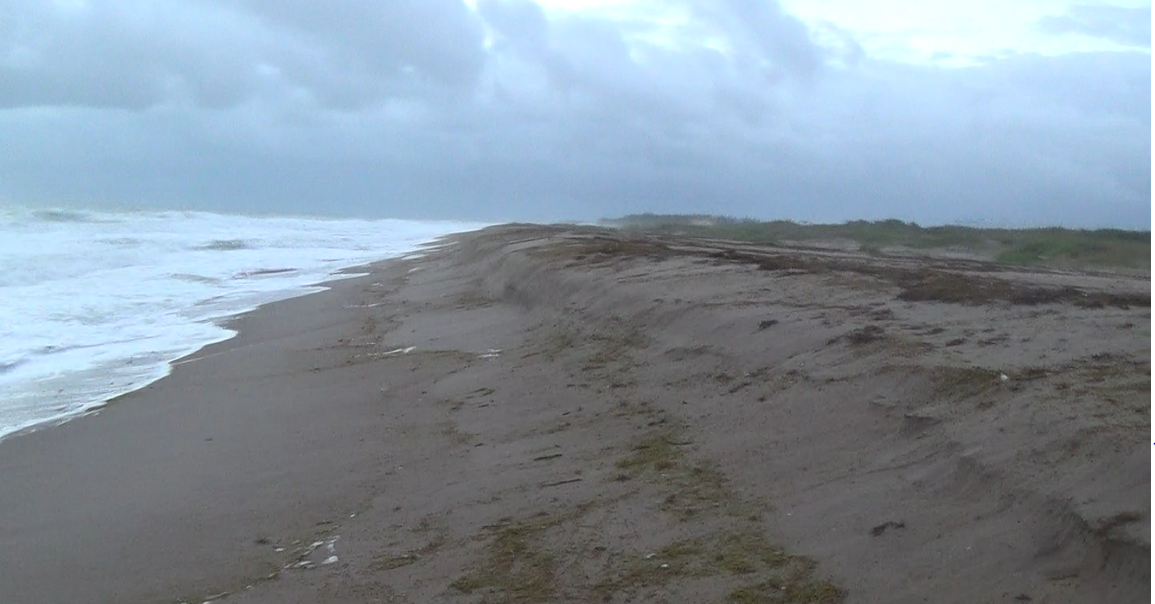
Above is what I saw this morning.  This beach had cuts of up to about two feet.  The front slope was unusually steep.  I've seen other beaches like that lately.

Most targets were near the bottom of the slope.  I found the same thing at a beach quite a few miles away yesterday.

I wouldn't be surprised if something interesting pops up somewhere, but from what I've seen I'm sticking with a 1 rating on my beach detecting conditions scale.

With all of the wind and surf we've had lately, you could easily expect more erosion.  The tides have been very flat though.  I was also noticing how there is still a lot of sand in front of the beach.

---
BBC has been reporting that Columbia has claimed that it found the San Jose, which has a treasure estimated to be in the billion dollar range.
The San Jose was discovered near Cartagena.  The wreck has been described as the "Holy Grail" of shipwrecks.
"Great news! We have found the San Jose galleon," the president tweeted.
The San Jose was carrying gold, silver, gems and jewellery collected in the South American colonies to be shipped to Spain's king to help finance his war of succession against the British when it was sunk in June 1708.
Here is the link for the rest of the story.

http://www.bbc.com/news/world-latin-america-35014600

---

I'm glad we've been getting a little weather.  The sand has been stirred up a little.  Hopefully there is more to come.

Only ond day left to respond to the blog poll if you did any detecting on the Treasure Coast the last couple of weeks of November.  I really appreciate your responses.

Happy hunting,
TreasureGuide@comcast.net

Friday, August 28, 2015

8/29/15 Report - Mystery Solved. Bogota Escudos: New and Old Finds. Real Eight Co. Changes For Erika Forecast.


Written by the TreasureGuide for the exclusive use of treasurebeachesreport.blogspot.com.

Another Group Of Recently Discovered Escudos
This grouping shows some escudos from Bogota, Columbia.  There are two signs that provide clues.

On the cross side of some of these, you see a design feature that some have refer to as "scissors."  I can see why they refer to it that way.  They do look a little like scissors, but not a whole lot.  That mark appears in each quadrant of the cross.  The scissors, are just a distinctive type of rendering of one type of Fleur-de-lis.  On some escudos they appear much larger than on others.

On the other side of the escudo, in the upper right quadrant of the shield, where Naples and Sicily is represented, you see two dots instead of two birds.  That is also a tip off.

You might remember how I was surprised to see lions and castles of Leon and Castile in the upper right of a shield that I pointed out yesterday.  I thought that was unusual and possibly an error.  It was not an error.  Well, it wasn't an error on the cob.  It was my error.

That is what you see on some of the shields of Bogota escudos.  I hadn't seen that before, but found it listed in an old auction catalog in which a lot of Kip Wagner's escudos from the 1715 Fleet were being auctioned.

Illustration From Bowers & Ruddy 1977 Auction Catalog.
In the illustration from the auction catalog shown immediately above, the Naples and Sicily symbols are in the upper left of the shield, and the Leon and Castile symbols in the upper right.

I'm only aware of 2-escudos and a few 1-escudos from the Bogota mint, and no other denominations. The auction listed 75 2-escudos from Bogota and five 1-escudos.  The catalog shows many more escudos from other New World mints and is a very good reference source.

There were eleven different shield designs for Bogota escudos illustrated in the auction catalog.  Two had the Sicily and Naples symbols on the left side of the shield rather than the right.  So it was not an error or anything like that, just a design that I didn't know about and didn't remember seeing anywhere before.

It was in the early sixties that the Real Eight Company found the famed "carpet of more than 1000 golden dubloons."  They hit big again in 1974.

Most of the Bogota escudos sold in the 1977 auction averaged around $150, which adjusted or inflation would be just over $600 in 2015 dollars.  The price of gold that year averaged around $150 an ounce.  I think you would actually expect to pay something more like $2000 for similar escudos today.  That gives some historical perspective to the money aspect.

---

Different subect: I feel a duty to provide the following warning.

Hurricanes are dangerous.  I don't want you to take the danger too lightly.  I don't want a hurricane.  I just want a storm that stays out at sea and churns up some waves.

Hurricanes do too much damage.  And people die in hurricanes.  I'd have to be a raving fool to want that.

Many of you have been through hurricanes.  Some who have been through a hurricane have been on the out skirts where you didn't get the full force.  I want to tell all of you, and especially those of you who plan to come in from other areas, (I've heard from a few that plan on doing that already) don't drive into a hurricane.  It is not a party.

They do a good job of forecasting these things anymore, but they are not totally accurate. Make sure you know what you are doing.  Don't do anything stupid.

You never know what you might be getting into.  There can be downed electric lines, blocked roads and closed bridges.  If we get much of a hurricane, you might not even be able to get to the beach for a few days.

I don't want to unnecessarily alarm anyone by saying that all or any of that will happen this time, yet it could.  Storms can do strange things.  They can take unexpected turns.

Play it safe on the beach too.  If you haven't been in a big hurricane before, you simply don't know what you might be getting into.  When the surf is high and the waves big, you might not be able to get on the beach anyhow for a few days.  The bridges will be closed.   And it will be too rough and dangerous to get down on the beach anyhow.  Wait until it is safe.

Some of the best beach finds have been made days after a storm.  People who have made really big beach finds have told me they thought they were too late and it was all over.  But that is when the big find was made.

Even after the water has gone down some, a big wave can easily catch you unprepared and sweep you off your feet.  It can be very dangerous.  Trees and other large debris can be washing in an out in the surf.  You can lose or have your equipment damaged.  I've known more than one person who was experienced with rough weather detecting that lost a detector or scoop to an unexpected wave.  Don't take this too lightly.  Err on the side of caution.  It isn't worth losing your life.

---

In support of the above, I received this message from Robert H.

You are 100 percent spot on. Those treasure coast barrier islands could be completely submerged under water with a full moon and big tides that were predicated the storm surge is what mainly kills people. As a survivor of one of the worse hurricanes being Andrew and being right in the heart of the storm many were lucky the storm surge wasn't any higher. I know certain areas did see that 15ft rise in sea level but I think most all were evacuated from those storm surge areas in advance thankfully. In all reality we were extremely lucky to survive that storm. If it slowed down and lasted another hour or two with that intensity many more lives including mine could had been lost. Would hate to think of any fellow Detectorist going to wait it out in there car right there ocean side and get swept in the ocean or the ocean swallows them and there car.

Thanks for sharing Robert.

---

There are two changes with the forecasts or Erika.  The track has moved more south.  She is now expected to land down at the southern tip of the penisnsula, and she is expected to remain a tropical storm rather than developing into a hurricane.

Predicted Track of Erika As Of 8 AM 8/28
The surfing web sites are now predicting only around a five foot surf now.  That means that it might not move much sand or stir up much of anything on the Treasure Coast.

Keep watching for any additional changes.

Happy hunting,
TreasureGuide@comcast.net