Thursday, January 8, 2015

1/8/15 Report - Treasure Coast Beach Detecting Conditions Upgrade. Cut Scallops All Along Treasure Coast Beaches. Signal Finds.


Written by the TreasureGuide for the exclusive use of treasurebeachesreport.blogspot.com.

I have a lot to report today but will hold much of it for some later time.  Today I'll get to the most important and timely information.

I took a look at a number of beaches this morning just after high tide.  All of the beaches that I looked at looked very similar.  There were similar scallops and cuts from South Hutchinson Island to Wabasso.

Douglass Beach This Morning After High Tide.
Seagrape Trail Looking South.

Seagrape Trail Looking North.
 Notice the detectorist between the two sets of stairs.

Wabasso Beach Looking Towards Disney

It isn't very often that the beaches look so similar from Fort Pierce to Wabasso.

The sand in front of the cuts was mushy.  Cuts were about three foot high at the highest.

The water didn't get very far back on the beach.  That was disappointing.

The waves were highest at the Fort Pierce buoy around 5 AM this morning, decreased after that, and then have been increasing again.

This NOAA web site shows the data coming from the Fort Pierce and Sebastian buoys.  Take a look.  You can get a lot of information from this web site.

http://www.ndbc.noaa.gov/station_page.php?station=41114


My increase in beach detecting conditions rating is only up from a 1 to a 2.  I only expect a very very few scattered cobs to be found.

The Turtle Trail access was closed.

North of Seagrape Trail there was a lot of very small iron pieces just below the cuts.   Pulse machines will be detecting barely visible pieces of iron.

I've talked about "signal" finds before.  I found some of those today too.  See photo below.

Lead Bullet "Signal" Finds
These small caliber lead bullets appear to have been shot into sand.  Sorry - not the best photo.

I've found many of these at Turtle Trail when the back dunes were eroding and found them in areas and at times when cobs were found on the beach.  I take them as one indicator that detecting conditions are improving.

I know for sure that many of these come from the dunes.  I've tracked them.

The surfing web site is predicting a higher surf through tonight and then decreasing slightly through tomorrow.

Happy hunting,
TreasureGuide@comcast.net

Wednesday, January 7, 2015

1/7/15 Report - Free FUN Educational Seminars In Orlando. Sedwick Coins Auction # 17. Strange Metal Ingots Found On Ancient Shipwreck.


Written by the TreasureGuide for the exclusive use of treasurebeachesreport.BlogSpot.com.


A front came through and the weather is cooler on the Treasure Coast.  The higher surf didn't happen as soon as predicted.  A smooth surf is predicted today.  The prediction is for a higher surf - up around five feet tomorrow and Friday.


From Sedwick Coins.

What's next? Now is not too early to consign to our Treasure and World Coin Auction #17, tentatively scheduled for the last week of April, 2015 (more details coming soon). In fact, the deadline will be here before you know it, so please contact us soon. At the moment we are looking for significant collections of cobs and choice Latin American coins. We will be on hand to collect consignments in person at FUN, Vero Beach, NYINC and Long Beach during the month of January.


There will be a large number of free educational seminars at he Orlando FUN convention.  These are great opportunities you won't want to miss.  Here is a listing.


Thursday, Jan. 8
The programs will be presented in Room W224A of West Hall of the Orange County Convention Center. The presentations are free and open to the public.
➤ 11:30 a.m. — “The Loss of the 1715 Plate Fleet,” by Ben Costello, a director of the 1715 Fleet Society. 2015 is the 300th anniversary of the historic Spanish fleet loss off the east coast of Florida. Costello will detail the “hows, whys and whens” of one of the most significant events in numismatic history.
➤ 12:30 p.m. — “Grading and Authenticating Mercury Dimes,” by Bill Fivaz. Fivaz, will guide collectors through the nuances of grading and authenticating the popular Winged Liberty Head dime series.
➤ 1:30 p.m. — “The Wonderful World of Foreign Coins,” by Bob Hurst, current vice president of FUN and one of America’s leading foreign coin dealers, will detail how collectors can get the most enjoyment out of their world coin collecting experience.
➤ 2:30 p.m. — “Grading 201: AU or BU, the Great Divide,” by Jacksonville, Fla., numismatist Ray Herz, will focus on some of the best ways to determine if a given coin is Uncirculated or slightly worn. The difference in value could be huge.
➤3:30 p.m. — “15 of My Favorite Coins for 2015,” by Don Bonser. Central Florida dealer Don Bonser is a consultant to several major professional grading services and a former full-time grader. Bonser will list his 15 favorite coins for potential growth in the coming year.
➤ 4:30 p.m. — “A Sunken Ship is a Time Capsule: The 1715 Plate Fleet Wreck,” by Peter Cowdrey, current educator in residence at the Museum of Florida History in Tallahassee. His program will focus on a range of issues including what was on these ships, the degree to which they’ve been preserved, and navigational problems faced by fleets of that era.
Friday, Jan. 9
➤ 10:30 a.m. — “12 Reasons Why Coin Grading is Difficult,” by Skip Fazzari. Almost every beginner struggles to master the art of grading. Independent Coin Gradiers grader Skip Fazzari has tips and vital information that will help those looking to improve their grading skills.
➤ 11:30 a.m. — “Looking Back at How the Top 10 Events of 2014 Will Shape Coin Collecting in 2015,” by Coin World Editor-in-Chief Steve Roach. Roach believes recent numismatic events will have a huge impact on the 2015 coin market. Roach will address exactly how will this play out.
➤ 12:30 p.m. — “10 Forecasts for 2015 and 5 for the Next Generation,” by Numismatic News editor Dave Harper. Harper is one of America’s most respected market observers. He has some interesting views on what the next generation will be collecting and how they will collect those items.
➤ 1:30 p.m. — “The Impact of Gold and Silver Values on Rare Coin Prices,” by Scott Travers and Maurice Rosen. The speakers are respected numismatic consumer advocates and prolific numismatic authors. Can certain rare coins do well in a falling bullion market? Which coins could be among the best performers? Travers and Rosen have the answers.
➤ 2:45 p.m. — “My Favorite VAMs for 2015,” by John Roberts. Roberts is the director of attributions for the ANACS grading service. He also writes a monthly column on VAMs in Coin World. What are his favorite Morgan and Peace dollar varieties for 2015? Attendees will find out in this outstanding educational program.
➤ 3:45 p.m. — “Annual VAM Thing,” by the Society of Silver Dollar Collectors. Once again, the FUN convention is the site for this meeting of silver dollar variety enthusiasts. Information on recent discoveries, and their approximate values, will be among topics covered in this lively and informative meeting that is open to new collectors and veterans alike.
Saturday, Jan. 10
➤ 11 a.m. — “Assembling an Affordable Short Set of Classic Buffalo Nickels,” by Bart Bartanowicz. Can the average collector afford to collect Buffalo nickels? The long-term hobbyist and researcher will show you how to put together a terrific collection of Buffalo nickels at a price you can afford!
➤ Noon — “What’s Hot and What’s Not in the Error-Variety Market,” by Fred Weinberg and BJ Neff.  Weinberg is a consultant for several of the major grading services and is considered America’s leading error-variety specialist. Neff has several decades of experience as an error-variety researcher. Together they will inform those in the audience about current happenings and developments in the error-variety market.
➤ 1 p.m. — “Building a Silver Dollar Investment Portfolio: Which Coins Should You Choose?” by Al Johnbrier and Randy Campbell. The speakers are both former presidents of the National Silver Dollar Roundtable. Each one of them will discuss their favorite silver dollars, as well as those items they believe should not be in your portfolio.
➤ 2 p.m. —“Review Quality Notes: Quality You Can Purchase Sight Unseen,” by John Bremer and Vince Cavo. The speakers are officials in a company that reviews certified pieces of paper money to make sure those notes are certified and graded appropriately. Expect a most informative overview of the status of the paper money market in this eye-opening program.
➤ 3 p.m. — “My 10 Favorite Copper Coins of All Time,” by Chuck Heck, who has been an officer in the Early American Copper organization for many years and an avid copper collector for several decades. Copper enthusiasts will be thrilled as Chuck Heck takes you on an unforgettable tour of his 10 favorite copper coins of all time. 
➤ 4 p.m. — “An Introduction to VAM Collecting,” by Dr. David Close. Dr. Close has been a well-respected silver dollar specialist for over 20 years. 


Ingots of a strange legendary metal called "orichalcum" was found on a ancient Greek shipwreck.

http://news.discovery.com/history/archaeology/atlantis-legendary-metal-found-in-shipwreck-150106.htm

There are always things out there to baffle us. 

Happy hunting,
TreasureGuide@Comcast.net

Tuesday, January 6, 2015

1/6/15 Report - Two-Million-Dollar Gold Coin. FUN Convention in Orlando. Florida State Museum Treasure Exhibit.


Written by the TreasureGuide for the exclusive use of treasurebeachesreport.BlogSpot.com.


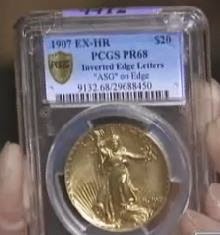
Two-Million Dollar Gold Coin.


Bidding starts Wednesday night at the Orlando Convention Center for this 1907 twenty-dollar gold coin expected to sell for near 2 million dollars.  Bids of well over one million have already been offered.

This high relief gold piece is said to be the most beautiful coin ever.


Below is a link to a video about that.

http://www.myfoxorlando.com/story/27765764/rare-gold-coin-up-for-auction-in-orange-county


Don't forget the FUN convention in Orlando January 8 through January 11.   Among the many highlights will be the Florida State Museum Treasure Exhibit.  According to the FUN web sites, many of treasure items from the museum have not been "... on pubic display for decades, and may never be again!"  That sounds like a great opportunity to see items that have been found on our public lands and kept at public expense, yet are hidden away for the benefit of a few.  Many of the items are from the 1715 Fleet on display in celebration of the 300th Anniversary.

This is a huge convention and it is only a couple hours away.

Here is a link for more information.

http://www.funtopics.com/fun-convention.html

Russ P. reminded me that the convention is this weekend.  Thanks Russ.

I previously mentioned a big hoard find that I couldn't previously tell you about.  I'll be able to post the details on that soon.


Concerning the mystery item I've been discussing, one more person thought it might be a "paint pot."  Two people thought it might be an aerator for a bait bucket.

While the size and shape seem right for an aerator, I don't know why an aerator wouldn't be made of plastic or some material that could be easily manufactured for less than a penny and would be much less fragile unless it was older and hand made.


Yesterday morning, I think just before noon, the wind picked up and was coming out of the North.

The Treasure Coast surf is predicted to be about three feet on Tuesday, a little less on Wednesday and then a bump up to near five feet on Thursday.   The wind is supposed to stay mostly out of the North during that period.

Happy hunting,
TreasureGuide@comcast.net

Sunday, January 4, 2015

1/4/15 Report - More Mystery Object Ideas And Close-ups. Learning A Ton By Researching Mystery Objects.


Written by the Treasureguide for the exclusive use of treasurebeachesreport.blogspot.com.

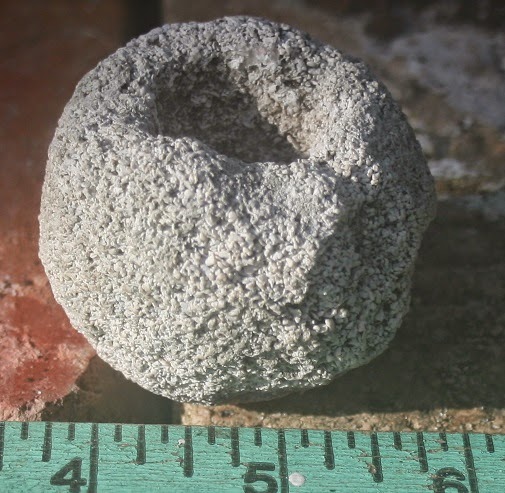
Unidentified Object Previously Posted.

When you research mystery objects, you may or may not positively identify the item.  In either case you will likely learn something and it is not uncommon to learn a lot about things other than the item while doing research.

A few days ago I posted this round mystery item with a hole part way through it and asked for thoughts and opinions about the item  and, as always, I received a lot of informative replys.  Nonetheless, I'm still far from a solid conclusion. 

I tested the object in water.  Despite how it looks, it is dense and sinks like a rock (no pun intended), however water pours right through it.  When picked up out of the water, the water in the hole disappears in a couple of seconds.  It did not appear to dissolve in a short submersion. 

Fred D.  It has me totally stumped but...I believe it to be within the last few hundred years. Early Native Americans did not have a concrete or cement knowledge and this thing is definitely a conglomerate of crushed shell. I do not believe it was made by a sea animal. Too utilitarian. It must be some sort of tool or utensil we just don't know about but it gives us a different world to explore.

Thanks Fred.   I get a lot of help from Fred.

Bill F. helped too.  His idea was... early concrete..Tabby..was made with shells.  The shells contributed lime, which formed more of a stucco than concrete.

My guess...a concretious material which formed above the waterline,
was broken off and rolled around by wave action to form the ball you
have now.

Thanks Bill.

Here is a link to a site about tabby.

http://www.beaufortcountylibrary.org/htdocs-sirsi/tabby.htm

Here is what Wikipedia says that tabby is.   A liquid mixture of crushed seashells (or limestone flakes,) sand, clay and crude hydrated lime made by burning sea shells was poured into the forms.

William M., someone else who frequently provides a lot of valuable input for the blog, said,
I think you may have a weathered bow drill capstone made of coquina.

William also provided some pictures of a bow drill (See below.).

Bow Drill Illustration
provided by William M.

 Ron J. also wondered if it could be part of a drilling tool.
Aquanaut John had another very different thought.  He wondered if it could be part of a time release chum ball.  From what I've read so far, I'm thinking not, but on the other hand, I'm not sure.  I don't know hardly anything about chum balls.

I took some additional close-up photos where I could see some things that appeared to be different than the typical small pieces of shell that makes up the bulk of the item.

Here they are.


Vibrant Red Spot. 
I'd like to get that under higher magnification.

Dull Blue Spot (right of center)

Brown Shell Pieces.
Well I haven't solved the puzzle to my satisfaction yet, and maybe I never will, but I've learned a bit in the process and hope you have too.

I learned something about tabby, bow drills, nutting stones, paint pots, coquina, and even chum balls.

I'm still would like any additional ideas about the object.


On the Treasure Coast we'll have nothing much more than a two-foot surf for a couple of days and then maybe around mid-week something closer to five feet.

Happy hunting (and researching),
TreasureGuide@Comcast.net

Saturday, January 3, 2015

1/3/15 Report - Shipwreck Finds From Dredged Renourishment Sand. Thousand-Year-Old Coins Found Worth Near $1.5 Million.


Written by the TreasureGuide for the exclusive use of treasurebeachesreport.BlogSpot.com.


Copper Religious Medallion
Find and photo by William B.
Yesterday I wrote about dredging and renourishment projects.  I mentioned that sometimes old items end up on the beach in the new sand.  It wasn't long ago that I showed you one of those finds. 

William B. sent photos of these three very nice examples that he found in beach renourishment sand.

He said, I found these 3 artifacts on South Florida beaches either during or shortly after beach renourishment projects. The sand was being dredged from directly offshore of the beaches, not trucked in as they do on other beaches. All three artifacts were found on different beaches within a 3 mile stretch of coast.  


Napoleon’s 7th infantry Button
Find and photo by William B.
The copper religious medallion was found right in from a wreck that went down in the 1800’s. I believe it was Cuban. You can see an angel standing over a child. 

The button is from Napoleon’s 7th infantry. The brass key is about 3 inches long and was bent when I found it. You can see the marks on the shaft from the vice grips that I used to straighten it. 

It wasn’t until 4 years after finding it that it dawned on me that the key was probably in the lockbox when the ship went down, and the box slammed into something causing the bend in the key. It took a lot of force to straighten it.

Nice Old Key.
Find and photo by William B.
 
 
All of the artifacts were found after rough seas, but there was still plenty of new sand on the beach.

Of course this is all speculation, but finding 3 very old artifacts in front of an offshore dredging operation seems to be more than just coincidence, if you ask me.  
HH. William B.

Thanks much William.  Great finds! 

Yesterday I also mentioned the tons of junk that was in the Fort Pierce South Inlet renourishment sand.  Dan B. wrote and mentioned all of the aluminum junk in the renourishment up by the Sebastian Inlet, something that I'm sure many of you have noticed.

Near Amber Sands Beach access there was also a lot of aluminum in the renourisment sand, but also silver US coins.

It can help to know where the renourishment sand is coming from. 

--------

Detectorists participating in a group hunt found over 5000 ancient worth over $1.5 million in a farm field.  The coins were in near mint condition and dated back over a thousand years.

Here is the link.

http://www.dailyrecord.co.uk/news/uk-world-news/ancient-coins-worth-more-1million-4906211

-------------


I've received several different ideas about the round mystery object that I posted not long ago.  Some time soon I'll post the ideas that have been submitted.  Thanks to all who submitted their thoughts.  Its not too late to submit yours.

--------

 If you are an experienced diver who knows how to use a detector and will be available for treasure diving during the upcoming season, send me an email telling me what you have done.   I'm not promising ANYTHING, but might be able to forward your information where it MIGHT be considered.

--------

On the Treasure Coast we'll be having a couple of days of two-foot surf. Swells will be coming from the south.


Happy hunting,
TreasureGuide@Comcast.net


Friday, January 2, 2015

1/2/15 Report - 2015 Beach Renourishment Projects. Dredging And Dredged Sand Around the Treasure Coast.


Written by the TreasureGuide for the exclusive use of treasurebeachesreport.blogspot.com.

Illustration of One Type of Dredge


Tourism brochures speak of unspoiled natural beaches, which in Florida are a thing of the past.  It seems like it is nearly impossible to find an unspoiled natural beach.   That is certainly the case on the Treasure Coast.

Here is an article listing beach renourishment projects that are currently being conducted or that will be conducted in 2015 from Jupiter south.

http://www.wptv.com/sports/recreation-sports/surfing-blog/here-come-the-dredgers-upcoming-beach-renourishment-projects-to-look-out-for-in-2015

Much of the Sebastian Inlet to Sandy Point area has been renourished in recent years, and Golden Sands and Treasure Shores have been renourished very recently.

While much of the Sebastian Inlet to Turtle and Seagrape Trail area has lost some of their renourishment sand, you can still see the unnatural white dredged sand that covers most of those beaches.

The beach at Fort Pierce South Inlet Park has already lost much of the sand from the last renourishment project.  The renourishment sand that remains is filled with so many mangled aluminum cans that you would think it is the county landfill instead of a beach.  Thoroughly disgusting!  The next contract should not permit so much junk to be pumped onto the beach.

The FPL area north of Walton Rocks received new sand not long ago (What was it a year ago?), and much of it has disappeared, but the dredged sand still covers the face of the dunes and the front beach.

I am seeing many turtle nests being lost all along the Treasure Coast as nests that were built in the dredged sand get destroyed as the unnatural renourishment sand erodes.

It seems Bathtub Beach is constantly being renourished.  

Jupiter Inlet Park down to Carlin is being renourished and there will be new projects there and farther south in 2015 as you'll read in the above linked article.

You'll have to look long and hard to find an "unspoiled natural beach" near the Treasure Coast.

I recently received a question about how they screen renourishment sand.  I'm sure it depends upon which system is used, but I think for the most part it comes down to sampling the borrow area to determine where acceptable sand can be dredged and then sampling and monitoring what is being pumped or dumped onto the beach.

Here is a link to an article telling how a 2007 Fort Pierce project was to be monitored.

http://bcs.dep.state.fl.us/env-prmt/st_lucie/issued/0269646_Ft.%20Pierce_Nourishment/001-JC_&_002-EV/FO&Variance/Stamped_Sediment_QAQC_Plan%20(12-29-06).pdf


As I said, I think they should control for the amount of trash in renourishment sand too.

Anyhow, what you are going to see around the Treasure Coast is a bunch of renourishment projects and other beaches partially covered with fine white unnatural looking sand from recent projects.

Mostly what you will find in renourishment sand is junk, however older items have been dredged onto the beach, but that occurs rarely.   I showed one that came out of renourishment sand not too long ago.


On the Treasure Coast expect about a three foot surf for a few days along with a South swell.

Happy hunting,
TreasureGuide@comcast.net

Thursday, January 1, 2015

1/1/15 Report - Happy New Year! First Beach Day of the New Year. Viking Finds.


Written by the TreasureGuide for the exclusive use of treasurebeachesreport.BlogSpot.com.


Silver Viking Cross
Source" Archaeology.org linked article.
More and more of the big archaeological stories that I read include a note stating, often very inconspicuously, that the discovery was made by a detectorist.  Those discoveries attributed to detectorists are most often made somewhere other than the US.  I would not be surprised if the laws and attitudes towards detectorists in the US are a factor. 

The story about this Viking silver cross is just one example.  The article began as follows: Metal detector enthusiast Derek McLennan found a hoard of more than 100 Viking artifacts on land owned by the Church of Scotland.

Here is the link for the rest of the story.

http://www.archaeology.org/news/2620-141014-scotland-viking-silver-cross

------


In 2008, workers digging trenches for electrical cables in the tiny island town of Salme uncovered human bones and a variety of odd objects that they unceremoniously piled next to their trench. Local authorities at first assumed the remains belonged to a luckless WWII soldier, until Konsa arrived and recognized a spearhead and carved-bone gaming pieces among the artifacts, clear signs the remains belonged to someone from a much earlier conflict. Together with a small team, Konsa dug a little deeper and soon found traces of a boat’s hull. Nearly all of the craft’s timber had rotted away, leaving behind only discolorations in the soil. But 275 of the iron rivets holding the boat together remained in place, allowing the researchers to reconstruct the outlines of the 38-foot-long craft.

http://www.archaeology.org/issues/95-1307/features/941-vikings-saaremaa-estonia-salme-vendel-oseberg


If you are wondering about the relevance of these discoveries, there are often very useful clues in articles like that.  For example the discovery described in the paragraph immediately above was made while electrical cables were being buried.  How often have you seen something like that while driving around town?  Did you think about what might be uncovered?  Did you think about returning later with you detector?

-----------

I took a look at the beach this morning before low tide. It was a little different than yesterday but not a lot.

There were scallops, as you can see.  The biggest cliff was about three feet at one beach and about one and a half feet at the other beach.

There were few targets but I found my first coin of the year, a zinc penny and first jewelry, a pendant.

Here is a video showing the surf and beach.


A Couple Treasure Coast Beaches This Morning Before Low Tide


The above photos show beach conditions this morning.   The sand in front of the cuts was mushy.  Very few targets there.

It was still rainy.  Not many people were on the beach this morning, just a few people fishing.

Happy New Year,
TreasureGuide@comcast.net