Tuesday, September 22, 2015

9/22/15 Report - How Coin Lines Are Formed: The Basic Beach Dynamics. CSS Georgia Salvage.


Written by the TreasureGuide for the exclusive use of treasurebeachesreport.blogspot.com.

Yesterday I talked about finding coin lines.  Today I will attempt to illustrate the basics of how coin lines are formed.

The above illustration shows how the amount of water and force decreases as it goes up the slope of a beach.

The key concepts are those I've mentioned many times before.  First is the trigger point, which is the amount of force needed to pick up and move specific objects - in this case coins.

The force is greatest near the bottom of the slope and decreases as the water goes up the slope, sometimes eventually ceasing altogether.

At some point the water slows enough that it can no longer carry the objects and they settle out.  In my simple diagram that would be about at the number two.

That is the most simple scenario capable of creating a coin line.

However, not only does the water rush up the slope, very often there is a backwash.


In this illustration the red line shows the backwash.  If the water retreating back down the beach is strong enough to carry coins, it can carry coins back down the slope.

Remember, when the water slows to the critical "drop off" points, objects will be dropped.

But different objects have different "trigger points" as well as different "drop off" points.  Both the surge and the backwash can move coins and sand, or if not strong enough to move coins, it will just move the sand, leaving coins behind.

If the backwash has enough force it will carry coins back down the hill and also sand.  Sometimes it will have enough force to carry sand but not coins.  That applies to both the surge and backwash.

To additionally complicate matters, the coins can start out either in the water or in the sand.  They can be washed up or down.  They can be carried up the beach and dropped off at some point, or if they start out in the sand, they can be uncovered as the sand is washed away and washed down the slope.

A coin line can be very narrow when the surge is consistent or wide when you have a waves and a surge that varies more.

Once a coin gets covered by sand, it can be protected from the flow of water, which will flow over it without moving it until the sand is moved and it is uncovered.  If the water is moving enough to move the coin, of course it will also move the sand.

The backwash can be very strong in some cases, and in others virtually non-existent.  The balance between the two is important.  You'll often see the surge colliding with the backwash,

This is overly simplified, but I think it is still a decent illustration of the key concepts.

I'll possibly add to this in the future, considering things such angles, different sources and abrupt changes in beach profiles.

---

Terry T. recently found these coins in a coin line.  You might remember that I mentioned that discolored coins are good signs or markers.  They have been out there long enough to have been sifted and sorted and dropped in a line.

Coins Recently Found In A Coin Line On The Treasure Coast.
Photo submitted by Terry T.
Here is what Terry said in response to yesterday's post about a coin line.

...All in the picture were found to the south of a public beach about 300 yards a few days ago. I had about an hour to detect. A cut approximately 3 ft ran for about 60 yards. 26 years ago people were able to park off of A1A on top the dune very close to the beach ( an old party spot). I have got stuck there many times in the sand. Only to come to the conclusion that a couple of 8 inch wide pieces of wood cut 3-4 feet in length stored inside my vehicle, and a little patience along with a small shovel (and a lot of sweat back in the day) would get me out of the situation. Now AAA will be called -lol. All are modern U.S. coins, but have been there for sometime ( I excluded the pop tabs - both modern and old school types from the picture). Not one fishing sinker was found - nor any gold, but this area has produced gold in the past along with other items. I went back 2 days later after digging the coins in the picture, and the cut was filled in. She hides it well.....

Thanks Terry.

The primary purpose of hunting a coin line is not to find modern coins, but they can also be made of old coins and sometimes even better things as well.  The thing about the coins is that they reveal a pattern that can then be exploited.

Any old green coin like those shown above can be a sign of a coin line or coin hole.

---

Many artifacts and a 9,000 pound Dahlgren cannon has been recovered from the wreck site of the CSS Gerogia.

Here is that link.

https://www.dvidshub.net/news/176414/second-dahlgren-rifled-cannon-surprises-css-georgia-archaeologists#.VgBQ1t9Vikq

---

It looks like Ida will fizzle out in the Atlantic.  There is a disturbance to the north of Florida that can be helping some of the states to the north of us.

The Treasure Coast is supposed to have a slowly increasing surf for the next week.  I'm not real hopeful.  We are getting into the Fall when typically we get some kind of storm.

Happy hunting,
TreasureGuide@comcast.net

Monday, September 21, 2015

9/21/15 Report - Scan Patterns and Coin Line Identification. Tropical Storm Ida.


Writtten by the TreasureGuide for the exclusive use of treasurebeachesreport.blogspot.com

One Treasure Coast Beach This Morning.
I took a look at a couple beaches this morning.  I was disappointed.  Yesterday it looked like we might get a little improvement, but not much happened.

The beach shown above is very mushy.  You can see the waves breaking right at the base of the beach.  The slope is fairly steep, ever so slightly scalloped and mushy.  Not good detecting conditions.


Another Beach At Low Tide Yesterday.
Notice the twenty or thirty yards of flat beach out front.  Water from the breaking waves is surging in over that flat part of the beach.

I saw another beach this morning that was very much like this one.

There were few targets where I did a little detecting this morning.  There were some though, although it took me a while to find them.

I started off by checking the two hot spots that usually produce good targets on that beach.  There was nothing at those two spots.  My guess is that the regulars hit those spots this weekend.

I quickly shifted to a very loose scan pattern to see if I could find some better spots to hunt.  I would often use a zig-zag pattern in a situation like that.  Today I checked down by the waterline first.  Nothing good there.  Then I checked higher on the beach.  Nothing there either.

It didn't look like it was worth spending much time either high or low, so then I checked the middle of the slope.  Bingo.  First a dime.  Then a quarter, etc.

There was a coin line.  It was a very narrow straight coin line.  If you looked back and connected the holes with a line, it would have been surprisingly straight.  By the way, this line was not by the most busy parts of the beach.  It was well north of that.  Again, I suspect that the weekenders cleaned the more busy areas.

It took me a while to find the first good target, but after that they came fairly quickly.  I used the first coin as a sign of a possible distribution pattern.  In this case it turned out to be a coin line.

I used the first find as a possible indicator of the most productive zone - in this case not high, or low.

The second find supported the idea that there could be a coin line and that the most productive area would be just a little below, mid way between the water and the high tide mark.

The third find and additional finds were all in that narrow coin line.

I've often talked about using finds as indicators.  Some will not be a part of a distribution pattern, but after finding one, the next thing I do is check to see if it might be a part of a pattern.

All the coins found in that line were discolored.  That is important.  A coin that was just dropped would not be a sign of a distribution pattern.  Discolored coins that have been out there for a while are more likely to be relevant signs.  That is especially true in areas where most coins are removed before long.  A discolored coin that pops up in a heavily detected area probably came from somewhere - either washed up or washed out.

I'm always looking for something to tell me where to spend my time.  First by looking at the beach and any features, considering hot spots that have been found in the past, and then by sampling.

At this point I could get into the details of how coin lines form, but that would take me a lot more time.  I think I'll wind this topic up for now.  Maybe I'll get into how such lines form some other time.
---

Here is the auction catalog for Sothebys Oct. 1 Rarities Auction.  There are over 200 lots of very fine coins to browse.

http://www.sothebys.com/pdf/2015/N09385/index.html

---

Here is a very good paper on bioturbation and artifact movement.  It shows how significant bioturbation can be.

http://alliance.la.asu.edu/rockart/scans/Balek.pdf

---

There wasn't much wind this morning.  I was disappointed that we didn't get more sand moved last night.

Wednesday and Thursday the surf will be up to around four feet if the predictions are correct.

Ida is supposed to become a hurricane in a few days.  It looks like she'll stay out in the Atlantic though.  It doesn't look like she'll affect us.

Happy hunting,
TreasureGuide@comcast.net

Sunday, September 20, 2015

9/20/15 Report - 18th Century Merchant Shipwreck Discovered. Processes That Cause Coins and Things To Sink. Bigger Surf Coming.


Written by the TreasureGuide for the exclusive use of treasurebeachesreport.blogspot.com.

Recovered Wood From 18th Century Shipwreck.
Source: see link below. 
The newly discovered remains were found in the Nanticoke River during a bridge repair.  About 20% of the ship was recovered.


“At least three curious or strange carvings have been found,” she said. “We don’t know what they mean. Usually when you see carvings on a ship, they were put there during the construction process, usually Roman numbers, but these were different. There are two geometric patterns (carvings) that no one in our team of underwater archaeologists and maritime historians, had ever seen before.”
Were they simply construction diagrams used when building the boat?

You can see the carvings in the photo.  It is hard to tell if they are anything more than doodles, but that is the kind of puzzle that makes it interesting.  You never know what the significance might be, and as I tried to show with the black light posts, the significance can be discovered over time.

Here is the link to the article.


---

How do coins sink?  That is a question that was addressed in one very popular post back some time ago.  There was a lot of input from readers of this blog, and I thought it was both interesting and helpful.

I have long maintained that things do not sink simply as a result of gravity.  Gravity is a part of it, but without something else going on, gravity is simply not sufficient to draw objects down through layers of soil or sand.  

Yesterday I became convinced that one process that I did not appreciate enough is what the archaeologists call bioturbation.

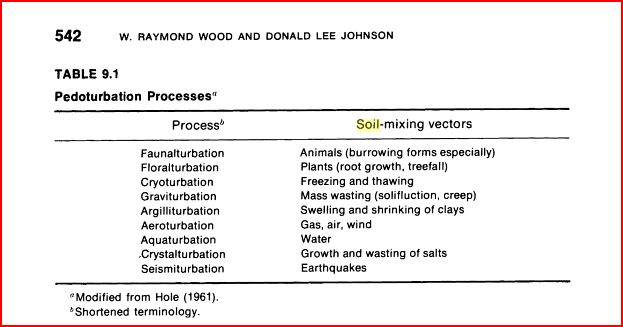
Pedoturbation refers to many different processes that can result in the displacement, movement, and burial of artifacts.  Bioturbation, which includes faunalturbation and floralturbation, is the common processes that affect most sites.

The illustration immediately  below provides a very good list of processes that move soil or sand and result in artifacts being buried or moved.


The illustration is found in chapter 11 of Advances in Archaeological Method and Theory edited by Michael B. Schiffer.   Part of that book can be read online. 

Click on the title of the book if you want to read more of that.

Chapter 11 of the book extensively covers site disturbance processes including the effect of animals, including ants, worms, and almost anything that burrows or moves earth.  The effect of these animals is estimated and measured in some cases, and it seems the effect can be very significant, especially when counted over decades or centuries.  Although I had recognized and mentioned the effect of animals in burying and uncovering artifacts, I am now convinced the effect is significantly greater than I previously recognized.

In my previous post, one factor that I felt was one of the larger factors was the creation of top soil by fallen leaves etc.  In a woods where leaves fall and deteriorate, it should be noted that there would be a lot of earth worms there as well as other animals foraging, digging and scratching around.  I am certain that I didn't appreciate the full extent of that until yesterday.

Anyhow, I found the illustration helpful.  It made me also think of underwater environments.  There are plenty of animals that disturb the bottom in the water too.  That deserves more attention.  That could be a significant factor in tight spaces like crevices and cracks.  I'll have to dig into that more myself.

Here is a link to an abstract for a paper that considers the relative effect of sedimentation versus pedoturbation.  I'd like to get that article.

http://link.springer.com/chapter/10.1007%2F978-1-4615-1183-0_10#page-1

---

The weather has changed and the wind has been coming more from the east/northeast all day.  The surf on the Treasure Coast is up a little today too.

I visited a couple of beaches this morning and the waves were a little bigger than expected.  Definitely three feet when I was there.

The waves were crashing out some twenty yards on the front of the flat beaches, while on the steeper beaches, the waves were crashing almost right at the waterline.

Wednesday or Thursday we might get as much as a four of five foot surf.

The change of wind direction alone has resulting in some small changes.  Sand has been moving a bit.  I saw a few small cuts - all less than a foot though.

I think some more sand might be moved around a little through the first part of this week, but not nearly enough to change my beach detecting conditions rating.

---

Congratulations to Mr. and Ms Dan B.  A nine pound baby boy just joined their family.

---

Happy hunting,
TreasureGuide@comcast.net

Saturday, September 19, 2015

9/19/15 Report - Surprising Results of Detector Test With Three Small Cobs. Tropical Storm Ida And Other Weather.


Written by the TreasureGuide for the exclusive use of treasurebeachesreport.blogspot.com.

Three Small Under Weight Cobs.
In the past I've talked a good bit about specific target training and tuning.  By that I mean learning the optimal detector settings for finding particular targets, and also tuning in the field for those specific targets.

If you are interested in finding small silver items like those shown above, you need to experiment with different detector settings to find the settings that are best.

These particular cobs are way under weight.  They were found on a beach near a 1715 wreck site. They lost much of the original material.  The one on the left is only about .015 ounces, and the other two around .02 ounces.  The second is actually a touch lighter than the third.  My scale isn't highly accurate for small weights like that.

When selecting test targets, I will often select those that are on the smaller side, assuming that if I can find the smaller ones I will have no trouble with the larger ones.

Size is much like depth in relation to signal strength.  Small items sound much, not exactly, like larger but deeper targets.

One thing I try to keep the same is the material.  If you want to find silver, test with silver.  You generally want test targets that are as similar to the desired targets as possible.  One possible exception, as I said, is size.  Again, I tend towards smaller test targets.

If you are going to hunt for a particular type of item, you want to know if your detector will detect it and what settings are required.  It is best to test your detector before going on a hunt so you have confidence that your detector will detect whatever you are hunting.  What a waste it is to spend hours hunting with a detector set up in a way that would not detect what you want to find if you were right on top of it.

I hadn't tested one my newest detector on small cobs and wanted to find out how it would do with those types of targets, and secondly, what settings would be best.  I had tested these test targets with a couple other detectors, and knew how they would perform, but I wanted to know how this detector would perform with the same test targets.

I took these items out to a space that I have cleaned out and often use as a test area.  I kept changing the settings and modes to see which worked best on these test targets.

My test area is not the easiest even though there is no ground mineralization.  There is a lot of ambient electrical interference to deal with that causes a lot of detector noise.  In this area, there are some inexpensive detectors that actually do better than some of the more expensive and powerful detectors because of the electrical interference.

Which of the above three test targets do you think gave the strongest signal?  You might well guess the first, which is both lightest and presents the smallest surface area.

Charles Garrett in his book Successful Coin Shooting, said that generally detectors are surface area detectors, and that mass makes little difference.  He suggested a way to prove that for yourself.  Take a coin and run your coil over it.  Then take a stack of the same coins and run your detector over it.  You should get about the same signal because the surface area that is presented to the coil is the same.

He threw that word "generally" in there, and that is a good thing, because I have found exceptions.  I haven't done a real precise experiment on that, but I have observed enough to feel confident about that.  There are times when thickness, or mass, seems to make a difference, though not a large one.

To answer the question, the first and third targets (as shown in the photo above) cause much stronger detector signals that the second one.  That is very consistent.  And it proves out with different detectors.

The first item, has a small surface area.  You can see that.  The photo accurately shows that.  It is however thicker than both the second and third items.

The second and third items are nearly the same weight, and one might be a bit thinner than the other, but it is not enough to be obvious from look or feel.

So what is it about the second item that produces a weaker signal?   I can't say for sure, but it does seem to be something other than surface area.  Perhaps it is the material, although the three cobs should not be very different.  They should have similar silver content.  Maybe they are a touch different though.

I've shown in the past that shape makes a big difference.  Detect a coin laying flat, and then turn it on edge and you'll probably notice a big difference in the signal.  On some detectors the difference will be greater than on others.

The second item does not appear to be shaped hugely different from the third item, but it is a little less round.  The first item is much less round than the second, but still produces a better signal even though it also presents a smaller surface area.

I've done experiments that show that angles and irregular surfaces make a difference.  A slanted surface may not produce a signal that is as strong as if the surface was flat and parallel to the surface of the coil.

The top surface of the small item is a little convex.  I don't know if that produces a better signal.

It is pretty complex.  I'd have to do a lot more experimenting before I could say exactly why the second items produces a much weaker signal than the other two.  At this point I just have some ideas.

The main thing I want to say today is that you should experiment with detectors and their various settings and relevant test targets before you go for a hunt.  Get to know what your detector will and will not do, and get to know the best settings.

---

Source; nhc.noaa.gov
We now have a named tropical storm, Ida.  Also a tropical depression, Nine.  And another disturbance up by Georgia.

I doubt we get much of anything from any of these, however there is a chance.  Both tropical depression nine and Ida will probably live and die out there in the Atlantic.

The disturbance up by Georgia might turn into something, but North Carolina has a better chance of getting something out of it than we do.

Right now the surf predications are for a slightly increase surf for mid week.  If you look out a week from Monday, they are predicting something like 4 - 7 feet.  That might be nice - if it actually happens.  I guess there is some chance, but I'm not betting on it.

Happy hunting,
TreasureGuide@comcast.net
Friday, September 18, 2015

9/18/15 Report - Rip Currents. Tropical Depressions Nine and Ten. The Heart Of Any Good Treasure Story.


Written by the TreasureGuide for the exclusive use of treaurebeachesreport. blogspot.com.


nhc.noaa.gov.

There are two tropical depressions in the Atlantic now - numbers nine and ten.

it is hard to tell what they will do, but at this time neither is predicted to become anything stronger than a depression in the next five days.

We also have a little disturbance just off shore near the Daytona area.

I don't expect any of that to affect the Treasure Coast significantly in the next few days.  

---

The Woods Hole Institute is doing a lot of research on waves and beaches.  I just ran across a nice article on rip currents.  Detectorists should know about rip currents, especially if they detect in the water.  If you unintentionally wander into a rip current it can be frightening if you don't know rip currents and what to do.  I think most people know to not struggle to swim directly against the rip current, but if you don't know what to do, you should look it up.  Be prepared.

I remember my first time.  It surprised me.

In this Woods Hole article 150 foot channel near shore using a landing craft and revving the engines to create the trench.  I'd love t see a picture of how they did that.

According to my understanding they weren't using anything like blowers.  I can imagine how they did it but would like to see it.


Rip currents can wash away sand and expose a firmer layer of rocks or other bottom.  If that happens in the right place, it can be a very good hunting spot, but by all means, do not jump into the dip until it is safe.

Rip Current
Source: whoi.edu link below.
The rip current shown above does not look exactly like a natural rip current to me.  It looks like it could be the one that made.

Notice the scientific monitoring equipment floating in the rip.

The dark water in the middle of the white water is the deep water where the water would be rushing out.

As the article points out, the waves will break on each side of the rip current, but not in the deep part. You'd expect that because waves break when the water becomes to shallow.

You might want to look at this article.  Here is the link.

http://www.whoi.edu/oceanus/feature/the-riddle-of-rip-currents

---


The crew of the Dare has been surveying the Lost Merchant site, 

----

Yesterday's post was a story about how an found item can continue to reveal more about itself over time.  Any treasure story consists of various threads.  Most treasure stories are told as if they were about items.  You've read the articles and books.  They tell what was found,  where it was found, how it was found, what it was worth and who found it, but the best part of the story is left out.  The part of the story that is most often left out is the contemporaneous human story.  

The best of the story is about people -  real people, fragile people, strong people, people with hearts and souls, people with emotions who act and react.  It is about ups and downs, successes and failures, relationships, friends, family, time and change.  It is about chance, cause and effect, and consequences. The crux of any treasure story is really about people and how they live, learn, feel and change.  It is about heart and soul.


I talk a lot about items, but if you look a little deeper, the other part of the story is always there to be found if you look deep enough for it.  In this blog, I don't have the space or time to bring it out like I should.  Maybe sometime in the future I'll be able to give that part of the story the justice it deserves.


Good stories make people think.  Great stories make people feel.

---

Happy hunting,
TreasureGuide@comcast.net

Thursday, September 17, 2015

9/17/15 Report - How One Artifact Continues To Reveal More Of Its Story. Tropical Depression Nine.


Written by the TreasureGuide for the exclusive use of treasurebeachesreport.blogspot.com.

nhc.noaa.gov


We have tropical depression nine now.  It is supposed to stay out there.  Probably won't have much effect on us.

As you can see there is another disturbance behind that one, and one down by Key West.

Today we had around a three or four foot surf on the Treasure Coast.

The tides are moderate.  The surf will be down around one or two feet again this weekend.

---


I found this red sea glass quite a while ago.  It is in my opinion an exceptional piece of sea glass and would sell for a few dollars.

It is nicely worn and shaped and is a rare color.  Yellow is more rare, but red is right up there.

But what I wanted to talk about today is the detective story and how information about an item can be revealed slowly over time.

As I said, I found it a long time ago.  As with all finds, I'm always interested in trying to determine what things are and where they come from.  I didn't know, but I guessed that this piece was part of a lens.  If so, what kind of lens?

Well, it sat around for a good while without me gaining any more information about it.  I had inspected it with a loop and saw some very small yellow specks in the glass.  They weren't really on the surface - more like in the small air bubble depressions.  I didn't have any idea what that yellow residue was about.

Yesterday I showed how a black light could be used to reveal more information about fossil seashells.  That was just one example, but a good one.  What I was really trying to show is how to inspect items in various ways, such as under magnification and different types of lighting.

Vintage Glass Finds.
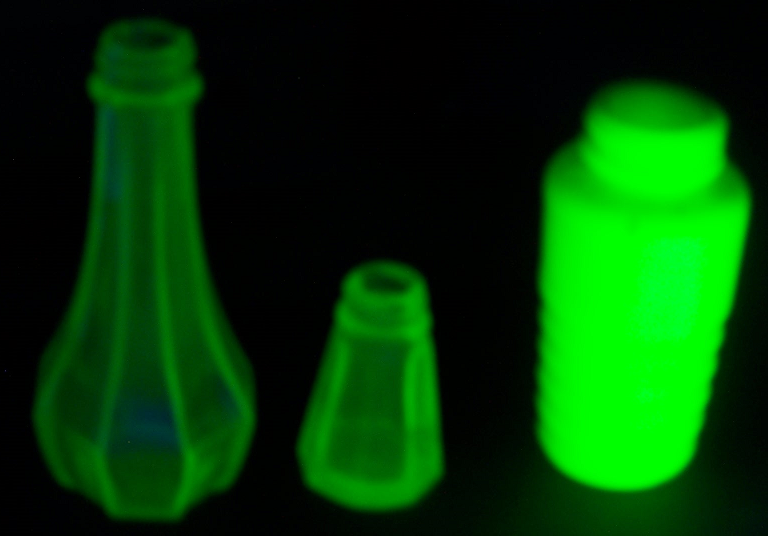
I often find old bottles and glass.  The above picture shows three such finds.  The two on the left are Depression glass and the one on the right is Vaseline glass.  I think those are the right terms.

There are a lot of collectors of both depression glass and vaseline glass.  I've sold some pieces in the past.

I'm not changing topics.  I'm going somewhere with this.

Depression Glass and Vaseline Glass Photographed Under Black Light.
I tried the black light on those items, and you see what I saw.  They glow.

Both types of glass were made with uranium.  Yes, uranium.  Vaseline glass has a more yellow color. To create the more green depression glass, iron oxide was added.

OK.  A black light can reveal some interesting things with some types of glass.  So now I tried the red sea glass under black light.

Red Sea Glass Under Black Light.
I shut out all the light and shined the black light onto the red glass.  The one side showed nothing.  I couldn't even see it in the dark room, let alone photograph it.

I turned it over, and saw a world of difference.  On this one side, it glowed!

It was the side with the yellow specks infused in the glass that glowed.  It glowed orange.

What does that say?  Uranium isn't used in glass nearly as much as it was back in the day, although people do copy depression glass and vaseline glass.  So is this glass older?  I thought it was older just judging from how it was worn into a very rounded cushion shape.  And why was it made to glow?

Then I ran across the following text.


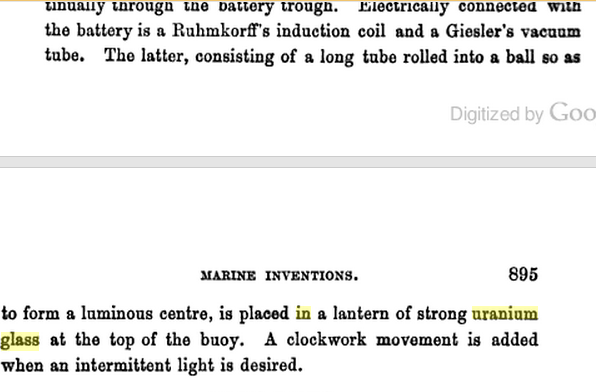
This clip was found in an 1878 nautical magazine.  It is talking about how uranium glass was used on a buoy.  Is that what I have a piece of?  I don't know.  But the evidence is mounting that this red sea glass was once part of a lens, perhaps like was used on a nautical buoy.

Click here to link to the nautical magazine.

What I am talking about today is how an item can continue to reveal more about itself, and how various methods of inspection and research can help make a find come alive.

The same process can occur with almost any kind of item.  Even an item as simple and mute as a squarish little piece of glass will continue to tell you more of the story as long as you are curious and really want to know.

It is something like that with people too.


---

I was without internet most of the day, so that is it for today.  I didn't think I was going to get any kind of post done today.

Happy hunting,
TreasureGuide@comcast.net.

Wednesday, September 16, 2015

9/16/15 Report - Old Rare Treasure Coast Treasures. Using Black Light On Sea Shell Fossils and Artifacts. Outer Banks Videos.


Written by the TreasureGuide for the exclusive use of TreasureBeachesReport.blogspot.com.

Fossil Seashell From The Treasure Coast
Lighted By Ultra Violet Light To Reveal Yellow Bands.

A black light can be used for more than lighting up psychedelic posters.  I found that out somehow long ago.

You can use a black light for finding or identifying some gem stones, such as corundum.  Actually not all corundum glows in black light, but an ultra violet light will make some rubies and other gem stones glow in the dirt.  That makes them easier to find.

You can also use a black light to classify gem stones.  Black light can also be used to tell if some gem stones are natural.

I've pointed out before that calcite crystals in fossil shells will glow under black light.

Black light can also be used to reveal the original lost color patterns of chalky white fossil shells, which can help to identify previously unknown species.

Southern Florida has a very rare and special treasure that you might not be aware of.

These fossil seashells are found in deposits at several places in southern Florida. The ones figured here [in the following linked paper] came from spoil banks bordering a canal in Okeechobee County and are ten to fifteen million years old...

Their "secret" character is not possessed by the Los Angeles County fossils or, to the same degree as far as I know, by other fossil seashells from elsewhere. We have tested all the ones in our museum collections, which is worldwide in scope, although obviously incomplete. What causes this geographic restriction is unknown at present. When exposed to the short wave kind of ultraviolet light in darkness, some of the fossil Florida seashells fluoresce brilliantly with symmetrical orange patterns against a glowing violet background.

The two paragraphs above are from a really good paper that can be found through the following link.

http://research.nhm.org/pdfs/33751/33751.pdf

I didn't have a good setup to make good pictures in black light, but I did manage to get the photo at the top of the post.  The nice yellow lines show under black light.

The paper found through the research.nhm.org link above shows other examples Florida fossil shells and their color patterns as seen under black light.

The fossil shell shown at the top of this post, to the best of my very limited understanding, is an excellent museum quality specimen of a fossil tulip shell.

Here is another link on the same subject of using a black light to see color patterns of fossil seashells.

https://www.washingtonpost.com/news/speaking-of-science/wp/2015/04/01/bone-white-ancient-shells-reveal-their-dazzling-colors-under-uv-light/

If you are not into seashells, even million-year-old Florida fossil shells, you can use a black light to bring out markings on artifacts that otherwise might be very difficult to see.  Black light will also reveal slight differences in the surface of artifacts.

One hand made lead fishing sinker that I found, when displayed under black light, showed how the edges were carved.  I didn't notice that under normal lighting.

If you have an ultra violet light take a look at a variety of artifacts under the black light and see what you can find.  I'd like to hear about it if you find anything interesting.   Send me an email.

---

Here are some nice quick video clips of a North Carolina beach sent by GoldNugget.  He shows the beach, finds and equipment.

The North Carolina beaches are a bit different from ours.  They get more tides, and I would say lately, they've also been getting more waves.  GoldNugget has some nice old coins and buttons and other things to show.


https://youtu.be/POT3aqQP2i0 


---

There are now two tropical disturbances in the Atlantic that could be headed our way.  Both have a 90% chance of becoming a cyclone in the next 48 hours.

Keep a watch on those two even if they are still out there a ways.

This was the kind of morning I like -  cloudy and rainy.  I could do without the thunder.  And I'd like more wind and better beach conditions, but otherwise, I prefer this to those glaring sunny days.

Happy hunting,
TreasureGuide@comcast.net