Friday, November 17, 2017

11/17/17 Report - 1715 Fleet Finds From the Treasure Coast This Week. Half Reales and Other Things.


Written by the TreasureGuide for the exclusive use of treasurebeachesreport.blogspot.com.


Two Half Reales Found This Week On The Treasure Coast
Finds and photo by Jerry P.
Here are some finds made by Jerry P. this week.  Above are two uncleaned half reales.


Here is another sheet of lead.  Just a few days ago I showed a similar one found by Darrel S.  This one also has the cloth imprint that I discussed in a recent post.

Below are a few more finds made by Jerry at the same location.


Bullet Finds.
Find and photos by Jerry.


John Brooks Yesterday.
This is how John Brooks looked yesterday.  Frederick Douglas looked about the same.  There seemed to be a lot of sand in front of the beach that was keeping the waves from doing much to the beach.


John Brooks Beach Yesterday.
Near low tidea a small dip was developing on the front of the beach and some shells were being exposed.

Erosion Control Bags At Tuttle Trail.
Photo by Darrel S.
I had a few photos of the Turtle Trail area and also Seagrape Trail, but it seems my computer won't open them right now.  This beach started filling and was more filled today, especially in front of the bags.

There were a good number and variety of finds made there.  Jerry's were made I think Wednesday.  I saw pictures of several others, including more cobs, lead, pieces of spikes and a variety of other pieces.  I also heard of a high karat gold ring being found.

Although Turtle Trail seemed to be filling, it wouldn't take too much, if the conditions were right, to freshen it up again.

I had more pictures, hopefully I'll get them working again before long.  I might have to ask some of you to resend photos if I can't get them opened.

The surf will not be as big tomorrow.  On top of that the wind will be shifting.  We had a nice period of north wind, even if it didn't affect too many of the beaches.  Most of the activity seemed to be in the Turtle Trail area.

Happy hunting,
TreasureGuide@comcast.net


Thursday, November 16, 2017

11/16/17 Report - Cache of Silver and Gold 12th Century Coins. Nice Old Ring. Beach Sign. Clad Coins.


Writen by the TreasureGuide for the exclusive use of treasurebeacesreport.blogspot.com.

Signet Ring Uncovered Along With Coin Cache
Photo by Alexis Grattier
See link below.

More than 2,000 silver and gold coins from the 12th century were found buried in the rubble as the archaeologists were digging the ground to try and identify the corner of an infirmary that was once situated at the abbey, said the researchers from University of Lyon II and France's National Centre for Scientific Research (CNRS)....


Cache of Coins Uncovered.
Source: See link below.

The medieval loot included 2,200 deniers (or pieces of silver) mostly issued by Cluny Abbey itself as well as 21 gold dinar coins, originally from the Middle East which were stored in a canvas bag... 


Gold Dinars Recovered with Coin Cache
Photo by Alexis Grattier
See link below.

Here is the link to read more about that.

https://www.thelocal.fr/20171115/medieval-treasure-trove-discovered-by-archaeologists-in-france


---

Joe D. sent the following message and find photos.

Just returned from my semiannual trip to Georgia to visit family! Of course I had to throw in a little detecting while there! On the last day ( yesterday) in my last few minutes of detecting some old torn down house lots, I found a nice silver solitaire about 5 inches down! Got confusing signals, but dug anyway! It was near other metal of course! And I was lucky to find it at all! Here's a before and after polishing! I will have to get the stone tested, but the ring says sterling! Looks to be pretty old! Also found some wheaties and some other interesting house stuff! 


Sterling Silver Ring Find After Cleaned.
Find and photo by Joe D.


Same Ring as Found by Joe D.

 Joe also mentioned a show on Netflix called "Detectorists." He said, "It's from the BBC! So English humor, but there are 2 seasons and it's pretty good! Don't know if you have heard of it, but it's not a reality show! Worth a look! Takes a few episodes to get into, but I think you will appreciate the finer points of the story! I bing watched the first season already!"


---


Darrel S. dug up the following sign on the beach a few days ago.  It reads "Stay Off Dunes."


Find and photo by Darrel S.

Darrel said the parking lot at Turtle Trail was full yesterday while the lot at Seagrape was empty.

---

Tuesday I detected less than an hour, which I think was still the most that I had a chance to do all year.   No serious detecting or anything, just a little quick entertainment.   I mentioned that there were coins on the beaches of South Hutchinson Island.  Here is what i found with my little light-weight Ace 250.

Coins and Crematory Tag Found Tuesday.

Couldn't tell what the crematory tag was until I got it cleaned.

Looks like we'll have a few more days or three to five foot surf.  I'd say beach conditions are still what I'd rate as a level 2.

Happy hunting,
TreasureGuide@comcast.net

Wednesday, November 15, 2017

11/15/17 Report - Artifact Research Process: Thoughts and Considerations. Example of a Lead Find. Three Days of North Wind.


Written by the TreasureGuide for the exclusive use of treasurebeachesreport.blogspot.com.

Lead Found by Darrel S. A Couple Days Ago
Photo by Darrel S.
We're supposed to have three days of north wind.  The surf will be three to five feet, but the swells have a bit of a north/northeasterly direction.  That is the thing that could make it interesting even though I wish the surf was bigger.

---

You might be asking yourself why I am showing this piece of lead again.  That is a good question.  The answer is that it gives me an opportunity to discuss my approach to researching finds.

If you dug up this piece of metal you might quickly conclude that it is junk and toss it, or you might respond very differently and quickly conclude that is something more exciting - maybe the lead lining of a treasure chest.  If you are on a TV treasure hunting show, you might be more PT Barnum than archaeologist, in which case you would hold it up and breathlessly announce that it is definitely from a treasure chest, and you know that is true because you've found hundreds of them before.  No matter if you are on a TV show or not, you might hope that it is something exciting and jump to the first exciting conclusion that comes to mind.  The fact is that it can be really difficult to be sure what an item like this is, so what I am going to try to present today is a very thoughtful, systematic, almost scientific way of proceeding that might be slow but will give you a good chance of coming up with a very good conclusion. The process of unraveling the identity, meaning and significance of a find can be a lot of fun as well as very informative.

It is a natural tendency to jump to a conclusion based upon your current knowledge, understanding or hopes, and then do everything you can to support that conclusion.   The key to what I am suggesting today is avoid jumping to quick conclusions, but rather to question everything, seek evidence, and carefully consider whatever the evidence might suggest.  It is better to start with questions rather than conclusions.  Ask yourself a lot of questions and carefully weigh the evidence as it is discovered.

I'm thinking of one item I found that I posted in this blog years ago.  I've changed my mind about that item a number of times, but now I feel about 95% confident that I know what it is.  It took a long time to get there and I changed my mind ( that means "learned something" ) a number of times.  When you learn something significant it will often cause you to change your mind.

Back to the lead item at the top of the post.  Could it be the lining to a treasure chest?  ( No one ever said that it was, I'm just using that as an example.)  I doubt it.  Why?  Lead-lined treasure chests have been found before, but according to what I've read, that is not how the coins on the 1715 Fleet were shipped.

The Cargo of Coins Aboard Nuestra Señora de Atocha, or “The Treasure Chest Defined” is an article written by Corey Malcom reprinted online from The Navigator: Newsletter of the Mel Fisher Maritime Heritage Society, Vol.16 No.5, June, 2001.  Here is an excerpt from that article.

 From impressions seen on both the coin masses and the interiors of the chests, the coins were put into cloth bags before being boxed. The fabric appears to have been a plainweave of fairly large, crude thread, yielding a cloth quite similar to burlap. Unfortunately, none of the actual material survived. Other examples of shipwrecked coin chests are rare - in fact, only one other has been found. An example from the 1715 Nueva España fleet was recovered in 1965 off Florida’s east coast. This crate was also of a simple design, and had dimensions comparable to those from the Atocha. A length of 54.0 cm, a width of 28.5 cm, a height of 27.8 cm, and a plank thickness of 2.5 cm yielded a chest with a storage capacity of 0.026 cubic meters (0.91 cu. ft.) - approximately 60% greater than the 1622 examples. It had no apparent decoration, hinges, or lock. Somewhat differently, its sides were not beveled, but flat. No data is available for the coins carried inside. All in all though, there appears to have been little evolution in the manner of shipping coins...

What, if any part of that, applies to the lead find shown above?  The article seems to suggest to me that the treasure chests, or coin crates, on the 1715 Fleet were not lined with lead.  Could there possibly be any exceptions?  I would think so.  Who said this was from a typical coin chest?  Might the hypothetical treasure chest be a passenger's personal chest and therefore be different from the typical coin chest?  Again, I think that is possible, however I would also guess that finding something like that would be less likely than finding something from one of the many coin chests stored as cargo.  However, I have not presented any evidence that it would have anything to do with a treasure chest or anything like that.

Dr. Lori on the Oak Island TV show suggested that a metal plate with holes in it could be from a treasure chest and everyone seemed to be very impressed.  There was no analysis or evidence presented at that time.  Maybe there will be some in the future.  We'll see.

For more of the Malcom article, here is the link.

http://www.melfisher.org/pdf/The_Treasure_Chest_Defined_Atocha.pdf

Now that we've considered one hypothetical idea and done a little research relative to that, lets consider another idea.  Could it be hull-sheathing?

We know that lead hull sheathing was used and you can see examples in the Mel Fisher artifact database.  Lets look at what an authority has to say about lead hull-sheathing to see if we can learn anything.

Lead Hull-Sheathing of the Santa Margarita is another article authored by Corey Malcom and reprinted online from The Navigator: Newsletter of the Mel Fisher Maritime Heritage Society, Vol. 16, No. 1 December, 2000/January, 2001.

Here is an excerpt.

Lead sheet in one form or another has been found on other Spanish vessels roughly contemporary to the Santa Margarita. The wrecks of the 1554 fleet found along Padre Island, Texas; the 1618 Honduran fleet’s San Martín, wrecked on Florida’s East coast; the mid-1500’s St. John’s wreck, the 1559 Emanuel Point wreck in Pensacola Bay, and the wrecks of the 1715 Nueva España fleet, have all produced lead sheet which was being used to cover seams, patch holes, or guard against shipworms. The sheet from these sites is generally described as similar to that from the Santa Margarita - thin, with a cloth impression - indicating that it was all used, or created in a comparable manner...  

Here is more from the same article.

The recovered lead bears many holes pierced by the fasteners that held it in place. Though none of the fasteners has survived (likely due to the aforementioned electrolysis) these holes, along with impressions in the lead, reveal the type that was used and the density of their spacing. The tacks that held the sheets to the hull had broad heads of 22mm diameter, and shanks 5mm square. They were spaced at 5-10 centimeters, with their placement tending toward the edges. The direction from which the tacks pierced the lead show that the sheets were placed with the cloth impression toward the hull, leaving a smooth exposed surface that was less friendly to adhering organisms. 

You can read more of that article if you want.  Here is the link.

http://www.melfisher.org/pdf/Lead_Sheathing_from_Santa_Margarita.pdf

Now we have some information that we can use to analyze the lead find.  If we were holding the item we could look for holes near the edge, measure the size, spacing etc.

If you look at the photo you can see what might be a cloth impression.  The reason I picked that photo is that is shows the cloth impression.  The impression could esaily be over-looked or thought to be insignificant.

Some people think the impression lead sheathing was made by the lead being installed on the hull over a layer of cloth.  Other people think the impression has to do with how the lead sheets were manufactured.  In either case, we can see what appears to be a cloth impression.  If you have any interest in this at all, I would recommend reading the entire article.

Some peope will say all of this is unnecessary.  They might be able to look at the item and immediately know what it is.  If they can do that, they have previously accumulated the necessary knowledge through long experience.  That is great, but when you are unsure, a research thorough research process is necessary. And I would encourage anyone to avoid being "too" sure, and continuing to learn and see if there is anything they can add to their knowledge.

One book on artifacts ( I had the reference here earlier but lost track of it somehow ) strongly makes the point that in the 18th century, items were used and repurposed and reused time and time again.  That would certainly be true of lead.  It could be used for a lot of things and it can be very difficult to say what it was last used for.  If it was sheathing, it could be kept for a variety of other purposes including being melted to make lead shot or fishing sinkers.

What I tried to do today was give you some idea of the slow process of researching a find rather than jumping to rash conclusions without sufficient continuing research.  The individual resources and facts were only presented to illustrate the process.

I know that some of you will find very little if anything new or interesting in this post, but I hope some of you benefit from what I tried to show of the long slow process of researching a find.

Disciplined research and thorough analysis can be key to unlocking treasure mysteries, while jumping to premature conclusions, no matter how exciting they might seem, can delay or prevent the solution.  I highly recommend an analytical scientific approach.


---

I'm eager to see what three days of north wind will do.

Happy hunting,
TreasureGuide@comcast.net


Tuesday, November 14, 2017

11/14/17 Report - Decent Detecting Conditions on Some Treasure Coast Beaches. Reports From South Hutchinson Island, Turtle Trail and Rio Mar.


Written by the TreasureGuide for the exclusive use of treasurebeachesreport.blogspot.com.

John Brooks This Morning.
 I visited John Brooks this morning for a short while.  There were some scallops, which I tried to capture in these photos.  I don't know if you can see them very well.

There were some nice flat spots below the dips at low tide that I would have liked to check out, but didn't have time.

Frederick Douglas was about the same.  There were weathered clad coins along the slope at Frederick Douglas.  

Small Scallops on John Brooks This Morning.
 At Fort Pierce South Jetty beach there was a long high cut.  There were plenty of clad coins and there was almost no junk.  

It was a pretty good coin line - the kind of thing that might hold a ring or some surprise if you keep at it.  It was really easy detecting.  The coins were very shallow.  You could fill a pocket in a short time.

Fort Pierce South Jetty.

Turtle Trail Yesterday
Photo Submitted by Darrel S.
Darrel S. sent the above photo with the following message.


Sea bags were exposed near first flag pole. Ton of sea weed. Saw numerous friends detecting. 

My first hit was a nice piece of lead sheeting.

Broke my shovel on a large object. 

I got one hit after hit once I got away from the bags. All the sand that was on top of the bags was in front of them. 

I dug several long bolts, stainless nuts, washers, and nails. 

Most of the long bolts were very deep. I was getting into her black sand...


Thanks much for the photos and report Darrel!


Tomorrow or sometime soon I'll post and comment on some new finds. 


Jerry P. sent in the following photos from Rio Mar yesterday where he did some detecting.

Rio Mar Yesterday
Photo by Jerry P.

Rio Mar Area Yesterday
Photo by Jerry P.
Jerry said his best find was a 1942 wheatie.

Thanks for the photos and report Jerry.

There are some beaches that are producing a lot of clad and at least one beach that seems to be producing old shipwreck finds.  I'm almost sure a few cobs will be found. Maybe I'll get some specific reports about that. 

I'm a little late with this but I'd rate the beach conditions as being at least a 2 on my 5 point rating scale.  If I'd been out to do some more checking on my own, I'd given an earlier rating.  

The surf is supposed to run three to five feet for a few more days.  After the small amount of time I spent out today, I'd say there are a lot of spots worth checking out -  more if you are interested in things other than old shipwreck items.

Happy hunting.
.
.


Monday, November 13, 2017

11/13/17 Report - At Least One Treasure Beach Improved by This Weekends High Surf. Finds Being Made. Robert Marx Lecture Tomorrow.


Written by the TreasureGuide for the exclusive use of treasurebeachesreport.blogspot.com.

John Brooks This Morning About 7:30.
I went out to see what was happening at the beach.  We had another full day of rough surf, yet John Books and Frederick Douglas beaches were little changed.  The tide had been high up on the beach.  There were some shallow scallops that weren't there yesterday.  That was about it.  No erosion, and the beach was mushy.

Sorry the pictures aren't so good today.  I was having trouble getting the mode I wanted and didn't get the camera settings right until after I came home.

John Brooks About 7:30 AM Today.
The Fort Pierce South Jetty Beach is very eroded.  There is about a seven foot high cliff there near the inlet.  You could see two or three distinctly different layers of sand.  I did a little detecting with the ACE there and picked up several coins in short order but nothing of interest.

It was raining on and off at the beach again today.  Also occasional thunder and lightning.

A couple of who were snorkeling south of the inlet Saturday were reportedly washed out to sea and not found.  Be careful of the currents and rough surf.

There was at least one treasure beach that was improved by the rough surf of this weekend.  I'm not going to name that beach right now because I don't want everyone going there, and the people that found it on their own would hate me if I told.  Also there might be some other places that are producing that you wouldn't want to miss.

Some finds were being made today.  Here are a couple early examples.

One Find Today
Photo by Darrel S.


Another Find Fro Today
Photo by Darrel S.
Notice the pattern in the lead.

---

Sir Robert Marx has been described as the true father of underwater archaeology. He is a pioneer among American scuba divers and best known for his work with shipwrecks and sunken treasure.

Now, the community is invited to hear him discuss the history of exploration and discovery in the Pacific Ocean during a free public lecture at 7 p.m. Tuesday, Nov. 14, at the Gleason Performing Arts Center on the campus of Florida Institute of Technology.

The lecture, “History of Exploration of the Pacific,” is sponsored by Florida Tech and hosted by the Honor Society of Phi Kappa Phi...

Thanks for Warren D. for submitting this like that you can use for more about the lecture.

https://ecurrent.fit.edu/blog/campus/happenings/sir-robert-marx-to-lecture-on-pacific-exploration-november-14-2017/

---

Happy hunting,
TreasureGuide@comcast.net


Sunday, November 12, 2017

11/12/17 Report - Rough Surf But Little Erosion. South Hutchinson Island and North. Bottle Finds.


Written by the TreasureGuide for the exclusive use of treasurebeachesreport.blogspot.com.

Rough Surf This Morning.
The surf along the Treasure Coast was supposed to be something like 5 - 8 feet this morning.  I went out to take a look and saw the above around 7:30 AM.  There was a lot of white water.  It looked like there was a lot of sand extending out maybe 75 yards or so.  The waves were hitting the beach straight on.  There was no erosion yet where I was.  Maybe there will be some erosion somewhere along the Treasure Coast, but I didn't see it this morning.  With all the north wind we had the past couple of days, you would hope for something, but when we had the north wind, we didn't have much surf.

John Brooks This Morning Just Before Low Tide.

John Brooks Looking South This Morning.
You can usually find something, even when detecting isn't good, but this morning there weren't many shells and I didn't see any fossils, but I did pick up a few bottles quickly yesterday, so that is something I might do when I get the chance.

Newly Found Bottles.
These bottles aren't worth much, but they tell me that there might be some good ones out there if I look a little more.  I would call them markers or signal finds.  While they aren't worth much, they provide some good information.

The one on the left is a CastorOil bottle and the one in the middle is a pharmacy bottle.

---

Here is what Darrel S. saw a couple days ago more to the north.

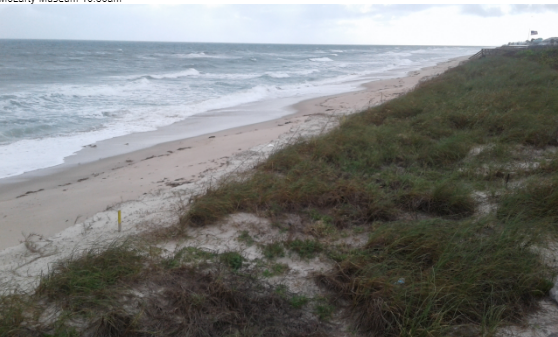
In Front of McLarty Museum.
Photo by Darrel S.
Seagrape Trail Beach.
Photo by Darrel S.
Bonsteel Park Beach.
Photo by Darrel S.
We just haven't had very good conditions lately.  Even Irma didn't do a whole lot of us.  There is a lot of sand in the shallow water in front of the treasure beaches of South Hutchinson Island.

Darrel has been hunting a lot recently and has been reporting very few signals.  He is going to try a new coil.  Maybe we'll get a report on that.

---

Thanks to the veterans on this Veterans Day weekend.

It is still rainy in my part of the world.

Happy hunting,
TreasureGuide@comcast.net

Friday, November 10, 2017

11/10/17 Report - Millions of Dollars of Coins Found By Detectorist. Turtle Trail. Oak Island Artifacts and Observations.


Written by the TreasureGuide for the exclusive use of treasurebeachesreport.blogspot.com.

Coins Found by Detectorist Mike Smale
Source: See DailyMail link below.

  • Treasure hunter discovers a rare hoard of 2,000-year-old silver Roman coins worth up to £200,000 with a metal detector in a farmer's field (but he'll have to split the cash with the farmer)
  • Some of the coins were minted during the era of Roman general Mark Antony
  • Experts said the find is very rare and each coin could sell for £900 ($12,000)
  • Coins would have circulated widely during Roman times - some dating to 32BC
  • Mike Smale, 35, found the hoard of rare ancient coins in a farmer's field
Detectorist Mike Smale With The Field's Owner.
Source: See DailyMail link below.
Here is the link for more about that.

---

Turtle Trail Yesterday.
Photo by Darrel S.
Darrel S. has been detecting the Treasure Coast beaches and sending in daily photos and reports.  I appreciate that a lot because I haven't been out to take a look at things much myself.

Yesterday he stopped at Treasure Shores, where he found a number of detectorists already there, so he moved on to Turtle Trail, where targets were scarce once again.  You can see the small dips or scallops that he described to me via email.

Thanks Darrel.

---

I didn't mean to carry on with this topic, but last night I watched a bit of a new episode of Oak Island and saw two things that I wanted to comment on.  First, there is now another spike.  The new spike was found in  the spoil pile.  I will refer to that spike as the "rose head" spike.  It is longer and does not have an offset head like the first spike.  I think things got more muddled when they discussed the new spike and why it was not a railroad spike. I don't know who would ever confuse the rose head spike with a railroad spike.  You could tell that even if the head was not present or was totally ignored.

The first spike, however, which I will refer to as the "swamp spike" was shown once again for a brief second or two earlier in the episode.  The view they gave only VERY briefly showed the offset head before it was turned to an angle that did not show the offset head.  It was super quick and you would not notice the offset head unless you were specifically looking for it.

It was supposedly the swamp spike that was researched by Dr. Lori.  However the spike she had in front of her did not appear to me to have the same offset head.  They undoubtedly were aware of the skepticism caused by that spike.  It was discussed all over the internet.

After getting another glimpse of the the swamp spike when the cut back again when it was found, I was not able to dismiss my impression that it was not the same spike discussed by Dr. Lori.  I hope to get another view of the spike that was in front of Dr. Lori and am sure I will in time.   If anyone wants to go back and really study the images of the swamp spike found as shown when it was found and when it was discussed by Dr. Lori, I'd really like to hear your conclusions.

So to summarize, there is now a new spike (rose head), which I don't think hardly anyone would confuse with a railroad spike even though they took the time to present the reasons why it was not a railroad spike.  It seemed to me that that would confuse many viewers and muddy the controversy around the railroad spike for the more casual viewer.

I haven't watched every minute of the show, and I might have missed or confused something myself.  If I did miss something or you need to correct me, please let me know.

I recently posted some thoughts on how hard it can be to identify and date artifacts so I won't delve into that much again.   I guess it is my scientific training that makes me very cautious about jumping to conclusions.  To me it is very foolish to pick up something out of the dirt and quickly state that it is from a certain time period.  I remember, for example, the time I found a musket ball on Cape Florida, where musket balls from the Seminole War period might be found.  That was way back a few decades ago.  I didn't recognize at first, that it was a new reproduction.  Musket balls are still made today using the same processes, and they are used with antique guns etc.  Rose head nails are still made today too.  And just because a coin has an 18th century date, does not mean that it was lost in the 18th century.  There are many possibilities, and quickly jumping to conclusions does not give me a great deal of confidence in either the source or the conclusions.  I know that it is a TV show and they are going to try to make it exciting,    but while saying that a piece of metal with holes in it could have been used in a treasure chest without providing any other evidence might excite some viewers, it will raise questions for the more discriminating viewer.  I'd really like to see a more thoughtful scientific approach.

Just one more example.  Did you notice the golden balls floating in the water in front of the diver's camera in the last episode?  That is how light sometimes reflects off particles under water.  Do you remember the "golden" object in the wall of the pit that they talked about as if it was gold?  Might be, but I really doubt it.

---

North winds have started today. Watch for the five to eight foot surf coming this weekend.

Happy hunting,
TreasureGuide@comcast.net