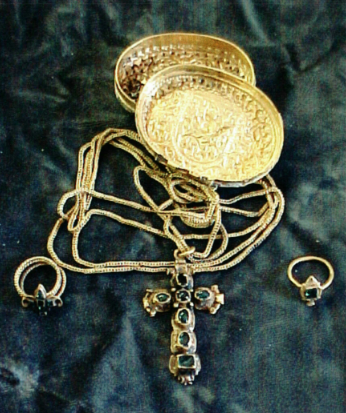
Showing posts with label gold rings. Show all posts

Friday, January 4, 2019

1/4/19 Report - Gold Trending Up. Rare Matching Pair Finds. Silver Dollar VAMs.


Written by the TreasureGuide for the exclusive use of treasurebeachesreport.blogspot.com.

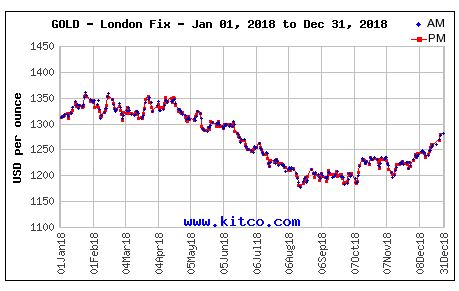
While the stock market has been going through wild gyrations, the price of gold has been doing well.  Above is the 2018 chart.  The early days of 2019 have also seen increases.  

The up-trend in gold prices started back around the end of August and has continued through yesterday, when it closed at about $1298 US dollars per ounce.  Today however it is down again.  You never know what it is going to do.

---

Some finds are rare for one reason or another.  Even though I used to target and find a lot of gold jewelry, I seldom found sets together.  There have been times though when I found a matching engagement and wedding ring.  On a few occasions I found a matching pair of ear rings.  I showed a diamond and pearl set before.

The one time that stick out in my memory when I found a matching engagement and wedding band together was in the shallow water beside a picnic area on a causeway in Pensacola.  They were only a couple feet apart.  They were the same size and design. They were gold and diamond, but fairly inexpensive.  I figured they just slipped off at the same time.  Maybe a little suntan lotion and a Frisbee or something was involved.  Who knows?  Anyway they ended up lost in the water in very close proximity.

Here is a more recent matching set found on a Treasure Coast beach.  14K with diamonds.  They were also found in shallow water very close together.  They make a more expensive set than the Pensacola set that I talked about.

Matching Engagement Ring and Wedding Band Set.

I always figured the matching earring finds were taken off together.  It is difficult to imagine a pair of those coming off at the same time.

---

Older silver dollars are also rare finds for me.  I haven't found too many, and most of the ones I did find were found together in a cache.  After finding those and doing a little research I learned just a little about VAMs.

VAMs are cataloged varieties of Morgan or Peace dollar. For each year and mint, there are varieties that are identified by characteristics that may include any of the following:


    VAM silver dollars are cataloged using a system of numbers and letters that incorporate the “VAM” name. A normal Morgan dollar or Peace dollar is classified as a “VAM-1.” Subsequent VAM dollars are recognized as a VAM-2, VAM-3, VAM-4, and so on...

The Comprehensive Catalog and Encyclopedia of Morgan and Peace Dollars by Leroy C. Van Allen and A. George Mallis.

See https://coins.thefuntimesguide.com/vam-dollars/

"VAM" is a combination of the initials of the fellows (Van Allen and A. Mallis) that extensively studied and catalogued all the Morgan and Peace dollar mint varieties in The Comprehensive Catalog and Encyclopedia of Morgan and Peace Dollars.

Some VAMS are quite valuable.

---

I added the 18th Century Material Culture Resource Center web site to my reference link list.  It is well worth browsing.

We'll have a few more days of calm surf on the Treasure Coast.

Happy hunting,
TreasureGuide@comcast.net

Monday, February 26, 2018

2/26/18 Report - Mystery Button. Old Metal Detecting Records and Finds. Big Surf Predicted for Next Week.


Written by the TreasueGuide for the exclusive use of treasurebeachesreport.blogspot.com.

Dug Unknown Button for ID.
Here is a button that I haven't researched.  I just found it in a jug of old crusty pennies.  Any ideas appreciated.  Below is the back of the same button.  Unfortunately it is obscured by crust and needs cleaned.

Button Back.
---

I always tell people to keep records of their metal detecting finds.  I often regret not having kept more detailed records and have never felt like I kept too much.

My wife was cleaning out a closet and found some old records.  They seem to cover part of 1989.  I was especially glad to see that on a few occasions I put down the year in addition to the day and month, which I always recorded.  When making the records I guess I didn't think it was necessary to record the year, but a few decades later it really helps.  I have some old records that I have to guess the year and don't know if my guess is right or not.

Metal Detecting Records From 1989 Discovered.

I've talked about some of my earliest records from the first year or two when I started metal detecting.  Those records did not have a year and I can only guess now when that was.  At that time I kept track of the coins I found.  The records that were found today only record gold and silver finds.  I quit keeping track of coins when I was targeting jewelry.

Beside the date, detector used, short description of finds, I also included the beach and specific areas of the beach, such as "just north of rocks" or "on far side of sand bar."

Back then my records were useful for keeping track of hot spots.  Now when I read those old records they help me remember the finds and experiences.

There were some pretty good days.  On the page I am looking at, I see that on 9/15/89 I found an 18K garnet ring, 14K blue sapphire ring, 14K man's gold nugget ring, one small hollow 18K medallion with small ruby.  I do not remember that day.

On 7/4 there was a small diamond man's ring, a 10K high school class ring, a 14K lady's diamond baguette and sapphire ring, 14K nugget ring with three small diamonds  and 18K medallion.  I do remember that day.  I remember telling the guy that made my detector about it.  That is probably why I remember it.

5/18 I definitely remember even though I found only one ring that day.  It was a nice national championship ring.

Not only did the records tell me where a lot was found, they also told me where the better stuff was found.

I think if you keep good records, some day you'll be glad you did.

By the way, in the back of the closet my wife found a jug full of crusty old pennies.  The button was in with the pennies.  Most of the pennies are totally encrusted or destroyed.  I guess that is why I didn't spend them.

---

The weather has been the same for a few weeks.  It looks like there could be a change in beach conditions.

Source: MagicSeaweed.com.
That is a big bump predicted for next Monday.

Feel

Happy hunting,
TreasureGuide@comcast.net


Sunday, December 10, 2017

12/10/17 Report - Ole Timer Talk: 10 Different Gold Items One Short Hunt.


Written by the TreasureGuide for the exclusive use of treasurebeachesreport.blogspot.com.

I've posted a few Ole Timer Talk pieces in this blog, but haven't told any of my experiences that way.
A few came to mind last night.  I've referred to parts of those experiences to illustrate some things I wanted to explain, but I haven't described them as completely as I could.

The experience I'm going to talk about today happened on an otherwise normal day about thirty years ago, so I'm sad to say that I forgot a lot about it.  That is mostly why I haven't told it this way.  Fortunately I have some written records to refresh my memory and help me get the most important parts right.

My records were scribbled in cursive with a lead pencil.  The paper is now old yellow crinkled tablet paper.  The entries are labeled with the month and day, but not the year.  That was a big mistake that didn't seem like it would be a problem at the time.

One sunny day near low tide in early February I arrived at a beach that I detected frequently back in those days.  I don't recall any, people on the beach, which is kind of strange for a nice day down south, so I would guess it was early morning.  The parking fee there was something like four dollars, so people mostly parked elsewhere if they could.  There were no other detectorists there.  That I know for sure.

The surf must have been calm.  I don't remember it being an issue at all.

I was in South Florida and was targeting modern jewelry in those days.  I had a few years of detecting under my belt, but was not much more than what I would consider to be a beginner.  I was using a Fisher Aquanaut 1280 at that time, I think.  Maybe I had started using a modified Nautilus.  I'm not sure about that.

When I arrived at the beach, I noticed a good bit of erosion.  It wasn't what you usually see.  The erosion was right at the front of the beach.  There was no slope between the cut and the water.  The cut was right at the waters edge.  The front of the beach had been cut back and the sand spread out in the shallow water.  Very often there is a cut farther back on the beach and then a slope down to the waterline.  In this case the cut fell off into the water.  It was more like the beach had been moved back a few feet.
Red angular line shows surface after erosion.
Grey line shows target distribution.

I stepped over the cliff and into the very shallow water.  It was only up to my ankles or lower leg.  I mostly hunted in shallow water back then.  I moved my coil.  Bingo.  Good target on the first swing.  I dug it up.  Blackened coin.  Without moving on, I took another swing,  Bingo again.  Another blackened coin.  There were targets everywhere.  I'd say every square foot had a target.  In the next four hours of the hunt, I picked up twenty dollars in quarters alone.  I remember telling somebody (Kevin Reilly) that, which is why I remember that number.  But it wasn't only coins.

The targets were not deep - at least not the ones I was digging.  I don't remember digging any big holes.  I didn't get around to that.  There were so many targets that I never got to the deeper ones that day, if there were any.  

I don't know what the total face value of the blackened coins was that day, because  I only recorded the nice jewelry finds and the general location.

Below is what my notes show for that day.  The notes are pretty much as they are written, although they were scribbled and not real easy to decipher.  Maybe that was intentional. 

2/4 -  at North picnic area below new play equipment - blue star sapphire ring, 2 gold ear rings,"SC" signet ring, and 10k band in water  Also silver double heart ring.

2/4 - middle picnic area just south of walkover -  14 k black pearl and diamond ring, also silver and turquoise ring.  In water.

2/4 - south picnic area by life guard station by turtle cage in water - silver love knot ring, silver and turquoise ring, gold religious charm, 2 class rings, 1 14k band.

What I recorded for that four hour hunt was 10 pieces of gold jewelry.

I left after about four hours.  I don't know why I left (maybe I had to do something), but I'm sure I dug less than 20 percent of the available targets in the area that day.  I was going to return the next day, and I did.  I have a couple entries for 2/5.  

I didn't record how many coins I found.  When I first started metal detecting, I recorded the number of each denomination of coin that I found.  From those records I knew when my Aquanaut paid for itself in clad coins, which it did in one year.  It cost me something over $600 for the detector, if I correctly recall, and I knew when I found enough change to cover the cost of that detector.

If I encountered the same situation today, I would do some things differently.  First of all I would try to hunt as long as it took to clean the area of all targets.  If for some reason I couldn't do that, I would  try to cherry pick the gold.  At the time I didn't have the skill to do that very well.   I'm sure the second approach would have meant missing some gold because the target density was so high.  You'll find more than you think after you clean out a lot of the louder targets, so the best practice would have been to spend the time to clean it all out properly even if it took more than one day.  Problem with that is that you never know when conditions will suddenly change and it all disappears.

As an aside, the only problem I ever had with the 1280 was, after I first got it, I kept breaking the plastic things that the upper forearm fit into.  They finally sent me metal ones to replace the plastic ones.  It was very reliable.  Fisher did a tune-up on it for me once.  I sold that detector after a few years and got nearly the purchase price for it.

I'm glad I have my records for that hunt.  They helped refresh my memory so I could tell the story.  It was a long time ago but a time to remember.

It s funny how some details stick so vividly in memory while other fade.

The second day I don't remember as well and my records do not seem to be as complete, but I do have entries showing an 18k charm, a crucifix with gold chain, a 10K band, a Jesus and Mary medallion, and a 14k nugget band.  I don't know what other coins or what else was found.

The one big thing I remember about the second day, and I remember it very clearly, is the end.  As I walked back to the car I looked up and noticed a weather front coming in.  A thick layer of clouds was arriving from the north.

The next day I returned to the same spot, and quickly found that it was all over.  No more targets at all.   It opened up suddenly and closed just as suddenly.  That is the way it goes, and why it is so important to make hay when the sun shines.

---

The cold front definitely arrived to the Treasure Coast.  The wind has been out of the west and north. We have some nice cold air.  The surf is small.

Happy hunting,
TreasureGuide@comcast.net


Monday, August 28, 2017

8/28/17 Report - Famous 1715 Fleet Find From the Past. More on Silver and Gold Rings. Silver Corrosion and Wear. Storm Situation.


Written by the TreasureGuide for the exclusive use of treasurebeachesreport.blogspot.com.

Famous Find From the 1715 Fleet
Photo submittted by Darrel S.

Darrel S.sent the above and following photos, about which he said, I remember when Capt. Jon Wilson found the gold box with these items inside near the Cabin Wreck. Steve Hancock received one of the rings, Jon got the necklace, state got the box, AND TAFFI GOT THE CROSS (displayed in their Sebastian Museum.)

It isn't a recent find. Darrel also said, The gold box with cross, necklace, cross, and rings was found 6/1/03.  [I originally posted 01, but the correct year is actually 03.]

 The photos are Darrel's personal photos, which he said were originally taken in the Fisher lab in Sebastian.

In the past couple of posts, I've been talking about intertwined or interlinked rings.  That discussion started with a couple of silver rings found by John C. along with a couple of cobs.  

The rings shown in the above and following picture have a very common design that I might describe as a twisted rope design.  Three gold twisted rope bands make one ring that has a gold setting with emeralds.  

Here is a closer picture of that.

Gold Ring Found by Captain Jon Wilson.
Photo submitted by Darrel S.
The twisted rope design is a very common design still used today.  You'll see that type of ring in silver and gold and other metals.

Thanks much to Darrel S. for the great pictures.


John C., after sending me the photos of the intertwined rings that were found with a couple of cobs, also sent me the following picture of a very thin silver ring and said, Some may be thinking, a silver wire ?  No it's what's left of a very badly worn silver ring .I guess it depends on the original size, but how many years does it take for a ring to become so badly worn ?

Thin Silver Ring.
Find and photo by John C.
Of course gold is not subject to the same type of corrosion as silver.  Some silver cobs found on the beaches are worn very flat and thin - by my estimation, sometimes to less than half the original weight.  The above ring is certainly worn down a lot, but I suspect was originally fairly thin to begin with. You can often find a joint on rings like that where they were cut and soldered together.

I think this kind of silver wear and corrosion can take place surprisingly quickly.  I think that kind of corrosion can take place in a matter of a few decades.  If I remember, and I run across the examples I'm thinking of, I might post them in the next few days.

Not long ago (8/3/17 post) I showed a paper thin silver Roosevelt dime that was found on a beach.  It is shown below.  I have others that are literally paper thin, and when I say literally, I mean it.

Paper Thin Silver Dime.
My first possible reale find was what I would call a razor.

Obviously, some silver coins and rings are not as worn.  Some show very little silver loss.  The amount of corrosion and material loss depends to a large extent on exactly where it has been, how much the item as been tumbled in the sand and rough surf and how much air and salt water it has been exposed to.

I still don't know why divers almost never find silver rings on the 1715 Fleet.  I have shown one example attributed to a 1715 Fleet source by our state archaeologist, who also has documented silver rings to Spanish colonial archaeological sites.  I suspect that more than one factor is involved.

Some jewelry found on the Nieves site suggests the presence of a jeweler on board.  Incomplete pieces, as well as materials and jeweler's tools, have been found on that site.

---

I hope I didn't make too many mistakes in this post.  I kept finding them, but I hope I got most of the typos corrected.

---

Maybe in the near future I'll post more examples of the kind of thing I was talking about today.

---

Source: nhc.noaa.gov
The low pressure area that has been hanging over Florida looks like it will become a tropical storm and skirt South and North Carolina.  We'll have a small surf for most of the week.

Havey looks to be headed towards Arkansas rather than going back out into the Gulf.  He won't affect us much.

There is still time to respond to the blog poll.

Happy hunting,
TreasureGuide@comcast.net

Saturday, August 26, 2017

8/26/17 Report - Intertwined Rings and Mixing of Old and New Metal Detecting Targets.


Written by the TreasureGuide for the exclusive use of treasurebeachesreport.blogspot.com.

Gold Intertwined Rings Found by John C.
Photo by John C.
Yesterday I was discussing a couple silver intertwined rings that were found by John C. along with some cobs on a shipwreck beach.  He also sent the above picture showing gold intertwined ring finds. The ring on the right is marked Cartier, which didn't have a U. S. office until 1909.

I'm afraid I made no progress in determining the age or source of the silver rings shown yesterday, although I did find that such rings have been used long enough that they could be of such an early date.  I also mentioned the extreme rarity of silver rings found by divers on 1715 Fleet shipwreck sites.

The difficulty of determining the age of unmarked items on a beach should be no surprise.  That is exactly why archaeology can not be conducted on a beach.

A beach is a dynamic environment.  Nothing stays in place.  Things get mixed together - even things from different centuries.  The same thing applies to shallow water sites.

There are a variety of ways that items from different time periods can get mixed together.  I'll try to describe one of those ways today.

Things lost in the dunes get buried as the dunes sand blows back and the dunes build.  Older things will naturally be deeper.  In the illustration above, the three colored lines represent layers from three different time periods that can be decades or even centuries apart.
Three Layers of Old Items In Dune Eroded Down to Beach Level.

When the dune face erodes, the items from various layers and age periods fall to the level of the beach, where they are then shuffled around when the waves come up to the bottom of the dunes. Items from different time periods get mixed together.

Something similar happens on the beach slope, but to a lesser extent because the beach slope gets stirred more often.  Still, when the beach gets cut, older items are mixed together with newer items, including those that were recently dropped.  The age range of items deposited in the mixture will probably not be as large as the various ages represented in the layers of the dunes.

Once the items of various ages get mixed together, the water distributes them primarily by shape and density.

Silver rings on a salt water beach corrode. That could make any markings difficult or impossible to find.  And silver was not always marked.  Silversmith in England and France began stamping sterling silver objects in the 14th century, but there was no requirement for marking silver in the United States until 1906.  That leaves a large gap of 191 years between 1715 and 1906.

The number and variety of older silver rings found on the beaches is huge.  I'm left with a lot of unanswered questions and my recent investigations have not answered any of them.  I am a little more informed though, and I hope you are too.

I wonder if large number of silver rings might have been used at some time as trade goods or might have something to do with later salvage efforts, either large scale or undocumented small scale efforts.

It is my opinion that a lot of the silver ring finds, even some that look quite old, are 20th century.  Are there exceptions?  Definitely!  But it seems difficult or impossible to identify the date of many of the examples we see with the information available.

There are other related questions that I'll discuss in future posts.

Couple Intertwined Rings Found by Author.
I wanted to go back and find a particular example - a triple ring composed of gold, silver and another metal - I think platinum.  I didn't find that one right off, but ran across the two examples shown above while looking.  The one on the left has three intertwined rings and the one on the right, five.

---

I'm hoping that everyone will respond to the blog poll.

On the Treasure Coast we're going to have one and two foot surf for a week or so.  I'll be watching our low pressure area for any developments.

As you undoubtedly know, Harvey hit Texas hard.  It could go back out into the Gulf again.

You can check out the live webcam from Galveston.

Here is the link.

http://www.galveston.com/seawallvideocam/

Thanks to GoSports for that one.

Happy hunting,
TreasureGuide@comcast.net

Sunday, July 31, 2016

7/31/16 Report - 1715 Fleet Gold Rings Facts and Theories. Tropical Disturbance Quickly Approaching.


Written by the Treasureguide for the exclusive use of treasurebeachesreport.blogspot.com.

Life Rings Shown in an Illustration
Submitted to me by Darrel Strickland.\

I received some excellent information from Darrel Strickland, a very accomplished student of Spanish Colonial artifacts, concerning the rings found on the 1715 Fleet wrecks.  Darrel sent me a section of Bob Weller's book that discusses salvaged rings, including what are called "Life" rings. Weller refers to the 1999 Florida East Coast Shipwreck Project Report where the rings are discussed (pages 216-226).

Weller says his Crossed Anchors Salvage group found over 90 finger rings, mostly from the Nieves site.  In 1993, they discovered 22 gold rings on the Cabin Wreck site. He said he believed, as did most of the salvage community, that the rings were carried as cargo, as opposed to being worn by the crew or passengers of the 1715 Fleet.  The clustering, something that I used to talk about a great deal, was one of the reasons for that conclusion.

Weller mentioned "Ringsville," an area where a lot of rings were found clustered. He described  Ringsville as an area where there was "some sort of swale or low depression between the reefs."

You might find the speculated source of the rings interesting.  Weller speculated that "many of the more intricately engraved rings were made in China, traded at the Manila fair, and brought to Mexico by way of the Manila Gallions."  He goes on to speculate that the Spanish artisans did not have the capabilities during the 1600s and 1700s to carve ring designs nor cut the emeralds and diamonds found on the rings.  He did however think that some of the more simple rings could have been made in Mexico or by conquistadors or sailors with spare time on their hands.

Thanks much to Darrel Strickland for forwarding this information.

I also received the picture shown at the top of the post from Darrel with some additional information.  From that information I can tell that the Life Rings were engraved with different images than the one that was most recently found.

It seems to me that the Life Rings were customized and engraved for an individual with scenes that were especially significant for that person.  But that would not seem to fit well with the rings as cargo theory.  Of course, there could be a mixture.

You might recall my discussion of the lack of silver rings on the 1715 Fleet.  That seems to me to go along well with the gold  rings as cargo theory.  Weller does mention one silver ring, but that is not much compared to the hundreds of gold rings.   I have my own developing theory on the silver rings found on the 1715 Fleet beaches.

Here is an email Darrel sent me.

I have enjoyed your site for years. We have met on the beach before. 

I started detecting when Kip took my grandmother and I to a coin shop located in the Ft. Pierce Hotel during the late 60s. They bought me a Whites Coinmaster with the big blue rectangular box. We went to the old Colored Beach and found some coins. After that I never found one item. I was too young to understand the mechanics. I decided to stick with looking for bottles and arrowheads. It wasn't until I met Bob Weller and Jon Wilson that I decided to take this more seriously. Bob has passed away and Jon moved to Georgia. 

Growing up as a child in Ft. Pierce I knew all the Reale 8 members. Mel and Mo used to nickname me "cracker." Don't think it meant what most thought. I used to love the crackers they would serve when visiting. My grandmother, Beatrice Sisco, known as Bea, would loan them money or "invest" into their adventures. She ran a trailer park where the St. Lucie Museum is now located. Many of the divers would hang at the old Chucks and tie their boats at the old park. I assume this how they all got acquainted.

Since 1990, I began to research material for many of the infamous salvagers. It is sad that most are gone. Last year, in sync with 300th anniversary of 1715 fleet disaster, I donated most of the material to Vero Beach Library. I met Pamela when she first started there and always appreciated her invaluable time and knowledge in regards to Eugene Lyons, John Debris, Jack Haskins, Rex Stockton, Molinar, Mel and family, etc., etc., etc. These were just the few of many that I had the pleasure of meeting, researching for, or knowing. Pamela knew them and that impressed me because her responsibilities exceeded gathering material on treasure hunters and I knew it would be good hands.

It has been 50 years since my first adventure of metal detecting. Time flies and I hope that others will donate their material on ALL the local wrecks in that area before it finds it path to a trash can or just forgotten forever! 

Thanks much Darrel!

Darrel also helped, along with John Powel and Jim Baldwin, create the www.artifacts.org web site, which is absolutely outstanding.  Darrel also wrote a book on the 1715 Fleet and donated much material to the Vero Beach Library, where you can find it.  Ask Pamela Cooper at the Vero Library. She has accumulated a lot of material on the treasure wrecks.

---


No matter what you eventually do with finds, be sure to store them carefully.  Many artifacts get very brittle and break.  Many corrode if not carefully cleaned and stored.  It can be heart breaking to see a nice item break or be destroyed with time, and that can easily happen.  I was recently reading about a museum that stored historic items in old coffee cans that resulted in serious damage to the items.  Don't make that kind of mistake.

---

Two Tropical Disturbances
Source: nhc.noaa.gov
We have two tropical disturbances now.  One, having a 40% chance of becoming a cyclone in the next 48 hours is moving over the Lesser Antilles.

The surf will be up a bit this week, but just to about two feet or so.

Keep an eye on this first storm.

Happy hunting,
TreasureGuide@comcast.net

Thursday, July 28, 2016

7/28/16 Report - 1715 Fleet Gold Rings Found. Tumbaga and Depletion Gilding. A Diamond Ring, Gold Coins and Stinky Cheese. Two New Tropical Disturbances.


Written by the TreasureGuide for the exclusive use of treasurebeachesreport.blogspot.com.


Gold Rings From 1715 Fleet Just Found.
Submitted by Captain Jonah Martinez


I just received this photo of the latest 1715 Fleet gold ring finds. Amazing finds! Great job guys!


The clasped hands motif is very common. I have seen it on a variety of 1715 pieces.

The clasped hands signifies friendship and love. That design motif has been used on antique jewelry since Roman times and continues to this day.

I wonder if the bird shown on the top ring is another reference to the pelican of piety that my friend Laura Strolia wrote about.  It very much looks like it could be.


---


Yesterday I mentioned tumbaga and how they used a procedure to get a relatively pure gold on the surface of the item.  I didn't remember the exact process at the time, but here is paragraph that describes the details.

The surface color of the objects could be modified by a process called “depletion gilding” (miseen-couleur), a gold surface enrichment. The cast copper-gold alloy figurines were treated chemically to remove the base metal from the surface of the object giving the finished piece the appearance of high purity gold. Either mineral salts or acidic plant extracts could have been used for this procedure. Depletion gilding produces a well bonded but porous and spongy layer only a few microns thick, which was then burnished. A higher copper content would result in a more reddish color and a higher gold content produced a more yellowish color.

That paragraph is from the web site found through the following link.


Here is another web site showing a variety of tumbaga artifacts.


---

A diamond ring, 14 gold coins, and you guessed it, 340 year-old stinky cheese, was found on an old shipwreck site.

Here is that link.


---

There is now a tropical disturbance, two in fact, coming off of Africa.  One has a 20% chance of becoming a cyclone in the next 48 hours and the other has a 30% chance.  When you see them start to line up like that, they sometimes keep coming.

They are too far away now to have any idea where they might go or what they might do, but keep watching.

Happy hunting,
TreasureGuide@comcast.net


Thursday, July 9, 2015

7/9/15 Report - Swimming Beach Finds Today. Gold Spirals. Question For Maritime Archaeology.


Written by the TreasureGuide for the exclusive use of treasurebeachesreport.blogspot.com.

Couple Finds From This Morning.

I hope you enjoyed looking at the finds made by the crew of the Capitana.  Today I'll get back to the beach.

People have evidently been going to the beach on these hot days. There are a good number of recent loses out there.  Most everything I've been finding is shallow, including a fair number of modern clad coins.  They look like they haven't been out there very long at all.

The sandy beach conditions aren't good, but at least there is the modern stuff to find.  A lot of junk jewelry though, and some good jewelry.

The rings to the left were found this morning.  The picture isn't great.  The ring on the left is 14K white gold.  The picture makes it look discolored.  It isn't.   .175 troy ounces.  I see from the picture that it still had sand on it too.

Recovery of most targets has been easy due the shallow depth.  No need to dig deeper than necessary.  If you can tell a target is shallow, don't over dig.

The surf was a little higher this morning than I expected.  It was about two feet I would say.  The surf predictions say that we'll have a few days of two foot surf and then back to one foot again.

The sand on some beach fronts is really packed good.  The fine sand continues to accumulate.  If it wasn't for the recent drops, targets would be pretty scarce.


Treasure Coast Beach This Morning Near Low Tide.


You can learn to identify a lot of targets with a PI detector from the signal.  Fish hooks are very distinct.  It just takes practice.

It is a good idea to switch hunting modes.  If you have a favorite mode, you can use it a lot, but you'll benefit from using any other modes you might have once in a while.  If you really get to know another mode, you might find that it has some benefits that can be put to good strategic use.

I was using motion mode first this morning, but before finishing and after getting a lot of the targets out of the way, I rechecked the area using non-motion mode.  The signals are very different in the different modes.  It took me along time to get accustomed to using motion mode, now I'm just as comfortable with it.

There are times for each.  It can be almost like using two completely different types of detectors.

---
Bronze Age Gold Spirals Found

The Danish National Museum announced on Wednesday that archaeologists have uncovered a trove of gold spirals that may have been used for religious ceremonies during the Bronze Age, when the Danes’ ancestors worshiped the sun.
The spirals were recovered from a site that had been excavated before, where a team found four gold bracelets. Amateur archaeologist Christian Albertsen offered to continue searching the area on behalf of the local West Zealand Museum, believing there was more to be found – and he turned out to be right.
The some 2,000 gold spirals that were found have been dated as originating between 900-700 B.C...
Here is the link for the rest of that article.

http://www.thelocal.dk/20150708/danish-archaeologists-make-huge-bronze-age-find

---

Unlike our state archaeologists, who seem to think that everything 40 years old is important enough to protect from the citizens of the state (and that is reflected in our laws), some in archaeology have actually questioned the idea that any and every item having a little age is actually archaeologically important.

William Baker, in a chapter he wrote for a book bearing the title Maritime Archaeology, actually points out that "most relatively modern unidentified ship finds" are of no importance to anybody other than what might be salvaged and sold.

You might want to take a look at this preview of his chapter, which is entitled The Technical Importance of Shipwreck Archaeology.

Here is that link.

http://link.springer.com/chapter/10.1007%2F978-1-4899-0084-5_3#page-1

I think I had the entire chapter online one time but can't find it now.

----

Well, like I said, conditions aren't good, but you will find some stuff at the swimming beaches these days.

Happy hunting,
TreasureGuide@comcast.net

Sunday, March 22, 2015

3/22/15 Report - One Hunt: Strategy And Results. Two Gold Rings In Two Hours On A Poor Beach.


Written by the Treasureguide for the exclusive use of treasurebeachesreport.BlogSpot.com.


Two Gold Bands Found
On The Treasure Coast Yesterday


I often talk about having more than one detector and selecting the one to use based upon your strategy.   Yesterday, like every other day that I hunt, I did that.

First came an assessment of conditions.  Here is what I considered.    On the Treasure Coast beach conditions have been poor lately.  The surf has usually been not big but not smooth either.   There have been many tourists in the area as well as locals enjoying spring break on the beaches.

The day before yesterday I went by some of the beaches but didn't detect.  I had other things to do, but I noticed where the people were.  I noticed one beach that was particularly jammed. 

Even though water hunting generally produces more gold per hour and wet sand can be very productive when conditions are right, I decided to hunt the dry sand where the people were.

My first consideration was beach conditions.  Another consideration was that I didn't have a lot of time and didn't feel like driving to a more promising beach where the conditions might be better and the finds might be higher quality.   So I narrowed it down to a few beaches that were close by, and selected one that I haven't hunted very often but where I saw a lot of beach goers the day before.

Then it was time to decide on a strategy and select a detector.   Just to give a couple of examples, I could select a simple target ID detector or a deeper seeking detector.   Of course you can have various combinations other than these two extremes, but I want to keep it simple here.

So one strategy would be to quickly skim a large area for recent drops.  Another would be to go for deep small gold that might have been missed by others.

Due to the fact that there have been so many detectorists on the popular and easy beaches lately, I didn't expect a large number of good targets.   I expected most targets to be recent drops, but there might also be a few small and deep targets remaining.

I decided to go with the deep-seeking PI detector.   Many people say they would never do that in the dry sand due to the amount of trash you will have to deal with.  Some beaches are pretty clean now.  Not even much trash remaining.

I was right about one thing.  The beach had been heavily worked- even more than I expected.  The area in front of the parking lot was pretty much cleaned out.  Somebody must have been there yesterday evening or early in the morning.   There was little trash, though some, and the surface clad had been removed.

There were however some recently dropped coins to the South of the area in front of the parking lot.

It takes a while to clean out an area of that size and when it is very clean there is usually at least one person that detects the area daily plus a few more detectorists that hit it once in a while.

I did a loose pattern scan to see if the area was clean and to identify how far the cleaned area might extend.  During my analysis, I considered what kinds of things, including trash, remained.  In this case the cleaned out area did have some foil remaining, a few pieces of small iron, and a few bottle caps.

One thing that I especially noticed is that there was foil down several inches.  Most junk foil will be near the surface.  But that also told me there might be deep gold that was missed.

As quickly as possible I did my analysis and identified the boundaries of the area that was cleaned out.   The really clean area, not surprisingly, was the area right in front of the parking lot.  That is very often the case.

I went just south of that and started to find a few scattered bright shiny recently dropped coins.  That area had been hunted some, but not as recently, and it was not completely cleaned out.

After hitting a few shiny clad, a small signal turned out to be a 14K ring down several inches.   I continued hunting south and hit another similar looking band, only this time it was 10K.  I soon called it quits. 

What I wanted to illustrate today is how you might analyze a situation and select a strategy for a particular hunt.  I hope that gives you some ideas about how to approach different situations.  There are a number of factors to take into account. 

In this case, it appeared that most good surface targets had been removed.  My strategy of going deep paid off in this case.

------

Treasure Coast Beach Yesterday Near Low Tide.
The beach above isn't as bad as many you'll see on the Treasure Coast right now. 

The surf should be small enough to do some water hunting -  only one or two feet Sunday.  The trouble is that in many areas there is too much sand.  It is not easy to find a good water hunting area now with all the sand near shore.

At least one beach had some shells and a good number of fossil pieces recently.  Also a little seas glass.

With the vernal equinox and the negative low tides, you'd think you could find some decent dips in the water somewhere, but the best dips that I've seen are still sandy.

Happy hunting,
TreasureGuide@Comcast.net


Monday, February 16, 2015

2/16/15 Report - Strategically Selecting Discrimination Settings. Rechargeable Batteries.


Written by the TreasureGuide for the exclusive use of treasurebeachesreport.BlogSpot.com.


Here is a simplified illustration.  It is not real precise, but I hope it helps.

If you are interested in finding gold jewelry on a beach or in the water and want to maximize the value of your finds, you should be aware of how discrimination will affect the results and the value of your finds.

As I've said before, back a lot of years ago I thought that women didn't lose nearly as many rings as men.  That was because I was using too much discrimination and missed many of the smaller women's rings.

The illustration above shows increasing ring size as you go from left to right.  The smallest rings are for babies and children.  Charms, ear rings and chains can also fall in this range.

On the right are the larger rings such as men's school class rings and championship rings.  Larger gold rings have more gold value, but small gold rings can be more valuable if they hold valuable gem stones.

The line plotted on the chart gives an idea of how the value of gold rings of different sizes.can vary.  The least valuable are small children's rings and small lady's bands.  The most valuable are typically diamond engagement rings.  High quality diamond rings do not typically have large bands, especially the highest quality solitaire diamonds.

Men's bands are typically bigger and have more gold weight. Men's gold diamond and gemstone rings can be quite large and hold valuable gems, although usually the gems are not of the same quality as those in quality engagement rings.

And then there are the very heavy championship rings, which usually don't have the highest quality gems, but are highly valued as sports memorabilia.

When I began serious water detecting I had a Fisher 1280X.  It had simple linear discrimination controlled by a single knob.  My initial setting was something like that shown by the orange line to the right of the chart.  I was then getting a lot of men's rings, but few women's rings.

If you have a simple linear discrimination setting such as that on the 1280 or the Minelab Excalibur,  you should be aware of what you might be missing.

One thing I want to show with this illustration is how you should strategically select your discrimination settings, simple linear or otherwise.

When I dialed back the discrimination to the level of the orange line to the left, I started getting more women's rings, which includes those in the high value engagement and gemstone category.

Large gold rings have more gold weight and gold value, but some of the most valuable rings will be those with quality gem stones.  They often have very small gold bands.

There are still small and possibly valuable gold items that will be missed even with the lower discrimination setting, such as diamond stud ear rings, which have very little gold weight.

Even if you have target ID, you should be aware of valuable targets you might be missing.  As I once demonstrated using the Ace 250, if you don't dig targets in the foil and aluminum range, you could miss something like 30 or 40 percent of the gold rings.

I am not showing precise experimental data in this chart, but I hope that it illustrates the main point  -- that you should be aware of the effects of discrimination so you can make strategic decisions with your settings.

------

If your detector uses AA batteries and you detect a lot, replacing batteries can be expensive.  In that case it can be worth spending on rechargeable batteries.  Every good consumer report that I've seen rates the Eneloop Pro as the best rechargeable battery.  An eight pack will probably cost you nearly $40, but it could be worth it.  They recharge quickly, don't loose their charge quickly during storage, and last long.

There are NiCad and NiMH batteries.  NiCad batteries can develop a memory and so it is best to discharge them fully before recharging them.   NiMH batteries, such as the Eneloop batteries, use a better technology and do not have the memory effect.

It can take a number of discharge/recharge cycles for your rechargeable batteries to reach maximum capacity.  You can see that if you have a battery tester.  After the first recharge, the batteries may only show a charge of something like 70 or 80 percent.  You can expect that to improve.

I get a lot of good use out of my battery tester.  If you don't have one I'd recommend getting one.

Here is a link if you want to read more about rechargeable batteries.

http://copquest.com/battery_care.htm

I was just informed that the Eneloop batteries were developed by Sanyo (not Sony as I originally typed) but were bought by Panasonic.

Champ F. also said, Always buy the highest rated amperage ones available since you will be using them for many many years.

Good tip.  Thanks!

----------

We are back to a small surf along the Treasure Coast again.  It will give you an opportunity to check out the low tide area to see what might have washed in during the larger waves.

Happy hunting,
TreasureGuide@comcast.net


Tuesday, June 3, 2014

6/3/14 Report - New Sand at Fort Pierce Eroding, Gold Rings, Indian Head Penny and Shark Attack in the Intercoastal


Written by the TreasureGuide for the exclusive use of treasurebeacheserport.blogspot.com.

The above picture shows the typical beach on the Treasure Coast now.  Not very promising at all.

The picture below is of Fort Pierce South Jetty Park.  It isn't typical.  It has recently been renourished. 

The cliff at the bottom of the photo was over six feet and straight down.  Some drunk could come out there at night and walk right over it. 


The newly added sand which you see at the bottom of that picture is comprised of course broken shells.  It is a yellow brown sand.

There is also some very fine powder that was dumped on this beach, which I wouldn't even call sand.  You can see that lighter color material above the people in the picture.

The erosion up in that area was exposing pieces of aluminum cans that were dumped on the beach along with the so-called sand.  It was filled with a lot of junk aluminum and very little else.

I really have a hard time finding any benefit in this most recent project.  

Small Gold Ring
Find and photo by Robert H.

Here is another of the three small rings found by Robert H. in a fresh water lake recently.

And below is another ring find photo submitted by Robert.  Not the same fresh water lake.


Ring Found by Robert H.
Photo by Robert H.

Dan B. found an Indian Head penny.  It was a 1905.

Below is the photo of that find.


1905 Indian Head Penny
Find and photo by Dan B.
It isn't surprising that a lot of the finds lately have been coming from places other than the beach.

Here is a nice web site that gives the values of Indian Head pennies.

http://coins.about.com/library/US-coin-values/bl-US0001-Indian-Head-Penny-Values.htm


I have a lot more find photos to show, but I'll have to get back to that some other time.


Here are a couple of detectorists that were out yesterday afternoon.

Couple Treasure Coast Detectorists on June 2.
I'll continue the discussion that I started yesterday some other time.


I reported once on watching a shark swim down the Indian River.  A girl recently was injured by a shark in the Intercoastal Waterway at Fort Lauderdale. 

Here is that link.

http://xfinity.comcast.net/video/Shark-attack-victim-recovers-after-harrowing-encounter/272709699526/Comcast/Today_in_Video/?cid=hero_sf_TIV


The surf on the Treasure Coast today is up to about five feet.  The tide is pretty flat.  The waves, unfortunately, are still hitting from the east/southeast.


If perception is reality, so is deception.  Quote from the TreasureGuide.


Happy hunting,
TreasureGuide@comcast.net
I' 

Monday, June 2, 2014

6/2/14 Report - UPDATED. Metal Detecting in Black Sand, Salt Sand, and Noisy Environments, Gold Rings From Fresh Water Lake, and Increasing Surf


Written by the treasureGuide for the exclusive use of treasurebeachesreport.blogspot.com.

Gold Ring Found by Robert H.
Photo submitted by Robert H.
On the Treasure Coast the wind has increased and the surf has increased as well.  We'll have to see what that does.  I don't like the angle right now.  I expect the waves to be too much from the East.

------------------------------

UPDATE:  I went to the beach this afternoon after high tide.  I looked at about 8 different spots along a stretch of just over twenty miles.
I didn't see any erosion except for some little six inch cuts at the best of all the spots (not counting Fort Pierce South Jetty Park where the new sand has washed away to create a six plus foot cut already). 

Below are pictures of two beaches that I saw. 

Jensen beach had deteriorated since I last showed it.  Notice the sea weed.  That is a bad indicator.

And also shown below is the best of the natural beaches.  Still nothing but six inch cuts.


Jensen Beach Just After High Tide Today.


The Only Cuts I Found on South Hutchinson Island Other Than At South Jetty Park.

It seems I was right about the angle of the wind and waves.  The waves were a good four to six feet but the angles were wrong and the beach detecting conditions remain poor.

-----------------------------------------------------------

Robert H. detected a fresh water lake close to his home and found three small gold rings and a pendant. 

Above is shown one of the gold rings.  It is a very common type.  If you've been detecting very long you've probably found more than one of these.

----------------------

The signal you get from your metal detector even if it is a good signal, always occurs in a background of noise.  Noise can keep you from hearing a signal, and therefore cuts down the effective depth that you can detect targets.  Generally speaking, the more noise there is, the more good signals you will miss.

Signal detection theory was developed during World War II when they were developing radar systems and trying to identify blips on a screen indicating the presence of planes.

We all know that you don't have to talk so loud when you are in a quiet room with one other person, and you have to talk much louder to be heard and understood in a noisy room.  That is a simple illustration of the signal in noise problem.

There are a variety of sources of noise when you are detecting.  Some are external, such as wind and the noise of waves breaking.  Some internal, such as tinnitus (that ringing sound you might hear in your ears, and even distracted thoughts.  And some noise come from your detector and the ear phones, such as the signals caused by black sand or minerals, or static in the ear phones caused by various things such as lightening or power lines or nearby metal detectors.

When you do an air test some sources of noise are eliminated or minimized and the noise level can be relatively low.  That results in unnatural results, sometimes better than what you would expect in the field.  In an air test, however, the results can also be worse than what you would get in the field.

Usually there is little difficulty in detecting large shallow targets that create a loud distinct signal, however, when you are trying to detect smaller or deeper targets that give a more faint signal, many of those signals can easily get lost in the noise.

Some detectors give very steady or stable threshold sounds.  That is the sound you hear when the detector is not detecting a target.  Others have a rough or unstable threshold.  An unstable threshold is a source of noise that can cause you to miss perfectly good signals and targets.

If you can adjust your threshold so that it is more steady, you might increase the probability of hearing good signals.  I say "might" because there are other factors that must be taken into account.

If you just increase the volume you will be increasing the loudness of the good signals, but would also be increasing the noise level.  That will not necessarily help you hear the more subtle signals, which can still get lost in the noise.

Here is a key point.  Lowering the threshold level too far to either eliminate the threshold or even to create a very stable threshold is not always a good thing to do.  The threshold level that is best for you will be determined by both your detector and your own operating characteristics.

When you lower the threshold too much, besides eliminating a lot of the noise, you can also lose a lot of the good signals. 

I personally run my detector very sensitive and fairly loud.  I hear the salt mineralization and other noise.   That doesn't bother me much, because I can usually identify those sources and distinguish those sounds from the good signals. 

Since we always operate in a more or less noisy environment, you should be aware that you are always attempting to discriminate between good signals and noise (bad signals.)    Sometimes that is relatively easy and sometimes more difficult.  One good thing to do is make any adjustments you can that will help  reduce the noise to signal ratio, without losing much good information.  That includes changing detector settings, headphone adjustments, and even your mental state.

If you hunt in all-metals or pin-point mode, you will hear a lot of things, many of which are not good targets.  You might, for example, hear concentrations of black sand or salt mineralization.  I'm talking about VLF detectors here.  Some people have a lot of trouble with that.  They think they can't hunt in black sand or salt areas without decreasing sensitivity.  They complain about their detector "falsing."  I don't have much trouble with that.  I generally run my detector the same over black sand as over non-magnetic sand, and over salt mineralized sand as over dry sand.  I hear those effects, but am not bothered by them because I know what they are and can distinguish between those effects and signals produced by targets.   I almost never decrease my sensitivity settings.   I really can't remember having done that.

If you are working over layers of black sand for example, your detector will respond to the black sand.  I say it sounds like a twang.  Smooth undisturbed layers will create a gradual sound, while a footprint or distinct edge in the black sand will sound more like a target.

Watch as you detect these things and you will see what it is that your detector is responding to.

If there is a coin in the black sand you will have a lot of noise but you will still be able to identify good signals.  Coins in black sand will cause signals that are more distinct than the twang of smooth black sand. 

Don't try to avoid all noise.  I've heard very experienced detectorists using very high-end detectors complain that they could not detect in black sand.  I used the same type of detector and detected in black sand every time I saw it and didn't make any adjustments to my settings at all to adjust for the black sand.  I simply listen to the sounds made by the black sand, but can distinguish other sounds created by targets in the black sand too.

The same thing goes for wet salt sand.  Where the salt water has just come up and stopped and then receded, at that edge, you might get a false signal.   Many times you will be able to see the edge that you are detecting. (Anther reason to keep your eyes open while detecting.)

That doesn't bother me.  I know what is creating the signal (noise in this case), and it doesn't bother me at all.  That is part of getting to know your detector.

If you learn to understand your detector and what it is telling you, you won't be bothered by noises like this.  In fact when you understand what it is, the noise becomes information. 

You might be surprised by the types of environments you will be able to detect when you learn how.

Don't try to avoid all noise.  Some noise is actually information when you learn what it is.

Don't be deterred by some falsing.   Try to identify the cause the falsing, which might not be falsing at all.


I'll be watching to see how the beach develops.


Happy hunting,
TreasureGuide@comcast.net