Showing posts with label movement. Show all posts

Saturday, May 30, 2020

5/30/20 Report - Lead Coin. Sand and Object Movement. Various Religious Items.


Written by the TreasureGuide for the exclusive use of treasurebeachesreport.blogspot.com.


One of the interesting odd items in the Sedwick auction yesterday is the lead coin shown above.  As you can see, it was listed as lot 1201.

You don't often see lead coins, but that Nicaragua 10 peson coin is one that has an interesting history.

fascinating relic from the rebellion of 1927-33 that pitted forces under revolutionary leader Augusto Cesar Sandino against the U.S. military, Sandino eventually being assassinated but still revered today as a national hero and symbol of resistance to U.S. domination in Central America. Tokens like this one were exchanged for goods from local merchants.

If you dug up a lead coin you might think it is some kind of token, weight or fake.

---

I've been thinking of doing this post for over a month now, but it isn't an easy one and I still don't have it together.   The topic is very complex and involves a number of factors and interrelationships, but I'll do my best to make it clear, which means keeping it simple to some extent.

I previously did a number of posts on the movement of sand and other objects.  Different objects move differently depending upon a variety of factors, and an object such as a coin can move in a variety of ways.

The main reason we are interested in the movement of sand is that it can cover or uncover the the types of objects we look for.  The uncovering can occur naturally, which is necessary for the beach detectorist, but if you are working a salvage lease you can move the sand using blowers.

What I want to describe today is the relative movement of sand and other objects.  First I must repeat one thing that is often neglected - it is not just about weight.  The density of the object - not it's weight - is important, but it's shape is also important.  A flat thin piece of copper will be washed around by the water differently than a coin of the same weight.  You'll frequently find small thin pieces of copper washed up and laying on or near the surface of the sand when you can find little else.  And an oval lead sinker will move around very differently than a flat or triangular one.


To get the basics, I'd recommend studying the following table shown above and a previous post in which I explained it.

Here is that link.

https://treasurebeachesreport.blogspot.com/2020/02/22620-report-reading-water-to-find.html

So a certain amount of force is required to move the sand and a certain amount of force is required to move an object such as a coin.  The amount of force required to move sand will typically be less than that required to move the coin.  Therefore, sometimes the sand will move, but not the coin.  The sand might then uncover the coin or let it sink down to the surface vacated by the sand.

In a previous post I mentioned five ways that coins move, so that can get complicated, however coins and items such as coins will move less often and not quickly as sand.  So the thing that is important is relative movement.

Imagine the situation in which the beach sand moves but the coin remains relatively stationary.  The coin will be uncovered and if the sand continues to move without the coin moving much, the coin will sink down to the new lower surface of the sand where it can stay until it is covered again.  That is not an unusual scenario.  One important thing to remember is that the coin will remain basically stationary as long as it remains covered.  If there is enough force the coin can move when the sand moves, but in most cases it won't move as much as the sand.

If you sketched a Christmas tree and took the side on one side, that would be a fairly typical coin movement pattern over the years.  Every time there is erosion it might drop with the sand surface and drift a little towards the surf.  It might get covered from time to time but seldom get washed back up.  Usually it would stay at its current position until it is uncovered again.

A ring, because of its shape, will get washed up less often than a coin because of its shape.  There is less surface area for the force of the water to act on.  Once either of them reaches a deep level they will seldom be washed up.  It would take a rare event for that to happen.  And once either reaches shelter in a rock crevice, it would be extremely rare for either to be washed up.

Where a lot of the action happens is where the wave breaks.  That produces a lot of turbulence and lifts sand, rocks and other things that can then be pushed up the slope by rushing water.  Again, it will take a lot to wash a ring up the slope because the lack of flat surface area.

What makes things especially complicated is the continually changing force of the water as it comes in and goes up the slope and then descends back down the slope and all of the interactions.  It would be much easier to figure out if the water simply flowed in a continuous stream, but that is far from what we are dealing with.

---

The Sedwick auction concluded today.  The last session included a variety of less expensive lots, including some rather large groups of coins, clumps, paper money and mounted coins.  Among the items were the following group of miscellaneous religious items.


Here is the lot description.

Lot of twelve crosses and religious medallions and other items in base metals, various periods (1600s-1900s). 47.95 grams total, 1/2" to 2". Cool little collection of objects, from a three-masted ship to a functioning miniature spur to various medallions and simple crosses to two crosses (one ornate though incomplete) with inlaid cabochon emeralds. Great for further study.

Some of the lots in the final session went unsold, but I thought the auction did much better than I expected.  For the most part, bidders were not deterred by the economic downturn.

---

It looks like we will have a two or three foot surf for a couple of days and then a possible increase.

Happy hunting,
TreasureGuide@comcast.net


Sunday, March 29, 2020

3/29/20 Report - Beach, Sand and Water Movemnts. Treasures in Books. Coronavirus Migrations.


Written by the TreasureGuide for the exclusive use of treasurebeachesreport.blogspot.com.

I've been thinking about presenting this topic for a long time, but it is difficult to present.  There are so many variables and it is so complex that it is hard to illustrate and explain.  Everything I am going to present is simplified, but that is the way it has to be.

It does NOT apply to steep areas or areas that the waves are breaking on.  It applies mostly to the mid and back beach areas that are only gently sloped.

If you talk about coins or things sinking at the beach, one way to visualize it is like objects sinking in water.  In other words, gravity would pull them down to a lower level without anything else happening.  That is not how it happens in sand.

You can set a coin or ring on the sand and it is not going anywhere unless the sand is agitated.  Try it for yourself.  It doesn't matter how long the object sits on the sand, it isn't going anywhere unless you stir things up.

Illustration A, which shows three objects on the beach.  They are going to sit there until the sand moves.  Assume the objects all have the same shape and size and density and the force of the water is enough to move the sand but not the objects.   If six inches of sand is removed from that area of the beach, the objects will then be down about six inches and on the new surface (NS), as shown in illustration B.

They will stay there on the new surface until more sand is moved from under them (again the assumption is that the water force is enough to move the sand but not the objects).

If more sand is moved while the force of the water is not enough to move the objects, the objects will drop down some more.  Remember, I'm oversimplifying here.  However if the sand returns (while the water force is still strong enough to move the sand but not the objects, the objects will get covered.  If six inches of sand moves, but this time in the opposite direction, the objects will be under about six inches of sand.

This coming and going of sand can happen many times.  If the amount of force is only great enough to move the sand, we will have some idea how deep the objects that started near the original surface will be.  If additional layers of sand are moved (without the objects being moved horizontally) the objects will find the lowest layer where the sand had vacated.  If, for example, three times six inches of sand was removed without any sand refilling, the objects will be down about 18 inches.  In actuality that would be unusual.   More commonly you would see sand eroding and then refilling to some extent in between erosion events.

My observations of local beaches seems to show that a foot or two is really about as much as you'll usually see, and that amount can put you into productive sand, and likewise cover it up when the flow of sand reverses.

More than a 100 times to 1 some amount of sand will be left covering the newly settled objects.  Only when a slight wash of water, most often during a descending tide, uncovers the items will the items be exposed and laying right on the surface.

I haven't even addressed when the water force is strong enough to move the objects too.  In that case, the objects, either a few or all of them will be moved some distance with the sand, but usually not as far as the sand.  And if the objects have different densities, sizes or shapes, they will also separate.

Another complicating factor is the fact that the water will be usually coming in and then reversing and going back out over the same area.  That means that in those cases the sand and any other objects can be moved in both directions.  The relative force of the incoming and outgoing water will determine which objects are moved how much, and the important thing - the net movement.  An easily moved object will can move a large distance in both directions, but one direction more than another.  Sometimes other factors come into play, such as the slope or other obstacles.

Objects that move less easily will remain closer to their original spot.  But there are also times such as when you have a good angle that the water comes in and washes out at more of an arc, which means a steady movement either south or north will be observed rather than only the back and forth of the up and down hill movement.

Back to the simple case in which we only consider a single sand moving wash of water.  The main point is that less easily moved objects fall into lowest layer and will tend to remain there, periodically being uncovered a little and then covered more deeply again.  They'll mostly stay at the same level until the sand gets moved and they reach a new lower level.  That might sound like sinking, but it is not sinking into a stable layer of sand.

When you can identify an old layer of sand that has been exposed, it likely has been relatively unmoved for a long time.  It will take an unusual event for it to be washed out - yet it does happened.  Usually when such a layer is near the surface it will get covered fairly quickly again and then most future movements of sand will be the coming and going of the one or two feet above that, but not much more.

If the objects are in deep layers that haven't been exposed for long periods of time, they will probably remain there for long periods of time.  It will take an unusual event to expose once again those deep layers.  And if items get down to bedrock and caught in crevices or whatever, they will stay there until some very dramatic event occurs or somebody removes them.  It will take a very unusual event, probably a sequence of events, to dislodge them naturally.

I started out trying to be specific, but couldn't cover much that way, so I got more general.  Like I said at the beginning, there are a lot of variables and it isn't simple.

---

Carpintero was working as an intern at the Z.D. Ramsdell Civil War Home Museum in Ceredo, West Virginia, when she discovered the letter tucked in a book. The letter, dated June 27, 1862, was written by then Lieutenant McKinley of the 23rd Ohio Infantry to Ramsdell. Carpintero found the letter Jan. 7 while researching another artifact in the museum and said her internship supervisor was just as surprised by her finding the letter as she was.

Here is the link.


I've written before about the surprises you can find in books.  I once wrote an article about that for a treasure magazine.

I have many old collectible books (over a hundred years old) that have never been read.   How can I tell?  The pages have never been separated.  They were never trimmed.

Old books are one of my favorite treasures, but unlike back forty or fifty years ago, the collectible book market is not good except for the most desired books.

---

Population migrations are interesting and often result in good places to detect.  Ghost towns are one good example.

Here is a link to an article about the coronavirus migration.

https://www.msn.com/en-us/news/us/the-great-american-migration-of-2020-on-the-move-to-escape-the-coronavirus/ar-BB11QAma?ocid=spartandhp

A few days ago I mentioned that people are escaping the high-risk New York area that has around fifty percent of the nations confirmed cases.  Instead of self-isolating that are spreading the risk.  There was some talk of stopping that, but it was those with means that were doing it, so it wasn't stopped.

Some local areas did take measures to stop it even if the governors didn't want to.

...From beaches and resort towns to mountain cabins to rural family homesteads, places far from densely packed cities are drawing people eager to escape from infection hotspots. But virus fugitives often are running into fierce opposition on their routes, including Florida’s effort to block New Yorkers from joining their relatives in the Sunshine State, a police checkpoint keeping outsiders from entering the Florida Keys, and several coastal islands closing bridges to try to keep the coronavirus at bay... 

...As the threat of the virus intensified last week, Danette Denlinger Brown, 54, hoped to relocate from Williamsburg, Va., to North Carolina's Outer Banks, where she and her husband own a second home. But as she prepared to leave, she learned that North Carolina police had blocked the Wright Brothers Memorial Bridge connecting the mainland to the barrier island. Only year-round residents could cross, a restriction county officials said was necessary to stop migrating families from overwhelming the area’s only hospital, a 20-bed facility...

They tell those who are moving to self-isolate for fourteen days, but who takes with them two weeks of supplies when they travel.  It's a farce.  Cuomo is happy to export his problem to another state, along the needs and statistics that go with them.

As per the TV news, there are so many private jets from New York now at the Palm Beach airport that there is no more parking space.

The blue state elites are now escaping to the culturally backward blue-collar red states for refuge.  Actually those who could always did.

---

The surf will increase to 3 - 5 feet in a few days.


Act responsibly not selfishly.  Think of others as much as yourself.
TreasureGuide@comcast.net

Tuesday, May 14, 2019

9/14/19 Report - Spanish Fort Site Excavation. Bottles and Movement of Submerged Objects.


Written by the TreasureGuide for the exclusive use of treasrurebeachesreport.blogspot.com.


An excavation at the site of a Spanish fort has yielded artifacts spanning centuries, including the medicine bottle shown above.

In 1626, the Spanish Empire dispatched a fleet of warships from Manila to the northern tip of Taiwan and established a small colony called Spanish Formosa.

The San Salvador fort was built there to counterbalance Dutch power in southern Taiwan and to safeguard Spanish interests in the shipping route between China's Fujian province and Manila in the Philippines.

However, Spain's rule in Taiwan ended in 1642 after years of battling and the fort was ceded to the Dutch... 


Here is the link for more about that.

http://focustaiwan.tw/news/afav/201905110003.aspx

---

Dan B. found the following bottles and would like any ideas about the broken neck, which was new to him.

Finds by Dan B.
Photo by Dan B..

Here is Dan's description of these finds.

Bottle on left just has an N on the bottom, is dark green, and has a seam.

One in middle says 54. 


The one on the right is a Lea and Perrins Worcestershire that I looked up and seems to sell for 15$. Its neck is slanted and is a nice color green. 

He'd like information on the bottle piece.

You might ask why he would care about that piece.  One reason is that if he can identify the piece he might be able to better identify the age range of the things he can expect from the site as well as the type of bottles.

I know of one good bottle site that has some interesting history.  Back in the day, a professional baseball player lived along the Indian River and would sit out on the dock drinking and throwing the empty bottles into the river.  Of course a lot of liquor bottles found there, but they aren't real old.  That doesn't mean that there are no older bottles found there, because bottles were collecting there before that happened, and bottles can be moved a lot.

It obviously helps to know the history of the area.

--

I was going to talk some about the movement of objects today anyway, but bottles are a bit of a special case, so I decided to talk on how old submerged bottles move in water.  I'm sure that some people won't be much interested in how bottles move, but understanding that will help you understand how objects in general move, which of course will help you know where you might find those objects.

Some people just want to know where to go or where other people are going and having luck. I'm thinking of calling them "X marks the spot" hunters.  They just want to know where the X is  They will hunt mostly the same spots over and over unless they get word that another place is producing. They mostly want to know where people are hunting and what is being found. That isn't me.  I like to figure things out - not that I don't appreciate a helpful tip.  But if you can figure things out for yourself, that will help you adjust to new places and different circumstances.

First off, bottle movement is more complex than the movement of an object like a coin or ring.  Why?  Because bottles come in various shapes, can be capped or uncapped, and can be empty or full, and filled with different things, such as air, water, sand or mud.

Normally when you find a flock of surface bottles near shore, most of them will be laying parallel to the beach.  I think I could go out this morning and take a photo of about fifty moss or seaweed covered bottles in a small area just like that.  I've checked them multiple times before and have picked up the older or more interesting ones.  They are where I found them over a year ago.

Most bottles will not be capped and will be filled with water.  They'll lay on the bottom.  Occasionally whole bottles will get buried.  That occurs when the bottle is full of something like maybe mud or the bottle gets trapped somehow.

When a bottle lays in an area where barnacle and moss or seaweed attaches, it can become heavier and won't move as much, eventually getting covered and settled. Otherwise rounded bottles will be very mobile.

But not all bottles are rounded.  Many older bottles are more rectangular, such as old medicine and pharmacy bottles.  They obviously won't roll around as much.

Once a bottle gets covered it will take a lot for it to move.  The sand can accumulate over it and the seaweed can hold it all in place, however those bottles can get uncovered by periods of rough water.

Bottles of different shapes can get sorted and accumulate together just like coins or other objects.

More mobile bottles can move in and out from shore, but once weighed down or trapped, can stay in place until something more dramatic happens to move them.

When bottles are filled with water they are close to neutral and will be much more mobile than coins or rings, but how they move in water and where you will find them is determined by the same basic factors - density (combined) and shape.  In a way they are something like watches because there can be trapped air that keeps them near the surface and makes them more mobile than would be the case if there were only the density of the materials and shape of the object to consider.  Rounded bottles filled with water are similar to waterlogged wood, and you'll often see cut limbs laying on the bottom with the bottles.

A year or two ago a lot of the seaweed died and bottles started showing up next to shore.  I think the death of the vegetation allowed the sand to move and the buried were freed.

What I like about bottles that they will show up during conditions that do not produce much in the way of coins or gold.   Like I've often said, when conditions are not right for one kind of treasure there will be something else that you can find.

---

Nothing but small surf.

Happy hunting,
TreasureGuide@comcast.net

Wednesday, November 21, 2018

11/21/18 Report - The Importance of Tracking Beach Movement Over Time. Big Surf Predicted.


Written by the TreasureGuide for the exclusive use of treasurebeachesreport.blogspot.com.

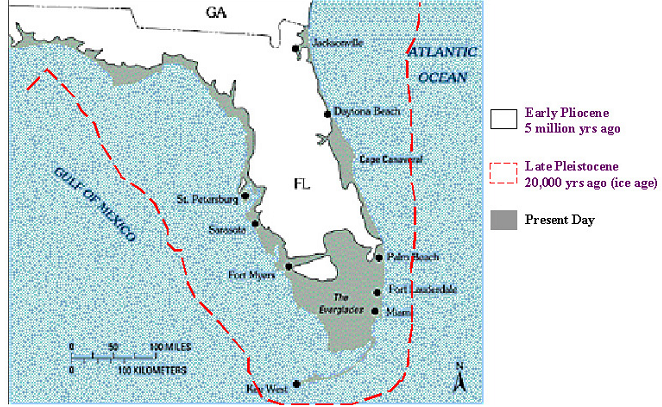
Florida's Changing Coastline.

Beaches move.  Beach sand moves constantly.  It is a complex choreography with countless moving grains - some moving in one direction and others moving in another direction - some moving rapidly and some moving slowly.

Sand is moved by wind and water.  I'm sure that doesn't surprise you, but the consequences are important for the beach hunter.

People talk about how items sink on a beach.  As I've argued before, items on a beach rarely move if the sand doesn't move.  Prove it for yourself.  Get a bucket of sand, put a coin on the top of the sand, and you'll be able to observe that a coin won't sink in resting sand.  Coins don't work their way down into sand like sand-fleas, moles or worms.  The biggest factor is the movement of the sand.

If I wanted to find old things at the beach, one thing I'd really like to know is the history of the beach and how it has moved over time.  The beach won't be where it used to be.  The sand will come and go many times in a year.  Beach could be a long distance from where it used to be. And even when the surface looks the same, the sand could have eroded several times and then filled again.  As that happens, objects will generally tend to settle lower.

I can remember times when local different Treasure Coast beaches were very different from what they are like today.  I'm sure you can too.  I remember, for example, when an old concrete foundation was exposed at the water's edge between John Brooks beach and the condos to the north.  I only saw it once, but I'm sure it is still there.  Of course the waterline is not where it was then.  In the same area, there was also once a line of tree stumps in the shallow water.  I haven't seen them again either.  The water line at that time was much closer to the condos than it is today.

I'd love nothing more than to have a overhead stop-motion video history of the beach changes.  You'd see the beach move in and out, slowly sometimes and at other times very quickly.

People often use stationary landmarks to judge beach changes and determine when old items might appear.  It wasn't long ago that I posted how people used a car frame up by Vero to judge when hunting would be good.  That car frame is gone now, but it provided a marker to estimate the movement of sand.

The illustration at the top of the post shows how much the Florida coastline has changed.  It changes year to year to, and even day to day.  Those changes are important to the beach hunter.  Many old objects that were once in the water are now covered by the beach, and other objects that were once on the beach are now in the water.

The beach can change quickly when there is a big storm.  Here are some photos of changes caused by hurricane Michael that did so much damage not too long ago.


The photos show how one section of beach disappeared in a very short time.  Here is the link for more about that.

https://www.usgs.gov/news/and-after-coastal-change-caused-hurricane-michael

Here is another example from the same article.


These changes caused by Michael are easy to see.  Most of the time the movement of sand occurs more slowly, but it does occur nearly continually. I'm sure that some of the erosion that occurred during Michael has been reversed by now.

I'm often amazed that people, sometimes conducting very big operations, are so far off simply because they failed to take into account beach movement. Remember, the beach is now different than it was a year ago, ten years ago, and certainly hundreds of years ago.

One of my old favorite shallow water hunting spots is now under the beach and the new waterline is out at least a hundred yards from where I hunted in the water about thirty years ago.  A beach renourishment project caused that.  If I went back there today and walked out into the shallow water, I'd be far from the area where I used to hunt and the old stuff would be deeply buried under the beach.

If you have a beach target that is dated to a general time period, one of the first things I'd recommend is that you do some research and try to find maps from that time and figure out where the beach was then relative to where it is now.

---

A six to nine foot surf is predicted for Friday.  That is a bit of an increase since yesterday.  It could get interesting.

Source: MagicSeaWeed.com.

Happy Thanksgiving,
TreasureGuide@comcast.net


Tuesday, May 1, 2018

5/1/18 Report - More On How Sand and Objects Move In The Water and On The Beach.


Written by the TreasureGuide for the exclusive use of treasurebeachesreport.blogspot.com.

Tires In Indian River Lagoon.
( I pulled the vegetation-covered one out of the water. )

Hours, days, weeks, months, decades, centuries are all units of time that can be appropriate for describing beach sand cycles.   By "beach sand cycles" I mean the cycles of beach accretion and erosion on specific beaches.  Besides sand, other objects wash in and out in cycles of varying length.

A beach might erode for an hour, day or week before filling in again, but there are what I would call long-term and short-term cycles.  To give an example, Bathtub beach and Fort Pierce South Jetty beach will continue to erode for years, decades and even centuries.  There are stationary obstacles that cause the erosion, such as the rocks and houses in one case, and the jetty in the other case.  Despite the long term trend of erosion, there will also be shorter term cycles when the sand actually builds a little in those locations and then erodes back again.  So even though a beach might generally erode for a week or so, there can also be daily or hourly fluctuations.

But not only does the sand come and go in cycles, there are also periods of time when other objects, such as coins, come or go, and those periods are not perfectly correlated with the sand cycles.  I've explained why that is in the past.  I have been observing this lately in the Indian River Lagoon.

There is, believe it or not, a bit of a beach along the west side of the lagoon, and like other beaches, it comes and goes.  The waves do not get as high as they do on the ocean, but at times they reach a foot or more.  They usually hit the west bank of the lagoon.

I consider the beach along the west bank to provide a small scale model of an ocean beach, admitting that there are some differences - one being the average size of the waves and another being the tidal change of current.  As you probably know, the water flows into and out of the lagoon with the tides.

Since I drive up Indian River Drive frequently, I keep watch the lagoon to see what is happening there.  You might remember that I once said that the west bank of the lagoon was littered with a mass of bottles after the 2004 hurricanes.  There was a solid thick line of bottles along the west bank - some fairly old.  After the hurricanes, the erosion caused so much damage to the banks and Indian River Drive that they put sheets of connected concrete blocks along the west bank between Fort Pierce and Jensen to hold the banks in place.  That project must have taken about two years, as I recall.  After a few years ( I don't remember exactly how many ) the bottles disappeared.  The source of many of the bottles was also cut off.  Many came from the banks where people used to discard their garbage before the days of garbage collection, but the banks and anything on the banks was now covered by concrete sheets.  So there were few bottles left in the water and on the small beach, and it appeared that no more would be washed onto the beach or into the lagoon from the banks.

After a very long period of very few bottles other than new trash thrown from cars, boats or whatever, the bottles began to reappear again couple of years ago.  Not only bottles, but old tires too.  The old tires are have been washing in, especially the last few weeks.

I've been watching the tires appear and move in towards the beach.  Also I've been tracking a few other objects, but the tires are plentiful and easy to track.  Tires are increasing in areas where there  were some before but are showing up where I have scarcely ever seen them in the past fourteen years.

I'm not really much interested in how tires or bottles move in the lagoon, except for what it can teach me about the movement of objects in general in the water and on a beach.  I believe there are some important lessons to be learned there.

I always say that one of the big factors that determines how objects move in the water and on a beach, besides the density, is the shape of the object.  Bottles and tires obviously have very different shapes and both are very different from coins.  Both are very interesting, but the big hole in the middle of a tire collects sand as does the space that would be filled with air when the tire is inflated.  It becomes very heavy and all that sand inside puts a drag on it.  You'll be surprised how hard it is to move a tire filled with sand in shallow water.  They become very heavy. yet in recent days and weeks the tires in the lagoon have been moving at a rate of at least a few feet per day.  Remember, the surf in the river seldom gets over a foot, yet these flocks of tires are migrating to the beach, and they haven't done that to this extent since before 2004.

Area Where Tires Have Been Accumulating For Years.
The photo at the top of the post shows where tires are now washing up for the first time, and the photo immediately above shows an area not far away where they have been accumulating for a longer period of time.  I think you can see how difficult it would be to move a tire that is half buried and filled with wet sand, yet they are moving daily in the small surf of the lagoon.

While coins are obviously different from tires, there are periods when coins move, just like there are periods when tires and bottles move.  So what is the thing that prevented the tires from appearing for so long before they recently showed up and started moving in towards the beach.  I can't answer that precisely right now, but the obvious answer is that they were previously buried.  Just like coins they won't move as long as they are buried - not unless all the sand they are under is moved too.

In the past I've mentioned the tons of sand in front of the ocean beaches and how it will protect the coins and keep them from being washed up onto the beach.  That sand has also protected most of the ocean beaches from eroding much over the past couple of years.

When talking about the junk washing in, one person who spends a lot of time wind-surfing in the lagoon, said there is no sea weed in the lagoon right now - at least not where he goes.  His thought was that the stuff that was normally under the vegetation was now free and getting washed in.

I noticed that many of the bottles that have been showing up lately were covered with barnacles and vegetation.  So are the tires.  Unfortunately I haven't been fishing or out in the water in the lagoon enough lately to say if the sea weed is just buried or if it has died or what, but sand has been moving in for the past couple of months and building bars.  That is happening while the bottles and tires are moving in.

The lesson today is not about tires or bottles.  The point I am trying to emphasize is the various periods when different things, including sand, bottles and coins move.  They move at different times, and as I've said in previous posts, according to the force of water and other factors, including the density and shape of the objects in question.

---

What do you call a flock of tires?  Anything you want I guess.  I'd say a "bunch" or a "mess."

The surf along the Treasure Coast is up to three to five feet today and expected to stay the same tomorrow.  The tides are decent.

Happy hunting,
TreasureGuide@comcast.net

Wednesday, April 25, 2018

4/25/18 Report - Understanding Factors Involved With How Coins Move in Sand. Archaeological Detecting. Emeralds and Silver Bars.


Written by the TreasureGuide for the exclusive use of treasurebeachesreport.blogspot.com.

A couple days ago I talked about how coins move on the beach.  Evidently a lot of people were interested in the topic and followed up by visiting previous posts on the subject.  As a result I decided to show something that clearly illustrates some of the main factors involved.  It isn't simple because it depends upon a variety of factors - the force and direction of the water being a couple of the most important.  The complication is that the water force can change from near zero to very high.

First, here is a question for you?  Will a coin always move in the same direction as the current.

Here is an illustration.


The illustration shows a coin lying on a sand slope.  The current is moving towards shore and up over the slope very much like it would with a surge.

What do you think will happen?   It depends upon the how strongly the current is moving, but if the current is very slight it can move sand in and pile it up on the slope and eventually cover the object.
However, if there is enough current, but not too much, the current will move the sand from around the coin, especially the that part of the coin that faces the current.  That would be red area shown in the next illustration.

When a sufficient amount of sand is moved from that area, the coin will slip down the slope a notch and remain there until enough sand is moved for the same thing to happen again.  Of course the current would have to remain about the same and the coin would be in the same orientation on the sandy slope.

I've seen this actually demonstrated in a tank filled with water and sand and a controlled current.  This is a case in which the object moves opposite the direction of the current,  If the current is either too weak or too strong, it won't happen the same way.  If the current is strong enough, it can push the coin along in the same direction as the sand.

The important factors are the characteristics of the objects to be moved, including both the density and shape, as well as the force of the current.

When an object like this coin is on a slope and the supporting sand is removed, gravity moves it down the slope.

One of the important characteristics of a coin is the shape.  Coins tend to lie flat against the surface and present a small and rounded edge towards any modest current.  The current then speeds a little as it is forced around the stationary object.

A variety of things can destroy this entire scenario.  Just think of a wave crashing right on top of the slope and coin.  In that case, sand will be thrown around and the coin moved rather abruptly.

 ---

The Society of American Archaeology web site lists a variety of projects involving detectorists.

Here is the link.

http://www.saa.org/ForthePublic/Resources/MetalDetectingInArchaeology/MetalDetectoristsParticipatinginArchaeologyRe/tabid/1030/Default.aspx

---

There are several 1715 Fleet emeralds up for auction in the current Sedwick auction.  They have starting bids of around $100.  I've posted about people who have found emeralds on the Treasure Coast beaches.  Some of those emeralds are not the greatest, but one exceptional one was a 68 karat emerald found by a lady that was collecting shells at Golden Sands beach.  Watch for green in the shell piles.

https://auction.sedwickcoins.com/Crude-natural-emerald-from-the-1715-Fleet-8-5-carats_i29836856

The big silver bars seem to be bringing in really good prices.  I think one is up to about $29,000 already.

---

The surf is pretty small now and won't start increasing again until Monday.

Happy hunting,
TreasureGuide@comcast.net

Friday, June 9, 2017

6/9/17 Report - An Earring Find. Surprising History of Earrings. Cycles of Moving Sand.


Written by the TreasureGuide for the exclusive use of treasurebeachesreport.blogspot.com.

Rainbow Over the River.
Rainbows have been a common sight lately on the Treasure Coast.


Very Encrusted Silver Earring.

This ear ring was dug on a treasure beach.  It is very small,  The main part of it will fit on a penny.

The stone is very small, but seems to have a remarkable surface.   

The back is made to let the light through the stone.
Back of Same Earring.
I'll have to get this heavy crust off to get a better look at this thing.

I got it partly cleaned - enought to see some design.  More cleaning is needed for the silver and the stone.


Same Item Partly Cleaned On Penny.

As often happens, after making a find, I try to narrow down the source and age of the find.  That means research.  In the process I usually find something interesting.  Here is a little of something I found on the history of earrings.

During the Middle Ages in Europe male earrings alternated between being popular and being out of style for long periods of time until in the 13th century when the Catholic Church forbade the piercing of ears. This was done in accordance with the dogma, stating that a person cannot alternate his or her body which is created in the image of God. Only thieves, pirates and representatives of the lower class continued to wear earrings.

Thieves used this means of expression to demonstrate their abhorrence for society, while peasants pierced the ear of the only boy in the family or of a child who had been born immediately following the death of another child. For pirates, the earring meant a plundered ship. The Russian Cossacks also gave much significance to earrings.

Earrings were worn on the left ear by the sons of a single mother whose husband had been killed and on the right ear by the only boy in the family. A man wearing earrings on both ears was the last of his family line. Such a man was guarded by his neighbors and was not allowed to participate in times of war, lest his line disappears forever...

For more of that article, here is the link.

http://jewellerypassion.net/the-history-of-earrings/

I now think this earring is 19th century or later.  One reason is the kidney style wire with loop.  That was invented about 1870.   I would also not expect the setting for the stone to be open on the back. That is my best attempt at dating the earring so far.

---

Sand moves all the time.  Every tidal cycle it moves to some extent.  The amount can be small and difficult to identify.


Most of the time it is just a small amount of sand in front of the beach that gets washed up or a small amount of sand from the slope that gets washed own into the water.  That happens all the time to some extent.  The same old sand keeps getting pushed up and dragged down.

Newly lost objects can be in the top layers of sand that always get moved.  The objects might or might not move move with the sand.  I've discussed that a lot in the past.

The force of the water can be enough to move the water and leave the objects behind, or it an be great enough to move both.  When both are moved they will be separated as the force decreases with the more difficult to move objects dropping out first.

In the illustration above the three orange dots represent good old objects.  The sand above those objects can get pushed up onto the beach many many times before the objects are moved.  They will just sit there under the sand until the sand over them gets moved and the force of water is great enough to move them.  That could be years or centuries.

Of course they can get uncovered enough to be detected with a metal detector.

I should also say that sometimes the sand at the foot of the beach will get pulled out to deeper water.

Those same objects will not sink much deeper than the lowest level of sand that has occurred in the past.  If they are sitting on bed rock, the sand above was at some time removed or at least agitated or disturbed.  In the past I've discussed various things that can result in those types of effects.

---

The surf is just a little higher today ( 3 - 3 feet).  The primary swell is from the north.  We are near a nice full moon.  The tides increased a little.

You might want to go early before the rain storms start.

Happy hunting,
TreasureGuide@comcast.net


Monday, February 23, 2015

2/23/15 Report - New Wreck On Corrigan's Beach. "Open Access" Movement. FCC To Vote On Internet Regulation.


Written by the TreasureGuide for the exclusive use of treasurebeachesreport.BlogSpot.com.


Wreck At Corrigan's
Photos by Captain Jonah Martinez
I received these photos via email just yesterday. This nice boat was left high and dry on the beach.

Notice the cut in the background of the second photo.  You might remember that the beach accesses around there were closed a few weeks ago for dune renourishment.  Well, as usual, the renourishment sand is being moved already.  We haven't had big waves lately but the tides have been bigger than normal.

Thanks for the photos Captain!

 -----

The most read posts of January, actually there was a tie, were the 1/3/15 Report - 2/3/14 Report - Beach Renourishment Projects. NDBC Buoy Data. Pirate Superstitions. Six Foot Surf Predicted Friday., and the 1/2/15 Report - 2015 Beach Renourishment Projects. Dredging And Dredged Sand Around the Treasure Coast.

The most "Google Plused" post of January was the

Don't forget that you can always go back to review old posts.  You can also do a key word search using the search box on the main page of the blog.

-----

If you've been reading this blog very long you know that I've complained about how archaeology claims to be saving history FOR the public yet does not provide easy access to the artifacts or information.  Most scholarly articles are published in high-priced academic journals.

The public pays for much of the archaeology that is conducted in the state.  Much of it is paid for by grants that come out of our tax dollars.  Much of it is conducted by faculty, staff and students of state universities.  Salaries, resources and other equipment are provide by the tax payers, yet the public does not have easy access to the results of the research.

I've conducted polls that show how few people have viewed the state collections.  If you've actually seen any of the coins collected by the treasure salvors off of our coast, you probably did not see them at the state museum.  It is much more likely that you saw them at a Mel Fisher Museum or for sale online.  Few of us have ever seen the "Florida Collection," and much of it can only be viewed by appointment for research purposes.

If the pubic pays the salaries and provides the equipment and opportunities for archaeological research, including that done by faculty and graduate students in our State universities, why shouldn't the results be easily available to the tax paying public that pays for it?  Well, it seems that some progress is being made.  There is an "open access" movement.

 In Feb. of 2014 ... AAAS (publisher of ScienceInsider) announced that it will launch the organization’s first online, fully open-access journal early next year...

The move marks a shift for AAAS, which has long been a target of complaints from some advocates of open-access publishing. They argue that the nonprofit organization, best known as the publisher of the high-profile subscription journal Science, has been slow to embrace open access, and over the past decade opposed certain proposals to require journals to make government-funded research papers immediately available for free. AAAS and other publishers have generally argued that such policies would imperil a business model that has served the scientific community well for more than a century.

In recent years, however, the conflict has reached something of a resolution. Science and many other subscription journals have adopted a policy of making research papers freely available after 12 months; at the same time, many publishers have launched scores of new open-access journals, which charge authors a fee...

That is all long over due. 

Here is the link for the entire article.

http://news.sciencemag.org/people-events/2014/02/aaas-launches-open-access-journal

------

On Feb. 26 the Federal Communications Commission will vote on regulating the internet.  According to what I read that means taxes, higher prices and loss of freedom.  Once they start, where will they stop?  Look into it.

Here is one web site where you can add your name to a petition.  Also you might want to contact your representative.

https://radiosong94.wordpress.com/2015/02/22/petition-the-fcc-vote-on-internet-regulations/

It is my opinion that if research is paid for or supported by the tax paying public, the results should be provided online free for easy public access, including good pictures and descriptions of any and all collected artifacts.

------

If you didn't see yesterday's post on the Pelican-in-Piety artifact from the 1715 Fleet, you might want to take a look.

Not much has changed on the beach.  We still have the small surf, but also some negative tides.

Happy hunting,
TreasureGuide@Comcast.net

Monday, March 10, 2014

3/10/14 Report - Experiments On The Movement Of Sand And Other Objects On A Beach


Written by the TreasureGuide for the exclusive use of treasurebeachesreport.blogspot.com.


I'm sure everybody had a great time at the TCAS club hunt this past weekend.

To the left is a picture of the beginning of an experiment.

Three lead sinkers were placed on a sand bar in shallow water where the water would get deeper as the tide came in.

At the time of placement the objects were in very calm water.  What I'm talking about here today happened before the water got rough.

Which object do you think would be the first to disappear from view while the waves were still gentle?

The big heavy one?  The little round one? Or the disc shaped one.

This might or might not be a surprise to you.

It was the disc shaped object that disappeared first.  It disappeared quickly and well before either of the other two.  The heaviest appeared to remain the most visible in those first minutes before the water got rough.

Some sand was removed from around the two egg shaped sinkers making a little depression around them, but the disc shaped one disappeared very quickly.

People often talk of things sinking.  And they talk about heavy objects sinking more.  That isn't always the case.

I should make one clarification here.  When I just said sinking, it was as much a matter of being covered as sinking.  There is a difference.

There is what I'll call a trigger point.  It takes a certain amount of water forced to move different objects.  Sand will be moved before the sinkers.

Very often when people think that things are sinking on a beach, they are actually being covered.

The trigger point is critical.  It is one of the factors that helps to create coin holes and lines.

There is also a trigger point or threshold of force that determines when an item will be dropped or settle out.

Considering the change in waves and changing tides etc. different items will be moved and dropped at different times.

In the first few moments of the experiment above the sand was being moved, not the objects.

When the sand moves objects can sink as they settle down as the sand is removed from under them or when they are pulled down a slope.

 I was flipping through TV channels the other day and happened to hit a program on USOs (Unidentified Submerged Objects, or something like that).  They were trying to find a plane that wrecked in the water off of the California coast and couldn't find it where they thought it would be.

In order to try to figure out what happened to it they did a little laboratory experiment.  I don't think it was a great experiment for what they were trying to accomplish but the experiment did reveal one thing.

I tried to find the video clip online but couldn't so I made the following diagram.  If you can find the clip I hope you'll send me a link.

They had a big tank of water and a sloped surface in it covered with sand.  They put what looked like a sinker on the sand.  The sinker was partly in the sand but mostly exposed.

They then toke a hose and made a current aimed at the object and up the slope.

Guess what happened to the object.


The current pushed the sand away from the front and sides of the object as the water rushed around it.  The object then STEPPED down the slope.  I say "stepped" because it moved in small quick steps, pausing in between steps.

The current moved the sand from the front of the object but not the back of the object.  Gravity on the object and also the sand behind the object then moved the object down the slope.

The current trigger or threshold level was sufficient to move the sand in the current up the slope but gravity moved the object down the slope.

That was a good illustration.

If you start putting all of these things together you will understand how gold and cobs and things move on a beach.  It isn't simple though.  There are many factors.


On the Treasure Coast we have beautiful weather again today.  A lot of sand though!

The wind is out of the West and the surf is only around three feet.  It will decrease even more for a couple of days.

Happy hunting,
TreasureGuide@comcast.net

Friday, February 21, 2014

2/21/14 Report - More on Reading Beaches for Detectorists and 2 Dug Class Rings From Same School


Written by the TreasureGuide for the exclusive use of treasurebeachesreport.blogspot.com.


Source of diagram:
 
http://www.seafriends.org.nz/oceano/beach.htm . 
I heard from some readers that wanted to hear more about reading beaches or what I might call beach dynamics for detectorists.  I decided to do some more of that today even though I haven't been able to upload the video clips that I made for the purpose.  I'll use this diagram again instead.

I added the A and B labels to the original diagram to point out the advance and retreat of waves that hit the beach.  Point A is the most advanced point of one wave, and point B shows the point to which the water of that wave recedes down the slope again.

I also added the small black arrows between A and B and the x.  Those arrows show the advance and retreat of the most mobile sand during the surge and retreat of one wave.  The x shows the start and end point of the mass of moved sand at the beginning and end of each wave.

Most of the time the beach is in a state of relative balance.  It isn't in precise balance.  There is always some gain or loss of sand along the beach, but usually it isn't a huge gain or loss and wouldn't be noticed by casual beach-goers unless they had a special interest and made careful measurements.

I'm talking today about what happens when the waves are hitting the beach at something near 90 degrees - not when the water is hitting from a good northeast or southeast direction, which is an entirely different situation.

If you watch successive waves that hit the beach straight on, you'll see that normally each wave transports sand (which my video that I wanted to upload clearly shows on a micro level).  Each wave normally moves some sand up the beach a little (towards point A), and then as the wave recedes, a small amount of sand retreats back down the slope about the same amount (towards point B).

It is almost like there is a smaller wave of sand (black arrows) within the wave of water.  The sand moves a smaller distance than the water, but also advances up the slope and then retreats with each wave.  Point x, where the bulk of moved sand settles after each wave, does not change much with  each wave that hits the beach, but does advance up the slope as successive waves move up the slope with the tide.  And it retreats down the beach as the tide goes out.

The amount of sand that moves with each wave is small, of course, but the accumulated effect of many waves can be considerable.

When I was making my video clip the distance that the wave of sand moved was a fraction of the distance that the water moved with each wave.  The wave of sand was something like 20% of the distance that the water moved, but varied considerably depending upon things such as the timing of waves and how they came together.

The distance that most of the moved sand will move (length of the small black arrows) with each wave depends on a variety of factors.

Remember, what I am talking about is when the waves are hitting the beach at a 90 degree angle.  The movement of sand is small and the advance and retreat of sand pretty much balances out. Another way of saying that is that point x does not change much with each wave, but does change more with the tides.

In the video I took to illustrate that common situation, there was one notable shell that was in the area where the sand moved with each wave.  It must have been a hundred or thousand times heavier than the grains of sand that were moving.  How do you think the shell moved in relation to the sand under these circumstances?  Do you think the shell moved more or less than the lighter grains of sand with each wave.

The answer is neither.  Under those conditions the shell moved very much with the sand.  It moved up the slope about the same amount as the wave of sand and then back down with each wave the same amount as the bulk of moved sand.

I've often said that weight is not the most important factor that determines how an object gets moved on a beach.  This illustrated that point very well.  The shell was much heavier than the grains of sand that were being moved, but it stayed right with the moving wave of sand wave after wave.

I won't go into that entire discussion again now.  I don't want to complicate this too much at this point.

Here is a big factor to add to all of the above.  When one of these 90 degree waves recedes, it will  hit another wave coming in behind it.

What do you think happens to the carried sand and other materials when the incoming wave hits the receding wave?

The momentum of the water stops and the carried materials drop out.  At that point you will get a little pile of material.

Also, despite its much greater weight, the shell stayed on top of the moving sand, wave after wave.

Back to the movement of sand.  From what I've said so far, it would appear that you would neither lose or gain sand during a tidal cycle.  It would balance out.  And it often does.  But there are other things that could change.  For example, the surf might be rough during the incoming tide but then calm down during the outgoing tide.  Or the period between waves might change.  Or the direction of the wind and waves might change.  All of those things can affect the flow of sand and other materials.

That is all for that topic today.  It takes me quite a while to make that understandable.  I hope I succeeded.


Here are two class rings from the same school but many years apart.

If you do much water hunting, you'll find a fair share of class rings.

They can be fairly heavy.  I've found a few over an ounce.  These two are closer to .75 oz.

I think they are making a lot of lighter ones these days.  And even a few are made of silver or stainless steel now.

But class rings are among the more common finds for water hunters.

On the Treasure Coast today the surf is around three feet.  It will be about that this weekend too.

I'll keep trying to figure out how I can get the beach dynamics videos done.

Happy hunting,
TreasureGuide@comcast.net

Wednesday, February 12, 2014

2/12/14 Report - Reading Beaches for Metal Detecting (Part II) and Important New Fossil Discovery


Written by the TreasureGuide for the exclusive use of treasurebeachesreport.blogspot.com.


Source:
http://www.seafriends.org.nz/oceano/beach.htm

Yesterday I started a series called Reading Beaches 101.  If you didn't read that, you might do that before beginning today.

I won't add all of the details to this discussion for a while.  The basics will be helpful enough.

I also recommend reading the web site that is the source of this diagram.  It only talks about beach building and erosion though.  I'll add details about the movement and distribution of other objects such as coins.


The lines showing the high and low tide change position of course, sometimes dramatically, and the water can get all of the way up to and over the rear dunes at times.  That can reshape the beach, including the fore dunes and everything in front of it.  At times there will be cuts, cliffs and dunes. and then they'll all be smoothed out and replaced again.

In the top part of this diagram it shows how sand is borrowed from the beach and the sand is dragged down into the water and deposited in shallow water.  Notice how the waves break on top of the newly formed bar.

Note also that during the storm sand comes in from deeper water and is dragged into the water from the beach (sometimes I might add).  There are more details that I won't get into now.

I will however mention my personal observation concerning the angle of the water being very important in determining how the sand and other items move.

The important thing here is that not only does sand move, but also according to the force of the water and other factors, other items such as coins also move.  Each type of item, as I explained yesterday, is different in terms of how much force it takes to get it to begin moving and how much force it takes to keep it moving.  Those things, along with other factors, such as the item's shape and weight and how deeply it was buried to begin with, will determine how the item is moved and where it ends up.  These are the forces that create coin lines and holes.

One of the reasons I discourage use of discrimination is that if you are not detecting a variety of different kinds of items, you will not be getting important information that tells you where different kinds of items are being deposited.  If, for example, you are finding thin light pieces of aluminum or whatever, that tells you something important.

A coin hole will normally have items that are more difficult to move  near the center of the hole, for example, lead sinkers, quarters or gold rings.  If you are in an aluminum or zinc penny zone, you are not in the sweet spot, assuming that there is one.  The information provided by the junk you find can help direct you to the sweet spot.

You might remember the experiment that I did to illustrate how the shape of an object as well as the objects weight helps determine how the object will be moved by water.  (See my 8/5/13 post.)

The bottom part of the above diagram shows how the sand that piled up after the storm gets redistributed again.  Some of it goes back up on the beach and some out into deeper water.

On the Treasure Coast right now there is one beach where you can see a large sand bar just off shore that was created not by any significant storm, but by beach renourishment sand washing out into the water.

If I was talking about shallow water hunting I would point out some important details here, but I'm going to stick to beach detecting for now.

I want you to see the news about a new fossil discovery so I'll leave off on my Reading Beaches 101 topic for now.

A historic new discovery of fossils has been made which reveals many that have never been previously seen.  New species are being discovered as well as new details of previously known species.

Here is the link.  If you like fossils, you'll love this.

http://www.rom.on.ca/en/blog/mighty-burgess-shale-fossil-site-discovered-in-kootenay-national-park

I wonder if some or all of those fossils couldn't/shouldn't stay in situ?  Why cut up and remove examples that can be made into casts, photographed, or replicated and documented in various forms be cut out and removed to a remote location.  Is it so some museum or paleontologist can possess them?  I'm sure that some will say so they can be better studied back at the lab, but I don't know how true that is.  Perhaps if they stayed in situ they could be better studied in the future with the new technologies of the future in the location and situation where they were found.   A similar argument about archaeological artifacts is sometimes made.  They say they are better off being protected in situ for study in the future when there are new methods of study.  I suspect that someday these fossils will be able to be viewed using new technologies exactly where they were found while still encased in the rock.  Just raising some questions here applying the logic and ideas that I've heard from academics before.

All of that is entirely different from beach found items which are already dislodged from their context and are undergoing tumbling and the unrelenting destructive forces of nature at the oceans edge.


On the Treasure Coast today the surf is around three feet, which is a touch higher than expected.  The next couple of days expect a slightly calmer surf.  Beach detecting conditions remain poor.

Happy hunting,
TreasureGuide@comcast.net