Monday, April 7, 2014

4/7/14 Report - Bad Timing, Tungsten Ring, 1715 Fleet Diamond Ring & Tips For Removing Encrustation


Written by the TreasureGuide for the exclusive use of treasurebeachesreport.blogspot.com.

I went out today to do some volunteer sub-surface junk removal.  That was successful.  I did my civic duty.

Tungsten Mother-of-pearl Ring
As far as finds, I pretty much struck out.  I went to a place I like to hunt occasionally.  I hadn't been here for a few months.  I prefer to get there when there is a low tide early in the morning.  The tide wasn't low enough this morning for me to get to some of the areas I like to get to, so I had to settle for the remaining area.

At first it was really bad.  Nothing but sinkers. I expected some coins, but wasn't hitting any at first.

The bank had eroded but there were bushes covering everything in front of the cut so I couldn't get in there very well either.

At least you can scrap the lead or sell the sinkers if you want to.  I say it is better to pick them up and remove them than take a chance on encountering the same ones again some other day.  Might as well give a fisherman a good deal on some cheap used sinkers.

Well, it was slow going at first and frustrating because I couldn't get to the places I wanted to detect.

Eventually I started to get into the green encrusted clads.  I'll have to check them a little better because I have found some older coins there in the past, but I'll have to do some cleaning before I know if there are any older coins in that bunch.

Then I found this tungsten ring with mother of pearl inlay.  I got excited when I put my hand in my scoop and my finger slid into the ring but then I saw it wasn't gold.

I guess tungsten rings like this sell for around $100 new.  I have no idea what it might be worth used. 

They use a lot of different metals these days besides gold and silver for rings.

I also picked up this encrusted junk whatever it is.   If nothing else it will be a good extrication exercise.  Good practice anyhow.

Soaking the item first sometimes helps. 

Encrusted Object
Same Object Partially Extricated

Here is another tip for removing hard crust.  Instead of hitting it with a hammer of something (actually it is better to lightly tap rather than hit) use a pair of pliers or something like that.  I think you'll find that if you use something to squeeze the crust instead of hitting it you will have more control of the amount of pressure applied.  Squeezing is a more cautious technique and often will crack the crust just as effectively.  Don't apply more pressure than necessary.  Needle nose pliers will allow you to direct the pressure to very small areas of the crust that might look particularly weak.


Well, I didn't do so good today, but there is plenty to look at in the Sedwick Coins auction catalog.


Here is a diamond ring from the 1715 Fleet.  Sort of unusual.  The estimated value is $25,000 - $50,000.

Here is the catalog description.

Gold-and-diamond ring, 4-1/2 to 5 carats, clarity SI1-SI2, fancy gray color. 8.44 grams, size 5-1/2. One of the most impressive jewels we have ever seen from the Fleet, with 11 high-quality diamonds in a circular pattern with the biggest rectangular diamond in the center and wedge-shaped diamonds to the sides, certainly not faceted to modern tastes or standards but obviously quite clear and brilliant, the gold with crosshatch pattern on saddle but plain at bottom and inside, completely intact and undamaged, the whole item very much on par with the "Queen's Jewels" found by Bob "Frogfoot" Weller and featured in various magazines. It should be noted also that diamonds are atypical for Spanish wrecks (unlike emeralds) and jewels containing them should be considered extremely rare. With photo-certificate. Recovered from: Spanish 1715 Fleet, east coast of Florida

The lot number is 1531.   

Notice the cut of the diamonds.  That isn't how they cut diamonds these days.  You can often tell something about the age of diamonds by the cut.   Also notice how they used to set stones.  That is diagnostic as well.

There is a plain gold ring from the 1715 Fleet in the May auction that has an estimated value of  $900 or less.  


I took a look at one beach today other than where I detected.   The surf was about three feet on that Treasure Coast beach.  The tides are pretty flat right now.

The wind is coming out of the South today, but that will be changing in a day or two, but we still won't get much surf even after the change.


Happy hunting,
TreasureGuide@comcast.net

Sunday, April 6, 2014

4/6/14 Report - Beach Gold Find, Florida Missions, Beach Sampling and Old Fort Pierce Inlet


Written by the TreasureGuide for the exclusive use of treasurebeachesreport.blogspot.com

Small Gold Pendant Find

As I've been showing, even though conditions have not been good you can still find a few things.

People have been enjoying the fine weather, and that always means there will be lost things.

I wish I could remember the coin to gold ratio that I once calculated for beaches.   I had it figured out.   The amount of gold relative to coins was much higher for water hunting than beaches.  I just wish I could remember the ratios that I had figured out.

The ratio is different from beach to beach, but my number was figured over a number of different types of beaches and over a fairy long period of time, so it was a good general number to go by.

There have been beaches that I hunted and found a good number of coins and knew that I was due for a piece of gold.  Other times I'd hit a lot of gold and new that it would average out over time.

Normally a beach that has no coins will not have gold either.  Coins are a good sign, but sometimes you have to find a lot of coins before hitting the gold.  Of course there are those times when you detect and find no coins but then hit a piece of gold.  That is unusual in my experience though.


It is probably not the best time for a poll but I added one anyhow because I wanted to find out what you think.  All answers are very much appreciated and will help me to focus the blog.    I'd like to get your input, especially as the seasons change and we head into the summer season when storms are the big thing.  Please provide your input.  And don't forget, you can always send me an email.

When I originally posted the poll I think it got posted twice.  They were duplicates.  I deleted the second one.  At the time there were only 8 and 6 votes.   If you were one of the first few respondents you might want to check to be sure your vote didn't get eliminated when I deleted the second copy of the poll.


It has been quite a while since I added any links to my Treasure Site Link List.  One link that I have personally been going back to time and time again is the bibliography that I recently posted ( http://uwf.edu/jworth/spanfla_bib.htm).   It provides a lot of good links to historical information about Spanish Florida.  I just added that link to the list, which you will find to the left of the posts.  It is the third item down on the list.  If you haven't looked at any of those links lately you might find some interesting links there.

If you go to the bibliography, one journal article that you will be able to access entirely online has the title The Archaeology of Mission Santa Catalina de Guale by David Thomas.   In that article can be found the following map showing the locations of the Spanish Missions of Florida in the 17th century.

 
The article discusses how archaeologists located the Santa Catalina de Guale mission site using magnetometers, radar and a test hole matrix.  They used an auger to drill the holes.

The test hole system is very much how I approach a beach, except I don't dig a bunch of holes to get a sample, I let my detector tell me where things are.  It is still a sampling technique.  The point is to do a very lose grid to find out where items of various types are located.  When a particular area or areas shows promise, then I will concentrate my efforts on those areas.

Using a sampling will result in misses.  That is to be expected.  The first step is simply to get some samples.  During the first phase, the point is not finding everything.  The objective of that phase is to identify areas that show signs that a more concentrated search might be productive.

When an area is identified as having potential, a tight grid can then be used.

Your first sampling doesn't have to cover all areas of the beach.  You can eliminate some areas by sight.

In fact sometimes you might be able to narrow down the search area to a fairly small part of the beach just by looking at it.  I still do a little sampling before committing to an intense search, not only to see if the spot is as good as it looks, but also to try to determine the boundaries and center of the productive area.

When you get a sense of where things are, including the center and boundaries, of a productive area you can often then tell the best spot for different types of items to be found in that area. 

I've talked about that before.


Is it just me, or did the snowbirds start to go home.  Yesterday was the lightest traffic that I have seen for a while.  One restaurant that has been packed every weekend had less than half the customers.  I think they are leaving.  I guess the weather has improved up North and it is that time of year.


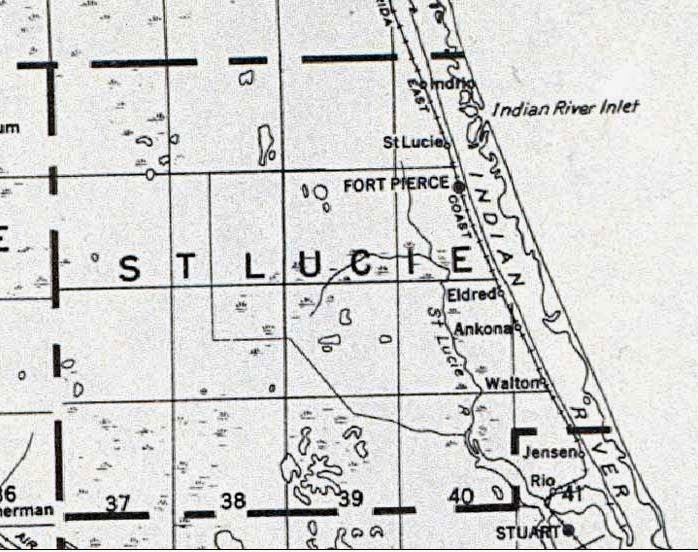
Here is an older map that shows the location of the Fort Pierce inlet before it was at its present location.

I've talked about that in the past.  The old inlet was north or Pepper Park.  And that is near where the Fort Capron gold coins were found in the water.

This map isn't real old.  You can see  the railroad is on this one.


On the Treasure Coast the surf is around three or four feet, but will be daily going down to reach a low of only 1 or 2 feet on Wednesday.  It will then go back up again the next few days.

The tides have moderated.  Not much variation now.

The continuing Southeast winds are not helping at all.

Happy hunting,
TreasureGuide@comcast.net


Saturday, April 5, 2014

4/5/14 Report - Barber Dime, Small Gold Ring, $40 Million Chicken Cup, Wood Butter Bowl & Multi- Million Dollar Chicken Cup


Written by the Treasureguide for the exclusive use of treasurebeachesreport.blogspot.com.

As you know the beaches haven't been great lately, but like I said yesterday, things are still being found. 

William M. has been off-beach and making a lot of very nice finds.  Here is one.

Photos by William M.
1907 O Dime Found by William M.


Good detail.  Nice condition.   Obviously circulated, but while that might reduce the price, the smoothing from handling makes it all the more charming to me.

Here is a good table of Barber dime values.

http://values.hobbizine.com/barber-dimes.html

It isn't nearly as old as some of the shipwreck cobs you might find, but it as valuable as some cobs.

Way to go William!


When the beach conditions are poor I often revert to hunting modern items.   That hasn't been too good on Treasure Coast beaches lately either, but when beach conditions are poor water hunting can be fairly easy even though the spots that aren't buried in sand can be hard to find.

Here is a very small 10K ring that was found yesterday.  It must be a child's ring. 

It is only 1 gram of 10K gold.  Gold rings that small are often missed by many detectorists, especially if they are using too much too discrimination, and it doesn't take much to be too much.

I like the nice delicate design.  As I've said before, I like finding the small items.  If you are finding the smalls, your detector settings and technique is probably pretty good.

The ring has a little sand encrusted in some of the depressions yet.


I ran across a web site the other day that I wish I could find again.  A fellow was showing a collection of old items that had been repaired long ago.  The repairs were old repairs and it was fascinating to see the old techniques of repairing things.   These days most things just get thrown away instead of being repaired.

If anyone knows the web site I'm talking about or a familiar one please let me know.

For example, they had a copper kettle and showed how it was repaired.

Below is an old wood butter dish.  I would say it is 19th century.  I really like it even though it is needs a lot of help.  In the picture it is sitting on an old sewing cabinet.

Old Wood Butter Bowl.
 Notice the cracks.  It has some gunk on it that needs cleaned off.

Below is a close-up of an old repair that was made to the bowl.

They drilled a hole on each side of the crack and threaded a wire through the hole and twisted it tight.  That was evidently done a long time ago.


Close-up View of Wire Repair on Cracked Wood Butter Bowl. 

When I grew up most of the local families out in farm country still had a butter churn even if they didn't use it anymore. 

I don't doubt that this bowl was actually used for making butter.

The fact that it was heavily used and repaired makes it all the more charming to me. 

You can see how it was worn by much handling over the years - more interesting to me than an unused mint item.


On the other end of the spectrum, there is a "chicken cup" being sold by Sothebys that was made in China just before 1500 AD that is expected to sell for tens of  millions of dollars.

The reason I mention the "chicken cup" is that people sometimes find shards on the Treasure Coast, including occasionally some Kang-Xsi porcelain which was carried on the 1715 Fleet.  You therefore might want to know something about how to identify items like that.   It can be difficult to identify shards, but there are some easy-to-identify features of fine Chinese porcelain.

Fine Chinese Porcelain "Chicken Cup"
There are only four authentic "chicken cups" known to exist and that is one reason they are worth millions of dollars.   There are many fakes.

When I saw the picture of this "chicken cup" I could immediately see many of the features that are common to fine antique Chinese porcelain including Kang-Xsi. 

If you study examples like this you will be better able to identify them if you see them on the beach.

Most of the pieces of Kang Xsi you might find will be blue and white.  Pieces with additional colors can be more valuable. 

Notice the shade of blue.  That is typical.  So are the flowing hand-painted lines.  They have a distinctive look.  Also, porcelain like this will be very thin and delicate looking and very white. 

With a little practice you can learn to identify pieces like this pretty well.  

Inexpensive 19th century pottery  is typically much thicker, of courser grain and if broken is yellowish or beige instead of white on the broken edges.

I'm definitely not an expert on this and might not be using the correct terms but from observation have learned how to tell the difference between common colonial ceramics and Chinese porcelain.


I did a few posts on beach dynamics.  I received some correspondence on that, but I don't know how helpful it was to you all.   To me it is very important knowledge and helps me to quickly tune into the hot spots on a beach.  It isn't easy to explain, but it is very important.


I also hope you appreciate the bibliography on Spanish colonial America that I posted.  That to me is very valuable.


On the Treasure Coast the winds will be mixed today.   The surf will be up around three or four feet this weekend, diminishing next week.

Happy hunting,
TreasureGuide@comcast.net


Friday, April 4, 2014

4/4/14 Report - $70,000 Gold Bar From 1622 Fleet, 2842 Reals Found on Beach in 17th Century & St. Jose de Anchieta


Written by the Treasureguide for the exclusive use of treasurebeachesreport.blogspot.com.


Yesterday I showed an 8 escudo that is expected to bring in up to $50,000 in the upcoming Sedwick Coins auction that begins on May 1.

Here is an item that is expected to bring in somewhere between $35,000 and $70,000.  It is from the 1622 Fleet.

Below is the description from the auction catalog.


Colombian cut gold bar, 760 grams, with markings of fineness XXII: (21-1/2K) and assayer/foundry Pena-Randa ("EN RADA"), from the "Dry Tortugas wreck" (ca. 1622), now believed to be the Buen Jesus y Nuestra Senora del Rosario of the Spanish 1622 Fleet, plated in Craig & Richards. 4-1/2" long, 1-1/4" wide and about 1/2" thick. Massive cut piece (probably about half of a whole ingot) with very bold markings (the fineness twice and the owner once, plus three partial circular tax seals), most filled with dark encrustation or at least toning, a couple crude places (as cast) but overall well made and impressively heavy, the cut end chiseled down to about half and broken from there (now filled with dark stuff), one of very few bars from this wreck publicly available and now with additional appeal due to recent research that has pinpointed the name of the wreck and attributed it once and for all to the famous 1622 Fleet (Atocha and Santa Margarita). 

And here is the link.

http://auction.sedwickcoins.com/Dry-Tortugas-Gold-Bar-760-grams-with-markings-of-fineness-XXII-21-1-2K-and-assayer-Pena-Randa_i19334534


Yesterday I mentioned a history book about old St. Augustine that presents letters and reports from Pedro Menendez to the King of Spain in the 16th and 17th Century.

I wanted to give you an example of what kinds of things you can find in that book.  Here is one example.


They found two thousand eight hundred and forty-two reals on the beach of San Meteo which came from wrecked vessels. That is what it says.  Now that should be music to the ears of any detectorist.

That was more than a hundred years before the 1715 Fleet wrecked. 

This reference can be found on page 63 of the book.  And  the letter was written in the year 1600, so obviously the wreck occurred before that time.

They found all of that without metal detectors!  Do you think they got all of it?   I really doubt it.

Where is San Mateo?  Well present day San Mateo is inland, roughly west of Palm Coast.   If you want to do some research maybe you can figure out where that beach was and what wrecks were there.

Here you can learn more about Fort San Mateo, which was constructed by Menendez on a good harbor with the possibility of providing safe harbor for  treasure fleets and also to serve as the center of the Jesuit mission system.

http://www.accessgenealogy.com/america/fort-san-mateo.htm

I just wanted to show some of the kinds of interesting things you can find in the history book.

Here is the link to the book again.

https://archive.org/details/unwrittenhistory00broo


Speaking of 16th century New World history, Pope Francis recently canonized three missionaries from that time period.

Pope Francis signed decrees April 3 recognizing: St. Jose de Anchieta, a Spanish-born Jesuit who traveled to Brazil in 1553 and became known as the Apostle of Brazil; St. Marie de l'Incarnation, a French Ursuline who traveled to Quebec in 1639 and is known as the Mother of the Canadian Church; and St. Francois de Laval, who arrived in Quebec 20 years after St. Marie de l'Incarnation and became the first bishop of Quebec.

http://www.catholicnews.com/data/stories/cns/1401370.htm

Some of the early missionaries worked tirelessly to obtain better treatment for the native peoples.  The religious conversion and treatment of the natives often had intended and unintended political consequences.  The natives (as well as the huge number of slaves in the New World) could easily be aroused to rebellion, a fact that we know from our French and Indian War, as one example.  The treatment they received often made either friends or enemies.


Off topic but I think very worthwhile - I just saw a video showing bison leaving the boundaries of Yellowstone Park.  Beautiful!  The story was carried by USA today and mentioned the bison leaving Yellowstone ahead of impending volcanic activity.  Yellowstone does sit on top of a huge volcano, and that is what fuels the geysers, but the bison were probably just leaving to find some better grazing.  

What that reminded me to tell you is that if you have never been to our National Parks, you should try to go.   Some, like Yellowstone or Grand Titons or Yosemite, are something that you should not miss.   If you are a 62 or older, you can get a senior pass for only ten dollars that will allow you lifetime entrance to over 2000 national parks or properties along with any number of people you have with you in  your car.  That is one of the best deals you will find anywhere.

It seems I've had plenty to talk about lately.  I have to pick and choose every day. 

There are still some nice finds being made along the Treasure Coast even though it has been slow.  Some are modern and some are off-beach finds.  I'll get into more of that later.

On the Treasure Coast the weather is beautiful for walking the beach or boating or just being out doors.  It couldn't be any better, except for detecting the beach.

We just haven't had much erosion this winter.  We are having southeast winds already.  I'm afraid that will be the trend most of the summer.  That means you will have to stay on top of things so you don't miss any good opportunities when they do pop up.  They are likely to be short-lived and easily missed. 

Happy hunting,
Treasureguide@comcast.net

Thursday, April 3, 2014

4/3/14 Report - $50,000 1715 Fleet Escudo & History of 16th and 17th Century Spanish Florida


Written by the TreasureGuide for the exclusive use of treasurebeachesreport.blogspot.com.


The upcoming SedwickCoins auction catalog for the upcoming auction is now online.  I took a look through the catalog and a few things stuck out. 

The escudo with the highest estimated price is the one shown here.  It has a starting price of $25,000 and a pre-auction estimate of 25,000 to $50,000, which is the high estimate of the escudos.

The auction begins on May 1, and the first session will be the gold cobs.  There are 75 lots in that session.

There are several gold cobs with pre-auction estimates of up to $30,000.   There are also a number of escudos that are estimated to go below $2000.


Here is the catalog description for this rare Lima 8 escudo.

Lima, Peru, cob 8 escudos, 1701H, Philip V, extremely rare, from the 1715 Fleet. S-L25a; KM-38.1. 26.95 grams. Almost round, evenly struck and perfectly centered, this would be an exceptional specimen for any date, let alone one that is missing in Calico and the State of Florida collection (theirs is Charles II). In fact we can trace only one other example for Philip V, an AU 55 of demonstrably inferior strike but with perhaps slightly more evidence of the coins' having been created from a modified 1700 die. The present coin is at least AU 58 but bears areas of red staining and gray coral that preclude professional encapsulation. What is more important is that the strike is nearly perfect--well centered and even--and the effect in hand is sheer beauty. From the 1715 Fleet.

The shield shows in the top row and L for the Lima mint, an 8 for the denomination, and then the assayer initial.

The second row shows the abbreviation for Plus Ultra.

The third row shows the last three digits of the date.


The source of these photos and catalog description is the following link.

http://auction.sedwickcoins.com/Lima-Peru-cob-8-escudos-1701H-Philip-V-extremely-rare-from-the-1715-Fleet_i19334312


There are very few individual half reales offered in this auction.  Most of the reales in this auction are 8 or 4 reales.   The few half reales in the auction are mostly included in lots.

There also seems to be more maravedis for sale this time.

It seemed to me there weren't as many interesting artifacts this time either.

There is plenty to see.   It seems to me that like with most collectible categories these days, the more common items are losing value while only the rare and remarkable are appreciating.


The Unwritten History of Old St. Augustine consists primarily of  letters and reports from Pedro Menendez to the King of Spain.  The letters and reports were found in the archives in Seville.  It makes very good reading and provides a number of treasure clues and detecting leads.  It concerns the events of the 16th and 17th Centuries.

Included is information about lost ships, pirates, battles, and the natives, along with daily life in and around the colony.

Here is the link.

https://archive.org/details/unwrittenhistory00broo


Some of the first home sites of old St. Louis are being investigated.  Here is the link to that.

http://news.stlpublicradio.org/post/first-evidence-french-colonial-homes-discovered-under-poplar-street-bridge


On the Treasure Coast the tides are becoming more normal.  The surf is around three feet or so.

Who can't love this weather besides me?

The wind is out of the Southeast.   I hope that doesn't last long.  It could with summer coming up.


Happy hunting,
TreasureGuide@comcast.net


Wednesday, April 2, 2014

4/2/14 Report - How East Winds Work Compared to Northeasters, The First British Sea Dog & A Civil War Prison Camp


Written by the TreasureGuide for the exclusive use of treasurebeachesreport.blogspot.com.

Yesterday  I showed how a Nor'easter affects a beach.  Today I'll show how that differs from a situation where the waves are hitting more from the East rather than the Northeast.  There are some very important differences.


If you didn't read yesterday's post, I'd recommend doing that before reading this one.

I'll start with the same photo that I used yesterday when I showed how a Nor'easter works.  Since this beach already has a long cut, we'll assume that cut was created earlier but now the wind has switched around and is coming from the East, as shown by the long black arrow.

Notice in the picture the wave orientation and direction of the Nor'easter, as shown at the top right of the picture.  That could be the situation that existed when the cut was created.

Below that is shown how the wave fronts would be more parallel to the beach and cut after the wind has changed and is coming from the East.  The straight black line shows how a wave would be oriented, and the long black arrow shows its direction as it hits the beach.

Assume that a single wave, indicated by the long black arrow, comes up the beach and hits the bottom of the cut.  It loses speed and stops and reverses direction, with the water then returning back down the slope.

With a Nor'easter, the water hits from the north, moves south along the beach, and then arcs down and back into the water.  

When the waves are hitting directly at the beach, though, the water goes up the slope and then retreats straight back down the slope.  But what happens then?  Another wave arrives to hit the retreating water from the first wave at some point.  That creates a dead area where most materials that were being moved by the water will be dropped.

The short black arrow shows water from the first wave retreating, and the red arrow shows the second wave coming in.  The yellow star between the black and red arrow is where the incoming wave hit the retreating wave.  That is the dead zone where the flow from both waves halts and where material is dropped.

Of course this happens with every wave.

The yellow star at the base of the cliff shows where the momentum of the first wave stopped before it began to retreat down the slope.

This is very different from what happens during a Nor'easter in which there is a nearly constant flow along the beach front as the water approaches from the Northeast, arcs up the beach and then back down to the South and back into the water.  With a Nor'easter, instead of each wave clashing into the previous wave as it returns down the slope, there is a much more uninterrupted flow which keeps its momentum going and therefore carries more material.

Remember the trigger points that I talked about back probably a couple of weeks ago.  Those are very important and you probably won't learn about them anywhere else.

It takes a certain amount of water flow to pick up and move different objects.  It takes more flow to pick up some objects and some types of objects are dropped more quickly than others.  It will take less flow to pick up and move sand, for example, than rocks.  It will also take more flow to keep rocks moving (unless they are round).  And the sand will not drop out as quickly as the rocks.

The point is that different types of objects will be picked up and dropped at different places depending up on the flow of water and the characteristics of the objects.  That is an important fact.

In the above picture I pointed out two places where objects will be dropped out (yellow stars).  Very movable objects such as sand or small shells that are carried up to the cliff will drop out there, and many of the objects  that are being brought back down the cliff by the retreating water will be dropped where the retreating water clashes with the next incoming wave as the flow comes to a quick halt. This is how a coin line can be created.

The location on the slope where the incoming wave hits the retreating wave will change as the waves change size and as the tides change.  If the swells and waves do not change, the clash point will be higher on the beach at high tide and lower at low tide. 

This illustration assumes that the water is not hitting the cliff with force, but is stopping near the base of the cliff.  In that case, the movement of water between the top and bottom star is relatively slow and light material, such as sand, will be dropped there.

The situation changes a little if the waves are hitting the cliff with force.  Then the cliff face will fall and more sand and other material will be moved by the retreating water until it is dropped, very much of it when it hits the next incoming wave.

If the tide is high and the waves high, so that the water goes up over the cliff, the cliff will be flattened out in a hurry, and a sloped mushy beach-front created.

I think you can now see that there is a big contrast between what happens during a Nor'easter and an Easter.  Of course I've left out a number of factors to keep it simple, but the main thing is that you have a much less interrupted and therefore more forceful flow along the beach with a Nor'easter. 

-------------------


The first of the British Sea Dogs was John Hawkins.  After learning from the Portuguese that the Spaniards in Hispaniola would buy as many slaves as they could get, in 1562 Hawkins sailed to Sierra Leone where he bought and captured three hundred slaves to take to the New World.  That was his first trip, and it was profitable as he received sugar, ginger, hides and pearls.

He made a second trip to the New World in 1564,   The second trip was a little more problematic, but he made trades and took time to learn all he could about the Caribbean and Spanish colonies.

On his third trip, in 1566, he was injured in Africa and then when arriving on the Spanish Main in South America, he found that the Spanish were under instructions to not trade with the English.  Nonetheless he managed to make the trades before having his ships damaged by a hurricane.  Then the Spaniards would not allow him to get provisions and refit and he was attacked, leaving only two of his five ships to return to England.  Most of his men were captured by the Spaniards, but he and Francis Drake (who sailed with Hawkins) both escaped.  Drake, in revenge, became a privateer.

That story is told in the West Indian History book that I referenced the other day as well as many other places.

--------------------------

Here is a link to a good article about a dig about the Civil War prison camp,  Asylum.

http://wfae.org/post/archaeologists-race-against-clock-unearth-civil-wars-camp-asylum

---------------------------

On the Treasure Coast the tides aren't quite as big today as yesterday, but still bigger than usual.

The surf is around three feet, and it will be about that for a few days.

Beach conditions remain poor for finding old things, but you can still find modern items.


Happy hunting,
TreasureGuide@comcast.net
Tuesday, April 1, 2014

4/1/14 Report. How a Nor'easter Works, What Happened at Riverbend Park & Seminole War Battle Site


Written by the TreasureGuide for the exclusive use of treasurebeachesreport.blogspot.com.

Why do people always talk about Nor'easters?  How are they different?  And why are they associated with treasure finds?  Those are a couple of questions I'll begin to answer today.


Here is a picture of a Treasure Coast beach that has a cut running for a hundred yards or more.  It is not a picture of the beach today but was taken some time ago.

First notice the two straight black lines.  The straight black lines show the line of wave fronts as they come up onto the beach.  They are hitting at about a 45 degree angle in this case.

I always talk about the angle that the wind and waves hit the beach.  That is very important and has a lot to do with what will happen to the sand on the beach front.

The picture was taken near low tide when the water was not hitting the cuts.  The cuts were made earlier during the previous high tide.

The small arc (C) in the picture shows how the water of one wave would come up onto the beach and go back down again.  It comes up onto the beach at about a 45 degree angle, moves south and then back into the ocean.

The larger arc (B) would be when the tide was higher or the waves were higher.  The water would come up, cut along the face of the cut and remove sand and possibly other objects back down the slope and into the water.

Typically, one wave will hit the face of the cut, and if it hits with force on the face of the cut, it will knock a slab of sand lose, which will get undercut and/or washed away by the next waves.

One very important thing about a northeaster is that the waves maintain much of their speed as they go up onto the beach at an angle and then back down the slope and into the water.

If you stand and watch when the water is hitting the face of the cut, you will see the water taking sand from the face of the cut and washing it down the slope and back towards the water.

Also if there is a lot of water coming up the slope, if you are digging a target and don't get it safely in your scoop, it will be moved with the water.  So if you know the path of the water you'll usually be able to find the lost target again, usually to the south and down the slope a yard of so, depending upon the density and shape of the target.  A piece of foil will wash away quickly and perhaps not be found again.

When the tide is up and the waves are up and hitting the beach at an angle like this, there is a continual flow of waves from North to South along the beach front in front of the cut.  This North to South almost river-like movement of fast water along the beach front is what makes a Nor'easter different.

Some time soon I'll show how things work very differently when the waves are not hitting at much of an angle.

Remember, it takes more than big waves and high tides to create erosion on a natural beach.

---------------------------------

It seems that history is never as simple as its made out.  There is always a perspective or bias of some sort.  I don't think that can be entirely avoided.

I once picked up a history book in a thrift store that had been used in a school in the West Indies.  The title is West Indian History.  It starts with Columbus and goes through the early days of colonialization, slavery, the Sea Dogs, buccaneers, etc. etc.  Pretty good reading, but it treats the British kindly, which is not really surprising considering the author and publisher.

One student had written 1955 in the book, which was first printed in 1936, so I guess it was still in use in the fifties.  

Anyhow, yesterday I mentioned that there was slavery and brutality in the New World long before the white men arrived.  As this school book points out, there was also slavery in Africa before Europeans got involved.  And the Spanish colonizers had large numbers of slave imported to the New World before other European groups got involved, other than the Portuguese who often purchased slaves from African tribes who enslaved members of other African tribes, and then exported them to the New World.

It would be easy to get the idea from what you hear today that white plantation owners in the South were responsible for slavery in the New World, but slavery was in both the New World and Africa before the white man became involved, and the Spanish colonial system in the New World made use of both native and imported slaves long before the British had significant settlements in the New World and long before the US was born.

You'll find a good description of some of that in the articles linked to the bibliography that I gave you a few days ago.


----------------

Do you know what happened at the site of Riverbend Park just south of Indiantown Road?

On January 24th 1838 Major General Thomas S. Jesup, accompanied by fifteen hundred troops, met three hundred Seminoles on the banks of the Loxahatchee River in the last standing battle of the Second Seminole War. During the battle General Jesup lead a charge to the river and was wounded. The Tennessee Volunteers, lead by Major William Lauderdale, took most of the casualties. The Battle ended when Col. William Harney and his Dragoons crossed the river and outflanked the Seminoles. Outnumbered, the Seminoles fled into the swamps. Seven soldiers were killed and thirty one wounded, including the General.

After the Battle of the Loxahatchee, General Jesup petitioned Washington to allow the Seminoles to remain in the Everglades and end the war. Washington denied Jesup’s request, whereby six hundred Seminoles were captured under a white flag of truce at Fort Jupiter.

Here is the Parks and Recreation web site link telling about that.

http://www.pbcgov.com/parks/loxahatcheeriverbattlefield/jesupsbattle.htm

That was the site of one very historic battle during the Seminole war.  And despite the pictures we often see, the Seminole forces were not all Native Americans.  A good number were black.


On the Treasure Coast today the high tide will be unusally high and the low tide very low.  The surf will be about two feet.   That means it will be easy to hunt down the slope near the water line at low tide.

Happy hunting,
TreasureGuide@comcast.net