Monday, September 7, 2015

9/7/15 Report - Great Numismatic Study of Dug Pistareens. Tropical Storm Grace Headed This Way. Ring Beach Find.


Witten by the Treasure Guide for the exclusive use of TreasureBeachesReport.blogspot.com.

Found This Morning On A Treasure Coast Beach.

I went to the beach this morning.  Conditions had not changed at all.  I saw a couple of detectorists on the same beach.  One had done a good bit of the beach before I arrived.  The other arrived later.

People were arriving early for the Labor Day holiday.  There were a few distant showers and a little lightning and thunder.

When the holiday crowds are at the beach, they spread out a little farther than normal from the main gathering spots.

I had just switched from motion mode to non-motion mode, just to check it out, and hit the ring.  It sounded much larger.

I think it is a very good idea to be very familiar and practiced with all the modes that your detector offers.  There are times to use each one.

---

Yesterday I posted Bernard Romans' statement about pistareens being found along the Treasure Coast beaches after Easterly gales.

The coins Romans referred to were not really pistareens.  Pistareens, as the term is more strictly defined, are Spanish coins minted in the old world. In the 1700s pistareens were commonly used in the American colonies along with a variety of other foreign coinage.  Of course, there was no U. S. currency yet.  It would be natural for Romans to refer to the Spanish cobs found on the beach as being pistareens, since they were commonly used in the colonies and had similar markings.

Pistareen 

Mint Marks.

1. Seville
2. Madrid
3..Segovia
4.Cuenca
I found a super study of dug pistareens recovered in the tobacco raising colonies of
America.  Pistareens found by both relic hunters and archaeolgists are included in the study.  Many of of those included in the study were found in Virginia.

This is definitely THE best study of a large sample of dug coins that I have ever seen.  The study was published in the April 2001 The Colonial Newsletter.  The title of the study is When Cross Pistareens Cut Their Way Through the Tobacco Colonies.  The author is Thomas A. Kays.  I posted the link below.

Here are some of the conclusions describing the typical dug pistareen.


It crossed the Atlantic westward as a 1721 dated pistareen minted by King Philip V at Seville.

The coin was used to make everyday purchases in Colonial America before the Revolution • 

It grades very fine having circulated actively for fifteen years and was saved for twenty five. • 

It was cut into quarters for frontier change at a tavern losing 25% by weight to the melting pot. • 

It would have gone to melt completely before the 19th Century had it not been casually lost. • 

It lay undisturbed (save for the pass of the plough) for over two centuries until it was dug up. 

The study includes many illustrations and a map showing where the pistareens were found and a lot of other really good information.  I think you'll want to read this.

Here is the link.

http://numismatics.org/wikiuploads/CNL/Pistareens.pdf

The mint marks shown to the left are from the same linked study.


I'll add this link to my list of reference links on the first page of the blog.


---

t
Tropical Storm Grace.
Grace seems to be following about the same path as Erika.  She is still days away and supposed to decrease to a depression around the West Indies.  We'll just have to watch that one for a while.

The surf this morning was one to two feet.  It looked a little rougher than I expected, but won't change much the next few days.

Happy Labor Day,
TreasureGuide@comcast.net

Sunday, September 6, 2015

9/6/15 Report - Bernard Romans And The 1715 Fleet. Tropical Storm Grace.


Written by the Treasureguide for the exclusive use of treasurebeachesreport.blogspot.com.


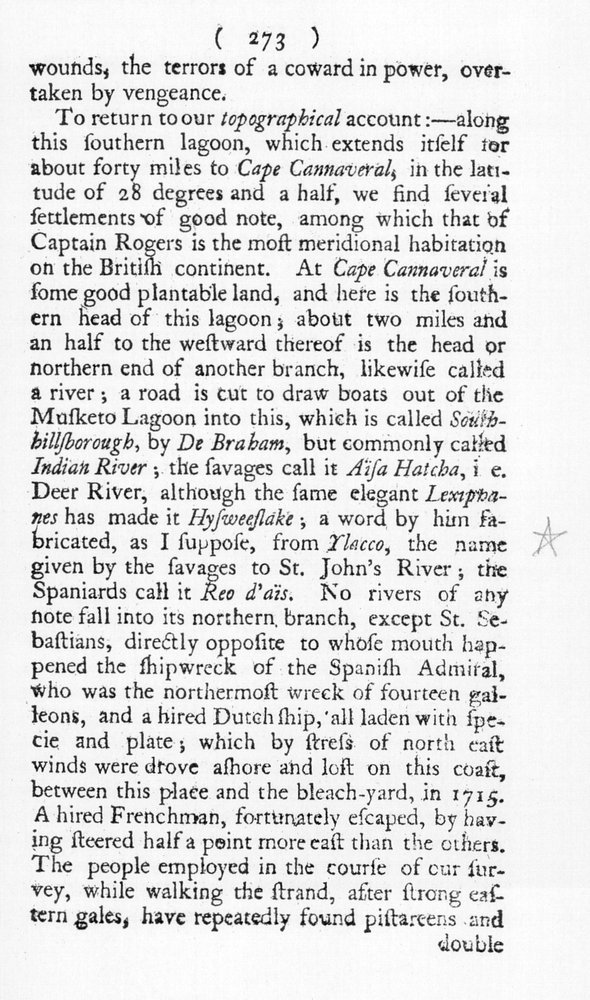
You might know the name Bernard Romans.  In 1775 he wrote the book, A Concise Natural History of East and West Florida.  As luck would have it, he turned out to be a well known name in treasure history.  It wasn't his intent.  He wasn't a treasure hunter.  He just happened to mention the shipwrecks of the 1715 Fleet that littered the area around Sebastian River back in the 1770s.

In 1962, the University of Florida Press reprinted his book, and it became a resource that was read by those seeking more information about the shipwrecks and the pistareens mentioned by Romans that were found in the sand after "strong eastern gales."

As is the case so often, history is produced by the alignment of circumstances.  Some moments become highlighted in the story of man - disproportionately so - sticking out in memory like stars in a night sky.   Many more moments, just as important and just as necessary, fade from memory and are never told.  The fact that they fade into oblivion makes them no less important and no less necessary to the flow of events.

Isn't it the little things we do, the countless moments, tasks and dreams that fill the vast space between the few over-remembered times and events that really makes us who we are?

Everyone knows the name Shakespeare, but who actually knows the man?  Who really cares? Is he anymore than a name?  He is not your grandma, brother, wife or son.  He doesn't touch your life like any one of them.   And he doesn't touch other's lives like you do today.

We need statues and monuments,  They may be hollow, but they are shared.  As much myth as fact, they provide the tapestry of human consciousness that unites us with a sense of common story.

Hidden in life are countless precious moments much like gold coins buried under sand. Many remain undiscovered.  They just don't grab our attention at the time.  They are just there.

Maybe moments like that are not important to anyone but you, but that makes them all the more unique and rare.  They belong to you and are to be shared with those you care about the most.  Take the time to seek out those moments, dig them up, hold them, admire them, jump up and down, share, and celebrate, like they were the most precious treasure you ever imaged.

---

I certainly didn't know where that was going when I started.  I'll leave it there for now even though it may seem a rambling meaningless mess to many of you.  It is more me than most of what I write.

Back to Bernard Romans.  He was a historical figure in many ways, though most of us know him for his mention of the 1715 Fleet.  He was a real person - a complex and many talented person at that.  He was a botanist, engineer and participant in the Revolutionary War.

The original printing of his book is rare and valuable.  Those who later used it for research undoubtedly read the 1962 reprint.  The original is that rare.

I highly recommend reading the Introduction to the reprint edition written by Partick Rembert.   It tells a lot about Romans and his work.

You might find much of the book of interest.  Romans mentions other shipwrecks and hurricanes as well as many interesting observations on the nature of Florida at the time.

Here is a link to the complete online book.

http://ufdc.ufl.edu/UF00095971/00001

Here is a sample page.  At the bottom of this page you will see his mention of the pistareens.

A concise natural history of East and West Florida - Page B-273
As you can see, they use "f" for "s."

It is an interesting book.

Thanks to the University of Florida Press for reprinting the book and making it available online.

---

On the Treasure Coast we'll have a one foot surf for the next couple of days.

Fred is sputtering out in the mid-Atlantic.

We now have Tropical Storm Grace that could head this way.  Here is the projected path of Grace.


Happy hunting,
TreasureGuide@comcast.net


Saturday, September 5, 2015

9/5/15 Report - Colonial Numismatic Presentations With Sedwick Auction. Sacred Heart Reales. Tropical Depression Seven.


Written by the Treasureguide for the exclusive use of treasurebeachesreport.blogspot.com.

Sedwick Coins Treasure Auction 18 Coming In October
The Potosi mint produced some oddly shaped cobs.  Some appear to represent the Sacred Heart.  The exact purpose or use is unknown, but some think they were used by church officials.

Many were "holed," and I've read they were sometimes sewn into clothing.

Here is a link to a Sedwick report on the heart shaped cobs

http://www.sedwickcoins.com/articles/hearts.htm

There are other events associated with the auction that you might want to attend.  Here is a schedule of events.


LOT VIEWING: OCT 28 10:00-6:30 = Evergreen Room.

Ricardo De León Tallavas (Evolution of Mexican Numismatics)
12:45-1:30 PM EST - Buena Vista Ballroom
-------------
Jorge Proctor (Mexican Assayers under Philip V)
2:00-3:00 PM EST - Buena Vista Ballroom
-------------
Glenn Stephen Murray Fantom (Colonial Mintage Statistics for Lima and Potosí:
Historical Context and Analysis) 
3:30-4:30 PM EST - Buena Vista Ballroom
-------------
Herman Blanton (Mysteries of Colombian Cobs)
4:45-5:30 PM EST - Buena Vista Ballroom
-------------
Luis Roberto Ponte (Venezuelan Numismatics) 
6:00-7:00 PM EST - Buena Vista Ballroom       

 -------------
Pre-Auction Dinner 7:30 PM EST 

- October 29, Floor & Internet Auction 10AM->
-------------   
- October 30, Numismatic Forum and Breakfast. Moderator: Jorge Ortiz Murias.


These events will be at the Doubletree by Hilton at Lake Buena Vista in Orlando.

---


Very Soft Sand Treasure Coast Beach This Morning.
You can see where the last high tide stopped.

I visited four beaches this morning before finally finding one I thought was worth detecting.  At that last beach I found a good number of coins in a small area and slightly more sinkers.  I think it was something like 60 per cent sinkers to 40 percent coins.  All fairly new coins.  I've found old stuff at that location before, but the conditions were so poor I was lucky to find as many coins as I did.  I'll be happy when we get cooler weather.  I was soaked with sweat from digging all those deep coins - and sinkers.

Even at low tide, the sand seems to extend out another twenty or so yards into the water before dropping off.  That is a lot of sand that needs to be moved.  Hopefully some day it will get moved.

Fred is still out there but not coming this way.  Tropical depression seven might come this way though.  It is still way over by Africa at this point.

We're going to have a flat surf through Labor Day.

Happy Hunting,
TreasureGuide@comcast.net

Friday, September 4, 2015

9/3/15 Report - Super Moon Reshapes Beach. Salvage Boat At Work. EMDM Story. Vintage Lures.


Written by the TreasureGuide for the exclusive use of treasurebeachesereport.blogspot.com.


Treasure Coast Beach This Morning Near Low Tide
I found a beach this morning that had really been reshaped by the Super Moon tides.  Sand had been washed down from higher up on the beach and into the water.  Then it was washed back up onto the front of the beach.

The sand now extended out much farther into the water than before.  The sand that was washed in shows as darker in the above photo.  That sand extends out into the water a good distance.  Previously there was a drop off near the water's edge but that is now filled with sand.


Maybe this will make it a little clearer.  A lot of sand was dragged out into the water (blue arrow), and then some of it washed back up onto the front of the beach (orange arrow).  The sand that washed back up stopped about where the arrow stops, and you can see the change in the color of the sand.

There were some shells to be found and sea glass and small fossil bits.  There were no good metal targets on the front beach where the sand washed back in, just a few thin aluminum pieces.


The water was bath tub flat this morning.


Salvage Vessel At the Nieves Site This Morning.
---

I first mentioned the Enviromental Metal Detecting Movement (EMDM) a few weeks ago.  At the time it seemed like there was no response and no interest.  A few weeks later I received an email from someone on the topic.  It now seems that it is catching on and gaining momentum.

I just received the following email from Larry.

Regarding EMDM stories, here's one that fits the bill I think.

I guess there's something about a guy swinging a metal detector on the beach that makes people think you are the one they should hand the hazardous floating object with 9 sharp hooks to. 
Makes sense to me. 

I looked up from the sand to see a middle-aged woman in a conservative black one piece swim suit emerge from the waves heading in my direction, and she's gingerly holding onto a diving plug with 3 treble hooks and a length of broken mono.

She walked right up to me and handed me the lure, which I gingerly lifted from her fingertips. I thanked her. She smiled and she and her husband continued up the beach to their umbrella.

Here's a case of just regular folk identifying me, an anonymous metal detectorist that she knew from Adam, as an EMDM figure. It just goes to show you that the MD image in the public mind may be more positive than we think, and it may just be that they see us as performing a sort of volunteer adjunct safety and sanitation service. If I were wearing an EMDM t-shirt, how much more jetsam and flotsam might I attract from the general public?

Later, with a magnifier lense I read on the plug's lip "Pflueger Mustang." I noticed that it's in pretty good condition. I knew that Pfleuger stuff can be worth a few bucks so I looked it up on ebay. Turns out its a vintage collectible lure, and recent sales  had ranged from $15 to $35.

Some kid probably didn't realize dad's old plug was a collectible. Thanks, kid. And thank you, ma'am.

Thanks for sharing Larry.

---

I've often suggested keeping your eyes open for all kinds of things and being familiar with a wide variety of types of objects and collectibles.  You never know what you might find.

I've accumulated a lot of fishing lures, bobbers, sinkers, etc.  Most were found without a detector.  A very few are old enough to be vintage collectibles.  The others I use.  That way I get to try out different types of lures that I would never buy. Often I put new hooks on them, but otherwise they work fine.

I always look for wood lures and bobbers, but don't find many.  They generally don't hold up well if they've been lost a long time.  I found one that is made of a plastic that glows in the dark.  It is very much like the old vintage glowing plastic ice cycle Christmas tree decorations.  I doubt if most of you remember those.

---

Expect smooth seas this weekend, and poor beach detecting conditions along the Treasure Coast.

Fred is still out there, and not coming any way near us.  There is one other disturbance coming off of Africa.  Nothing for us to be concerned about yet.

Happy hunting,
TreasureGuide@comcast.net

Thursday, September 3, 2015

9/3/15 Report - Some 1715 Fleet Salvage History and Implications. Five Simple Ways To Improve Detector Perfomance.


Written by the TreasureGuide for the exclusive use of treasurebeachesreport.blogspot.com.


I thought I'd present a little of the history on the 1715 Fleet today.

We know about the salvage efforts of recent years, but salvage of the fleet started immediately after the disaster.  Of course the first priority was survival.  Fresh water and food was needed.  Guns were undoubtedly a top priority.

Imagine the hostile environment of the barrier islands in those days.  I read that survivors buried themselves in the sand for relief from the mosquitoes.

Within a week of the disaster, Juan del Hoy Solrozano, sergeant major at Havana, had divers working on three of the eleven ships.   Those were the Tierra Firme Almiranta, Urca de Lima and La Hollandesa.  Those efforts continued for several years.

Illegal salvors also arrived from all over the Caribbean.  In 1718, that is three years after the disaster, the Spanish surprised and captured eight sloops in the act of looting the wrecks.

We also know how in 1716 Henry Jennings attacked the salvage camp where a lot of the salvaged treasure was kept in a block house that was on the narrow strip of land near the present McClarty museum.

As I've mentioned a few times lately, it weren't thrown away so much like they are today.  In days past items were repaired again and again.  Archaeological excavations show items such as guns that were over a hundred years old that had been repaired and upgraded again and again and were still in service a 100 years after they were first manufactured.  That is something that can make it more difficult to identify the age of artifacts.

We can imagine the Native Americans and how they would have been attracted to the wrecks and any strange items found on the wrecks or on the beach.

I remember once when a cargo ship leaving Port Everglades lost a cargo container of furniture and people were running up and down the beach picking up what they could.  It was mostly small tables, as I recall.  That would have been nothing to the wreckage of the 1715 Fleet.

I think people often think of the wreck as happening and then just laying there to decompose over the years.  I'm thinking that it must have been like a carcass on the Savannas of Africa.  It would have attracted everybody from miles around.  First the big predators like the lions and jackals, which would have to protect the carcass from other predators or lose their prize.  Then would come the smaller predators and vultures to clean up any easy pickings.  It wouldn't stop until every useful item that could be easily obtained was taken.

The only thing that saved all of that treasure over the years is the water and sand, which made the remaining treasure invisible and/or simply unsalvageable.

We know that by 1744, while much of what could be salvaged at that time had been salvaged, the British cartographer Bernard Romans reported the masts of the Spanish Fleet were still visible above the water.

You know how it goes.  The beach hides things like coins.  The sand covers it up, only exposing a little from time to time when the conditions are right, and then covers it up again.

The masts and other visible signs eventually rotted away or were covered up and the fleet faded into history until Kip Wagner started it all over again.

One thought I wanted to put out there today is that the galleons and all the treasure didn't sink straight to the bottom and then sit there for three hundred years undisturbed.  We know the water moves things from time to time, but I think we often fail to take into account all that took place in the years after the sinking, especially all of the salvage efforts by the Spanish, pirates or privateers, and Native Americans.

We know that items have been found around the salvage camps.  I'm sure the the salvage crews, working with less technology and precision than is exercised today, picked up items and sometimes lost them in the sand again.  I'm sure that there were people who made off at night to bury their own little personal cache with the hope of recovering it at some future time.

When you find a piece of treasure on the Treasure Coast, it might have been lost and found before.  It might have been salvaged and then lost in one way or another.  It might have been lost by pirates.

One thing I find useful is this chart that I've posted a few times before.


The chart provides a reminder of many of the ways that things were dispersed from pre-impact to post salvage.

It is difficult to guess how an item ended up where it did.  It might have come from the local shipwreck.   Or it might have ended up where it was found only after a long series of human and natural events.  That makes it all the more mysterious and wonderful, and provides a lot of food for thought as we try to unravel the mystery.

---

Here are five simple ways to improve detector performance without any adjusting your settings.

1. Keep you coil close to the ground.

2. Keep your coil at the same distance from the ground through the entire sweep.

3. The front and back of the coil should be the same distance off the ground - not tilted.

4. Make the change in direction at the end of each sweep smooth.  Take some of the jerkiness out of the change in direction.

5. Identify and use the optimal sweep speed.

---

We had a West wind this morning on the Treasure Coast.  The surf was only around one foot.  Expect a smooth surf through at least the weekend.

Fred is still out there as a tropical storm but won't affect us.

Happty hunting,
TreasureGuide@comcast.net


Wednesday, September 2, 2015

9/2/15 Report - Nice 1715 Fleet One Escudo. Buried Nazi Gold Train Found. First ECC Photo. Jamestown Discoveries.


Written by the TreasureGuide for the exclusive use of treasurebeachesreport.blogspot.com.

1715 Fleet One Escudo

Very nice one escudo from the 1715 Fleet.  This is referred to as a Type II in the Sewall Menzel book.

The date appears to be 1712, if I am reading it correctly.  Looks like it could be a 2 over 1.

The other side would have the cross potent.

The mint is Lima, and the assayer (M) would be Felix Cristobal Cano Melagejo.

---

This is an Indiana Jones mega-treasure story.  It appears that an armored train full of Nazi treasure has been discovered in a buried tunnel.  If you read the different accounts of this story it is hard to tell how much is true and how much is myth and how much is cover-up.  The different stories just don't stick together entirely.

Here are a couple of links.

http://www.theguardian.com/world/2015/sep/02/nazi-gold-train-poland-to-bring-in-army-to-help-in-hunt


http://my.xfinity.com/video/treasure-hunters-claim-to-find-nazi-treasure-train/517077059784/Comcast/Today_in_Video?cid=hero_sf_TIV

---

When the Jamestown Rediscovery Archaeological Project started, the hope was to find the site of the original 1607 James Fort, which had been written off for more than 200 years as lost to shoreline erosion.
Since then, the team has discovered the fort and more than a million artifacts in the ground...
This is an ongoing excavation.  They keep coming up with more every week it seems.  
http://wydaily.com/2015/08/28/local-news-jamestown-unearthed-recycled-breastplate-stoneware-found-in-probable-cellar/

CT Scan technology is being used to analyze artifacts to help identify the presumed important persons buried under the church.

http://news.cornell.edu/stories/2015/08/cornell-technology-identifies-artifacts-jamestown-graves

---

I have been hearing from people who are going to get a detector and start detecting and people who want to know the laws.  That happens every time after a big discovery.  People get excited and people that have never detected before get interested.

---

Yesterday I wrote about the Environmental Metal Detecting Movement and the proposed Environmental Clean-up Crews.

Here is the first picture from an independent volunteer of the ECC (Dan B.).

Removed By Dan B. From A Boat Launch Area.
Just an example of the type of work provided by the ECC.  Good work Dan!

For those of you thinking of going out and buying your first detector, you can find a lot more of these than gold coins.  Just a reality check.

---

Fred is a tropical storm and won't affect us.  It will dissipate in the middle of the Atlantic.


The Treasure Coast will only have something like a one foot surf through the weekend.

Happy hunting,
TreasureGuide@comcast.net

Tuesday, September 1, 2015

9/1/15 Report - Lazy Surf and Poor Beach Detecting Conditions On The Treasure Coast. First EMDM Award.


Written by the TreasureGuide for the exclusive use of treasurebeachesreport.blogspot.com.

Beach This Morning.


In my 6/13/15 post  ago I suggested what I referred to as the Environmental Metal Detecting Movement.  Brian Hall of Gold Ring Rescue sent me the following message.

I have been reading your blog and thought what if we had T-Shirts with Environmental Clean up Crew printed on them. Would make a great conversation point.

I have been studying your blog mainly on how objects move in the sand, fresh water lakes act different than the ocean but the fluid dynamics are the same. I do have the Great Lake Michigan in my back yard and it acts like an ocean.

I will hit a hot spot of 60's era flip tops and think no one has been here before? Then I will get into bottle cap heaven and dig like a hundred of them. One day I saw one in the water scooting across the surface of the sand and I started thinking differently.

It is when I get into the coins and nickels that I normally find the gold rings. Birds of a feather?

 The weather on the lake for tomorrow will change to a Norte East and a Super Moon.  I will take a couple of machines and watch the sand movement.

Brian Hall
Gold Ring Rescue
(262)527-5022

---

I think T-shirts promoting the positive effects of the hobby are a great idea.

Speaking of the EMDM, I want to  announce the first TreasureGuide EMDM .  It goes to South Beach Park in Vero and the guys that detect there.  I stopped by this morning and there were virtually no pull tabs, no bottle caps, and almost no junk at all.  It was the cleanest park beach that I have ever seen.

Great job guys!  You get the first ever EMDM award!

---

No one conducting an archaeological investigation of the battlefield in National Park,

Gloucester County, expected to find evidence of that deadly moment 238 years ago. Over

the past few months, JMA, a West Chester firm in charge of the dig, has recovered the

usual refuse of battle: musket balls, shell fragments, buttons, buckles, and ramrods.


But Tuesday, archaeologists unearthed what could be the cannon that blew up during that 

Oct. 22 fight, when hundreds of Hessians were cut down during a 45-minute hailstorm of

iron and lead...


Here is the link for more of that article.


http://www.philly.com/philly/news/local/20150826_Archaeologists_unearth_key_artifact_at_Red_Bank.html

Part of that cannon was buried a few feet deep.  Neat picture.

---

I'm having technical difficulties.  The computer is giving me fits.  I'm going to cut it short today.

One thing I want to say is that the cuts north of Seagrape Trail that I reported as starting on Sunday are pretty much filled in by now.

Other beaches that I looked at had a lot of sea weed.

The surf this morning wasn't big.  It was what I would call a lazy surf.

A week or so in the future a bigger surf is predicted.  You know how that goes.  Most of the time it doesn't happen.

Happy hunting,
TreasureGuide@comcast.net