Showing posts with label Inca. Show all posts

Friday, April 5, 2019

4/5/19 Report - More Thoughts On The Gold Mystery Item. Treasure Beach Ring Find. Tide Coefficient Tip.


Written by the TreasureGuide for the exclusive use of treasurebeachesreport.blogspot.com.

Corroded Old Silver Ring Treasure Coast Find
Photo and find by Richard W.

It is not uncommon for me to receive a photo of a heavily corroded small silver ring that was found on a  Treasure Coast shipwreck beach.  When found on one of the beaches where old shipwreck coins and items are found, it is natural to wonder if the ring came from a treasure wreck.  After finding the ring shown above, Richard W. sent me the above photo with the following email.

Detected this ring at Golden Sands Beach on March 19 with my Minelab Equinox 800. I took it to the Mel Fisher Treasure Museum and they said it looked “very interesting”. Back home here in Colorado my Jeweler just examined it and she said it’s silver and very old. Also it could have been cast from a mold as opposed to hammered. I detected all the beaches every day from Bonsteel to John Brooks from March 5 thru March 20 and this was the only thing of interest I found except clad coins and lead fishing weights. Met some nice people and had fun at the TCAS Hunt at Wabasso. Hope to be back next year!

It is very difficult to put a date range on these types of rings, but they are obviously old enough to be very heavily corroded, but that can happen in much less than three hundred years.

Without more information or perhaps some kind of inscription or something, I can't say any more than Richard has already been told.

The most experienced treasure diver on the Treasure Coast has said that no silver rings have been found on 1715 Fleet wrecks.  We do, however, know that they have been archaeologically found on land sites of similar age, so it is difficult to ignore the possibility.

I wonder if they might be trade rings. They are generally small and thin and do not show any outstanding design work that would in any way suggest that they belonged to anyone of high status.

---

I received a couple more emails on Terry's gold mystery item.  That post received a lot of attention,

Sal G. thought Terry's gold mystery item could have be Incan.  He pointed out the similarity between the gold mystery item and the gold pendants hanging on the Incan funerary mask shown below.


Picture of Incan Funerary Mask
Submitted by Sal G.
\

Closer View of Pendants.
Submitted by Sal G.

Bill K added these thoughts on the mystery object.

...One thing that came to mind when I saw pictures, was that there was a lot of contraband on those old wooden sailing ships and I wouldn't have put it past one of the crew to snitch some, pound it together and punch a hole through it, then tie around his/her neck with a leather strand and try to smuggle it back into Spain. Thus the crude workmanship and punched hole.


Thanks Sal and Bill.

---

A lot of my recent posts have been very popular.  I judge by the number of people that read them and also comments I received in emails.

Some topics attract a lot of readers, while other topics do not attract as many readers, they are deeply appreciated by some individuals.

My posts commenting on Oak Island attract more than the average number of readers, and I get nearly universal positive comments about those discussions.  No matter what you think of the show, it gives me examples and illustrations that a lot of people are familiar with and provides a lot of sharp contrasts with my approach.  If you  read what I wrote yesterday and notice how I approach things,, I think you might be able to see some very basic differences.  

Although I don't always know why a particular post gets a lot of readers and others do not, big finds are always popular, as are big changes in beach conditions.  

There are some posts that are read by a huge numbers of people, and i don't know why.  I suspect that they are picked up elsewhere.  One of my all-time most popular posts was the post I published the day after I was interviewed by CNN.  That naturally drove a lot of people to the blog.

On the other hand, there are some posts that I really like that aren't read by many people.  Even though they are read by fewer people, they can be very meaningful to those people that relate to them in some special way, and I get emails telling me so. 

When I started doing this blog I never thought I would have something to talk about everyday, but that hasn't been much of a problem.  In fact right now I have about a hundred pages of content on my mind that might make good posts.  In fact, I keep delaying some items.

---

DJ sent the following tip.

... I use the fishing tide tables to scope out future high and low tides that may be good. This site has a handy “Tide Coefficient” that lets you look for a number 90 or higher - they also show the noon phase. You can choose the location - make sure it is for the ocean not river. 

Thanks DJ,

For the next week the surf will be gradually decreasing from the two to three foot range down to about one foot.

The tides will be a bit higher.

Happy hunting,
]TreasureGuide@comcast.net

Thursday, October 12, 2017

10/12/17 Report - Metal Detecting Over A Few Decades. Thomas Jefferson's Home. Inca In Peru.


Written by the TreasureGuide for the exclusive use of treasurebeachesreport.blogspot.com.


Metal Detecting: The Changing Journey For One Person.

Life looks a lot different when you are 20 years old and looking ahead than it does at 70 something and looking back.  Its not the same at all.  I guess if you live in the moment or are totally consumed by daily struggles, you might not notice the difference, but otherwise you might come to see things entirely differently.

Not only do I see life differently, but also metal detecting.  When I started, I had no idea what I might accomplish.  I started trying to find  pocket change - counting it at the end of each hunt and trying to find more the next time out.  As I improved my skill level and finds, I started to focus on jewelry and better things.  I counted gold rings instead of small change.  I was still studying and trying to learn as much as I could and kept improving.  During one period of about six months when I was between jobs, I proved to myself that I could find enough to make a living at it if I wanted to.  I wanted to know what I could do.  I wanted to prove something, mostly to myself.   Now that matters very little.

When I moved to the Treasure Coast I started hunting more for shipwreck finds than modern jewelry even though I had done some of that before moving.  I like historic stuff better anyhow.  Unlike with modern jewelry finds, there is no living person that had to lose the item first.

Loved ones pass away.  Heavy life and death situations are faced.  And surprise, surprise, I got old.

Life doesn't look the same.  It is just as amazing and marvelous - even more so.  A lot of things were once taken for granted that are now appreciated and recognized as fleeting.  Things that were once important, like education, degrees, career accomplishments, no longer matter.  No body cares, and I almost never think of it.  While those things once consumed a large part of life, they are now irrelevant to me except as distant memories.

As far as metal detecting, there were times when I was very competitive.  And I'm not a competitive person by nature, but when I set a goal for myself, I can pursue it very intensely.  I'm no longer competitive with my metal detecting at all.  I don't see anyone else's success as affecting mine in any significant way.  I always have a strategy, and a way to adjust or work around or use what anyone else might be doing.

I used to do things that I would not even consider doing today, such as water hunting in the ocean at night alone.  Or working really rough or other dangerous conditions.

Just like in the rest of life, many of the things that once seemed very important to me in metal detecting, are no longer important to me at all.  Finds that I would once drool over, no longer excite me.  Some of those, as precious and hard to come by as they are, now seem sort of boring.  But don't get me wrong.  The fun and interest of the activity is not gone.  It is still an activity that I very much enjoy.  I still enjoy finds.  But in a different way.

The finds I most like now are not necessarily valuable or the kind of things most sought by many people.  I like little things.  They don't have to be amazing or tremendously valuable.   I appreciate the little pieces of history - pieces that require study and tell a story and still leave a little mystery.   It could be something valuable, but if it was, I'd prefer a one-of-a-kind piece or something unusually rare.  It would have a little mystery to it or help solve a mystery.  It doesn't have to mean anything to anybody else.  It only has to mean something to me.

My professional career involved research, teaching and consulting.  I do that now, but as it relates to metal detecting.

Since I began this blog, I've communicated with a lot of people.  A lot of peope read this blog, and some send emails.  Some have helped me a lot.  Fred Dengler, for example, always answered my every fossil related question.  He was more than an always helpful expert: he is a great guy. and I proudly count him a friend.   I haven't heard from him for a while and hope he is well.  Fact is, I miss him.  He provided expertise, but also something more.  He freely gave of himself.

The thing that I have come to appreciate is the kind and generous people. Some contribute to this blog in some way.  Some send encouraging comments, thank me for what I do and wish me well.  Some have offered to financially compensate me for the benefit they get from the blog.  I haven't accepted any contributions, but I appreciate the offer just as much or more than what might have been offered.

I have made friends through this blog that I never met.  A very few I have met.

For me, the journey has changed.  It is now less about the finds and much more about the search and the experiences I had along the way, and now, more than ever, about the fine people that I met.

I've met good people.  They care about others and try to help others.  They've been good to me.  That has been my biggest reward for doing this blog - getting to know that there are so many good people out there in the world and getting to know some of them personally.

---

Arcaheological investigations were conducted around Thomas Jefferson’s historic home and plantation in Bedford County.


At a tour on Saturday, Jack Gary, the director of archaeology, said that a new two-lane “Polar Forest Parkway” soon will be constructed to make the property more accessiblevia an extensive section of unused land.
To prepare for the road, Poplar Forest’s archaeologists excavated 4,000 small sites along its marked path . That way, they can ensure the road doesn’t obscure anything with potential historical import...
Here is the link for the rest of that story.

http://www.roanoke.com/news/local/bedford_county/archeology-at-poplar-forest-details-time-before-and-after-jefferson/article_13febf10-4fdc-57a6-b34a-5f9bc53dd995.html

---

An Inca site was recently discovered in Peru.

Here is the link to that story.

http://www.andina.com.pe/Ingles/noticia-peru-inca-citadel-remains-found-in-cusco-686051.aspx

---

Only one day remaining to respond to the blog poll.  All responses are appreciated.


Ophelia is still a hurricane but is just a fish storm.

On the Treasure Coast today we have a little wind from the northeast, but the swells are still more easterly.  The surf is around four to six feet.

Happy hunting,
TreasureGuide@comcast.net

Sunday, April 30, 2017

5/1/17 Report - Artifacts Exceeding Expected Valuations. Easy Bottle Find. Its Not All About The Search For Me.


Written by the TreasureGuide for the exclusive use of treasurebeachesreport.blogspot.com.


Source: Current Sedwick auction listing.

The current Sedwick auction is online and will be closing with live bidding this Wednesday and Thursday.

There are a couple artifacts that are doing very well with bids well over the auction estimates.  This small copper figure (possibly Inca) already has a bid of $425.  The auction estimate was $70 - $100.

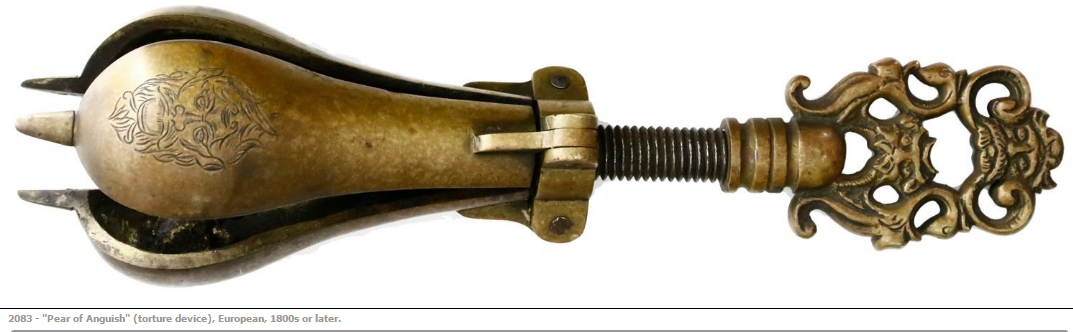
Another artifact that has received bids well above the auction estimates is the following "Pear of Anguish."


Source: Current Sedwick Auction.

This non-shipwreck artifact is a torture device and already has a bid of $1700.  The auction estimate was $300 - $450.

Other items have already exceeded expectations, but generally not by so much.

Here is the link for this item.

http://auction.sedwickcoins.com/Pear-of-Anguish-torture-device-European-1800s-or-later_i26973436

---


Old Bottle Find.
I took a walk the other day to a bottle hunting area close to my home.  There were bottles from ranging over several decades in the shallow water.  Some were partially exposed in the sand at low tide.  This was one of those, and one of the older ones that I saw.  I've been past that spot hundreds of times, but there appears to be no end to the old bottles that surface from time to time.

---

I've heard some people say it is all about the search.  That seems to be a pretty good way to look at it, and it is probably true for some people, but for me it isn't all about the search.

The search is a big part of it, but there is so much more.  There is the find - sometimes.  And when there is a find, then another search sometimes begins.  There is the search to find the meaning of the find.  What does it tell you about current conditions and also about the local area and its history.

Then after all of that there might still be other important steps.  They might include cleaning and conservation.  And after that, finding the right home for the object.

Finding the meaning of the object can last many years.  It might be difficult to identify and date the object.  Where it came from and what it means is something that might take years to learn.

After recovering the story, the story needs to be maintained and sustained.  Part of that is finding a good home for the object.  It might be your home or it might be best to sell the object to a person that appreciates the object and is able to care for it.  A good home is one where the object and the story will be appreciated and passed on.

There are some objects that are not easy to maintain.  Ephemera is one type of object that does not stay in good condition if exposed to Florida heat and humidity.  Any type of object can deteriorate if it does not have the proper care.  You can't take it with you and there might come a time to pass on the objects that you appreciate.  Pass the story along with the objects.

There are other things too.  You learn and grow.  You deal with success and frustration.  And maybe you change.  They say that aging is not optional, but maturing is. I could disagree with the first part of that statement, but I get what they mean.

Happy hunting,
TreasureGuide@comcast.net

Wednesday, April 26, 2017

4/26/17 Report - Metal Detector Damage That Can Be Prevented. Artifacts Left Behind After Inca Attack.


Written by the TreasureGuide for the exclusive use of treasurebeachesreport.blogspot.com.

Detector Showing Poor Maintenance and Serious Damage.

Yesterday I started a post in which I was talking about why you might want to keep old metal detectors in good working order.  I mentioned the dangers of salt water.  Above is a good example of the damage that can be done to a metal detector by things like wind driven sand and salt spray and splashing water.

Notice the corrosion around the knobs and toggle switches.  Also notice the sand in the speakers.  The headphone plug is also vulnerable.

The best conditions for metal detecting can be the worst conditions for your detector.  The wind can be blowing sand and salt and the water can be splashing off of steep cliff faces.  Even knowing all of that, you can be caught by surprise.

There was one time that I was wading not much more than knee deep water in a calm bay and a single wave surprised me and splashed up onto my detector control box (not the detector shown in the pictures).  While I mostly use submersible detectors, I was not using one on this occasion.  The very small amount of salt water that splashed onto the control box was noted by the manufacturer and voided the warranty even though the detector worked fine for many years to come.

Closer Look At Some of the Corrosion.
The damage to the detector shown in these pictures is extreme and severe but happened with normal but heavy usage.  Obviously much needed maintenance was not done.

Most of my detectors are submersible.  Submersible detectors are better protected from the dangers of salt water environments, although even submersible detectors need to be rinsed and properly maintained.  If you work salt water beaches at all, wind driven sand and salt spray is enough to require periodic maintenance.  Salt and sand seem to find their way into the smallest cracks and crannies.

A lot of people complain about detector rods freezing up.  My experience is that all detector rods used on salt water beaches or in the salt water will freeze if they are not maintained.  Rinsing and working them occasionally should prevent that.  While I hear a lot of complaints about the ATX rods, I've had no trouble with them and prefer that type of rod to the others that I've used.

Some people seldom change their detector settings.  I advise working all knobs and switches once in a while even if you don't change your settings much.  I think it helps keep things in good working order and helps you identify any signs of deterioration early.

Even if you get salt water in your control box, rinsing it out with an electronics cleaner can save the electronics.

WD-40 or other oils and cleaners can be a good idea for various parts of your detector.

The Florida sun and heat can also cause damage.  The sun and heat can weaken plastic parts.  I had a lot of trouble with the plastic parts on a White's detector breaking.  It wasn't an old detector either.

Replaced Ear Phone Attachment.
Plastic parts on both the rod and ear phones broke.  I replaced the ear phone tab by making a new one from the metal of a soda can.  The rod was repaired by using a small section of PVC pipe.

I like to have more than one detector with me but I seldom do because I don't like to leave a metal detector in the car in the hot Florida heat.   I also don't like to leave anything good in the car because of possible theft.  That does happen on the Treasure Coast.  I saw some broken glass in a beach parking lot no long ago.  I reported other break-ins at the same parking lot before.

Dennis S. wrote and reminded me to mention the damage that can be caused by leaving old batteries in a metal detector.  Leaking batteries damaged one of his detectors.  I'm sure that many of you have experienced the same thing.  Don't leave batteries stored in your detector when you are not using it for a while.  Thanks for the reminder Dennis.

My main point today is that the beach is a tough environment for metal detectors, but with periodic maintenance you might be able to keep your metal detector working for many years.  The pictures I showed today show extreme and severe cases, but they do show what can happen.

---

Here is an interesting article.


Treasure trove of bronze and copper reveals incredible speed of flash Inca invasion

Bronze jewellery, stone tools and intact pottery were abandoned as the native Colla people fled...


Bronze Chisel Left Behind by Colla.Source: See link below.

Here is the link for the entire article.

http://www.ibtimes.co.uk/treasure-trove-bronze-copper-reveals-incredible-speed-flash-inca-invasion-1618394

---

I have some good emails and other things to talk about tomorrow.

The weather is beautiful on the Treasure Coast.  The air was cooler this morning after the front went through.

The surf is small, but we're having some nice low tides.

Happy hunting,
TreasureGuide@comcast.net

Sunday, November 9, 2014

11/9/14 Ancient Glitter Covered Tunnel With Artifacts. Beach Gold Prospecting and Mining In Alaska. 10,000 Year Old Arrowhead Found By Ten Year Old.


Written by the TreasureGuide for the exclusive use of treasurebeachesreport.blotspot.com.


Not Indiana Jones
Source: Telegraph.Co.Uk link below.

An interesting 2000-year-old tunnel below the Temple of the Plumed Serpent is coated with powdered glitters so that when a torch is lit it appears to sparkle like the night sky.  The 340-foot tunnel has yielded thousands of relics.

Here is the link to the video.

http://www.telegraph.co.uk/earth/environment/archaeology/11198329/Mexico-powder-glittered-tunnel-reveals-ancient-relics.html


Source: Nevada-outback-gems.com web site linked below.

Maybe you've watched the TV show Berring Sea Gold.  Don't you love to see those guys dredging under the ice?  

Prospectors have worked the beaches around Nome with a variety of types of equipment.  I've never seen anything about anyone nugget shooting with detectors on the beaches there.  I'm sure they so if it works.

Anyhow here is a web site with a lot of great information about gold mining in that area.  Included is information about old creek beds that are now under water off shore and a lot of other good information.

It is worth remembering, that like up there, our beaches were once way out from where they are now.  There is a lot of archaeology to be done under he water.

Here is a link to that jam-packed site about gold mining along the beaches of Nome.

http://nevada-outback-gems.com/prospecting_info/nome_gold.htm


A 10 year old boy found a 10,000 year old arrowhead on a New Jersey beach. 

Here is the link for the story and video.

http://www.aol.com/article/2014/08/26/boy-finds-10-000-year-old-artifact-on-beach/20952328/


Happy hunting,
TreasureGuide@comast.net

Tuesday, November 2, 2010

11/2/10 Report - Mystery Clay Artifacts & Inca Gold


Artifact Found in Association with Musket Balls and Other 18th and 19th Century Artifacts.

This was found in an area where a battle took place around 1800. Of course, it could be from a later or much earlier time period. There were a number of these items. All had holes like the one in the photo, and all were about the same size and shape, but not exactly the same shape. They are made out of clay similar to olive jars. I never figured out what they are and would gladly receive an ideas.


A few Days ago I mentioned a site that provides photos and information on the Jupiter are beaches. If you are down that way or thinking of making a trip, you can use that site to get an idea of the condition of those beaches.

That site is now linked to this blog. You will find it listed to the left of my posts under the Tide and Surf Projection section.


Todd S. sent me an email with some good information including one tip that I've never mentioned. Todd uses a stainless steel scoop with a wood post-hole digger handle. He says, "I took off the shovel and drill out a number of places (size of a dime) in which I expoxied a few neod. rare earth magnets. Reinstall the wooden handle back on and it is fantastic."

By using magnets in the scoop, you can quickly locate and capture any small iron items in your scoop. That will save you time in the field.

I have a limited amount of field time and like to make the most of my time in the field. As a result, I don't spend a lot of time looking at finds until I get home. I do look at finds close enough to determine if they might provide any clues to where and how I should be detecting, but otherwise I wait to further inspect finds more closely when I get home.

Supposedly there could still be a hoard of lost Inca gold to be discovered. At least that is what a National Geographic article suggests. I'm sure there are some, but as for this story, you'll have to judge for yourself.

http://www.nationalgeographic.com/guides/history/ancient/lost-inca-gold.html

Interesting story anyhow. Makes you want to go on a field trip.

Forecast and Conditions.

The wind is now from the southeast and the seas are about three to four feet. I'm downgrading my beach conditions rating back to a 1.

The high seas that were projected for 7.5 feet for Saturday have now been reduced. The surf web sites have a definite systematic error. I've been watching this long enough to know that about ninety percent of the time, seas projected to peak in about six or seven days, are reduced as the time draw near. It happened again, and now they are projecting only about six foot seas. I wouldn't be surprised to see further reductions in the next couple of days, even though I wish we would get 6 to 8foot seas. I'm not expecting much though. Maybe things will change.

You have to stay on top of it. Good days for beach detecting have been so few lately that you don't want to miss one when it actually occurs.

In the mean time, there is a lot to do. Try something different. Or go after modern coins and jewelry or do some research and scout around a bit.

Here is the projected path of Tomas.


Don't forget to vote.

Happy hunting,
TreasureGuide@comcast.net

Tuesday, October 12, 2010

11/12 Report - 800 Foot Long Gold Chain & Detecting Coin Lines


Simplified Illustration of a Coin Line.


I wanted to discuss coin lines a little more today, so I made this illustration. Usually a coin line would be much thinner in relation to the width of a beach than what is shown in this illustration, but I wanted to focus on the coin line.

The dashed line represents the path of a detectorist along a beach. In this case, he is zig-zagging from the water line to the dune line.

The upper left diamond points out the first coin that this detectorist finds. If the detectorist did not know about coin lines or suspect the presence of a coin line, he might just continue on his zig-zag pattern and miss many of the coins in the line.

In my illustration, the small dots represent pennies and the slightly larger circles represents quarters.

After finding the first coin in a area where there might be a coin line or hole, I first check down the slope to see if other coins might have washed out at the same place.

After checking below the first found coin, it would then be good to check to the left and right of the first coin found. If he discovers other coins that would increase the chances of being in a coin line or hole.

In my illustration, there is a second coin right below the first, but none below that. That gives the first indication of the possible width of the coin line if these two coins are indeed part of a line.

The detectorist might then begin detecting to the right of the first two coins to see if there are more at a similar distance from the water as the first two. In my illustration the detectorist then locates another coin near the top edge of the coin line, and then checks below that coin and finds one near the bottom edge of the coin line. He is now getting an idea of the width of the coin line, which is wider than the first two coins suggested.

The position of the pennies and quarters tends to confirm the approximate width of the coin line.

Often pennies are found near the top of a coin line or hole, while heavier targets such as quarters are found near the bottom of the line or hole.

After continuing to thoroughly detect to the right of the first finds to find all of the remaining coins in the line in that direction, the detectorist would return to the first two holes that he dug and then thoroughly detect to the left of them to see if the line continues in that direction.

The coin line that I mentioned a couple of days ago was much more narrow than the one in this illustration, with all the coins being within about a three foot band running across the area in front of the dunes.

In my experience, coin lines are more often closer to the water and in wet sand. I believe the line I found that day was produced by coins washing out of the dunes instead of out of the water.

I mentioned in one other blog how I often use a loose scanning pattern prior to tightening up and detecting an area more thoroughly. One reason for that is making an attempt to find a coin line or hole, and that does not require a tight pattern.

There is just too much beach to cover it all thoroughly so you want to find the spots where the most targets can be found.

After detecting as far right and left as the line seems to go, then before quitting, it would not be a bad idea to scan a path just above and below the line to find any targets that just happened to fall a bit outside the area of the coin line. That would often include targets that are either heavier or lighter or have a different surface area or composition than those in the line. Heavier targets, such as gold rings, are often found lower on the beach and below coin lines.

There are a variety of scan patterns that seem to suit different situations. I might mention some of them in the future.

I'm sure I didn't describe the procedure very well. There are just too many details that I didn't have time to get into today. There is a lot more to this, but I'll have to give it to you a little at a time.


On another topic, how would you like to find an 800 foot long chain of gold as thick as a man's wrist? According to the story, there is one that was hidden by the Incas.

Here is the link for more of the story.

http://www.scribd.com/doc/22717756/Locating-the-Lost-Chain-of-the-Inca-Mysteries-Magazine-05


Forecast and Conditions.

Hurricane Paula is down below Cuba. Current forecasts have Paula making a loop and staying south of us, but the path is a bit unusual and might be something we need to watch for the future.

The seas are calm now and will remain calm for at least a few days. The surf web sites project slightly increasing seas next week, but nothing that looks promising.

I'll maintain a level 1 (poor) beach conditions rating. It will be mostly clean-up duty for a while.

Happy Hunting,
TreasureGuide@comcast.net