Sunday, December 10, 2017

12/10/17 Report - Ole Timer Talk: 10 Different Gold Items One Short Hunt.


Written by the TreasureGuide for the exclusive use of treasurebeachesreport.blogspot.com.

I've posted a few Ole Timer Talk pieces in this blog, but haven't told any of my experiences that way.
A few came to mind last night.  I've referred to parts of those experiences to illustrate some things I wanted to explain, but I haven't described them as completely as I could.

The experience I'm going to talk about today happened on an otherwise normal day about thirty years ago, so I'm sad to say that I forgot a lot about it.  That is mostly why I haven't told it this way.  Fortunately I have some written records to refresh my memory and help me get the most important parts right.

My records were scribbled in cursive with a lead pencil.  The paper is now old yellow crinkled tablet paper.  The entries are labeled with the month and day, but not the year.  That was a big mistake that didn't seem like it would be a problem at the time.

One sunny day near low tide in early February I arrived at a beach that I detected frequently back in those days.  I don't recall any, people on the beach, which is kind of strange for a nice day down south, so I would guess it was early morning.  The parking fee there was something like four dollars, so people mostly parked elsewhere if they could.  There were no other detectorists there.  That I know for sure.

The surf must have been calm.  I don't remember it being an issue at all.

I was in South Florida and was targeting modern jewelry in those days.  I had a few years of detecting under my belt, but was not much more than what I would consider to be a beginner.  I was using a Fisher Aquanaut 1280 at that time, I think.  Maybe I had started using a modified Nautilus.  I'm not sure about that.

When I arrived at the beach, I noticed a good bit of erosion.  It wasn't what you usually see.  The erosion was right at the front of the beach.  There was no slope between the cut and the water.  The cut was right at the waters edge.  The front of the beach had been cut back and the sand spread out in the shallow water.  Very often there is a cut farther back on the beach and then a slope down to the waterline.  In this case the cut fell off into the water.  It was more like the beach had been moved back a few feet.
Red angular line shows surface after erosion.
Grey line shows target distribution.

I stepped over the cliff and into the very shallow water.  It was only up to my ankles or lower leg.  I mostly hunted in shallow water back then.  I moved my coil.  Bingo.  Good target on the first swing.  I dug it up.  Blackened coin.  Without moving on, I took another swing,  Bingo again.  Another blackened coin.  There were targets everywhere.  I'd say every square foot had a target.  In the next four hours of the hunt, I picked up twenty dollars in quarters alone.  I remember telling somebody (Kevin Reilly) that, which is why I remember that number.  But it wasn't only coins.

The targets were not deep - at least not the ones I was digging.  I don't remember digging any big holes.  I didn't get around to that.  There were so many targets that I never got to the deeper ones that day, if there were any.  

I don't know what the total face value of the blackened coins was that day, because  I only recorded the nice jewelry finds and the general location.

Below is what my notes show for that day.  The notes are pretty much as they are written, although they were scribbled and not real easy to decipher.  Maybe that was intentional. 

2/4 -  at North picnic area below new play equipment - blue star sapphire ring, 2 gold ear rings,"SC" signet ring, and 10k band in water  Also silver double heart ring.

2/4 - middle picnic area just south of walkover -  14 k black pearl and diamond ring, also silver and turquoise ring.  In water.

2/4 - south picnic area by life guard station by turtle cage in water - silver love knot ring, silver and turquoise ring, gold religious charm, 2 class rings, 1 14k band.

What I recorded for that four hour hunt was 10 pieces of gold jewelry.

I left after about four hours.  I don't know why I left (maybe I had to do something), but I'm sure I dug less than 20 percent of the available targets in the area that day.  I was going to return the next day, and I did.  I have a couple entries for 2/5.  

I didn't record how many coins I found.  When I first started metal detecting, I recorded the number of each denomination of coin that I found.  From those records I knew when my Aquanaut paid for itself in clad coins, which it did in one year.  It cost me something over $600 for the detector, if I correctly recall, and I knew when I found enough change to cover the cost of that detector.

If I encountered the same situation today, I would do some things differently.  First of all I would try to hunt as long as it took to clean the area of all targets.  If for some reason I couldn't do that, I would  try to cherry pick the gold.  At the time I didn't have the skill to do that very well.   I'm sure the second approach would have meant missing some gold because the target density was so high.  You'll find more than you think after you clean out a lot of the louder targets, so the best practice would have been to spend the time to clean it all out properly even if it took more than one day.  Problem with that is that you never know when conditions will suddenly change and it all disappears.

As an aside, the only problem I ever had with the 1280 was, after I first got it, I kept breaking the plastic things that the upper forearm fit into.  They finally sent me metal ones to replace the plastic ones.  It was very reliable.  Fisher did a tune-up on it for me once.  I sold that detector after a few years and got nearly the purchase price for it.

I'm glad I have my records for that hunt.  They helped refresh my memory so I could tell the story.  It was a long time ago but a time to remember.

It s funny how some details stick so vividly in memory while other fade.

The second day I don't remember as well and my records do not seem to be as complete, but I do have entries showing an 18k charm, a crucifix with gold chain, a 10K band, a Jesus and Mary medallion, and a 14k nugget band.  I don't know what other coins or what else was found.

The one big thing I remember about the second day, and I remember it very clearly, is the end.  As I walked back to the car I looked up and noticed a weather front coming in.  A thick layer of clouds was arriving from the north.

The next day I returned to the same spot, and quickly found that it was all over.  No more targets at all.   It opened up suddenly and closed just as suddenly.  That is the way it goes, and why it is so important to make hay when the sun shines.

---

The cold front definitely arrived to the Treasure Coast.  The wind has been out of the west and north. We have some nice cold air.  The surf is small.

Happy hunting,
TreasureGuide@comcast.net


Saturday, December 9, 2017

12/9/17 Report - Hoard Uncovered by Roadwork. Finds: Tools of Sailing Ships and Sail Making. Jacksonville Area Conditions.


Written by the TreasureGuide for the exclusive use of treasurebeachesreport.blogspot.com.

Hoard Uncovered by Road Project.
Source: See RT.com link below.
A Swedish farmer has been awarded thousands of dollars after roadworks on his land uncovered a Viking treasure trove that included hundreds of silver coins.

Here is the link for more about that.

https://www.rt.com/news/412305-viking-treasure-coins-sweden/

Thanks to Norbert B. for submitting this link.

---

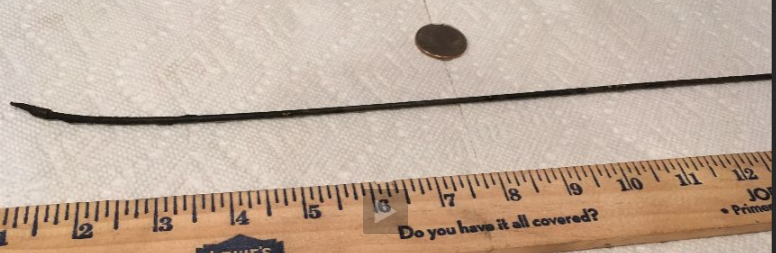
Chris N. said, Here is the rather large needle either Upholstery or a Sail Needle, it was rolling in the surf whence I found it. 


Broken eyelet curved needle point, some corrosion, especially on needle point end. I cleaned up best I could with out destroying item.  

Below are three pictures Chris sent of that needle.

 Found Needle

Pointed End of Same Needle.

Other End of the Needle.
I don't know much about sail making tools, neither new or centuries old, but because of recent posts I've been doing some research and learning a little.  

I found the following on a site having to do with sail making.  The author used the name Savage24.

A sail needle has a 3 sided point, like a leather needle, except the edges are rounded off.
They slip between the fibers of canvas or heavy sail cloth without tearing the fibers...
A properly tempered sail needle will last for years I have some that I have been using for 10-12 years. 
They will cost you a couple of dollars each for the larger sizes, but you get what you pay for.
I would recommend from size 12 - 14 for general use. That's about a 3 to 3 1/2 inch needle that will take the inner strands of 550 cord.
As a sailmaker I use them for sewing sails and sailor stuff, they also make a dandy vent pick for your flintlock. 

Savage24 is talking about needles that you can get today, so they might be a bit different than those used centuries ago.

Another source said,

Sail needles are used for canvas repair work by hand sewing, it is generally much thicker as compared to normal machine needles to provide a comfortable finger grip. The body of the needle is triangular in shape with a sharp triangular point for sewing onto the fabric using minimal force. The eye of the sail needle is also ...
While sails were made on land, I would expect tools for maintenance and repairs to be carried on a ship or brought in after a wreck for various uses.

Here is a good list of sail making tools from the boat-building.org web site (See link below.).

The additional hand tools used by a sailmaker are:
  • Sail needle: a strong needle with a sharp triangular point.
  • Sailmaker’s thread: strong thread for sewing up the sails, leech ropes and grommets.
  • Sailmaker’s palm: a strip of leather with a metal pad with an indentation that is used to force the needle through the sailcloth. The strip is strapped around the palm of the hand.
  • Awl, to create a hole in heavy sailcloth or multiple layers of sailcloth before inserting the needle.
  • Pliers, for pulling through a needle inserted into heavy sailcloth or multiple layers of sailcloth.
  • Seam-rubber: a wooden handle with a strong 'scraper', made from strong lignum vitae (tropical type of wood) for creasing down seams in the edges of the sailcloth.
  • Fid: a cone-shaped piece of lignum vitae for splicing rope or opening up holes in the sailcloth. The fid is inserted between the strands of a rope in order to create space through which another piece of rope can be inserted. The fid can also be inserted into a hole in the sailcloth and will open it up wider, so that the hole becomes larger.
  • Marlinspike (also known as a marlingspike): a wooden handle with a piece of metal that tapers to a point in the form of an awl and which has a hollow in it and which is intended for splicing stranded rope. The marlinspike is inserted between the strands of rope, a strand is inserted through the hollow section of the marlinspike and is thus fed through the gap in the rope.
  • Hollow punch: a metal pin with a round hole at one end with a sharp edge and a flat face on the opposite end so that it can be hit with a hammer. Hollow punches are available in various sizes and diameters to make small and larger holes.
It appears that one of the diagnostic features of a sail making needle would be a triangular point.  I can not usually see that in pictures of either new or found needles.

Although I've learned a little, I'm not yet able to say if the needle in question today is a sail making needle or an upholstery needle or how old it might be.  Perhaps somebody more familiar with those types of items can say.  If so, please let me know.  Perhaps the above information will help some one identify the item.

Here is the link I mentioned above.

http://www.boat-building.org/learn-skills/index.php/en/wood/sail-making/

---

Chris N. also sent a beach report from up around the Jacksonville area.  Here it is.

Went out a little bit today,, not very much.. Very sanded in.. this storm is bringing the sand up and covering were all the good material is, except down by the very low water tide line.  I did not stick around to wait.. really early out in the surf in and around Jacksonville. I bet although Anastasia Island and further south conditions may be better...

Bad weather still on the move unfortunate for folks who live in homes by the ocean... Major construction all over Northern Coast from Irma.. there finally establishing Sea Walls for folks who pay for it..

Note* When I find a lot of fossilized bones, larger sharks teeth etc Items I usually get good hits on my detector... "Just a thought".. 


On the Treasure Coast there is lot of thunder, wind and rain this morning.  It looks like we'll just have a two foot surf for a couple weeks on the Treasure Coast.

Happy hunting,
TreasureGuide@comcast.net

Friday, December 8, 2017

12/8/17 Report - Erosion at One Renourished Beach. Ole Timer Talk: Crate of Dishes. Benefit of Reading Broadly.


Written by the TreasureGuide for the exclusive use of treasurebeachesreport.blogspot.com.

Fort Pierce South Jetty Beach Erosion
Photo by Gaylen C.

You might remember Gaylen's find that looked something like a Marlinespike or maybe an engraving tool.  Galen sent a message and some photos from his hunt yesterday.  Here is what he had to say.

Went back to the same area as my relic find. Found another nail or spike, but it may prove to be fairly modern. Lots of signals. Picked up a few things. The dunes look like this from the south jetty for a long way and then gets a little more slope. High tide was within a foot or so of dune. Really undercut in some places, with lots of sand falling to the foot. Several different layers showing. The piece I got was among larger rocks at the base.

The following photo shows how high the cliff is and the various layers.  Note the rocks at the bottom of the cliff.


Thanks for the report and photos Gaylen.

---

Brain M. sent the following Ole Timer Talk.

Here is a quick little treasure story that happened to an old friend of mine 20 + years ago on the treasure coast. He was out metal detecting after a storm . Big cut on the beach and if I remember correctly it was at night. He noticed something that stood out as strange. There partially exposed in the wall of the cut was a stack of dishes. He told me when he saw it he figured that someone had a pic-nick back in the 1930’s   and must have left them on the beach. He didn’t mess with them he was looking for coins and metal. Days later he was talking to another treasure hunter and was told of Chinese porcelain dishes were cargo. I don’t remember what dynasty he said it was from. He told me they looked like they were stacked and the crate must have rotted away and left the stack of dishes in the wall of the cut. From what he told me they were worth a fortune had he only known what he was looking at. When he went back the sand was in and the cut was gone. We wonder if they are still there waiting to be found intact or did the incoming sand and surf knock them out and smash them to bits.

We most likely will never know.

Thanks Brian.

A stack of well preserved Kang Hsi porcelain would indeed be worth a lot.

I've been very much surprised by how often I already know something about these accounts that go back twenty years or more or the people involved.

I knew the fellow who found the eight escudo in Clint's account, for example, and I also heard about these plates.  I don't remember now when or where I heard about the plates, but I think I might have even posted something about them in this blog years ago.

The lesson Brian's account provides is that you should get to know as much as you can about various types of treasure so you will recognize them and their possible significance when you see them in the field. There have been a lot of times when I failed to recognize something good.  I regret some of those failures to this day.

One example that came to mind yesterday was the time when I was on Pigeon Island at a battle site from right around 1800 when I dug a rusted twisted piece of metal that I later realized was the hammer from a flintlock.  Right beside that piece was a squared piece of flint.  I can see it in my mind's eye today.  I was hanging on the side of a steep cliff, with an old Tesoro detector, which I fitted out with a short board as a rod stem.  ( The short stem helped since the face of the cliff was right in front of my face.)  I was using a screw driver as a dig tool.

I didn't pay much attention to either the rusted metal item or the flint when I dug them.  I wish I had realized their significance and kept them.  If I found the same items today, I know I would have kept them, and better realizing their significance, I also would have hunted the immediate area more thoroughly to find other pieces of the musket or other items.

It is easy to get so focused on coins or some other particular kind of target that you miss other types of items that can actually be more valuable, not to mention being significant clues.

Those dishes, as Brian pointed out, could have been worth a lot, but they were ignored because of a lack of that realization.  They could have also been a clue that other good things might have been buried in the area.

I didn't know what my first fossil find was, but I kept it.  I just kept it out of curiosity.  I didn't find out what it was until probably at least ten years later.  I undoubtedly passed up other fossil finds before that one, not knowing what they were.

I also failed to recognize the first enameled ring I found from a 1715 Fleet wreck site.  I thought it was modern because I incorrectly thought that enameling was a modern process.  Even though it was gold and very attractive, I didn't pay very much attention to it when I dug it.  I just slipped it into my pocket not thinking much of it because I was targeting shipwreck items.  How wrong I was!

Enameling is actually a very old process.  In fact it is believed to go back to at least the 13th century BC. (See https://www.ganoksin.com/article/earliest-cloisonne-enamels/)

I used to hear people say that if something is plated, it is not hundreds of years old because plating is a fairly modern process.  That might be true of some types of plating, but gold and silver gilding is a very old process.

I think you get the point.  Knowing something about a wide variety of types of objects can be very helpful.  The failure to recognize items you see in the field can be a big mistake.

I'm sure I sometimes talk about items that a lot of people are not interested in.  You might not have any interest in iron artifacts, for example, but those rusted old items might provide important clues to a site and other types of treasure.  They might also hold more economic value than you think. 

You might not be interested in sea glass, but a piece of black glass washed up on a beach might be a good clue to the presence of other historic items nearby.  If you do a lot of reading, you might be better prepared to recognize various kinds of treasure when you see them and be better able to interpret what the item is telling you about the site.

---

We're going to be getting a cold front.  The wind will be coming from the north for a couple of days, but the surf will be small.  The tides are pretty good yet.

Happy hunting,
Treasureguide@comcast.net

Thursday, December 7, 2017

12/7/17 Report - Sebastian Fisher Treasure Museum Admission Free Sunday. Analyzing Cut Marks. Coastline Angles.


Written by the TreasureGuide for the exclusive use of treasurebeachesreport.blogspot.com


I just received an email announcing the open house yesterday.  Admission free Sunday.

---

John C. sent his thanks for helping to identify his USMC ring and wanted to especially thank Sherry, who came up with the answer.

He sent the following picture and said, Here is What happens with discarded fishing line ,This turtle washed up at wabasso beach in 2010 ,It looks like heavy test 80 or a 100 pound ,I think it's from long liners, But I'm not sure .

Turtle On Wabasso Beach Back A Few Years Ago
Photo by John C.
I just happened to see a TED talk where they showed small pieces of plastic in a fishes gut.

---

You probably know about Vero Man and what that is all about.  It all started when a local collector noticed carvings on an old fossilized bone.  I've found what appears to be shark bite marks on Dugong and other bones, but just the other day I picked up a vert and later noticed what appears to be bite marks on it (See below.).  Of course that is nothing scientifically significant.  It was just interesting to me, and goes right along with an article I was going to post today anyhow.

Large Vert With Cut Marks.
By the way, if you can identify what this vert is from, let me know.

The International Business Times reports that scientists have developed a method to analyze the marks on animal bones recovered from archaeological sites. The shallow marks left by stone tools are often “V” shaped, while those made by trampling animal hooves are usually “U” shaped. The new technique, which employs 3-D imaging, shape analysis, and Bayesian statistics, was shown to identify butchery marks made by volunteers with stone tools 88 percent of the time.

Here is the link.


http://www.ibtimes.com/how-smart-were-prehistoric-humans-their-knives-tell-scientists-lot-2624672

---

Source: Google Maps

I was talking to somebody about beach and wave angles.  I often talk about the beach like it runs north/south, which is seldom the case.  As you can see from the map above, the Treasure Coast runs more to the northwest, while south of Palm Beach it is more north/south.

On the Treasure Coast it takes more of a northerly direction to get that slicing action that causes erosion.  If it is just a little to the north, it will actually be hitting most of the beaches pretty straight on.

Of course the coastline is not straight and there are many curves or bends.  That means that the waves will be hitting at a different angle as you go around a bend.  Before you get to the bend you might see accretion, but when you get around the bend you might see erosion.  The angles change.

Beautiful day.

I'm planning some experiments that will demonstrate some important things, but I don't know if I'll get it done by tomorrow.

Happy hunting,
TreasureGuide@comcast.net


Wednesday, December 6, 2017

12/6/17 Report - Ring of Well Known Person Found After Being Lost On A Florida Beach For Decades. Another Reale Find On The Treasure Coast.


Written by the TreasureGuide for the exclusive use of treasurebeachesreport.blogspot.com.

Some Nice Coins and a Ring Found Sept. 25.
Finds and photo by Chris N.


Below is a message I received from Chris N. who found the items shown above.

I found this ring belonging to Fairleigh S Dickinson Jr of New Jersey. He was an avid fisherman, adventurer, businessmen, New Jersey Senator, and instrumental in laying out the plans for the Meadowland Complex along the Hackensack River in East Rutherford New Jersey. Also note His father was Farleigh Dickinson Sr. who help start Becton Dickinson Medical formally in that area as well as the University in Rutherford, NJ.  He attended the New York Military Academy in Cornwall,New York, and the Ring was dated 1937. .And was in the United State Coast Guard in the 1940's.

With help of the Police departments in New Jersey and a little research,we were able to get the ring back to the family, who were astonished that we went through all this trouble to get it back to them. They were surprised and happy that Metal Detector Enthusiast do their best to try and return items. "Thats what we do"

He passed away in 1996, and I was informed that they had no idea the ring would ever be found. We can assume that "Hurricane Irma and the Nor'Easter shortly between each other exposed the original hard pack in which we were able to pick it up on the Metal Detectors September 25, 2017. {Using a Garrett AT Pro, and Mine Lab Sovereigns  GT}

Extensive erosion inadated the Northern Florida coast where ring was found. 
Amongst other items found were old coins dated 1895 and later to Modern Clad, other Jewelry Items, Copper Sheeting, Ballast Rocks, but no Spanish Coins!!! Yet?


Found Ring With Name Clearly Inscribed Inside
Find and photo by Chris N.

Thanks Chris for all of the good work involved in getting it back to the family and providing some more good PR for the metal detecting hobby.

Congratulations of the great finds as well!

Florida beaches have long attracted people from around the country and around the world.  That is one thing that makes detecting here so interesting.


---

Below are some items found by Darrel S. not long ago. 

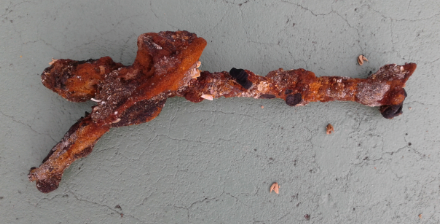
Fused Bolts.
Photo by Darrel S.
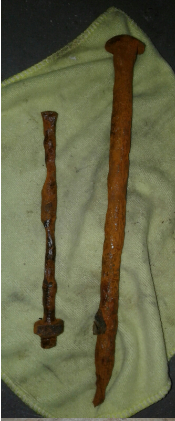
Darrel S. sent me the above photo of the two dug fused bolts or spikes and then the picture below of the same items after they were cleaned.

Bollts After Cleaning.
Photo by Darrel S.

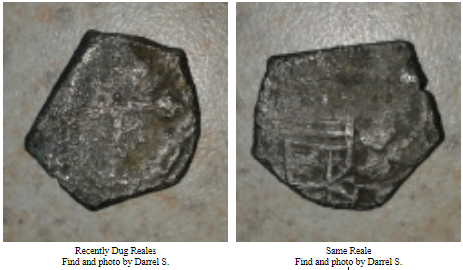
Here is something else he found with the bolts.


Thanks Darrel.

---

We''re still having some big tides on the Treasure Coast, including a nice negative tide in the early AM hours.  The surf is going to be only around two or three feet.

Happy hunting,
Treasureguide@comcast.net


Tuesday, December 5, 2017

12/5/17 Report - Wabasso Beach Report. Best Resource I Know Of For Overview of History of 1715 Fleet Salvage.


Written by the TreaureGuide for the exclusive use of treasurebeachesreport.blogspot.com.

Wabasso Sunday
Photo by Eric H.

Eric H sent in these photos and a report on his Sunday Wabasso hunt.  Here is what he said.

Just wanted to let you know I went out to do a little hunting today ( Sunday ) at Wabasso beach and had plenty of targets, but nothing exciting...

What was interesting is that I was getting deep targets.  I found an 18 inch long piece of rebar that was buried 20 inches deep and my Sea Hunter screamed out the signal. I was really excited there for a while until I saw that it was rebar. 

I got one iron target that was about 22 inches deep (lucky for me it was high enough on the beach that I could retrieve it, if it had been in the wet sand I would have had one heck of a time getting it out.  As it was I had to dig a huge hole.  One thing that surprised me was that I found all the heavy items higher up on the beach, and the trash aluminum was at the low tide line in heavy shells (where I thought the better targets were going to be). There were virtually no items in the small holes and pockets in the low tide line/shallow water.


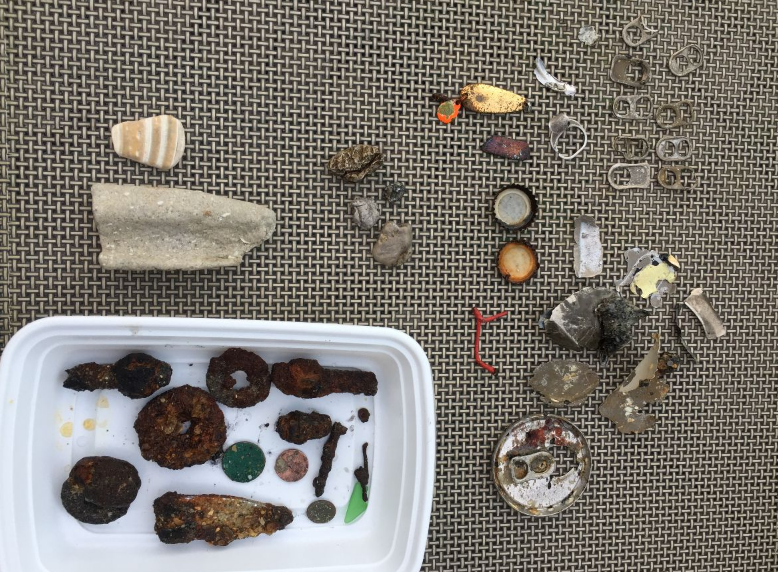
Miscellaneous Targets Frm Wabasso Sunday
Photo by Eric H.

Depth Eric Was Digging.
Photo by Eric H.
\
Thanks for the photos and report Eric.  Your report should help anyone interested in evaluating beach conditions.

---

Detectorists remove a lot of junk from the beaches.  That is a benefit that the public doesn't realize.

It doesn't hurt to pick up some of those ropes, flip flops and plastic bags while you are out there.

Here is an article about how such things endanger the sea turtles.

http://www.spacedaily.com/reports/Sea_turtles_sad_fate_from_restaurant_menus_to_plastic_soup_999.html

---

The best book on 1715 Fleet salvage history that I've seen is the 241 page large format The Rainbow Chaser's Tricentennial Yearbook by T. L. Armstrong and Tommy Gore, published by Signum OPS, 2015.  I was sent a copy of that book some time ago by Jon Morgan, who does the Lets Talk Metal Detecting podcasts after he interviewed the primary author, and I found it to be the best and most comprehensive summary that I have seen.  There are sections on the wrecks, the finds, stories, techniques, dig boats, and the finders.  

The first sentence of the foreword refers to the Donald Rumsfield comment,"We don't know what we don't know."  That is something I said in this blog before I knew anyone famous said it, and it is something good to remember, especially as it relates to treasure hunting.  Sometimes things become commonly accepted as fact and, but when new information turns up, we sometimes have to change our minds.

There is new information concerning the location of at least part of one 1715 Fleet wreck that will be coming out before long, but I can't say more about that now.  I'm sure it will be published.

If you have access to the Rainbow Chaser's book, you might want to check out page 152, which is part of a section entitled Anchoring.  You'll see a photo taken by the author entitled A Mangled Anchor, Destroyed by the Reef  that looks very much like the one Darrel S. found and which I recently posted, though Darrel's was not mangled.  

Anyhow, good book.  Thanks Jon.

---

In the past I wrote a lot about beach dynamics.  I learned a lot of that when I was hunting modern gold on the beaches of South Florida before I moved to the Treasure Coast.   In retrospect, I can see that it was a good place to start detecting.  The crowds left a lot of coins on the beach, which made it easier to identify patterns.  As I said yesterday, beside goals, you need a way to quantitative measure to evaluate what you are doing.  Careful monitoring will teach you a lot by itself.  Learning is easier when you have a lot of data points.  Careful observation and constant monitoring helps the learning process no matter what you are trying to do.

---

I have a good post started for tomorrow.  It is about a ring lost by a famous person eighty years ago that was recently found on a Florida beach and returned to the family.

---

Don't wait until later to do the things that you want to do.  You might think you'll have all the time in the world to do those things when you are retired, but things can happen and it might not turn out like you expected.

The moon is beautiful and the tides are big.  The surf will be increasing a little in the next couple of days.

Happy hunting,
TreasureGuide@comcast.net
Monday, December 4, 2017

12/4/17 Report - Focus, Goals, Feedback Loops and Analysis For Improving Metal Detecting Success. Perspective.


Written by the TreasureGuide for the exclusive use of treasurebeachesreport.blogspot.com.

Focus, Objectives and Strategies.

I don't think there is anything that improves the chance of success in anything more than a good clear specific statement of the objective.  I used to teach that a lot when I did consulting for fortune 100 companies and government agencies.   It is very obvious that you need to know exactly what you want to accomplish, yet most people don't see the need to develop a good clear specific statement of the objective.  I'm not just talking about having a a general idea of what you would like to happen or what you would like to accomplish.  There is a great benefit in thinking it out completely and being able to specify the goal in very specific terms along with some kind of quantitative measure of success.

It is perfectly OK to just go out and bop around and see what pops up, if that is what you want to do, but if there is something you really want to accomplish then you need to be clear about exactly what that is.  If, for example, you really want to find a Spanish shipwreck coin, then set that as a goal, and make decisions based upon that goal.  If you want to find a big glitzy diamond ring or a lot of glitzy rings, that is an entirely a different matter, and you might want to choose a different type of detector and visit a different set of sites.

If you watch what people do over any length of time, you can often tell that they don't have a very well defined goal.  They don't have focus.  They jump around from one thing to another and seldom make any real progress.  That is what I see on the Oak Island TV show.

One of the things that drives me crazy when I watch that show in particular is the apparent lack of focus, goals and strategy.  They only go far enough in any one direction to come up with new questions.  That might be OK for keeping a TV show going, if that is their primary goal, but it is not the most efficient way to accomplish a serious goal of any type.  At different times they express different goals, and that is one reason the search appears to be such an unfocused hodge podge of unanswered questions and dead ends.  I'm sure the goals of the TV production company adds to the apparent disorganization.  They want to keep the excitement level up. and to do that they encourage wild unwarranted assertions that do little but keep the viewer watching.  It doesn't bother them when someone picks up a find and excitedly exclaims that it is a gold coin even when it is a plated button.

Whatever happened to the shipwreck spike and plank found in the swamp?  Not important?

Exploring the TV side of things for a minute, they have to keep it interesting while the big longer term projects plod along.. They have to find something to get excited about every once in a while.  An endless series of frustrated attempts and questions without answers would be too much for most TV viewers, so the production company has found a savior in metal detecting, which, while not recovering anything near the magnitude of the Holy Grail or treasure chests overflowing with gold, at least it provides something to entertain the viewers, even if it is nothing more than broken toy guns, chunks of iron, spikes without ships, with some old coins and buttons thrown in, all of which is standard detecting fare for any location with history that has not been cleaned out by detector wielding hoards. 

What does all the metal detected surface trash and treasure have to do with the money pit or answering the big questions?  Very little.  Maybe there might be some clue discovered that actually answers an important question, but most of the metal detected finds are little more than momentary diversion to keep viewers entertained while the big finds remain elusive.  It has little to do with what I would suspect is the major objective.

How does that relate to you?  First, if you want to accomplish something, it helps to be very clear about exactly what that you want to accomplish.  Secondly, it helps to have a quantitative measurable way to evaluate your progress.

When I started metal detecting, I wanted to find a lot of coins.  I kept records of each hunt.  I could tell how I was doing and if I was improving.  Then I started keeping track of the value of the coins I found.  That is slightly different than finding a lot of coins.  Later my goal was to find a lot of gold items.  Then high value gold items.  As I improved, I changed my goals.  But it was important to have a way to measure progress.

In these days when AI and robotics are talked about so much, you probably know that the feedback loop is an important element.  You can't make the best adjustments unless you have some way of measuring analyzing performance.  You need to keep on track.  That is the function of the feedback loop.  If you have a very clear objective (or objectives) and some way of measuring progress, you can keep track of how you are doing and continually make improvements.

For example, I look at the number of hits and page views on my blog daily.  That helps me get an idea of what people are interested in and what they like.  The total number of page views is near two million now, and the daily hits are usually somewhere between 500 and 1000.  Of course, I also use other things, such as emails.

It isn't always simple to analyze the data.  Some people love certain posts, but the posts that some people really like are not always the ones that get the most views.  They touch certain individuals powerfully but don't particularly appeal to the mass audience.  There are various reasons for that and I won't get into all of that now.

In summary, I'd encourage you to be real clear about what you want to accomplish, and come up with some measurable way to keep track of your progress.  I know I won't get a lot of people to do that, but if you do, I think you'll be happy with the results.

I don't really think this will be one of my most popular posts, but to me it is probably one of the most important and can help you a lot if you take it to heart.

---

I thought I might need to add some perspective.  If my Ole Timer Talk post about Clint's finds back in 1984 and 1991, you might be tempted to conclude that those were the good old days, and now it is all gone.  If that is what you think, what you are missing is the rarity of those times.  Thanksgiving 1984 is known as an exceptional time for treasure hunting on the Treasure Coast.  It doesn't happen all the time.  And did you notice that Clint went from 1984 to 1991.  That is a period of seven years.  When it is hot it is hot, and when it is not it is not.  There are times when the beaches are exceptionally good, and when they are not.  You can't take blowers and remove all of the sand from the beach.  You have to wait, and hopefully you'll be at the right place at the right time.  That is why I put so much attention on the wind, waves and surf.  If you keep up on that, you'll have a better chance of being there at the better times.  You can spend everyday on the beach for a year and not get as much as you would in a week when the conditions turn good.  We've had some better beach conditions a few times this year and finds were made, but it wasn't anything like Thanksgiving of 1984.  2004 was good after Francis and Jeanne.  Some of the other hurricanes since then didn't do nearly as much for metal detecting.

----


They've been running the Shooter movie a lot lately.  It is an interesting movie, but I found it more interesting and less far-fetched than when I saw it about a year ago because of the current political environment and what we've learned about the intelligence agencies the past year.

---

We're having some nice big tides but the surf is only running around two or three feet.  The winds aren't particularly favorable.

Happy hunting,
TreasureGuide@comcast.net