Tuesday, September 9, 2014

9/9/14 Report - 122-Year-Old Gravestone Found on Beach. Hoard Found by Detectorist. Tungsten Ring Markings. Laser Inscribed Diamonds.


Written by the TreasureGuide for the exclusive use of treasurebeachesreport.BlogSpot.com.


This 122-year-old gravestone appeared on Ocean .  A headline or an article about that claimed the the gravestone "washed up" on the beach.

Some of those who read the article wondered how something like that could wash up on a beach, especially considering that there hadn't been any recent storms.

As we know, when things suddenly appear on a beach, it might not be because the object washed up.  It can just as well be that the item got uncovered.

An observer might notice the depressions in the sand around the corners of the stone.  The water obviously rushed around the corners, where the sand was suspended and washed away.

One thing I found most interesting about the article is the number of comments.  The discussion was pretty much what you would expect.  Some accepted the author's conclusion that it washed up while others realized that it might have been uncovered.

One person wondered why the inscription had not worn more on that beach gravestone when they commonly wear down while still in the cemetery exposed only to air.  One person found the obituary in the paper that gave details of the deceased and another located the a picture of the residence of the deceased.

The readers discovered that an old cemetery was moved and the old tombstones were used for breakwaters or sea walls and many are now buried under the sand of that beach.

It was interesting to follow the story from the misconception of the stone having washed ashore, to the discovery of the details of the deceased and to the source of the stone.

Here is the link.

http://www.missionmission.org/2012/06/04/122-year-old-gravestone-washes-up-on-ocean-beach/

And here is the article about the stones being removed and used to support a sea wall.

http://sfhcbasc.blogspot.com/2009/09/bits-and-pieces-of-san-francisco.html

You never know what will be found on a beach, and the unraveling the mystery of how it got there can be a lot of fun.

You might get more good information from comments than from an article anymore.  That is something to remember when doing research.


Here is a picture of a hoard discovered during an excavation that was being conducted on the site of an old department store.

The picture reminded me of the photo of the artifact cluster that Captain Jonah sent us a few days ago.  About the same size.

Anyhow, for more of the story about these Roman artifacts, below is the link.

http://www.eadt.co.uk/news/colchester_roman_find_of_national_importance_discovered_under_williams_griffin_store_1_3756005


Bottle collecting got popular in United States back in the 1970s.  Then a chip didn't matter if the bottle was rare. Today condition is very important and a rare bottle with a chip will auction for half what a perfect bottle brings, according to Jeff Wichmann, the founder and owner of American Bottle Auctions of Sacramento, Calif.

Concerning toys, it seems like it is the 70s and 80s stuff that is popular now.  The boomers are down sizing while the children of the 70s and 80s are now collecting.


Markings Inside Tungsten Carbide Wedding Band.
Here are the markings I found inside the tungsten wedding band.  Triton on the left.

These markings aren't like the stamps you usually find in gold.


Did you know that some diamonds are microscopically inscribed with a certification number of personal message?   You can sometimes read them with a 10X jewelers loop.  Sometimes they are covered by the setting. 

The best diamonds do not always have a certification number.  They can be buffed off.

For identification purposes, a carbon pattern is better than an inscription.


The only thing worth watching in the Atlantic is way over by Africa and still days away.

Right now we only have about a one foot surf on the Treasure Coast.

Happy hunting,
TreasureGuide@comcast.net


Monday, September 8, 2014

9/8/14 Report - Great Finds on the SS Central America. Odyssey Marine Reports. Gold Coins and Artifacts. More On Beach Dynamics.


Written by the TreasureGuide for the exclusive use of treasurebeachesreport.BlogSpot.com.


A Few of the Gold Coins Salvaged From The
SS Central America July - Aug.
Source: See link below.
Odyssey Marine Explorations has been working on the SS Central America.  They have been recovering a lot of gold and artifacts and doing a lot of research.  They provide monthly reports on their web site, which I find both fascinating and informative. 

The reports show site maps with artifact distributions, photos of the site, items recovered, and even experiments conducted in the process, such as one experiment that studied how wood deteriorates on the ocean floor.

In the June/July report you will read about how they recovered loose gold that was lost in the wreck.  The gold was being returned from the gold fields when it was lost when the ship went down.  Now they are mining it for a second time, this time from the bottom of the sea.

I think it is interesting that they are using a dredge and a sluice, very much like the sluice that might have been used by the original miners.


I've mentioned before about the gold dust in the ocean off of Rio Mar.  At least one attempt was made to recover it, but it was very difficult and not very effective.


Source of photo: Odyssey report link.
I also find the idea of twice-found objects interesting.  I've mentioned an escudo that was mined and minted in Mexico, then lost in a shipwreck, then salvaged and put on another ship which sank, salvaged and sold, and then lost by whoever purchased it before I found it.  In other words, it was lost in the water and found three times.


Below is the link to the Odyssey Marine June16 to July 15 report.

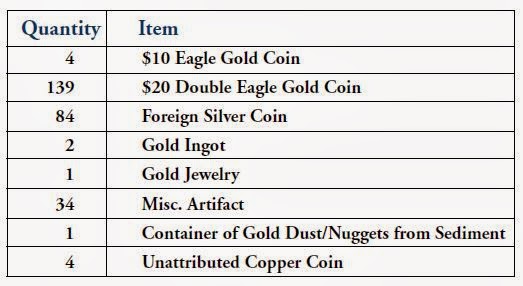
Also below is the summary of finds for that period.

To the left you see a photo of the sluicing operation on board the salvage ship.

http://www.shipwreck.net/documents/OMECourtReport14-3_000.pdf


Summary of Finds From the June - July Odyssey Report.
Source: Odyssey report link above.


And here is the link to their July 16 - Aug. 15 report.

http://www.shipwreck.net/documents/OMECourtReport14-4.pdf


They found a lot of coins during that reporting period.

Below is a photo of a neat pin manufactured from a gold nugget found in the gold fields.\

The report and nugget pin are both from the July16 - Aug. 15 report.


As you know I've done a few posts giving the results of some observations I made on how objects sink at the beach. 

Here is what Bill F., our resident oceanography expert, sent via email concerning objects sinking.

Why do objects sink rapidly?  Look at our beaches..coarse material, or
in some cases, stuff from offshore pumped onto our beaches.  Both of
these materials create a relatively steep beach front.  The high
velocity incoming wave moves material toward the shore. and it drops
out of suspension as the water velocity drops, forming a steep beach.
Now, another aspect takes over.  The water soaks into the coarse
substrate, with very of the wave actually running back out.
Basically, the beach surface churns in place, and the water slowly
returns to a lower elevation.  You've probably seen it running out of
the upper beach at low tide, usually along a line of denser material.

I'm sure you've encountered this well packed shell layer under all
this loose top material.  That's where objects will settle to.

Wave action moves a tremendous amount of material.  If you draw a line
from the dunes to the water, sand will move north and south across it,
but the NET TRANSPORT will be as much as 400,000 cubic yards SOUTH in
our area.

Bill
Thanks Bill!


On the Treasure Coast we still have a very small surf.  We'll have that for at least a few more days.

At least the tides are getting little bigger.  I suspect the rain kept a lot of beach goers from going to the beach this weekend.

There isn't much to be concerned with in the Atlantic.

Happy hunting,
TreasureGuide@Comcast.net


Sunday, September 7, 2014

9/7/14 Million Dollar Coin Found by Detectorist. How Objects Sink Very Quickly Into Beach Sand.


Written by the TreasureGuide for the exclusive use of treasurebeachesreport.BlogSpot.com.

Very Rare Coin Found by Detectorist.

I hope you enjoyed seeing all of the fantastic Treasure Coast treasure finds sent in by  Captain Jonah.  Things like that are still out there to be found.  If you didn't see them, you'll want to go back to the previous two posts.


The threepenny piece shown here was struck in Boston, Massachusetts back around 1652 and is one of the first coins struck in what would become the US.  The coin was recently found by a detectorist in England.  Nobody knows how it ended up over there.

The coin, expected to be worth nearly 1.5 million US dollars, was dug by a detectorist who did not know how rare and valuable it could be.  He put it in a jar and lost track of it for a bit.

The coin is a real rarity in any condition, but to top it all off, this one is in amazing condition.

Here is the link to the article about that.   I think you'll enjoy reading it.

http://www.dailymail.co.uk/news/article-2745782/Minted-Dug-Midlands-field-1m-perfect-US-threepenny-bit-time-Pilgrim-Fathers.html

The detectorist and landowner will split the proceeds.  The coin is not claimed by England because it is a single coin and not a hoard.  

I wish we had something more like their antiquities laws.

One of the things about this story that is very interesting to me and very relevant to any detectorist is that nobody expected such a rare US coin to be found in England.  Things don't always pop up where you expect them.  It is possible to find a rare coin from England or any other country right here on the Treasure Coast.  It doesn't have to be a US coin, or even a Spanish cob.  You just never know!

Many thanks to Peter H. who sent this link.  He is one of our detecting friends from across the big pond. 


My 9/4/14 post, which discussed how objects sink in beach sand, received the most +1s of any of my posts.  I'll continue with that topic today.

A few days ago I showed how moving water would suspend a layer of sand and cause a coin or ring to sink.  How far the item would sink was very much determined by how fast the water moved, and how much sand was suspended and moved by the current. 

As I showed in my simple demonstration, the objects sank down to a stable layer of sand and stopped there.  I didn't see any relationship between the amount of time the water and sand moved and depth other than the very short amount of time that was needed for the objects to reach the stable layer of sand.  After that the object sank no more.

If this was the only way that objects like coins and rings sank into beach sand, it might take numerous periods of rough seas for an object to eventually sink through enough layers of sand to reach bedrock.  That is not the only way that objects sink though.  There is another thing that causes objects to sink more quickly.

You might have read articles about objects sinking into beach sand very quickly.  I've read reports that seem fantastically unbelievable.  I have however observed something that makes objects sink more quickly than the type of currents I talked about a few days ago.

When I circulated water and sand in a cup, it took seconds for the test objects to sink a mere eighth of an inch.  However, when water was forced down on the sand, rather than simply circulated as a current would do, the sand was quickly suspended and the objects sank much faster.

Here are two very short videos showing what I am talking about.  The only difference between the two videos is the amount of water force.  Take a look.

https://www.youtube.com/watch?v=36tgNx9a8Fg

https://www.youtube.com/watch?v=ESSOdH78eic

The results were amazing.  In that one second or so when the water was on, the objects sank an inch or more.  The rate of sinking was many times faster than when the water was circulated horizontally as was the case in my previous experiments.

After turning the water off, I stuck my finger into the sand to find where the objects went and found them down an inch or more.  Each time I repeated this experiment, the results were very similar.  The more force, the deeper the objects sank.

It appears that the downward force of water disturbs sand to deeper levels and suspends sand more quickly than horizontally circulating water, and as a result the objects sank more quickly.

How does that apply to a beach?  Waves crash with a similar downward force.  That happens not once, but repeatedly.  Each crashing wave disturbs and suspends sand.

As the tides go in and out the waves will crash at a slightly different place.  That means a wide area will be affected during each tidal cycle. 

If you have ever observed how they build a dock in the river, you might have seen them pump water downward, pushing sand up and out so that the post can be inserted down to bedrock.  This is a very similar effect.  When the sand is being suspended by the forced water, the post is easily pushed in, but once the post is in place it remains very stable in the sand.  (Bedrock in the river is about six feet deep.)

So now I have described two different types of forces that make objects sink in beach sand.  One is the horizontal current that suspends and moves sand, and the other is the vertical force of crashing waves.

When a wave crashes, sand is suspended, then the water rushes in towards shore, carrying sand with it.

I observed this very clearly on a beach recently when the waves were crashing on a sand bar and a flat layer of sand was being washed in towards shore where it was beginning to fill a small dip.  The front edge of the moving sand was very obvious.  (That was the day my camera batteries were dead.)


I posted this picture of that same beach back in my 8/13/14 post, but now I have a much better appreciation of the forces, how the sand is moved and how objects sink.

Notice the red line where the waves were crashing.  The waves look big, but they were less than two feet on that particular day.  Where the waves crashed, sand was kicked up, very much like in the two videos above. 

Any objects under a crashing wave could sink inches, and maybe more. 

Add to that the fact that the sand would only partially settle before being hit again.  Some of the suspended sand would then be pushed towards shore where it would settle. 

After a wave, the water rushing back out is not moving with as much force as the incoming water and is met by more incoming water.

Another thing to point out is that in the situation shown in the illustration the waves are nearly parallel to the beach.  There is no angle to slice away beach sand.

After objects sink deeply, they will likely remain put until they are uncovered again.  If there is a storm and the water rises and the waves crash on the beach or near shore buried objects can be uncovered again.


On the Treasure Coast we still have a small surf.  There is some weather that has very slight chance of developing into a cyclone over North Florida and another disturbance that is still closer to Africa.  It won't get here for several days, if at all.

We'll have a small surf through most of this week.

Happy hunting,
TreasureGuide@Comcast.net

Saturday, September 6, 2014

9/6/14 Report - 16th Century Cob Found on Treasure Coast. Reales, Emerald & Porcelain Found Too. Biggest Dino Ever.


Written by the TreasureGuide for the exclusive use of treasurebeachesreport.BlogSpot.com.

Very Early Mexico Four-Reale Found Along Treasure Coast
Photos submitted by Captain Jonah Martinez


I showed a great escudo and a very interesting cluster of artifacts yesterday.  Today you'll see that that was only the beginning.  You might consider this post to be continuation of yesterday's.

The crew of the Capitana has been busy this year.  It has been a good season.  Here are some more photos of finds sent in by Captain Jonah Martinez.

This is a very early four-reale.

You can see the denomination over the waves between the Pillars of Hercules.


You can see the legend running across the coin reading "PLUS ULTRA," meaning something like "more beyond" and referring to the New World.


Same Mexico Four-Reale
Photo submitted by Captain Jonah Martinez


Here is the other side of the same cob.

It would have been minted prior to the Great Shield era, which began in 1572.

Notice the M mint mark to the left of the shield.

In my 8/28/14 post I showed another old Pillars and Waves cob that will be auctioned by Sedick this November.  That particular eight-reale could possibly be a million dollar cob.

The coin shown today is probably just a bit later.


Below is a real handful of treasure.   Looks like about sixteen or seventeen reales and a piece of K'hang Hsi porcelain.  It is spelled in a variety of ways.

You can occasionally find pieces of the K'hang Hsi porcelain on the beach.

 
Handfull of Treasure
Photo submitted by Captain Jonah Martinez.

I've talked about Kang Hsi porcelain in this blog a few times, for example in my 12/29/13 post.

http://treasurebeachesreport.blogspot.com/search?q=Kang+Hsi

You can use the blog search box to find specific topics by keyword.

There was a fellow who found a entire stack of plates that were uncovered by a storm.  He didn't know what they were.  When he found out that they could have been K'hang Hsi porcelain from a sunken galleon, he returned to find them, but never did.   They could have been worth a fortune.

It helps if you read a lot so you know what to look for.

The variety of cobs you see here ranges from small half reales on up.

If you look close you can see details on a few.  Those look a lot like what you can find on some of our shipwreck beaches when the conditions are right.


An Emerald Found On The Treasure Coast
Photo submitted by Captain Jonah Martinez.


Here is one more thing to keep your eyes open for when walking down the beach.

There are treasures that aren't made of metal.
This emerald is one more example.  You have to use your eyes to find these.

Well, you've seen a good sample of the kinds of treasures that are still out there waiting to be found.  And things like this will be found from time to time, occasionally showing up on the beaches.

Thanks to the Captain for letting us see all of these.  Keep it up guys.


The remains of the largest land mammal has been discovered.  They think it would have weighed something like 65 tons, about what a Boeing 767 weighs.

Here is a link to that very good article.

http://www.washingtonpost.com/news/speaking-of-science/wp/2014/09/04/this-is-the-kind-of-dinosaur-you-find-in-hollywood/


We still have a small surf on the Treasure Coast, but there are two disturbances to watch.  One is over North Florida and one is just coming off of Africa.


I'll have more new information on how coins and rings sink on a beach soon.  I made a little video of another experiment which shows what causes things to sink quickly.

Happy hunting,
TreasureGuide@Comcast.net

Friday, September 5, 2014

9/5/14 Report - Gold Cob Found By Salvage Crew On Treasure Coast! Fascinating Clump of Artifacts Too. How Objects Sink In Dry Sand.


Written by the TreasureGuide for the exclusive use of treasurebeachesreport.blogspot.com.

Gold Treasure Coast Shipwreck Coin
Photos submitted by Captain Jonah Martinez
The past few days I've given a lot of information on how objects sink on the beach, and I'm far from done with that.  I've only addressed a few factors so far and will continue with that topic in the future.

Today I wanted to take a bit of a break from that and show you some finds to drool over.  The finds were made by the crews working the shipwrecks off of the Treasure Coast.   Thanks to Captain Jonah Martinez for sending the pictures.

First, here is a gold coin they found.  Although this gold coin sure is pretty, they found a silver coin that actually might be much more rare.


I'm no expert on Spanish shipwreck coins - far from it.  So if you can correct anything I say here, feel free.

Notice the type of cross on the top photo.  Each arm of the cross is like a cross on the end.

That is not a real common type of cross, but that type of cross was used on some Mexican escudos,

On the left side of that coin, I think I can make out part of the "M" mint mark for Mexico.

I can not see the legend on this coin or the date.  They do not appear to be present.


Below is a photo of what I believe is a very similar escudo.

It is found in Monedas Espanolas desde Juana y Carlos a Isabel II 1504 a 1868, by F Calico et al, 1985.

Illustration of Similar Design Escudo from the Calico et al Book.

The following illustration more clearly shows a similar type of shield and the same type of cross although there may be some differences.

Illustration of Similar Escudo Design Elements.
Source: Cobs, Pieces or Eight and Treasure Coins book by Sewall Menzel
From what I've seen I would guess the escudo above to be an early 1700s Mexico two-escudo.  That is just m guess from what I can see from the photo.


Below are two pictures of a recovered clump.   Captain Jonah says this clump of objects was found by Mike and Gavin and ... if you look close you can see to buckles, two medallions, a silver spoon and maybe cuff links...

Photos submitted by Captain Jonah Martinez.

I always find clumps exciting.  You never know what all might be in them.  And I never know if I want to leave them alone or take them apart to find what is in them.  There is that conflict between wanting to preserve them and wanting to find out what might be in there.

They can be x-rayed or examined internally by using other technologies without taking them apart.

Those are just a couple of the photos that Captain Jonah sent me.  I'll show more of them in future posts.  Included are cobs, porcelain, and one very early and exciting cob.

Thanks for sharing Captain!


The last two posts that I did received  lot of +1s.  It seems they were very much liked.

I should explain that the did not discuss all relevant factors, but maybe it did help to put to rest some common misconceptions.  I still want to add just a little to that discussion today.

First of all, people might wander how objects sink in dry sand where the water does not hit if objects only sink through suspended or disturbed sand.   One big factor affecting dry sand is the wind.  Barrier islands and beaches in general tend to migrate away from the ocean as wind coming off the ocean tends to blow sand towards the back beach where it piles up as dunes and fills in marsh land.  You can find that fact in any number of books.

On our local beaches I've seen a lot of dune building over the past year.  Any plants or anything that serves as a wind break will cause wind driven sand to drop off and build up.  That causes items lost on the dry beach to be buried as the sand builds up.

If you go to the beach after a busy holiday, you'll notice how much the busy spots have been churned up by foot traffic, kids digging, etc.  That certainly disturbs the top layers of sand and causes items to sink or get covered.

Also, the water does occasionally come up over the dry sand and all of the way to the back dunes.

And they sink in when dropped, flung or thrown.

There are some ways that the dry sand is disturbed causing things to sink or get more deeply buried in the dry sand.

I'll discuss more details on how items sink on the beach and in the shallow water in the future, but I'll also be showing some more pictures of the Treasure Coast treasure finds that Captain Jonah sent me.


We still have a one to two foot surf on the Treasure Coast.  Beach hunters are tired of the consistently smooth surf this year, but it has been good for the salvage crews.

There is one disturbance coming off of Africa, but it is days out, and we'll have smooth water on the Treasure Coast for at least several days.


Happy hunting,
TreasureGuide@comcast.net

Thursday, September 4, 2014

9/4/14 Report - How Coins and Rings Sink In Beach Sand. Targets Only Sink As Far As The Disturbed Layer.


Written by the TreasureGuide for the exclusive use of treasurebeachesreport.BlogSpot.com.

Same Cup of Water and Sand
Shown Yesterday.

Just in:  I have some great new pictures of treasure ship finds sent by Captain Jonah!   Probably tomorrow.


I accidentally did an ingenious experiment.  I should probably call it an observation rather than an experiment.  I'll get back to that in just a minute. 

I always enjoy receiving emails from this blog's readers.  They are an educated and intelligent bunch.

Yesterday I talked about how objects of interest sink in sand.  I received an email from Bill F., who has a degree in physical oceanography and did his undergrad thesis on beach erosion at Ponce Inlet.  

Here is some of what Bill said.

1)  The finer the sand particle, the flatter the beach
2)  The faster the current, the bigger the particles which are moved
3)  As you show, without wave/water energy, objects don't settle on their own.
4)  The heavier/denser an object, the less likely it is to move horizontally.
5)  Shape makes a difference.

Thanks Bill!   Those are some good points to remember.


Above is a picture of the same cup that I showed yesterday.  The ring and coin in this cup never sank so much as a micro inch while it sat undisturbed.   That clearly demonstrates one thing Bill said -  without wave/water energy, objects don't settle on their own. 

I decided to see what it actually takes for objects to sink in the sand.  I put my hand over the cup and moved the cup in a semi-circular motion so that the water moved.  When the water moved the very top layer of sand lifted and the suspended sand moved with the water while the objects pretty much stayed in place.  When I stopped, a little sand covered the objects, but very little.  With gentle only the sand above the green line moved.  This is important, and I'll get back to it.

When the objects got covered there were a couple of ways I could tell how deeply they got covered.  You'll notice that the surface of the sand in the cup (below the yellow line) is not exactly horizontal. 
A perfectly circular even motion moved the water so that the sand remained level across the cup, but by moving in a more jerky  manner resulted in the sand moving from one side to the other of the cup to the other. 

I could see how deeply the objects got buried either by sticking my finger in and finding the objects or I tilting the cup and moving it so that the sand then uncovered one side and one object.   I could then see where the previously covered object had stopped sinking.  

Here is an important point.  The amount of sand that moved when I moved the cup was directly related to how fast I moved the cup and therefore how fast the water moved. 

I had no idea how important it was going to be for me to be able to see through the container when I started this experiment. 

When moving the cup gently, a small amount of sand moved - only a thin layer.  Approximately the amount of sand above the green line which I drew on the picture of the cup moved when I moved the cup gently.  The top of that layer moved the most, decreasing as the moving layer got deeper until there was no suspension and movement of sand at all.

The fastest moving sand was clearly suspended, and the grains appeared farther apart than the grains that were lower in the moving layer, which moved more slowly and less overall.

 How deep do you think the objects sank in the sand when the cup was moved gently?   Now this is an important principle.  The objects sank to the surface of the layer of stable sand, and then stayed there.

I recalled how many times in the past few years that I dug an object and found it on the surface of a lower layer of sand.  If you go back through this blog I'm sure you can find that.  Often the lower layer was a different color or texture.  Often it was a layer composed of course shells.

That might not be surprising finding, but it sure was interesting to see.  I could keep the water moving at a relatively slow rate and no more sand would be suspended or moved.  No matter how long I kept the water moving at the same speed, the objects sank no deeper than to the surface of the layer of stable sand.

I know this is not a highly controlled experiment and what happens on a beach will be somewhat different, but in I think this principle will hold.  Just like in the previous report, the objects did not sink into the undisturbed sand no matter how long they sat there in the cup.  In this demonstration the objects did not sink into undisturbed sand even though they did sink through the suspended moving sand.

Here are a few observations that held up all through these demonstrations with the moving cup.

 (1) Only a relatively thin layer of sand was disturbed by the moving water. 
(2)  When the cup and water was moved more forcefully, a larger layer of sand was moved.
(3)  The speed of the sand decreased in the moving layer of sand from top to bottom until there was no movement at the bottom of the layer.

At first I moved the cup gently and only the layer above he green line moved, but when I moved the cup more forcefully, then the sand moved as deep as the light blue line, and that is where the objects ended up, and when I moved it even more forcefully, the sand moved as deeply as the dark blue line, and that is about where the objects ended up.

On the beach, different storms will disturb deeper layers of sand allowing targets to sink deeper.  They will then often be covered again by incoming sand. 

In this demonstration I'm only addressing sinking targets, which occurs primarily when the trigger point for sand is reached but not the trigger point for targets. 

This simple experiment has many limitations, but it reveals some important principles that I've observed in operation on the beach.  I reasoned that objects in deeper layers of undisturbed sand would remain in place, but with this demonstration I observed it and am much more certain of it.

Another thing I observed with this little experiment is how it is only suspended sand that moves.  I could see this on the beach just yesterday.  The waves were crashing on a sand bar.  In front of the sand bar was what I might call a flat topped creeping sand bar.  You could see a clear edge of a layer of sand that was moving from the crash zone towards shore.  The crash would suspend sand, and then that suspended sand would be washed ahead in the surge.

Where the sand was suspended, you couldn't see through the water.  That makes sense.  But closer to shore, where there was a dip beyond the creeping sand bar, and the water there was clear.  That is where I found a couple of relatively new coins that had not yet been covered by the incoming tide and creeping sand bar. 

As the tide comes in, the area where the waves crash and most sand is suspended closer to shore.  Obviously that means that a greater area of sand is affected.  The crash zone changes and the area of surge comes in and then goes out again.

If you've spent much time down in the Fort Lauderdale and Miami area, you know that they have much more calm water than we do.  Many days the shallow water sits still almost like you are in a bath tub, especially before the sun starts to heat things up.   The shallow water on the Treasure Coast seldom has that kind of flat water even when the surf is down to one foot.  That small difference in roughness appears to make a big difference in the average sink rate of targets.  They'll stay in detector range down there a lot longer than on the Treasure Coast.  Couple that with the absolute number of people and what they wear and there is an even bigger difference between South Florida and the Treasure Coast.  Bottom conditions are very different.

Well, I'll quit there for today.  This is getting long.  The principles demonstrated are important and help explain how things settle and therefore how and where things will be found.  I know that I did not address all of the relevant factors and situations. 

I'll do some more experiments someday to help answer some of the remaining questions.

I'm sure some of you will find this post tedious although several of you used the +1 button to indicate that you particularly liked the previous post.  For my own purposes and understanding, I'm glad I did the demonstration.


There are no storms to watch in the Atlantic right now.

On the Treasure Coast we still have a one foot surf and will continue to have a calm surf for at least a few more days.

Happy hunting,
Treasureguide@Comcast.net

Tuesday, September 2, 2014

9/2/20 Report - How Objects Sink in Beach Sand, Density of Common Metals. Movement of Sand. Tropical Storm Dolly


Written by the TreasureGuide for the exclusive use of treasurebeachesreport.BlogSpot.com.


Gold Ring and Quarter In Cup of Sand and Water.
I always read  about how "heavy" objects sink in beach sand.  I understand why people say that, but it is not correct.

To the left you see a cup of genuine Treasure Coast beach sand and tap water.  I poured about half a cup of water into the cup and then about a half a cup of sand.  The sand filled the cup up over three fourths of the way with about a half inch of water on top of the surface of the sand.  I then put a quarter and thin gold ring on the sand.

How much do you think the quarter and ring sank in the last week?

Here is the answer.  Not at all!  

The way some people talk, or write, it sounds like gravity pulls objects like these right down through sand.  That didn't happen in this cup. 

You might say that this is a poor experiment, and it is nothing like a beach where the water and sand move.  Precisely!  It is not like a beach.  Everything is stable, and gravity alone will not pull coins or a rings like these down through this sand.  Other forces are at work when an object settles down to lower layers of sand on the beach.

On a beach the water and sand moves, and the moving sand covers  objects like these that do not move as much as sand.  But that is just part of it.

The objects will move some too, but much more often it is the sand that does MOST of the moving.

Before I go on I want to address another part of this.  People say that "heavy" objects sink, but it is not the weight of the object alone that determines if an object will find its way to lower levels of sand.  As I've explained in the past, a one-ton block of Styrofoam weighs one ton but will float in water and will not sink into the sand.  It is not the weight, but the density that has more to do with it.  But it isn't just the density of the object either that determines how an object will sink in the sand.  The shape of the object will have something to do with it too.

Lets focus on density for a bit.  The site linked through the following link presents a list of common metals along with their density.

http://www.engineeringtoolbox.com/metal-alloys-densities-d_50.html

Here are some of the most relevant metals listed on that web site.  (Density is given in Kg. per cubic meter.)

Aluminum  2712
Brass  8400 - 8700
Copper  8940
Gold  19320
Iron 7850
Lead 11340
Platinum 21400
Silver 10490
Steel  7850
Titanium 4500
Tungsten 19600
Zinc 7135

This correlates somewhat with how things will be distributed on a beach - but not perfectly

Aluminum is the least dense of the above group followed by titanium.  You'll see those often during poor beach conditions.

Copper and zine are sort of in the middle, with zinc being slightly less dense than copper.  Zinc cents will be found more towards the outer boundaries of coin holes, and copper cents just a bit closer to the center.

Lead is slightly more dense than silver.

The most dense of those listed above are platinum followed by tungsten, followed by gold.

(You might remember the tungsten ring that I found not long ago.  I caught it in the right light yesterday and saw on the inside of the ring that it was marked as tungsten.  On a detector the target ID came up as nickel.  I could tell when I picked it up that it was heavy for its mass, although without really thinking, I called it titanium at first before being corrected.)

If you look at that list, you'll have some indication of how those objects will sink into sand.  But as I showed above using the cup, they won't sink by themselves unless there are other forces at work.

The water moving the sand is a very big part of it.  I've explained before about trigger points.  Different objects require different amounts of water force to move them.  Grains of sand move relatively easily.  They have lower trigger points.  It takes less water force to move sand.  Objects like the coin and ring require more force to get them moving.  They have a higher trigger point.

When the water isn't moving much, the sand will be moved while the object remains relatively stationary.  Sand will be washed over the object, out from around the object, and if the shape is right, even from under the object.  This movement of sand is one of the biggest factors in determining how a object will sink into the sand.  With stationary sand, there is little to no sinking.

The shape of the object is also important in determining how an object will be moved on a beach.

I once showed an experiment in which lead sinkers having different shapes but the same weight were moved by crashing water - a disk shaped sinker was moved less by the same water than a egg shaped sinker, which was moved more than one of those fish shaped sinkers.  That is exactly what I predicted before the experiment.

The disc shaped sinker provided less surface for horizontally moving water to push against.  It hugged the surface of the sand something like a coin would.

Flat thin sheets are moved more by water - much more so than most other shapes.  As a result, even though copper is about three times as dense as aluminum, you will find thin copper sheets being deposited on a beach very much like aluminum.

Again, shape has a lot to do with how an object will sink in beach sand or be moved around and deposited.

For a more complete discussion of trigger points and the lead sinker experiment see my 3/10/14 post.
http://treasurebeachesreport.blogspot.com/2014/03/31014-report-experiments-on-movement-of.html

I also once showed an experiment that showed how an object "stepped" down a sand slope when the water current was rushing up the slope.  What happened is that the current moved the sand from around the object and from in front of the object as the object sat on the slope, and when enough sand was removed from the lower side of the object, the object slipped down the slope into the void, where it came to rest until the current moved enough sand for it to slip down another step.  Again, it was more about the sand being moved than the object sinking through the sand.

Of course loosely packed sand will move more easily and permit objects to "sink" lower more quickly than would packed sand.  That affects how much the sand moves too.  I can't get into all of the factors here, but wanted to make it perfectly clear that objects do not sink into sand simply by the force of gravity pulling the object down through the sand.

This might not seem important, but to me it is very important to me because it helps me understand how different types of objects will move on a beach, and therefore, where they are most likely to be found.  Sometimes when an object seems to be sinking, it is actually being covered rather than sinking.   And, of course, there are times when the water force is enough that more dense objects are moved forcefully by the water.  Coins have been observed to flip up and over a sand berm, for example.

That's all of that for today.


On the Treasure Coast we're supposed to have a one to two foot surf for a week or so.

There is a new tropical storm Dolly, but she will be hitting Texas.

Happy hunting,
TreasureGuide@comcast.net
jewelrymarks.html#art